Owl Pellets vs Owl Poop: What You Found Under the Tree
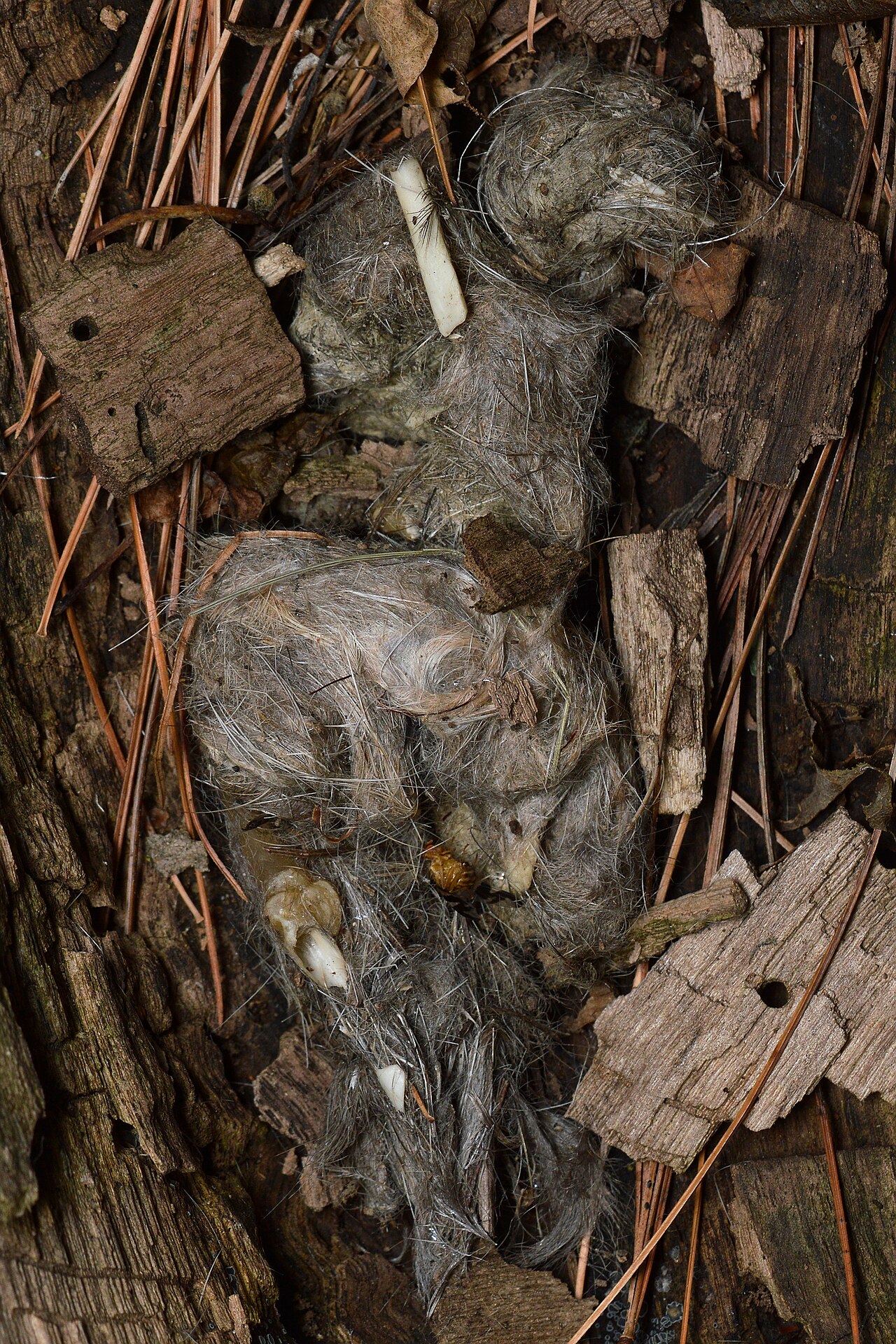
Owl pellets and owl poop are two completely different things produced at different ends of the bird. A pellet is a dry, compact, grey-brown mass of fur and bone roughly 1 to 3 inches long, coughed up through the mouth around 6 to 10 hours after a meal. Owl poop is a liquid white splash, called whitewash, ejected from the vent and visible as chalky streaks down a trunk, branch, or wall below a roost.
Finding both under the same tree is the classic signature of an active owl roost, and the two together tell you more than either alone: whitewash confirms the perch is in current use, and pellets tell you what the bird has been eating and roughly how long it has been there. Neither is dangerous to handle with basic hygiene, though wild pellets carry risks that sterilised classroom pellets do not.
| Feature | Owl Pellet | Owl Poop (Whitewash) |
|---|---|---|
| Origin | Regurgitated from the mouth | Excreted from the vent |
| Appearance | Dry grey-brown compact mass | Liquid white chalky splash |
| Size | 1 to 3 inches long | Streaks and splatters, variable |
| Contents | Fur, feathers, bones, teeth, chitin | Uric acid and waste, no bone |
| Timing | 6 to 10 hours after a meal | Throughout the day |
| Smell | Little to none when dry | Faintly ammoniac when fresh |
| What it tells you | Diet and roost duration | Roost is currently in use |
What an Owl Pellet Actually Is
Owls swallow prey whole or in large pieces and cannot chew or digest bone, fur, feathers, or insect exoskeleton. Their digestive system separates the indigestible fraction in a muscular part of the stomach called the gizzard, which compacts it into a tight oval mass. That mass travels back up the oesophagus and is expelled through the beak.
The process is not vomiting in the usual sense and involves no distress. An owl about to cast a pellet stretches the neck, opens the beak, and the pellet emerges over a few seconds. It happens roughly 6 to 10 hours after feeding, and an owl generally cannot eat again until the pellet has been cast, which paces its feeding schedule.
Owl pellets are unusually informative compared with those of other birds because, as the Cornell Lab of Ornithology notes, owl stomach acid is weaker than that of hawks and falcons. Bones survive nearly intact rather than being dissolved, which is why complete rodent skulls, jaws, and limb bones come out of a pellet identifiable to species. Our dedicated guide to owl pellets covers dissection and what the contents reveal.
What Owl Poop Looks Like
Owl droppings look nothing like mammal droppings. Birds combine urinary and digestive waste and excrete nitrogen as uric acid rather than urea, which produces a thick white paste rather than liquid urine. The result on a tree trunk or a wall is a chalky white streak, often with a darker core of true faecal material at the centre.
Fresh whitewash is wet, bright white, and slightly glossy. It dries within hours to a matte chalky white that adheres firmly to bark, stone, and painted surfaces. On a heavily used perch it builds into thick crusted deposits, and the ground or vegetation directly below gets coated as well.
There is no bone or fur in owl poop, which is the definitive test if you have both and cannot tell them apart. Everything indigestible went out through the beak. A white splash containing visible bone fragments is not owl droppings, and is far more likely to be the droppings of a bird that does digest bone, such as a hawk. Our guide to bird poop identification covers the broader range.
Reading a Roost Site
The two signs answer different questions. Whitewash tells you the perch is being used now, because it weathers away over weeks of rain and a bright, thick deposit means recent activity. Pellets tell you how long the roost has been in use and what the owl has been catching, because they persist far longer than droppings do.
Position matters. Whitewash appears directly on the trunk or branch beneath the perch and on the ground below, since the bird ejects it while sitting. Pellets fall vertically and accumulate in a scatter on the ground within a metre or two of the base, sometimes in a substantial pile at a long-used roost.
Look up before concluding anything. Owls roost tight against trunks in dense conifers, in tree cavities, in barn rafters, and under bridge structures, and they are extremely difficult to spot. Finding pellets and whitewash and no owl is the normal outcome, and it does not mean the bird has left. Our guide on attracting owls covers what makes a site suitable in the first place.
What Species Left It
Pellet size scales with the owl. Great horned owl pellets are the largest at roughly 3 to 4 inches long and thick enough to be unmistakable. Barn owl pellets run 1.5 to 2 inches, dark, and notably smooth and rounded. Screech owl pellets are small at around 1 to 1.5 inches and often contain a high proportion of insect fragments.
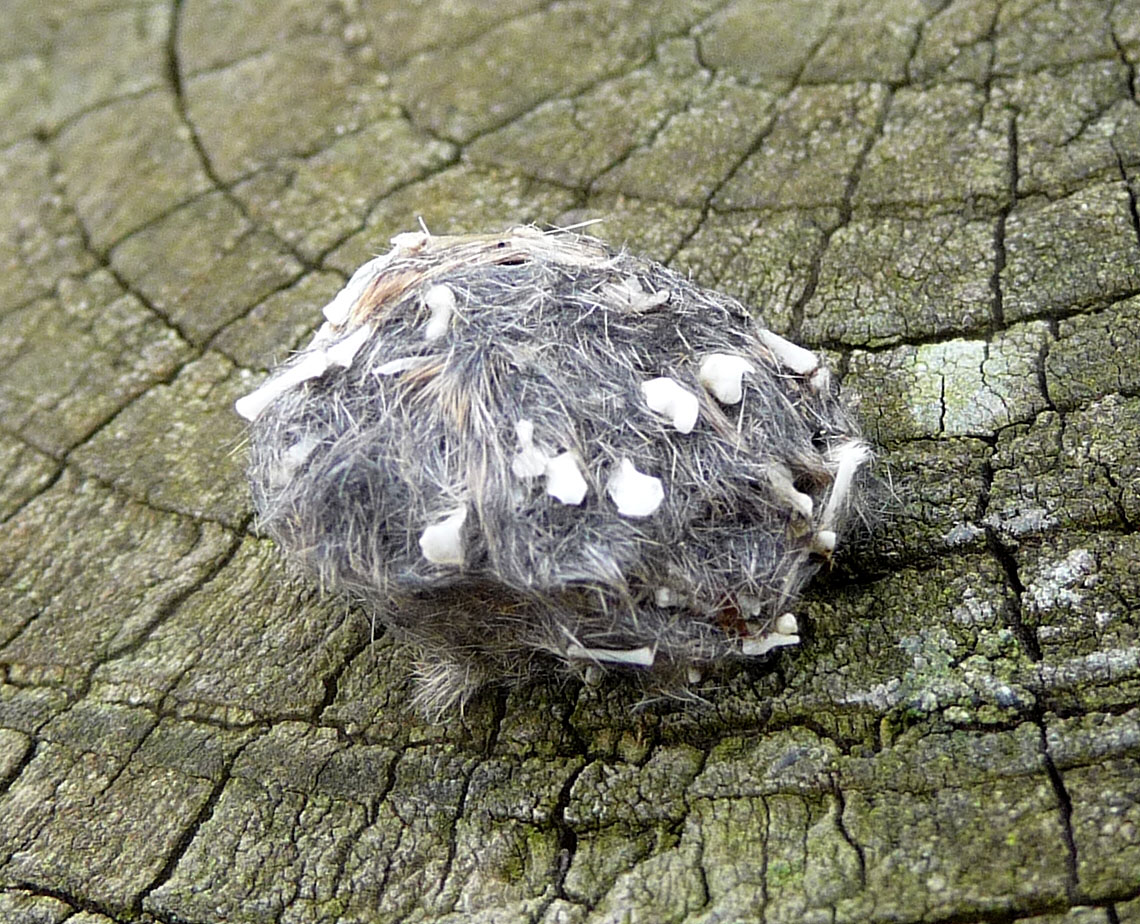
Contents narrow it further. Pellets packed with vole and mouse skulls point toward barn owls, which are rodent specialists. Pellets containing rabbit bone, skunk fur, or the remains of other birds point toward great horned owls, which take much larger and more varied prey. Insect chitin dominating a small pellet indicates a screech owl or a small insectivorous species.
Habitat helps. Barn owl pellets accumulate in barns, silos, church towers, and nest boxes. Great horned owl pellets turn up under mature trees in woodland edge and suburban parks. Our guides to the barn owl and the great horned owl cover the two species behind most pellet finds.
Are Owl Pellets Safe to Touch?
Wild pellets should be treated as biological material rather than as inert curiosities. They can carry Salmonella and, less commonly, other pathogens, and they are frequently colonised by clothes moth and dermestid beetle larvae. Handling with gloves and washing hands afterward is the appropriate precaution.
Classroom pellets are a different matter. Commercially supplied pellets are heat-sterilised, typically at around 250 degrees Fahrenheit for several hours, which kills pathogens and insect larvae. The CDC (cdc.gov) has documented salmonella outbreaks traced to classroom dissection of inadequately sterilised pellets, which is why the heat treatment standard exists. This is why school dissection kits are considered safe and why using a wild pellet collected from a yard for the same activity is not equivalent.
Dry pellets have essentially no smell. A pellet that smells strongly is either very fresh, damp, or is not a pellet at all. Carnivore scat, which is the most common misidentification, smells distinctly and unpleasantly. Our guides to coyote poop and skunk poop cover the two mammal droppings most often mistaken for pellets.
Pellets vs Carnivore Scat
This is the confusion that actually costs people time, because both contain fur and bone. Three features separate them reliably. Shape is the first: pellets are compact ovals with rounded ends and no taper, while carnivore scat is tubular and usually tapers or twists at one end.
Content structure is the second and most decisive. Pellet bones are intact and identifiable, with complete skulls and unbroken limb bones, because they were never chewed and were only weakly acid-etched. Bones in mammal scat are fragmented, chewed, and partly dissolved, and complete skulls essentially never survive.
Smell and location finish it. Pellets are odourless when dry and sit below a perch. Carnivore scat smells strongly and is deposited on trails, at territory boundaries, and on prominent objects as a scent marker. A fur-and-bone mass on top of a rock in the middle of a path is a scat marker, not a pellet.
Is It Legal to Collect Owl Pellets?
Collecting pellets and whitewash is not restricted in the United States, because neither is a part of the bird. The Migratory Bird Treaty Act protects owls themselves along with their feathers, eggs, and nests, and those restrictions are strict enough that possessing a single owl feather without a permit is technically a violation.
The practical caution is where you collect rather than what. Pellets on private land require permission, and pellets in national parks and many state parks fall under general rules against removing natural objects. Disturbing an active roost or nest to reach them is a separate and more serious problem regardless of the pellets.
Commercially sold pellets come overwhelmingly from barn owl nest boxes on farms, where collection is straightforward and the birds are unbothered. That supply chain is why the educational market exists at all and why prices are low, typically a few dollars per sterilised pellet.
What to Do If You Find Them at Your House
Whitewash and pellets on a porch, a barn beam, or a fence line mean an owl is using the spot regularly, which for most properties is a benefit. A resident barn owl family removes a substantial number of rodents over a breeding season, and great horned owls take rats, skunks, and rabbits.
Cleanup is straightforward. Whitewash comes off painted and masonry surfaces with warm soapy water and a stiff brush, ideally while wet since dried deposits bond firmly. Wear gloves, avoid dry brushing that raises dust, and wash the area rather than scraping it. Pellets can be picked up and binned.
If the roost is somewhere genuinely unworkable, such as directly above a doorway, deterrence rather than removal is the route, and it needs to happen outside the nesting season. Owls are federally protected and nests cannot legally be disturbed while in use. Blocking access to a specific beam or adding a physical barrier is the usual approach.
Related reading: Armadillo Poop.
Frequently Asked Questions
What is the difference between an owl pellet and owl poop?
A pellet is regurgitated through the mouth and is a dry compact mass of fur and bone. Owl poop is excreted from the vent and is a liquid white chalky splash containing no bone or fur at all. They come from opposite ends of the bird and look nothing alike.
Do owls poop?
Yes. Owls excrete waste as whitewash, a thick white uric acid paste that streaks down trunks, branches, and walls below a perch. The pellet handles only the indigestible fur and bone, so both outputs exist and serve different functions.
Is it safe to touch owl pellets?
Wild pellets should be handled with gloves and followed by handwashing, since they can carry Salmonella and are often colonised by beetle and moth larvae. Commercially supplied classroom pellets are heat-sterilised and are considered safe for dissection.
How long does it take an owl to cast a pellet?
Roughly 6 to 10 hours after a meal. An owl generally cannot eat again until the pellet has been cast, so the cycle paces its feeding. Most owls produce one to two pellets a day depending on how much they have eaten.
Is collecting owl pellets legal?
Yes in the United States, since pellets are not part of the bird and are not covered by the Migratory Bird Treaty Act, unlike feathers, eggs, and nests. The practical limits are landowner permission and park rules against removing natural objects, plus not disturbing an active roost to reach them.
Do owl pellets smell bad?
Dry pellets have essentially no smell, which is one of the easiest ways to separate them from carnivore scat. A strong odour means the material is either very fresh, damp, or is mammal droppings rather than a pellet.
How can you tell an owl pellet from animal droppings?
Shape, bones, and smell. Pellets are compact ovals with rounded ends and contain intact, identifiable bones including complete skulls. Carnivore scat is tubular, tapers or twists at one end, contains chewed and fragmented bone, and smells strongly. Location helps too, since pellets fall below a perch while scat is deposited on trails as a marker.