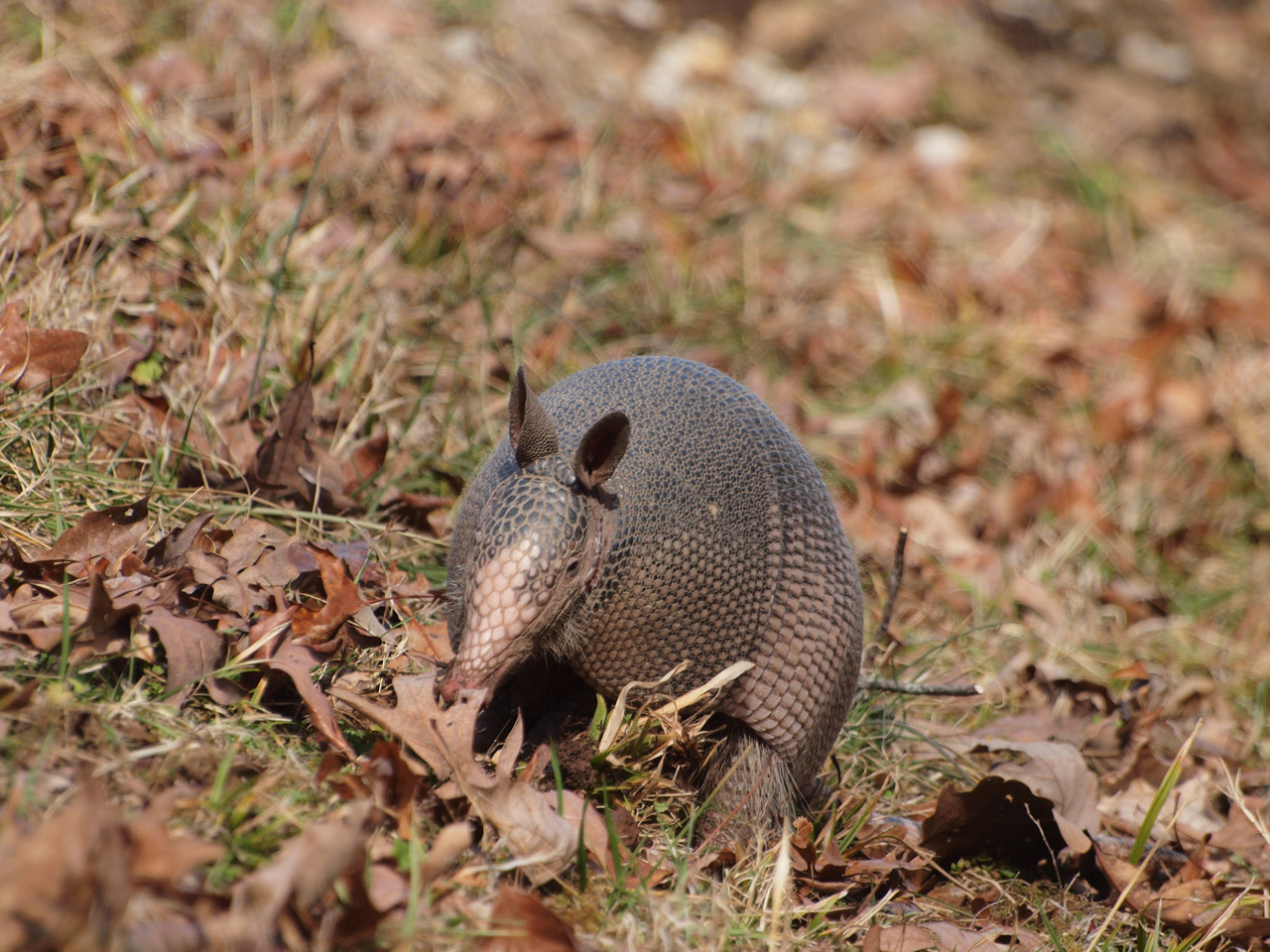
Armadillo Poop: Identification Guide
Armadillo poop is a round or slightly oval pellet about three quarters of an inch to an inch across, dark grey to brown, hard, and packed with visible soil and gravel from the insects the animal digs out. The clay content is the giveaway: armadillo scat looks like a marble of dried mud and breaks apart into grit rather than into fur and bone fragments.
Finding it is uncommon, because armadillos usually defecate in or near their burrows rather than in the open, and the pellets break down quickly in wet weather. Most people identify an armadillo by the damage instead, and the combination of cone-shaped nose holes across a lawn plus burrow entrances is far more diagnostic than any dropping. This guide covers the scat, the digging signs, disease risk, and what actually moves them on.
Armadillo poop is a hard round pellet about three quarters of an inch to an inch across, dark grey or brown, and full of visible clay, soil, and gravel. It is usually deposited near burrows rather than in the open. The more common signs are cone-shaped nose holes in lawns and burrow entrances near foundations.
| Feature | Armadillo Sign |
|---|---|
| Scat size | 0.75 to 1 in, round to oval pellets |
| Scat contents | Clay, soil, gravel; little fur or bone |
| Where found | Near burrows, rarely in the open |
| Digging | Cone-shaped holes 1 to 3 in across |
| Burrows | 7 to 10 in wide, under structures and roots |
| Active hours | Mostly night; dawn and dusk in cool weather |
| Health note | Can carry Mycobacterium leprae; do not handle |
What Do Armadillo Droppings Look Like?
Round, hard, and full of dirt. Individual pellets are typically three quarters of an inch to an inch in diameter, dark grey to brown, and roughly marble-shaped, sometimes slightly elongated. They are notably dense and heavy for their size.
The composition is the identifying feature. Armadillos feed by digging insects, grubs, worms, and larvae out of soil, and they swallow a large amount of soil and small gravel along with the prey, so the scat is essentially compacted clay with insect fragments in it. A pellet broken open shows grit rather than the fur, bone, or seeds found in mammal scat generally.
They are usually deposited in or immediately around a burrow entrance rather than scattered across a property, which is why finding them is uncommon compared with finding the digging. The pellets also break down fast in rain, so they persist mainly in sheltered dry spots. The groundhog poop guide covers another burrowing mammal whose scat is similarly rarely seen.
What Else Looks Similar?
Rabbit droppings are the closest match by shape but much smaller, around a quarter to a third of an inch, lighter brown, and fibrous with visible plant material. They also appear in scattered groups across a lawn rather than at a burrow. Deer and rabbit droppings are both plant-based and crumble into fibre.
Raccoon scat is tubular rather than round, darker, and often contains visible seeds, berries, and fragments, and it is deposited in latrine sites on logs, decks, and roofs. Opossum scat is similar in shape but smoother, and both are longer segments rather than marbles.
Dog droppings are the confusion that catches people out most, since a small firm dog stool can look round in dry weather. The clay and gravel content settles every case: nothing else in a North American yard produces a dropping that is essentially compressed soil. The coyote poop guide covers the tapered, fur-filled scat that is the other common find.
What Are the Signs of an Armadillo in Your Yard?
Cone-shaped holes are the classic sign. An armadillo pushes its snout into the soil and digs with the front claws, leaving a funnel-shaped hole one to three inches across and one to three inches deep, and a foraging animal leaves dozens across a lawn or bed in a night. The holes are neat and conical, not scraped, and they are distinct from the raised surface tunnels and volcano-shaped mounds covered in the mole sign guide.
Uprooted plants and disturbed mulch follow. Armadillos flip mulch, overturn shallow-rooted bedding plants, and dig along the edges of beds where soil is soft and grubs are concentrated. Damage appears overnight and is often blamed on skunks or raccoons, which dig differently: skunks leave shallow scrapes and small pits, raccoons roll turf back in sheets.
Burrows confirm it. Armadillo burrows are seven to ten inches across, dug into slopes, under sheds, decks, concrete slabs, foundations, and around tree roots, and a single animal may maintain several. Fresh soil fanned out from the entrance means active use. The deer poop guide covers reading yard sign generally.
Is Armadillo Poop Dangerous?
Handle it with the same care as any wild mammal scat, and do not handle armadillos themselves. The nine-banded armadillo is one of the few animals other than humans that can carry Mycobacterium leprae, the bacterium behind leprosy, and transmission from armadillos to people has been documented in the southern United States, though cases are rare.
Risk comes mainly from direct contact with the animal, from handling or butchering one, rather than from scat. The bacterium is not thought to spread readily through droppings, but the sensible position is to avoid contact with both. Armadillos can also carry Salmonella and various parasites.
For cleanup, wear gloves, wet the material rather than sweeping it dry, bag it, and wash hands thoroughly afterward. Do not attempt to catch or relocate an armadillo by hand. State health departments in Texas, Louisiana, and Florida publish specific guidance, and the U.S. Centers for Disease Control (cdc.gov) maintains current information on the transmission risk.
What Gets Rid of Armadillos?
Removing the food is the only durable answer. Armadillos dig for grubs, earthworms, and soil insects, and a lawn with a heavy grub population is a reliable food source that will keep drawing them back regardless of what else is done. Treating for grubs where a lawn count justifies it removes the reason they are there.
Exclusion handles the burrows. Fencing works if it is buried at least a foot deep and angled outward at the base, since armadillos dig rather than climb, and hardware cloth skirting around decks, sheds, and slab edges prevents them from denning there. An L-shaped footer is the standard design.
What does not work is the long list of repellents sold for the purpose. Mothballs, ammonia, castor oil, coffee grounds, garlic, and predator urine have no reliable effect on armadillos, and several of them are illegal to use in ways contrary to the product label. Ultrasonic devices do nothing. Live trapping with wing boards funnelling the animal into the trap is effective, but relocation is restricted or prohibited in several states, so check local rules first.
Should You Fill an Armadillo Hole?
Only after confirming it is empty, using the paper test above or a similar check. Filling an active burrow traps the animal, which will either dig out somewhere less convenient or die underground, and a carcass under a slab or deck is a considerably worse problem than the hole was.
Once confirmed empty, fill the tunnel with soil and tamp it, and for burrows under structures place hardware cloth or a concrete collar at the entrance point before backfilling so the same spot is not simply reopened. Burrows against foundations and slabs are worth taking seriously, since sustained digging can undermine footings and crack concrete.
Armadillos maintain several burrows within a home range, so filling one often just shifts activity to another. That is why exclusion around structures and grub reduction matter more than dealing with individual holes.
When Are Armadillos Most Active?
Mostly at night, which is why the damage appears overnight with nothing visible during the day. In hot weather armadillos are almost entirely nocturnal, emerging after dark to forage and returning to a burrow before dawn, and in cool weather they shift toward dawn, dusk, and even midday since they tolerate cold poorly.
That temperature sensitivity shapes the whole pattern. Armadillos have little body fat and poor insulation, so they cannot hibernate and cannot survive extended freezes, which is what limits the northern edge of the range. A cold snap pushes activity into the warmest part of the day, and severe winters kill animals at the range margin outright.
Foraging range is small. An armadillo typically works a home range of a few acres and returns to the same productive patches night after night, which is why a lawn with a grub problem gets hit repeatedly rather than once. That predictability is what makes trapping and exclusion effective when they are aimed at the right spot.
Are Armadillos Worth Having Around?
They eat a large volume of insects, including grubs, ants, termites, beetles, and larvae, with insects and invertebrates making up the overwhelming majority of the diet. In that respect they are doing the same work as the birds and mammals people encourage, just far more destructively.
They also do not eat garden vegetables in any meaningful quantity, do not damage structures directly except through digging, and are not aggressive. An armadillo that appears alarming is usually just short-sighted, since their vision is poor and they frequently blunder close to people without noticing, then leap straight up when startled.
That leap is why so many are killed on roads. The vertical jump reflex, useful against a snake or a coyote, puts the animal directly into the underside of a passing vehicle, and road mortality is the leading cause of death across the range. The species has expanded steadily north and east from Texas since the nineteenth century and now reaches Missouri, Tennessee, and the Carolinas.
Frequently Asked Questions
What do armadillo droppings look like?
Hard round pellets three quarters of an inch to an inch across, dark grey to brown, and full of visible clay, soil, and gravel. They break apart into grit rather than fur or plant fibre.
Where do armadillos poop?
Usually in or immediately around a burrow entrance rather than scattered across a yard, which is why the scat is rarely found. The pellets also break down quickly in wet weather.
What are the signs of an armadillo in your yard?
Dozens of cone-shaped nose holes one to three inches across appearing overnight, uprooted shallow plants, flipped mulch, and burrow entrances seven to ten inches wide under sheds, decks, or slabs.
Is armadillo poop dangerous?
Treat it like any wild mammal scat: gloves, wet before cleaning, wash hands. The bigger concern is the animal itself, since nine-banded armadillos can carry the bacterium behind leprosy. Do not handle them.
Should you fill an armadillo hole?
Only after confirming it is empty. Stuff the entrance with crumpled newspaper and check for three nights; if it stays undisturbed, fill it. Blocking an active burrow traps the animal underneath.
What gets rid of armadillos?
Removing the grubs they are digging for, plus fencing buried a foot deep with an outward-angled base and hardware cloth skirting around structures. Mothballs, ammonia, castor oil, and ultrasonic devices do not work.
What smell do armadillos hate?
None reliably. Every repellent marketed on smell, including mothballs, ammonia, garlic, and predator urine, lacks evidence of working on armadillos, and some are illegal to use contrary to the label.