Cricket Poop: Identification and Cleanup
Cricket poop looks like small dark cylindrical pellets about one to two millimetres long, black or dark brown, dry, and often slightly ridged along the length. It accumulates in scattered piles rather than trails, concentrated wherever crickets shelter during the day: behind appliances, in basement corners, under boxes, along baseboards, and inside garages.
The droppings matter mainly as evidence, because crickets themselves hide during daylight and are usually heard rather than seen. Distinguishing cricket frass from mouse droppings, roach droppings, and bed bug spotting decides what you are actually dealing with, and the difference is not subtle once you know what to look for. This guide covers identification, what the droppings indicate, health risk, cleanup, and whether cricket frass has any use.
Cricket poop is small dark cylindrical pellets 1 to 2 millimetres long, black or dark brown, dry, and often ridged. It gathers in scattered piles near daytime hiding places. Mouse droppings are larger and pointed at the ends, roach droppings are blunt with ridges, and bed bug spots are smeared stains rather than pellets.
| Feature | Cricket Droppings |
|---|---|
| Size | 1 to 2 mm long |
| Shape | Cylindrical pellets, often ridged |
| Colour | Black to dark brown |
| Texture | Dry, crumbles when pressed |
| Where found | Scattered piles near shelter |
| Mouse comparison | Mouse: 3 to 6 mm, pointed ends |
| Health risk | Low; wash hands, wet before cleaning |
What Do Cricket Droppings Look Like?
Small, dark, dry cylinders. Individual pellets are one to two millimetres long and under a millimetre wide, black or very dark brown, with squared or slightly rounded ends and often fine ridges running lengthwise. Under magnification they look like tiny grains of dark rice.
They are dry and crumble to powder when pressed, which distinguishes them immediately from fresh mouse droppings, which are moist and pliable when new. Colour varies slightly with diet, and crickets feeding on plant material produce slightly greener or browner frass than those eating protein.
The distribution is as diagnostic as the pellets. Crickets defecate where they rest, so droppings accumulate in loose scattered piles in dark sheltered corners rather than along runways. A cluster behind a water heater, under a stack of cardboard, or in the corner of a garage is the classic pattern.
How Do You Tell Cricket Poop From Mouse Droppings?
Size and shape settle it. Mouse droppings are three to six millimetres long, several times larger than cricket frass, and taper to a point at one or both ends. Cricket pellets are blunt-ended cylinders and much smaller.
Texture is the second test. Fresh mouse droppings are dark, soft, and shiny, hardening and greying over a few days; cricket frass is dry from the start and stays crumbly. Mouse droppings also appear along walls and travel routes in lines, following the mouse’s habitual path, rather than in resting piles.
Other associated signs confirm it. Mice leave gnaw marks, shredded nesting material, greasy rub marks along baseboards, and a distinct musky ammonia smell. Crickets leave chewed fabric or paper, shed exoskeletons, and the sound. Never sweep or vacuum suspected rodent droppings dry, since aerosolised particles carry hantavirus risk. The carpet beetle poop guide covers another small dark frass often confused with both.
What Else Gets Confused With It?
Cockroach droppings are the closest match and the most consequential to get right. German cockroach frass is similar in size but blunter, more granular, and often described as looking like ground coffee or black pepper, and larger species produce cylindrical pellets with distinct lengthwise ridges. Roach frass also concentrates in tight harbourage spots, in cracks and under sinks.
Bed bug evidence is different again: dark reddish-brown smears and spots that bleed into fabric rather than discrete pellets, found on mattress seams and bed frames. Termite frass is pale tan to brown, granular, and shaped like tiny six-sided pellets, appearing in small kicked-out piles under wood.
Bat and mouse droppings are both far larger. Bat guano is the size of a grain of rice, dark, and crumbles into shiny flecks of insect exoskeleton when crushed, which is the confirming test. The bat poop vs mouse poop guide covers that pair in detail.
What Does a Cricket Infestation Look Like?
Sound first. Persistent chirping from inside a wall, a basement, or a garage, especially at night, is the usual first sign, and a single male can be loud enough to disrupt sleep across a floor. Only males chirp, so a silent infestation is possible.
Then the physical evidence: scattered droppings in corners and behind appliances, shed exoskeletons, and damage to fabric and paper. House crickets chew irregular holes and surface damage in wool, cotton, silk, linen, and paper, and they favour materials with food or perspiration stains. Damage is usually surface roughening rather than clean holes.
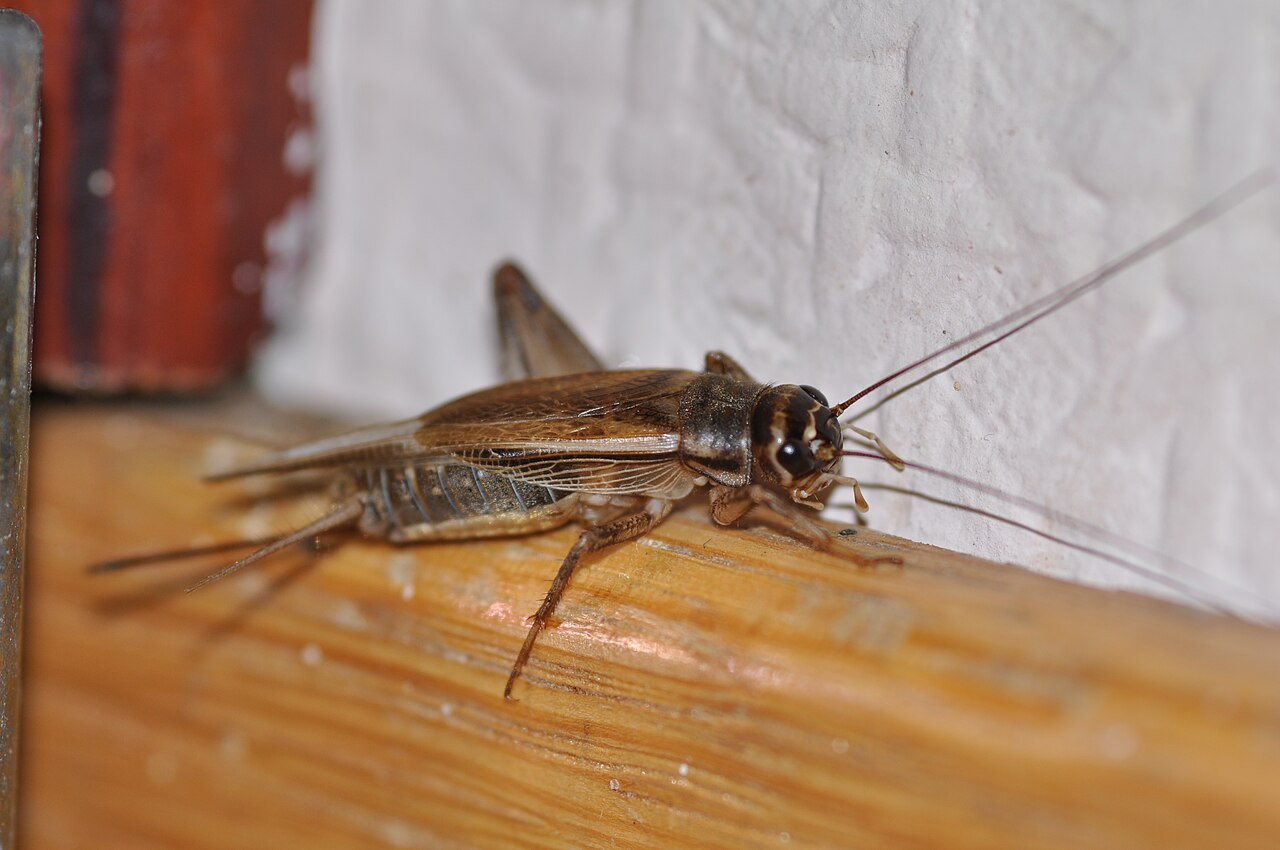
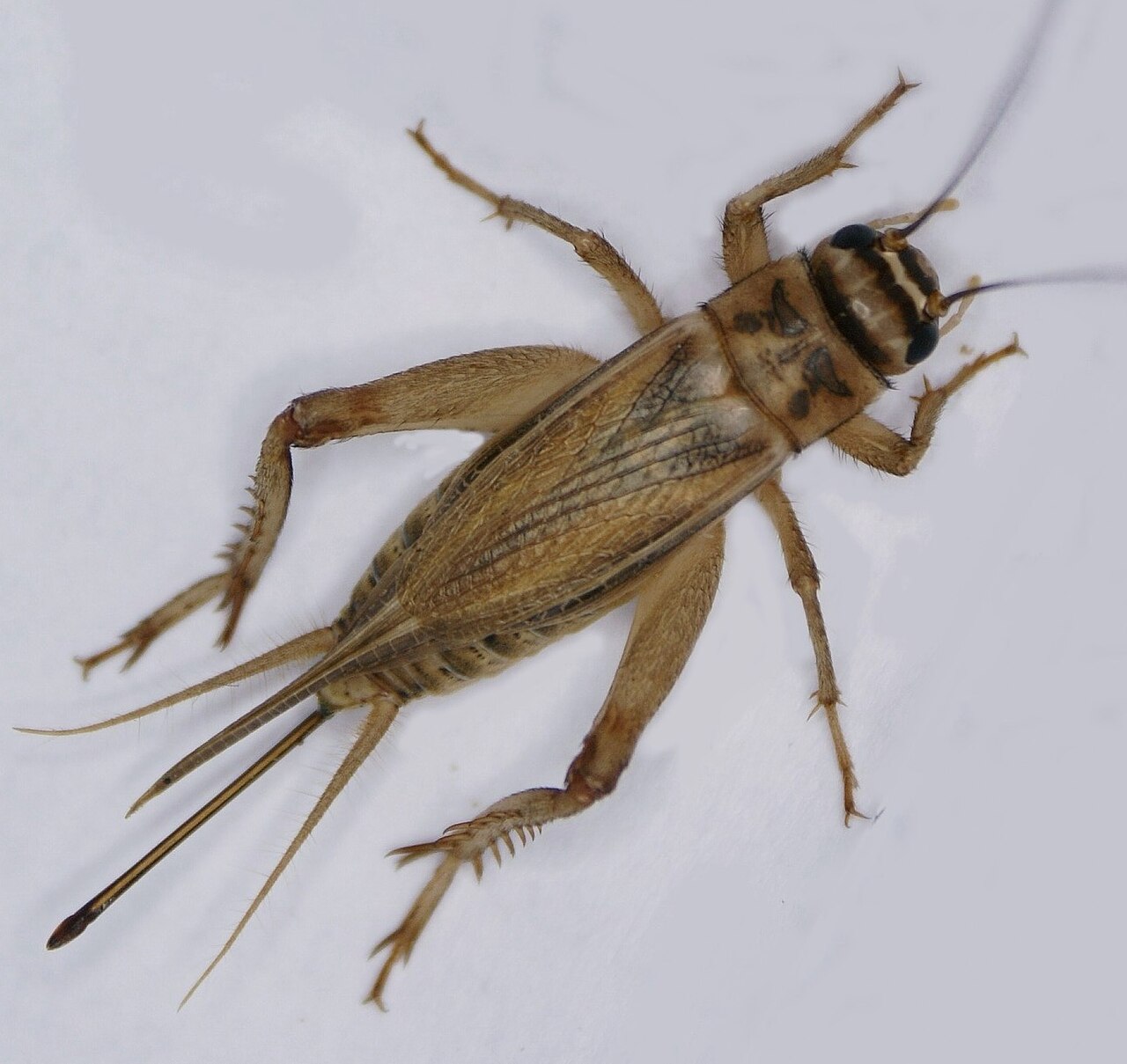
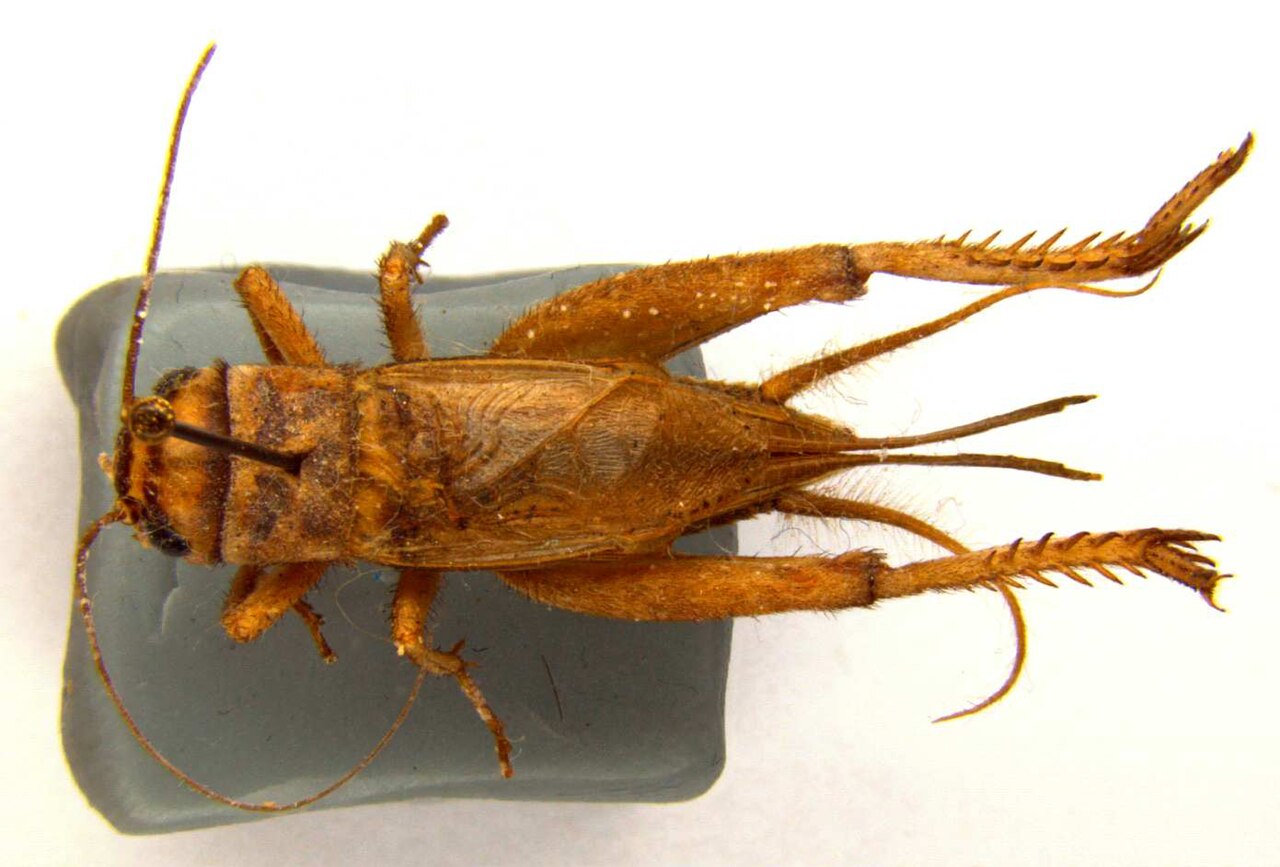
Seeing them confirms it. House crickets are light yellowish-brown with three dark bands across the head, about three quarters of an inch, and they run and jump when disturbed rather than flying. Camel crickets, which are humpbacked, tan, wingless, and silent, are the more common basement invader in much of the United States and never chirp at all. The cricket sounds guide covers telling the species apart by ear.
Are Cricket Droppings Harmful?
The risk is low but not zero. Crickets can mechanically carry bacteria including Salmonella and E. coli on their bodies and in their droppings, picked up from wherever they have been feeding, and they can host parasites including nematodes and tapeworm stages that matter mainly for pets that eat them.
Allergy is the more common issue. Cricket droppings and shed exoskeletons break down into fine particles that can trigger asthma and allergic reactions in sensitive people, in the same way cockroach allergens do, and this is the main argument for cleaning up accumulations properly rather than leaving them.
Crickets do not bite people in any meaningful sense, do not sting, and do not transmit disease directly. A large cricket may pinch with its mandibles if held tightly, which does not break skin. The practical risk from an infestation is fabric damage, noise, and allergen accumulation rather than illness.
How Do You Clean Up Cricket Droppings?
Wet first, then wipe. Spraying the area lightly with a household disinfectant or soapy water before cleaning prevents the dry frass from becoming airborne, which is what matters for the allergen risk. Let it soak briefly, then wipe up with disposable cloths.
For larger accumulations, a vacuum with a HEPA filter works, and the bag or canister contents should go straight outside afterward. Avoid dry sweeping, which throws particles into the air and spreads them across a wider area than they started.
Finish by removing the harbourage. Cardboard boxes on basement floors, stacked newspaper, damp storage, and clutter against walls are what hold a population in place, and clearing them does more than any repeated cleaning. Wash affected fabrics in hot water, since surface damage and staining both worsen if left.
Is Cricket Poop Good Fertilizer?
Yes, and it is sold commercially as cricket frass fertiliser. It is a balanced organic amendment with an NPK ratio typically around 4-3-2, releasing nutrients slowly, and it also contains chitin from shed exoskeletons mixed into the frass.
Chitin is the interesting part. Applied to soil it stimulates plant immune responses and encourages chitin-digesting soil microbes, which also attack the cell walls of fungal pathogens and the eggs of root-knot nematodes. This is why insect frass is marketed on plant health grounds rather than nutrient content alone.
What is sold is a by-product of commercial cricket farming for feed and protein, collected clean and dried. Frass swept from a basement floor is not the same product and is mixed with dust, exoskeleton fragments, and whatever else was on the floor, so it belongs in the bin rather than in a raised bed. Cricket farming for protein has expanded considerably, and the U.S. Food and Drug Administration (fda.gov) treats farmed insects as food ingredients subject to standard food safety rules.
Why Are Crickets in the House at All?
Because something drew them to the building and a gap let them in. House crickets are strongly attracted to exterior lighting, and porch lights, security floods, and lit windows concentrate them against a wall, from where they find their way under doors and through foundation cracks, vents, and utility penetrations.
Camel crickets arrive for a different reason: moisture. They do not fly, are not drawn to light, and enter at ground level seeking damp dark shelter, which is why they turn up in basements, crawl spaces, and garages rather than upstairs. A camel cricket problem is almost always a damp problem.
Timing follows the season. Numbers indoors peak in late summer and autumn as outdoor populations reach maximum and temperatures start to drop, and a house that gets crickets every September is being colonised on the same route each year. Finding and sealing that route once solves it permanently.
Should You Get Rid of Crickets in the Yard?
Generally no. Field crickets outdoors are food for birds, lizards, toads, spiders, and small mammals, and they contribute to breaking down plant material. A yard with crickets calling in late summer is functioning normally, and the sound is one of the standard markers of the season.
Outdoor control is also mostly futile, since crickets recolonise from surrounding ground continuously. What reduces indoor numbers is reducing what draws them to the building: bright exterior lights, dense vegetation and mulch against the foundation, wood piles, and damp debris.
Indoors the approach is exclusion and habitat removal rather than spraying. Sealing gaps around doors, windows, vents, and utility penetrations, fixing damp, and clearing clutter handles almost every case. Sticky traps along baseboards catch the individuals already inside and confirm whether the problem is house crickets or camel crickets. The guide to what crickets eat covers what is drawing them in the first place.
Frequently Asked Questions
What do cricket droppings look like?
Small dark cylindrical pellets one to two millimetres long, black or dark brown, dry, often ridged lengthwise, gathered in scattered piles near daytime hiding places rather than in trails.
How do you tell cricket poop from mouse droppings?
Size and shape. Mouse droppings are three to six millimetres and pointed at the ends; cricket pellets are much smaller with blunt ends. Mouse droppings follow travel routes; cricket frass piles up where they rest.
Are cricket droppings harmful?
The main issue is allergens, since dried frass and shed exoskeletons break down into particles that can trigger asthma. Crickets can also carry bacteria mechanically, so wet the area before cleaning and wash hands.
What does a cricket infestation look like?
Persistent chirping at night, scattered droppings behind appliances and in corners, shed exoskeletons, and surface damage to fabric and paper, especially on stained wool, cotton, or linen.
Is cricket poop good fertilizer?
Farmed cricket frass is, with an NPK around 4-3-2 plus chitin that stimulates plant defences and beneficial soil microbes. Frass swept off a basement floor is contaminated and should be binned.
Do crickets carry diseases to humans?
Not directly. They can mechanically carry Salmonella and E. coli and host parasites relevant to pets that eat them, but they do not transmit disease to people the way biting insects do.
How do you get rid of crickets indoors?
Exclusion and habitat removal: seal gaps, fix damp, clear cardboard and clutter, and switch off or change bright exterior lights that draw them to the building. Sticky traps catch those already inside.