Yellow Ladybug: Species, Meaning, and Identification Guide
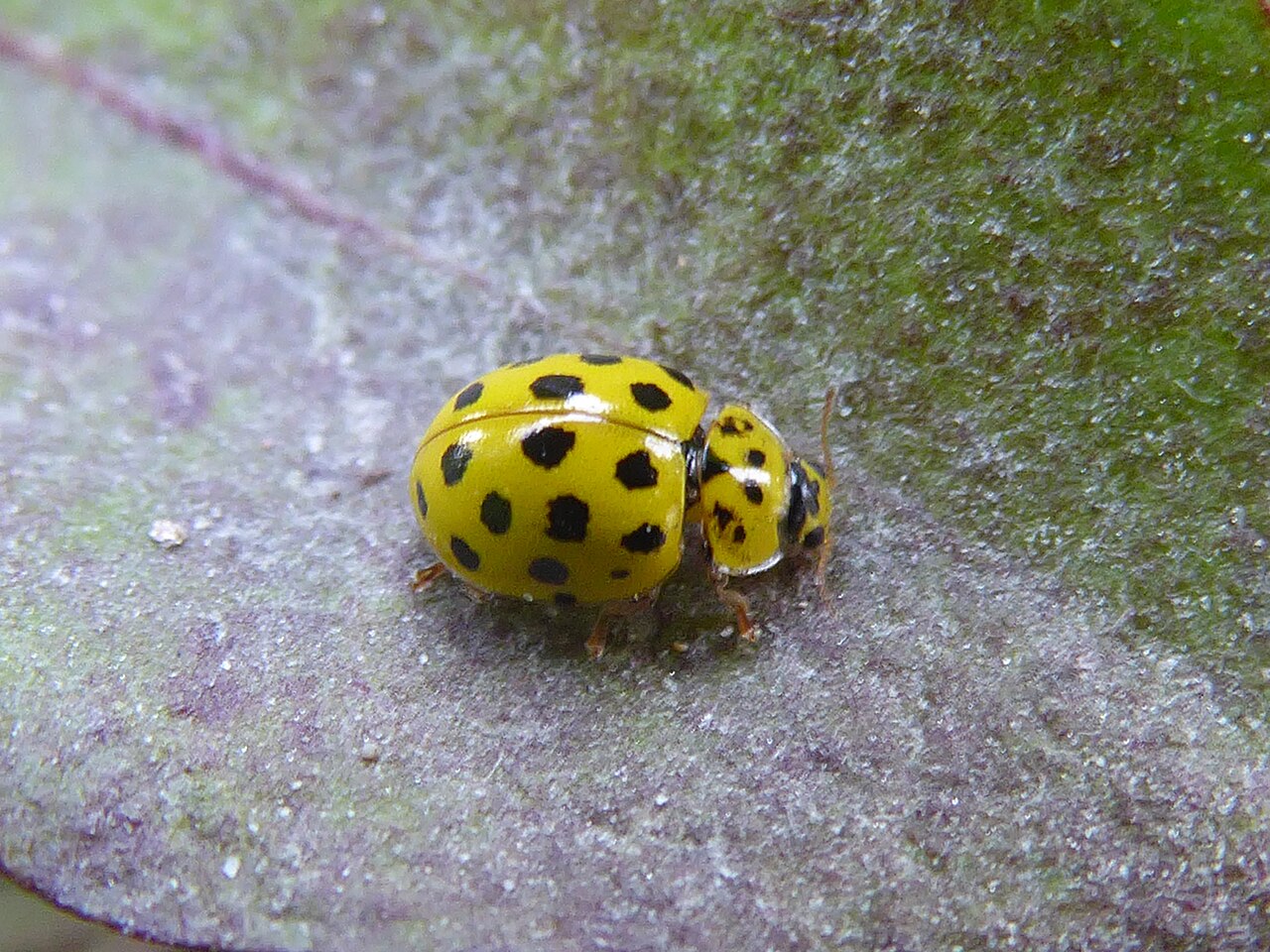
A yellow ladybug is not a single species but a color form shared by several different beetles, and the most common ones in North America are the 22-spot ladybird, the 14-spotted ladybird, pale color morphs of the Asian lady beetle, and the squash beetle. Most yellow ladybugs are completely harmless to people, they do not sting, and they are far more likely to be eating mildew or aphids in your garden than causing any damage. A smaller share of yellow ladybug sightings are actually red species that emerged from the pupa only hours earlier and have not developed their adult pigment yet.
Telling these beetles apart matters more than it sounds, because one yellow ladybug in your squash patch is a plant pest while another one on the same leaf is quietly cleaning powdery mildew off your crop. This guide covers how to identify each yellow ladybug you are likely to find, what the black spots mean, whether they bite or release that alarming yellow liquid, what they eat, and the folklore that has grown up around finding one.
| Quick Facts | Yellow Ladybug |
|---|---|
| Common species | 22-spot ladybird, 14-spotted ladybird, Asian lady beetle (pale morph), squash beetle |
| Typical size | 0.1 to 0.3 in (3 to 7 mm) |
| Spot count | 0 to 22, depending on species |
| Diet | Powdery mildew, aphids, or squash leaves, depending on species |
| Dangerous to humans | No, not venomous and not medically significant |
| Active season | Late spring through first frost, peaking mid to late summer |
Yellow ladybugs are not poisonous to people. They do not sting, and the yellow fluid they leak from their leg joints when handled is a foul tasting defensive chemical, not venom. In North America a yellow ladybug is usually a 22-spot, a 14-spotted ladybird, a pale Asian lady beetle or a squash beetle.
What Is a Yellow Ladybug?
Ladybugs belong to the beetle family Coccinellidae, which includes roughly 6,000 described species worldwide and around 500 in North America alone. Yellow is one of several warning colors that run through the family, alongside red, orange, cream, and brown, and it serves exactly the same purpose in every case. The bright shell tells birds and other predators that this insect tastes foul and is not worth swallowing, a defense strategy biologists call aposematism.
Because yellow shows up independently in several unrelated groups within the family, the phrase yellow ladybug describes a look rather than a lineage. A pale lemon beetle with black spots on your kitchen window in October is probably a different insect entirely from the tiny sulfur yellow one you found on a cucumber leaf in July. Their diets, their life cycles, and their value to your garden all differ, even though a casual glance groups them together.
Size is often the first useful clue. Most yellow ladybug species you will encounter measure between 0.1 and 0.3 in long, which puts several of them noticeably below the familiar seven-spotted red ladybug at around 0.3 in. If the beetle looks convincingly small, roughly the size of a sesame seed, you are probably looking at one of the mildew-eating specialists rather than an aphid hunter. For a broader look at how color operates across this family, our guide to the orange ladybug covers the same identification logic from a different starting point.
Yellow Ladybugs That Are Actually Newly Emerged Adults
Before working through species identification, rule out the most common false positive. When a ladybug completes metamorphosis and breaks out of its pupal case, its wing covers are soft, pale, and usually unmarked. This stage is called the teneral phase, and depending on species and temperature it can last anywhere from a few hours to two full days while the cuticle hardens and the adult pigment develops.
A teneral seven-spotted ladybug looks strikingly yellow, sometimes almost translucent, and its black spots may be faint smudges or missing altogether. Gardeners who find one of these beside an empty pupal shell on a leaf underside frequently report discovering a rare spotless yellow ladybug. Come back to the same leaf a day later and the beetle will typically be the ordinary red species everyone recognizes.
Two details separate a teneral beetle from a genuinely yellow species. First, a soft-shelled new adult usually sits still and does not fly, because its wings are not ready yet. Second, it is almost always near the shed pupal case it just left, which looks like a small dark crusty blob glued to the plant. A true yellow species, by contrast, moves briskly, flies readily, and shows crisp, well defined markings from the moment you spot it.
Common Yellow Ladybug Species in North America
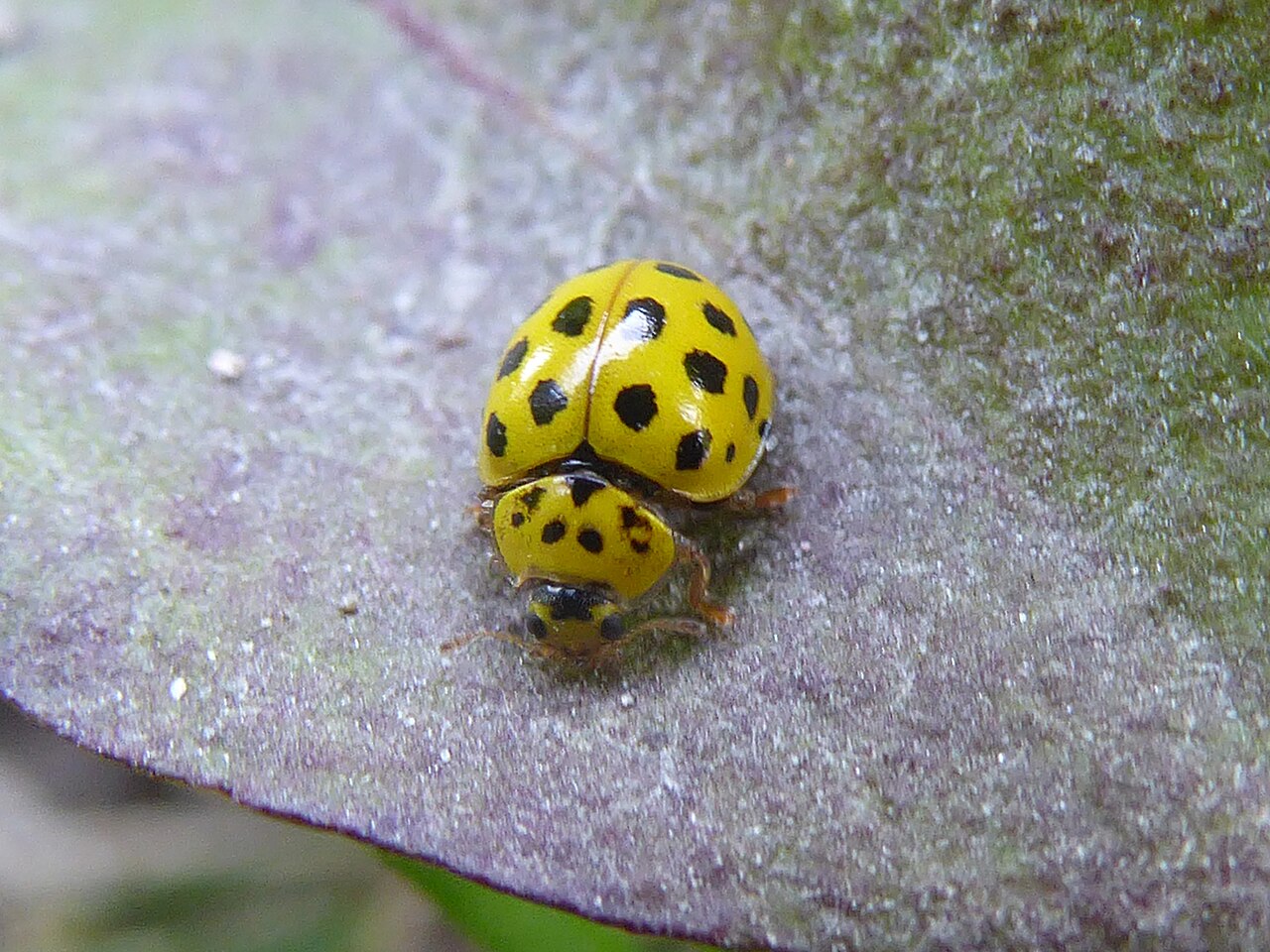
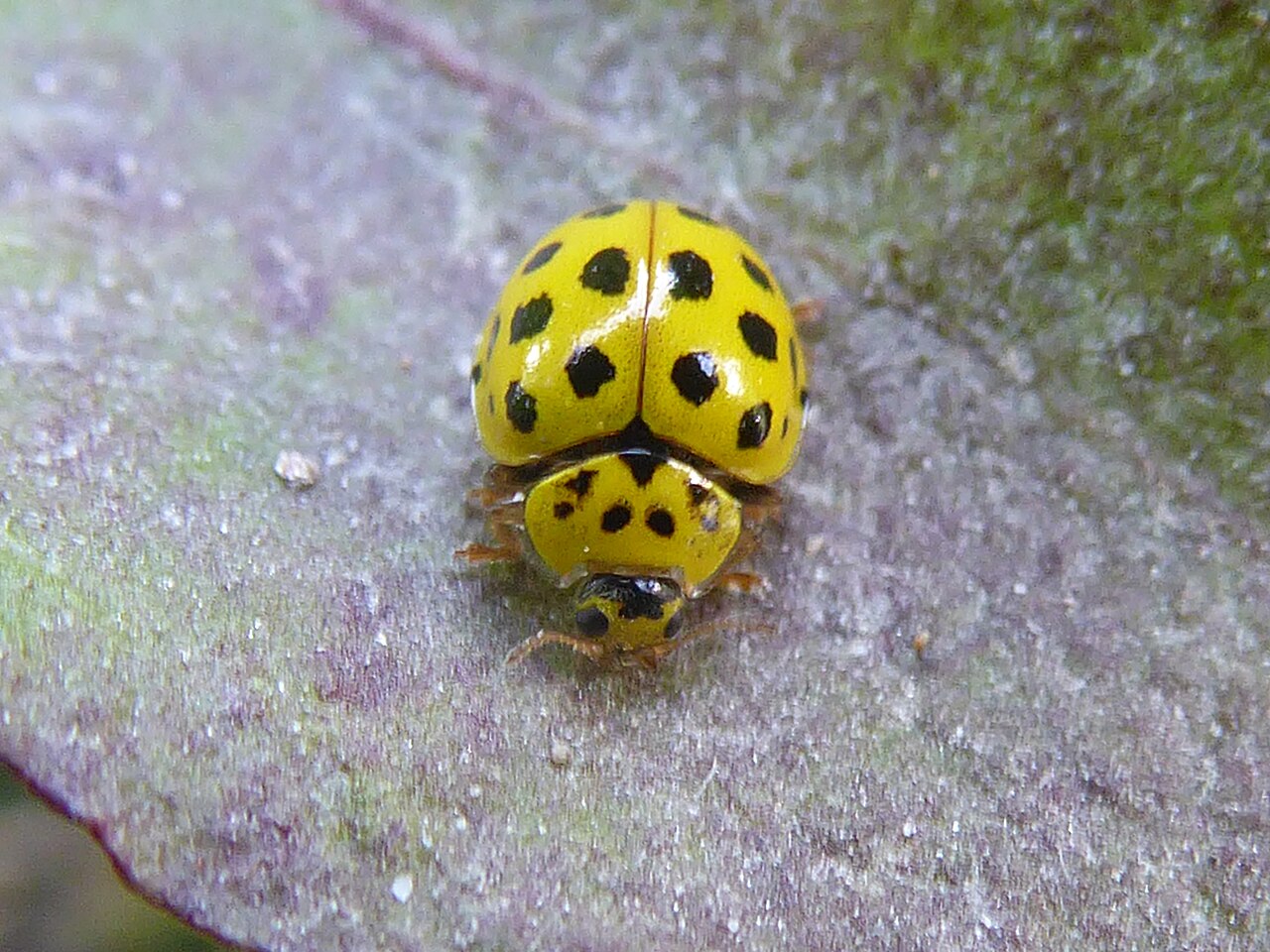
The 22-spot ladybird (Psyllobora vigintiduopunctata) is the classic bright yellow species, and its relatives in the genus Psyllobora occur across the United States. It is small, around 0.1 in, with a vivid lemon yellow shell carrying up to 22 round black dots, plus additional spots on the thorax. Unlike most of the family, it does not hunt other insects at all, which changes how you should think about finding one on a plant.
The 14-spotted ladybird (Propylea quatuordecimpunctata) is an introduced European species now established through much of the northeastern and midwestern United States. Its markings are the giveaway, because the black spots are squared off rather than round, and they often fuse into an interlocking anchor or checkerboard pattern across a cream to yellow background. It is a genuine aphid predator and a welcome sight on infested plants.
The Asian lady beetle (Harmonia axyridis) is the wildcard, because its color ranges from deep red through orange to pale straw yellow, with spot counts from zero to 19. Pale individuals are frequently reported as yellow ladybugs, especially in autumn when the species swarms buildings looking for overwintering sites. The identifying mark is a black pattern on the white shield behind the head, often shaped like a letter M or W, which our comparison of the Asian lady beetle and the native ladybug breaks down in detail.
Black Ladybug With Yellow Spots and Other Color Patterns
Searches for a black ladybug with yellow spots turn up thousands of times a month, and the answer usually falls into one of three groups. The most likely candidate in North America is a pine ladybird or a related species with a dark shell and a few orange to yellow marks, typically two to four in number. These are legitimate ladybugs, they are small and shiny, and they hunt scale insects and aphids on trees and shrubs.
The second group is the beetles that get mistaken for ladybugs. The two-spotted and twice-stabbed lady beetles carry red or orange marks on black, and in dim light or a poor photo those marks can read as yellow. Beyond the family entirely, several leaf beetles, false ladybird beetles, and even some young true bugs have the domed shape and bold spotting that trigger the ladybug association, but none of them share the family’s feeding habits.
The third possibility is a squash beetle (Epilachna borealis), and this is the one gardeners need to recognize. It runs closer to 0.3 in, wears a dull orange-yellow shell with seven large black spots on each wing cover, and has a slightly fuzzy rather than glossy finish. It is a member of the ladybug family that switched to eating plants, and it feeds on squash, pumpkin, and melon leaves, sometimes stripping them to a lace of veins. If your yellow ladybug is chewing the leaf instead of walking across it, this is your culprit. For a broader survey of dark-shelled beetles that get mistaken for one another, see our black beetle identification guide.
Are Yellow Ladybugs Poisonous?
Yellow ladybugs are not poisonous to humans in any meaningful sense. They carry no venom, they have no stinger, and handling one poses no health risk beyond the minor nuisance of the fluid they may release. The Xerces Society for Invertebrate Conservation, which tracks native beetle populations across North America, treats ladybugs of all colors as benign garden insects rather than a hazard requiring management.
The reputation comes from a genuine chemical defense called reflex bleeding. When a ladybug feels threatened, it forces a small amount of yellow or orange hemolymph out through its leg joints. That fluid contains bitter alkaloids, and it works as intended on birds and lizards, which learn quickly to leave the beetles alone. Against human skin it does nothing worse than leave a faint stain and a lingering musty smell.
The one real caution involves large indoor aggregations of Asian lady beetles, including pale yellow individuals. Studies of homes with heavy autumn infestations have documented allergic reactions in sensitive people, including runny nose, itchy eyes, and asthma flare-ups triggered by beetle proteins in household dust. A handful of beetles on a windowsill is not a health issue, but thousands overwintering in a wall void can be. Rare reports also describe minor mouth irritation in dogs that eat large numbers of them.
Do Yellow Ladybugs Bite?
Most yellow ladybugs never bite people. Species like the 22-spot ladybird have mouthparts built for scraping fungal growth off leaf surfaces, and they simply cannot deliver a meaningful pinch to human skin. If one walks across your hand, you will feel the feet and nothing else.
The Asian lady beetle is the exception, and pale yellow individuals bite just as readily as red ones. The bite is a defensive nip rather than a feeding attempt, it feels like a sharp pinprick, and it may leave a small red mark that fades within an hour. It does not break the skin in most cases and carries no venom or disease risk. Bites are most common in late autumn when large numbers of beetles are crowded together indoors and running short of moisture.
If you want to move a yellow ladybug without any chance of a pinch, scoop it onto a sheet of paper rather than picking it up between your fingers. Pressure on the body is what usually triggers both the bite and the reflex bleeding. Our full breakdown of whether ladybugs bite covers the differences between species and what a bite actually feels like.
What Do Yellow Ladybugs Eat?
Diet is the sharpest dividing line between yellow ladybug species, and it determines whether the beetle helps or hurts your garden. The 22-spot ladybird and its Psyllobora relatives are mycophagous, meaning they eat fungus. Their entire diet is powdery mildew scraped off the surfaces of leaves, which makes them genuinely useful on squash, cucumbers, roses, and grapevines where mildew takes hold in humid weather.
The 14-spotted ladybird and pale Asian lady beetles are predators in the conventional mold. They hunt aphids, scale insects, mites, mealybugs, and the soft eggs and larvae of other insects. A single adult ladybug can consume roughly 50 aphids per day, and the larvae, which look like tiny spiny alligators, often eat more than the adults do. This is the appetite that made ladybugs a standard tool in biological pest control.
The squash beetle inverts the whole arrangement by eating plants. Both the adults and the yellow spiny larvae feed on the undersides of cucurbit leaves, cutting a distinctive arc into the tissue before feeding inside it. If you are trying to work out which insects in your garden are working for you, our guide to what ladybugs eat lays out the full range of feeding strategies across the family.
Yellow Ladybug Meaning and Symbolism
Ladybugs carry unusually consistent folklore across cultures, and the yellow ones inherit most of it. Across Europe the beetles were associated with agricultural protection long before anyone understood that they were eating the aphids destroying the crops, and finding one on your person was read as a sign of coming good fortune. Yellow specifically tends to be linked with sunlight, warmth, optimism, and creative energy in symbolic traditions, so a yellow ladybug is commonly interpreted as a sign of renewal or a bright turn ahead.
In more recent spiritual writing, a yellow ladybug is often described as a prompt toward joy, playfulness, and lighter thinking after a difficult stretch. Some traditions attach meaning to the spot count, reading each mark as a month of good luck or as a wish being granted. None of this has any basis in the beetle’s biology, which is worth stating plainly, but the symbolism is a real and widespread part of how people respond to finding one.
The practical read is more grounded and arguably more interesting. A yellow ladybug on your plants means the local food web is working. Either mildew is being cleaned off your leaves or aphids are being hunted, and in both cases the beetle showed up because your garden supports enough life to feed it. That is a better indicator of a healthy yard than any omen.
Yellow Ladybugs in the House and How to Handle Them
Yellow ladybugs turn up indoors most often in autumn, when Asian lady beetles seek out sheltered overwintering sites. They orient toward warm, sun-lit surfaces, which is why south and west facing walls attract the heaviest numbers, and they enter through gaps around window frames, siding, soffits, and utility penetrations. Once inside a wall void they stay dormant until a warm spell wakes them and they wander into living space.
Sealing is the only durable fix. Caulking gaps, repairing damaged screens, and fitting door sweeps before the first cold snap does far more than any treatment applied after the beetles arrive. For the ones already indoors, a vacuum with a fresh bag or a nylon stocking rubber-banded into the hose lets you collect and release them without crushing them, which matters because crushed beetles leave stains and release that bitter defensive fluid.
Avoid squashing them on painted walls, curtains, or light-colored upholstery, because the alkaloid fluid stains and the odor lingers. If a yellow ladybug is already in your kitchen, a glass and a sheet of paper move it outside in seconds. Household insects that gather in similar autumn aggregations follow the same exclusion logic, which our guide to getting rid of gnats applies to a different indoor nuisance.
Are Golden Ladybugs Real?
Golden ladybugs are real, but the metallic gold ones are not lady beetles. The insect behind almost every photograph of a shining gold ladybug is the golden tortoise beetle, a small leaf beetle with a translucent shell that reflects a genuine liquid-metal gold. It can shift from gold to orange-red within minutes when disturbed, because the color depends on moisture in layers beneath the shell.
Separating it from a true lady beetle is easy once you know what to look for. The tortoise beetle has a wide flattened rim of clear shell extending past the body, so it looks like a tiny domed shield with the legs and head hidden underneath. A lady beetle has a solid opaque shell with no transparent margin, and its head is visible from above.
The paler golden-yellow beetles that are genuine lady beetles are usually freshly emerged adults whose color has not darkened yet, a stage that lasts only a day or two. The University of Minnesota Extension guide to lady beetles covers that emergence sequence.
Related reading: Yellow Fly Bite.
Are Yellow Ladybugs Poisonous to Dogs and Cats?
Yellow ladybugs are not poisonous to dogs or cats in any meaningful sense, and a pet that eats one or two will at most drool, gag or bring them straight back up. The defensive fluid the beetle releases from its leg joints tastes bitter and irritates the mouth, which is exactly what it evolved to do, and that reaction is usually the end of the story.
The real veterinary problem is mechanical rather than toxic, and it comes from one insect. Asian lady beetles, which include pale yellow and orange forms, can embed themselves in numbers in the roof of a dog’s mouth, where their secretions cause chemical burns and ulcers on the palate and tongue. It is uncommon, it happens most often when a dog mouths a cluster of overwintering beetles indoors, and it needs a vet to remove them rather than a home remedy.
The practical takeaway is to tell the two apart before worrying about either. Native ladybugs are round, glossy and turn up one at a time, while Asian lady beetles gather in clusters on warm walls and windows in autumn and carry a pale M or W mark behind the head. Our guide to telling an Asian lady beetle from a ladybug covers those marks in detail, and whether ladybugs bite answers the question people usually ask in the same breath.
Frequently Asked Questions
What does a yellow ladybug mean?
Symbolically, a yellow ladybug is usually read as a sign of good luck, renewed optimism, and creative or joyful energy, drawing on the sunlight associations attached to the color yellow. Biologically it means nothing more than that a mildew-eating or aphid-hunting beetle found something to eat nearby. Both readings can coexist comfortably.
Is a yellow ladybug poisonous?
Not to humans. Yellow ladybugs produce bitter alkaloid compounds that make them unpleasant to birds and lizards, but the chemicals are not dangerous through skin contact. The only documented human health issue involves allergy symptoms in homes with very large indoor Asian lady beetle infestations.
Do yellow ladybugs bite?
Mildew-eating species such as the 22-spot ladybird do not bite at all. Pale Asian lady beetles can deliver a defensive nip that feels like a pinprick and leaves a small red mark, most often in autumn when large numbers are crowded indoors. The bite is harmless and needs no treatment beyond washing the spot.
What is a small yellow ladybug with no spots?
A spotless yellow ladybug is most often a newly emerged adult of a spotted species whose pigment has not developed yet, a stage that lasts a few hours to about two days. Check the same location the next day. Some Asian lady beetle individuals are also genuinely spotless, and they can be identified by the dark M-shaped mark behind the head.
Why did a yellow ladybug leave a yellow liquid on my hand?
That is reflex bleeding, a defense in which the beetle releases hemolymph through its leg joints when it feels threatened. The fluid contains bitter alkaloids that deter predators, and it can stain fabric and leave a musty smell. It is harmless on skin and washes off with soap and water.
Are yellow ladybugs rare?
They are less frequently noticed than red ones, but they are not rare. Psyllobora species are widespread wherever powdery mildew grows, and pale Asian lady beetles are abundant across most of the United States. People simply overlook the yellow ones because they are small and do not match the expected image of a ladybug.
What is a black ladybug with yellow spots?
Most often it is a pine ladybird or a related dark-shelled species carrying two to four orange-yellow marks, all of which are aphid and scale predators. Some sightings are leaf beetles or false ladybird beetles that mimic the shape and pattern. A larger, duller, fuzzy-looking beetle chewing squash leaves is a squash beetle, which is a plant pest rather than a predator.