Purple Frog: The One True Species and 5 US Lookalikes
There is exactly one frog that is genuinely purple, and it does not live in the United States: the Indian purple frog (Nasikabatrachus sahyadrensis), a glossy, bloated, violet-brown burrower from the Western Ghats of India. Every other purple frog people report is a native species caught in a color phase, a wet-skin trick of the light, or a pet trade color morph with a marketing name.
That matters for identification, because a purple-looking frog in a US yard is almost always one of five or six common species. Below, the safety question comes first, then the real purple frog, then the native species that pass for purple and how to separate them from their lookalikes.
The only true purple frog is the Indian purple frog (Nasikabatrachus sahyadrensis), found only in the Western Ghats of India. It is not poisonous and not dangerous to people. In the United States, frogs that look purple are usually pickerel frogs, gray treefrogs, barking treefrogs, or American toads showing a lavender or reddish color phase.
| Frog | Purple look | Size | Where | Safe to handle? |
|---|---|---|---|---|
| Indian purple frog | Deep violet brown, glossy, bloated body | 2 to 3.5 in (5 to 9 cm) | Western Ghats, India only | Yes, but protected and rarely seen |
| Pickerel frog | Purplish brown with squarish dark spots | 1.75 to 3 in (4.5 to 7.5 cm) | Eastern and central US | Skin secretions irritate, wash hands |
| Gray treefrog | Shifts to lavender gray within an hour | 1.25 to 2 in (3 to 5 cm) | Eastern US | Yes, with wet clean hands |
| Barking treefrog | Turns dark purple brown when cold or stressed | 2 to 2.75 in (5 to 7 cm) | Southeastern coastal plain | Yes |
| American toad | Brick red to reddish purple morphs | 2 to 3.5 in (5 to 9 cm) | Eastern US and Canada | Parotoid secretion irritates eyes |
| Axanthic green frog | Blue to blue violet, pigment mutation | 2 to 4 in (5 to 10 cm) | Rare, scattered across range | Yes |
Is a Purple Frog Poisonous or Dangerous to Touch?
No purple frog is venomous, and none will hurt you if you leave it alone. The Indian purple frog has no toxic skin defense worth worrying about; it survives by living underground, not by poisoning predators. Among the US species that look purple, only two deserve caution, and neither is an emergency.
The pickerel frog is the one most often mistaken for purple, and it is also the only common native frog with a genuinely unpleasant skin secretion. The fluid from its skin glands irritates human eyes and noses, and it can kill other amphibians kept in the same container. Never put a pickerel frog in a bucket with other frogs, and wash your hands before touching your face.
American toads carry bufotoxins in the two kidney-shaped parotoid glands behind the eyes. A dog that mouths one will drool and foam; a person who rubs an eye after handling one will regret it. Handle any frog or toad with clean, wet hands, never with insect repellent or sunscreen on your skin, and wash afterward because amphibians can carry Salmonella. The genuinely dangerous frogs are tropical and brightly colored, like the blue poison dart frog, and even those are only toxic in the wild where their diet supplies the alkaloids.
Where Are Purple Frogs Found?
Purple frogs are found in the Western Ghats mountain range of southwestern India, and nowhere else on earth. The species occupies a narrow band of forested hill country in Kerala, Tamil Nadu, and Karnataka, mostly between 200 and 1,100 ft (60 to 335 m) in elevation, close to fast-flowing streams where it breeds.
Almost all of its life happens out of sight. The frog spends roughly 50 weeks of the year in burrows up to 12 ft (3.7 m) deep, eating termites and ants with a short grooved tongue it flicks into their tunnels. It surfaces for about two weeks at the start of the southwest monsoon, which means a visitor could stand in perfect purple frog habitat for eleven months and never see one.
If you are in North America and someone tells you they found a purple frog in the garden, the honest answer is that they found a native species in an unusual color. Escaped or released exotic pets happen, but a burrowing Indian endemic is not a realistic candidate, while a juvenile native frog with damp, dark skin is.
Indian Purple Frog: The Only True Purple Frog
The Indian purple frog was described in 2003, and it was a genuine shock to zoologists: a frog so distinct that it needed its own family, Nasikabatrachidae, whose closest living relatives are the tiny Sooglossidae frogs of the Seychelles islands. That split happened well over 100 million years ago, when both landmasses were still connected, so the species is often called a living fossil.
Physically it looks like nothing else. The body is a bloated, rounded sac of deep violet to purple brown skin, the head is absurdly small for the body, and the snout narrows to a pale, pointed, slightly upturned tip. The hind feet carry hardened spade-like projections used to dig backward into soil. Adults measure about 2 to 3.5 in (5 to 9 cm) from snout to vent, with females noticeably larger than males.
Its tadpoles are as odd as the adults. They cling to wet rock faces behind waterfalls with a sucker-like mouth and graze algae for up to 100 days, a strategy almost no other frog family uses. You can read the current research record for the species through institutional databases like the Smithsonian Institution, which hosts much of the amphibian systematics literature that followed the 2003 description.
What Does a Purple Frog Sound Like?

The purple frog’s call is a low, clucking, chicken-like series that comes out of the ground rather than from the water surface. Males call from inside shallow burrows at the edge of streams, so the sound seems to have no source, which is one reason local communities knew the call long before science knew the frog.
Calling is tied tightly to the monsoon. The first heavy rains trigger a short, intense chorus, females dig down to the males, and amplexus happens partly underground before the pair moves to the stream to deposit eggs in rock crevices. Within days the chorus stops and the adults vanish again.
That brief window is why population counts are so difficult and why most photographs of the species look alike: nearly all of them were taken during a handful of monsoon nights.
Pickerel Frog: The Purple Brown US Lookalike
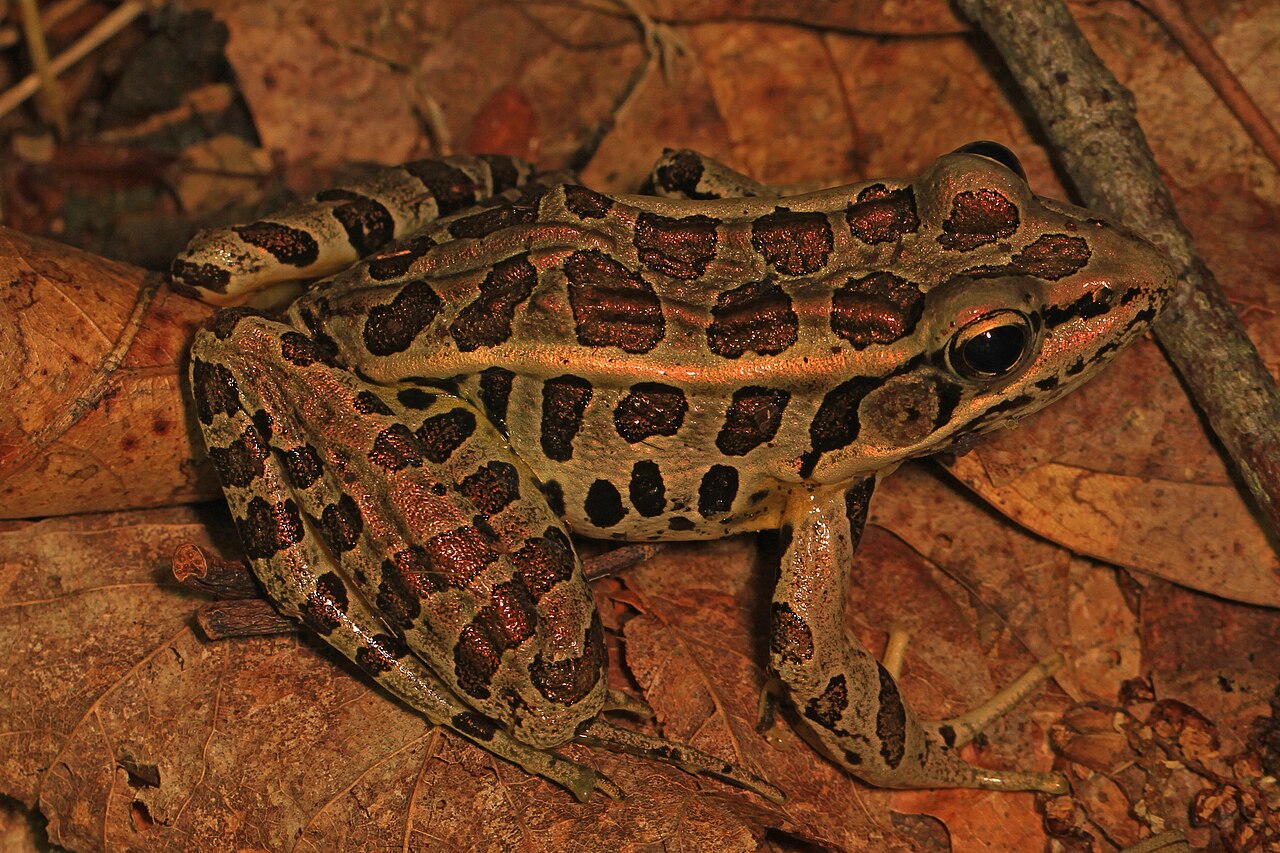
If someone in the eastern United States photographs a purple frog, the pickerel frog (Lithobates palustris) is the single most likely answer. Its base color runs tan to coppery bronze, but in cool, wet conditions it deepens to a distinctly purplish brown, and the bright yellow to orange wash on the inner thighs makes the contrast look even stranger.
The diagnostic mark is the spotting. Pickerel frogs carry two parallel rows of squarish, chocolate-colored blotches down the back, arranged almost like printed blocks. Adults run 1.75 to 3 in (4.5 to 7.5 cm). They prefer cool, clear water: spring seeps, meadow streams, bog edges, and limestone quarry pools across the eastern and north-central states.
They are also the reason the safety section exists. Predators that learn what pickerel frogs taste like generally leave them alone, which is why these frogs sit calmly in the open far more often than a leopard frog would.
Gray Treefrog: The Lavender Color Shift
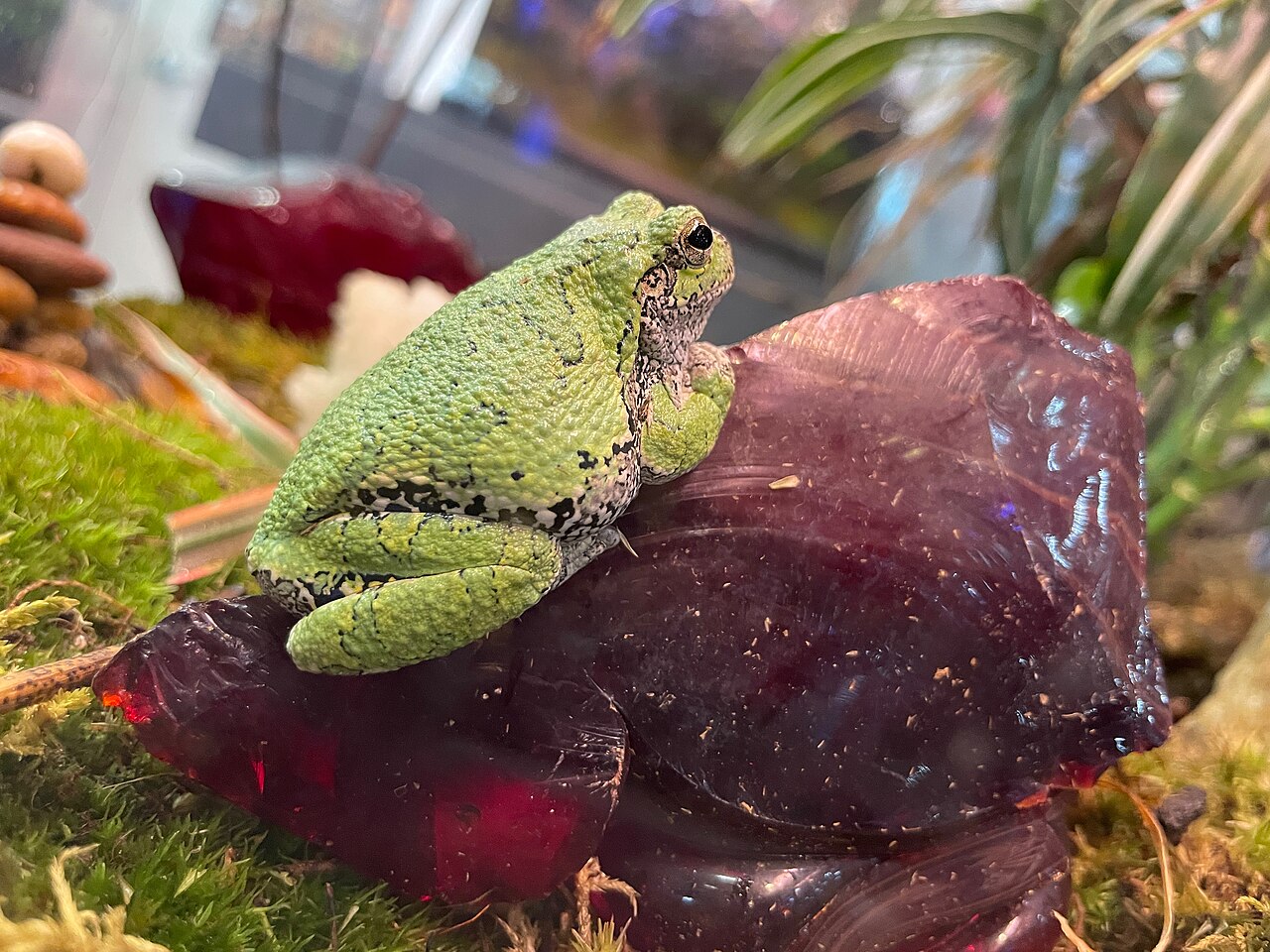
The gray treefrog (Hyla versicolor) earns its species name honestly. A single individual can be bright green on a leaf in the morning, pearl gray on bark by noon, and a soft lavender gray by evening, with the change taking anywhere from a few minutes to about an hour. Photographed in that lavender phase, it reads as purple.
Look for a small frog of 1.25 to 2 in (3 to 5 cm) with warty skin, a pale blotch under each eye, large sticky toe pads, and bright orange to yellow flash coloring hidden in the hind leg folds. Cope’s gray treefrog (Hyla chrysoscelis) is visually nearly identical and does the same color shift; only the call separates them reliably in the field.
These frogs climb, so they turn up on porch railings, window screens, and patio umbrellas across the eastern states. If you want the green end of the treefrog spectrum for comparison, see the American green tree frog, which holds a far more constant color.
Barking Treefrog: Green That Turns Purple Brown
The barking treefrog (Hyla gratiosa) is the largest treefrog native to the United States, at 2 to 2.75 in (5 to 7 cm), and it has the widest color range of any of them. A relaxed, warm individual is apple green with dark round spots. A cold or stressed one can go dark brown with a strong purple cast, which is exactly the condition most backyard frogs are in when someone picks one up to photograph it.
Its range covers the southeastern coastal plain from the Carolinas through Florida and west to Louisiana, with scattered inland populations. It breeds in shallow, fish-free ponds and spends the rest of the year high in trees, so sightings cluster around warm rain. The call is a hollow, repeated bark, often described as a dog heard from two streets away.
Side by side with its relatives, the granular, almost pebbled skin texture is the giveaway. More on the species itself is in our barking treefrog guide.
American Toad: Reddish Purple Morphs
American toads (Anaxyrus americanus) vary more in color than almost any other North American amphibian. Individuals from the same pond can be sand brown, olive, brick red, or a muted reddish purple, and the same toad darkens or lightens with temperature and humidity. A wet, cool toad on dark soil at dusk photographs convincingly purple.
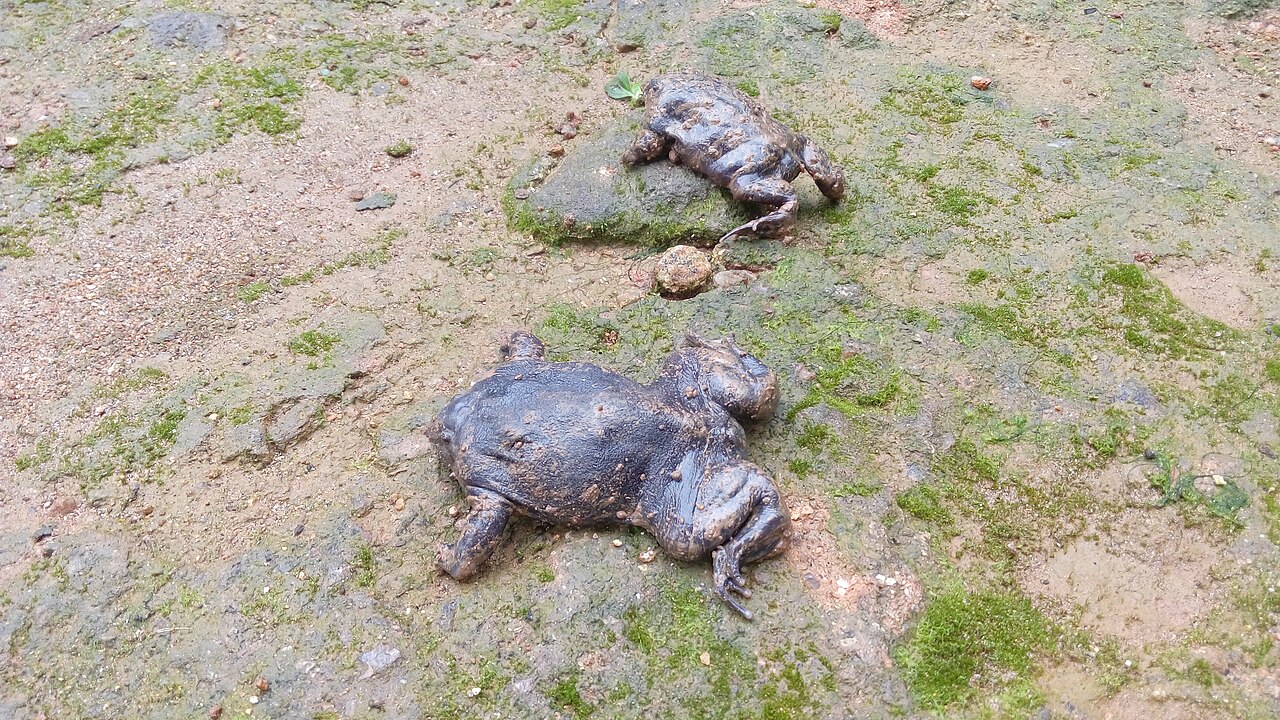
Separating a toad from a frog takes two seconds: toads have dry, heavily warted skin, short hind legs for hopping rather than leaping, a pair of raised parotoid glands behind the eyes, and prominent bony ridges on the head. Adults reach 2 to 3.5 in (5 to 9 cm), and females are the larger sex.
They are also the amphibian most likely to be in a US yard year round, since they tolerate dry lawns, mulch beds, and window wells that true frogs cannot use.
Blue and Purple Morphs: When Pigment Goes Wrong
A small number of wild frogs are genuinely off-color because of a pigment mutation. Frog skin builds its normal green from a yellow pigment layer sitting over a blue-reflecting layer. Remove the yellow, a condition called axanthism, and the animal comes out blue, sometimes blue violet or slate purple.
Axanthic green frogs (Lithobates clamitans), bullfrogs, and leopard frogs all turn up this way, usually as single individuals that make local news. Whether a given animal reads as blue or purple depends heavily on light and on how much brown pigment remains, which is why the same frog gets reported both ways by different observers.
These are rare but not biologically mysterious, and they are not a separate species. A blue or purple morph frog stays whatever species it was born as, and it behaves normally, including going dormant in winter like any other; see how frogs hibernate for what that looks like.
Purple Frogs in the Pet Trade
Search for a purple frog to buy and you will find color morph names rather than species: lavender, blue phase, violet. Most trace back to a handful of species bred for unusual pigment, including White’s treefrog (Litoria caerulea) in its blue phase and various captive-bred dart frog lines whose photographs are frequently enhanced.
Two honest warnings apply. First, no legitimate breeder sells Nasikabatrachus sahyadrensis; the species is protected, hard to keep, and has never been established in captivity, so any listing using that name is mislabeled. Second, color morph pricing rewards photo editing, so judge an animal from video under neutral light rather than from a product image.
If what appeals to you is the color rather than the species, a captive-bred blue phase treefrog is the realistic version of the idea, and it is a far easier animal to house than any burrowing specialist.
Pickerel Frog or Leopard Frog? The Lookalike Table
Almost every misidentified purple frog in the eastern US comes down to one pair. Pickerel frogs and northern leopard frogs (Lithobates pipiens) share a size class, a habitat, and a spotted pattern, but only one of them has the irritating skin secretion, and only one regularly looks purple.
| Feature | Pickerel frog | Northern leopard frog |
|---|---|---|
| Spot shape | Squarish, in two tidy parallel rows | Rounded, scattered irregularly |
| Base color | Bronze to purplish brown | Green to olive brown |
| Inner thigh | Bright yellow to orange wash | Pale white to cream |
| Skin secretion | Irritating, toxic to other amphibians | None of note |
| Typical water | Cool, clear seeps and streams | Warmer ponds, ditches, wet meadows |
Check the thigh color first. It is the fastest field mark, it does not change with temperature, and it settles the question even when the spot pattern is ambiguous in a photograph.
Is the Purple Frog Endangered?
The Indian purple frog is assessed as Endangered, and its problems are easy to list: its entire range sits in one of the most densely farmed mountain regions in India, its breeding streams are dammed and diverted for irrigation and hydropower, and its forest cover is being converted to coffee, cardamom, and tea.
Tadpole collection adds pressure in some districts, where the larvae are harvested from rock faces for food and local medicine. Because adults are visible for only two weeks a year, population trends are inferred from breeding sites rather than counted directly, so the estimates carry real uncertainty and researchers say so.
Conservation work focuses on protecting stream stretches with confirmed breeding rather than on captive breeding, which has not worked for this species. For context on how differently a widespread amphibian fares, compare the Alaskan wood frog, which freezes solid each winter across a range larger than India.
Frequently Asked Questions
What does it mean if you find a frog in your yard?
Biologically it means your yard has moisture, insects, and shelter. Frogs need damp cover during the day, so a frog under the hose reel or in a mulch bed is a sign of a functioning small ecosystem rather than a problem. Folklore reads it as luck or coming rain, which is harmless but not predictive.
What is the most endangered frog?
There is no single answer, because several species are down to double digits or fewer. The Sehuencas water frog, the Panamanian golden frog, and Archey’s frog are all regularly cited. Honest comparison is hard: some species are rare, others are merely unsurveyed, and amphibian assessments lag behind the chytrid fungus outbreaks that cause the collapses.
Do frogs drink water?
Not by mouth. Frogs absorb water directly through a highly permeable patch of belly and thigh skin, sometimes called the drink patch, by pressing against damp soil or shallow water. That is also why a dry frog dehydrates quickly and why handling one with dry hands damages the mucus layer it depends on.
Can frogs feel love to humans?
No, and the evidence points the other way. Frogs have no neural structures associated with social bonding in mammals and birds, and they show no individual recognition of keepers. What people read as affection is habituation: a frog that stops fleeing has learned you are not a predator, which is a real response but not attachment.
What does the frog symbolize in the Bible?
Frogs appear as the second plague of Egypt in Exodus, where they represent divine judgment and uncontrolled infestation, and again in Revelation as unclean spirits. Both readings are negative, which sets biblical frog symbolism apart from the fertility and rebirth meanings frogs carry in Egyptian, Chinese, and Mesoamerican traditions.
Is the purple frog the ugliest frog in the world?
It regularly wins that title in popular articles and videos, mostly because of the bloated body and tiny pointed snout. Both features are functional: the shape suits a life spent pushing through soil, and the snout protects a tongue built for raiding termite tunnels. For a visual contrast within the same color family, see our purple butterfly guide.