Ornate Box Turtle: Identification, Range, and Legal Status
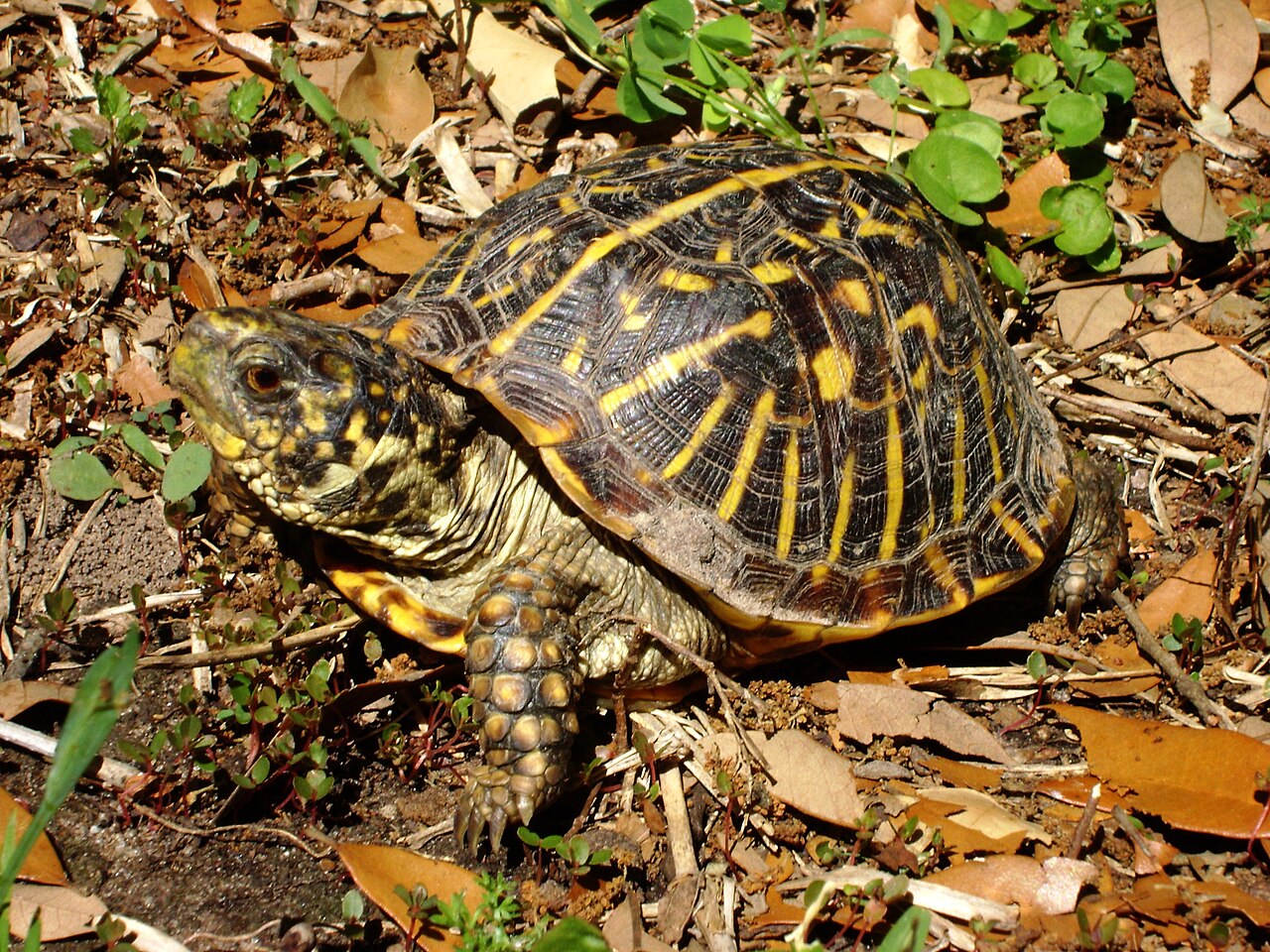
The ornate box turtle (Terrapene ornata) is a small, dry land turtle of the American Great Plains, identified by the bold yellow lines radiating across a dark brown or black shell. Adults stay under about 6 in (15 cm), live 30 to 50 years, and spend their lives in prairie and sandhill country rather than in water. It is the state reptile of Kansas.
It is also a species that most people should admire and leave alone. Populations have been shrinking for decades, collection is illegal in a long list of states, and a turtle removed from its home range usually dies. This guide covers identification, range, diet, lifespan, predators, legal status, and what captive care looks like for the animals that are legally kept.
The ornate box turtle is a terrestrial North American turtle with a hinged plastron and yellow lines radiating on a dark carapace. Adults reach 4 to 6 in (10 to 15 cm) and live 30 to 50 years. It ranges across the Great Plains from South Dakota to Texas, and collecting wild ones is illegal in most of that range.
| Quick Facts | Ornate Box Turtle |
|---|---|
| Scientific name | Terrapene ornata |
| Adult shell length | 4 to 6 in (10 to 15 cm) |
| Range | Great Plains, South Dakota to Texas and into Arizona and Mexico |
| Habitat | Prairie, sandhills, open grassland, not aquatic |
| Diet | Omnivore, mostly insects |
| Lifespan | 30 to 50 years, records beyond 60 |
| Legal to collect | No, in most of its range |
What Is an Ornate Box Turtle?
The ornate box turtle is one of two box turtle species native to the United States, the other being the eastern box turtle (Terrapene carolina). It belongs to the pond turtle family Emydidae, but it left the water behind: this is a fully terrestrial animal that drinks from puddles and soaks occasionally and otherwise stays on dry ground.
Two subspecies are recognized. The plains or ornate box turtle (T. o. ornata) occupies the eastern and central part of the range, and the desert box turtle (T. o. luteola) lives in the southwest, from western Texas through New Mexico and Arizona into northern Mexico. Desert box turtles have finer, more numerous lines and a paler overall look. For the wider genus, see our overview of the box turtle.
How to Identify an Ornate Box Turtle

Look at the pattern first. An ornate box turtle has a dark brown to black carapace with 5 to 11 sharp yellow lines fanning out from the center of each scute, like spokes. The plastron carries the same radiating yellow on dark brown, and unlike most turtles it is hinged, letting the animal close up completely. The shell is domed but noticeably flatter on top than an eastern box turtle’s.
Sex is easier to read in this species than in most turtles. Adult males usually have a bright red or orange iris, a slightly concave plastron, a thicker tail and a distinctly inward curved claw on each hind foot. Females have a yellowish brown iris, a flat plastron and a shorter tail. Both sexes have four toes on each hind foot.
Ornate Box Turtle vs Eastern Box Turtle

The two species overlap in the eastern Great Plains, and people mix them up constantly. The eastern box turtle has an irregular pattern of yellow or orange blotches and streaks on a higher domed, more olive to black shell, and its plastron is typically plain or mottled rather than boldly striped. Its habitat is woodland and forest edge, not open prairie.
Habitat is usually the fastest tell. An open grassland turtle in Kansas or Nebraska is almost certainly ornate; a turtle crossing a shaded woodland trail in Ohio is an eastern. Our guides to the eastern box turtle and the Florida box turtle cover those look alikes in detail.
How Big Will an Ornate Box Turtle Get?

Adult shell length runs 4 to 5 in (10 to 13 cm), with large females occasionally reaching 6 in (15 cm). Typical adult weight is 10 to 16 oz (280 to 450 g). This is a genuinely small turtle, and it does not keep growing the way aquatic sliders appear to; growth slows sharply once sexual maturity arrives.
That maturity comes late. Males are usually mature at 8 to 9 years, females closer to 10 or 11, and in cooler parts of the range it can be later still. The slow clock matters for conservation, because a population that loses its adults cannot replace them quickly. Hatchlings emerge at barely 1.25 in (3 cm), as described in our guide to the baby box turtle.
Where Ornate Box Turtles Live
The range covers the central grasslands: South Dakota and southern Wisconsin south through Nebraska, Iowa, Kansas, Missouri, Oklahoma and Texas, west into Colorado, New Mexico and Arizona, and south into the Mexican states of Chihuahua and Sonora. Illinois and Indiana hold small, scattered populations that are legally protected.
Within that range they want sandy or loose soil, short and mixed grass prairie, sandhills and pasture. Loose soil is not optional, because these turtles dig: shallow scrapes for daytime shade, deeper burrows to escape summer heat, and burrows below the frost line to overwinter. State wildlife agencies track them closely, and the Missouri Department of Conservation is one of several that publish population and roadway mortality data.
What Ornate Box Turtles Eat
They are omnivores that behave mostly like insectivores. Beetles are the single largest item in most studies, followed by grasshoppers, caterpillars, crickets, spiders, earthworms and snails. Dung beetles are a favorite, which is why ornate box turtles are often found working through cattle droppings in a pasture.
Plant food fills the remainder: mulberries, prickly pear fruit, wild grapes, cactus pads, tender greens and mushrooms. They also eat carrion and will pick over a roadkill grasshopper or a dead bird. Captive animals need that split respected, roughly 60 to 80 percent animal protein for juveniles with the plant share rising in adults.
Are Ornate Box Turtles Rare?
They are not rare in the sense of being hard to find in the right habitat, but they are declining across most of the range, and in the eastern edge states they are genuinely scarce. The drivers are habitat conversion of prairie to cropland, road mortality, collection for the pet trade, and the species’ late maturity, which makes recovery slow.
The conservation labels differ by source, and it is worth saying so plainly. All Terrapene species are listed on CITES Appendix II, which regulates international trade. IUCN assessments of Terrapene ornata have moved between Near Threatened and Vulnerable as data improved, and several states list it as threatened or as a species of conservation concern independent of any federal status.
Why Is It Illegal to Own a Box Turtle?
In most of the ornate box turtle’s range it is illegal to collect one from the wild, which is not quite the same as illegal to own. Wildlife agencies protect them because wild collection removes slow breeding adults that take a decade to replace, and because released or escaped pets spread disease into local populations.
The rules vary state by state and change. Collection or possession of wild box turtles is prohibited or tightly permitted in states including Illinois, Indiana, Iowa, Kansas, Nebraska, Wisconsin, Missouri, Colorado and New Mexico, while a few states allow a small personal possession limit. Some states also ban commercial sale outright. Check the current regulation with your own state wildlife agency before acquiring any box turtle, and keep the paperwork for a captive bred animal.
Can You Have an Ornate Box Turtle as a Pet?
Legally kept ornate box turtles are captive bred animals acquired where state law permits, with documentation. They are rewarding but demanding: long lived, sensitive to dry indoor air, prone to respiratory infection and shell problems when kept too warm and too dry, and they need real space rather than a tabletop tank.
They are also poor candidates for handling. Box turtles do not habituate to being picked up the way some lizards do, and a stressed turtle simply shuts its shell and stops eating. Anyone drawn to the species mainly for its looks should consider watching wild ones on public land instead, which costs nothing and harms nothing.
Ornate Box Turtle Enclosure and Care
An outdoor pen in the species’ climate zone is the best setup: at least 4 x 8 ft (1.2 x 2.4 m) per adult, with a sunken barrier to stop digging out, a wire top against raccoons, clumps of grass for cover, a shallow water pan sunk to the rim, and 6 to 8 in (15 to 20 cm) of diggable soil and sand. Indoors, use a large tortoise table rather than a glass aquarium, because glass sides trap stale, humid air.
Provide a basking spot around 85 to 90 F (29 to 32 C) with a cooler end in the low 70s F, UVB lighting if indoors, and moderate humidity in the substrate with a dry surface. Soak the turtle in shallow warm water twice a week. Wild animals brumate through winter underground, and captives in outdoor pens generally should too, which is a decision to plan with a reptile veterinarian rather than improvise.
Lifespan and Predators
Ornate box turtles routinely reach 30 to 40 years, and marked wild individuals have been documented past 50, with a handful of claims beyond 60. That lifespan is the whole strategy of the species: low reproductive output, 2 to 8 eggs per clutch, very high hatchling mortality, and adults that survive decades to make up for it.
Hatchlings and eggs are eaten by raccoons, skunks, foxes, coyotes, badgers, crows, hawks and fire ants. Adults have few natural predators once the shell hardens, though coyotes and dogs can crush one. The dominant modern killer is the automobile, followed by farm machinery, and both fall hardest on adult females crossing open ground to nest. Overwintering behavior across North American turtles is covered in our guide to whether turtles hibernate.
Frequently Asked Questions
Does a box turtle bite hurt?
Rarely. Box turtles have no teeth, and a defensive nip from an adult ornate box turtle feels like a firm pinch from a beak edged jaw. It can break skin on a finger but does no real damage. They almost never bite unprovoked, since closing the shell is their first and preferred defense.
Can I keep a box turtle I found in my yard?
No, and in most of the range it is illegal. A wild box turtle has a home range it knows, and removing it costs the local population a slow breeding adult. Leave it where you found it, remove hazards such as unfenced pools, and let it continue on its way.
How can you tell the age of an ornate box turtle?
Counting growth rings on the scutes works only loosely and only for young animals. Rings are laid down with growth spurts rather than strictly once a year, and in old turtles the shell wears smooth. Past roughly 20 years, shell wear and size give an estimate, not an age.
What is the difference between ornate and desert box turtles?
They are subspecies of the same animal. The desert box turtle (T. o. luteola) of the southwest has more numerous, finer yellow lines that often fade with age to a nearly uniform pale shell, and it is slightly larger on average. The plains subspecies (T. o. ornata) keeps bolder, fewer lines.
Do ornate box turtles need water?
Yes, but not to swim in. They drink daily and soak in shallow water, and they can drown in a pond or a steep sided water dish. Provide a pan no deeper than the height of the turtle’s shell, sunk level with the ground so it can walk in and out.
What do ornate box turtles do in winter?
They brumate. Starting in October in the northern range, they dig into loose soil or take over a mammal burrow below the frost line and stay there until March or April, living off stored reserves. Warm winter spells can bring one briefly to the surface. Related cold weather behavior in aquatic species appears in our guide to the eastern painted turtle.