Florida Box Turtle: Size, Lifespan and Why You Cannot Keep One
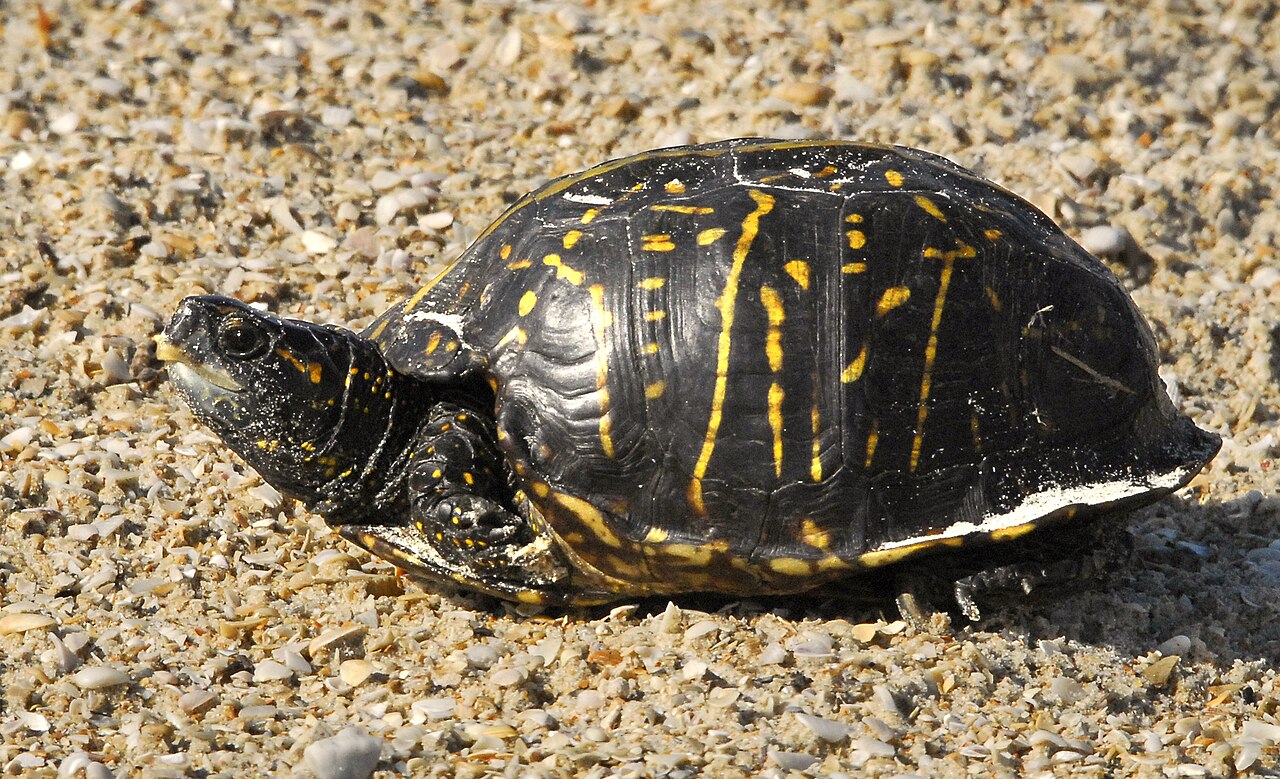
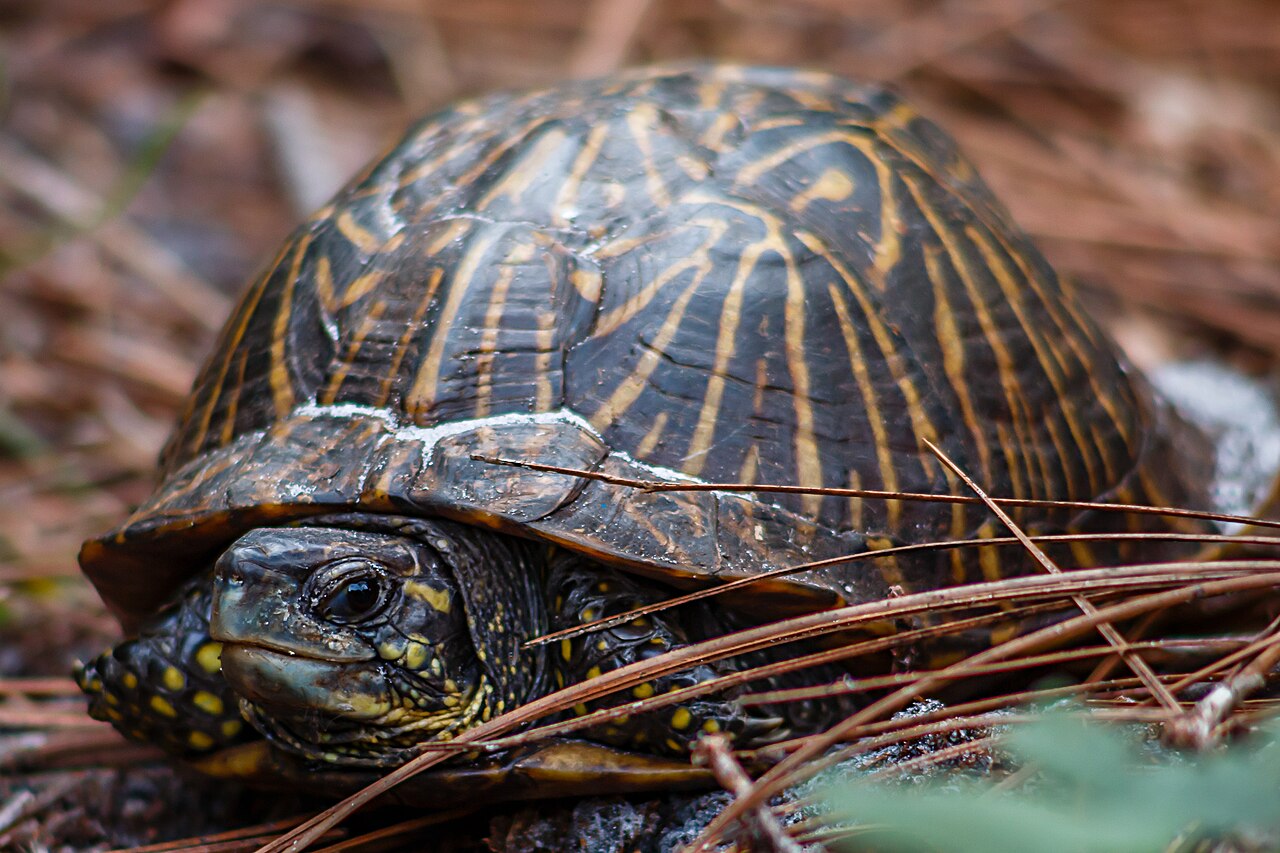
The Florida box turtle (Terrapene carolina bauri) is a small subspecies of the eastern box turtle found only in peninsular Florida and the Keys, recognizable by the bright yellow radiating lines on a high-domed dark shell and two yellow stripes on each side of the head. Adults stay under 6 inches (15 cm), making it the smallest of the four US box turtle subspecies.
It is also the subspecies most often picked up by people who find one crossing a driveway, which raises the legal question immediately: in Florida, taking a box turtle from the wild is prohibited. This guide covers identification, range, diet, lifespan, the pet question, and what the law actually says, along with the behavior that makes these turtles so frequently encountered and so poorly understood.
Florida box turtles reach 4.5 to 6 inches (11 to 15 cm) in shell length, live 40 to 80 years in the wild, and eat a mixed diet of insects, snails, mushrooms, and fruit. They are not endangered but are declining, and Florida law prohibits collecting them from the wild for any purpose.
| Trait | Florida Box Turtle |
|---|---|
| Scientific name | Terrapene carolina bauri |
| Adult shell length | 4.5 to 6 in (11 to 15 cm) |
| Weight | 8 to 14 oz (230 to 400 g) |
| Lifespan | 40 to 80 years, some past 100 |
| Range | Peninsular Florida and the Florida Keys |
| Clutch size | 2 to 5 eggs, 1 to 2 clutches per year |
| Legal status | Collection prohibited in Florida |
How big does a Florida box turtle get?
Adults measure 4.5 to 6 inches (11 to 15 cm) along the upper shell and weigh 8 to 14 ounces (230 to 400 g). That makes Terrapene carolina bauri the smallest and most slender of the four recognized box turtle subspecies in the United States.
Growth is slow and front-loaded. A hatchling emerges at about 1.2 inches (3 cm), roughly the size of a quarter, and needs five to seven years to reach adult size and sexual maturity. After that, shell growth nearly stops, which is why a 20 year old and a 60 year old turtle look much the same.
Males and females are close in size, with males averaging slightly smaller. The reliable sex differences are elsewhere: males have red or orange irises, a concave plastron, and a thicker tail, while females have yellow-brown irises and a flat plastron.
How do you identify a Florida box turtle?
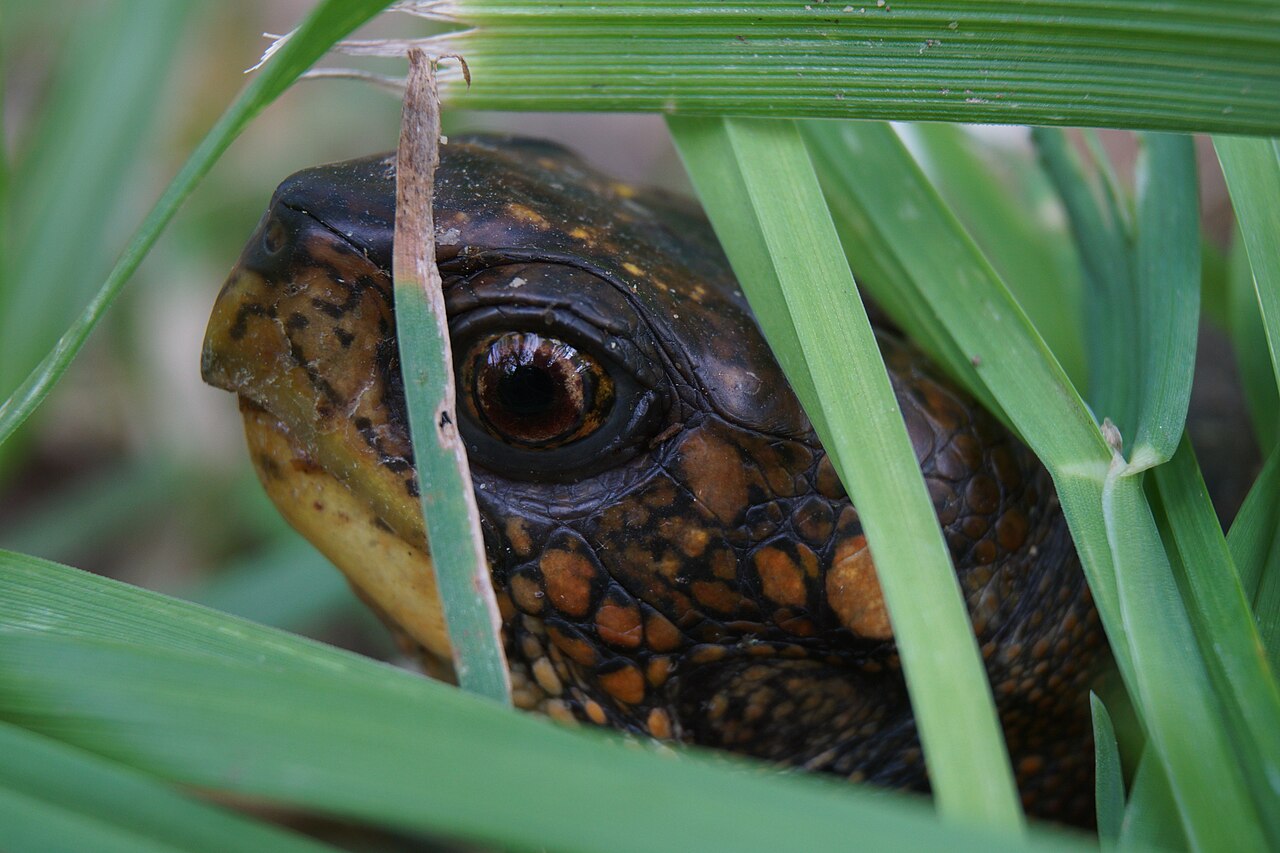
Look for narrow yellow lines radiating outward across each scute of a steeply domed, dark brown to black shell, and two distinct yellow stripes running along each side of the head. That head striping is the single most reliable field mark and separates bauri from every other box turtle in the country.
The shell shape is the second clue. Florida box turtles have a taller, narrower carapace than their northern relatives, often with a slight keel down the midline. The yellow pattern is finer and more linear, where the eastern box turtle shows broader, blotchier orange and yellow markings on a lower, wider shell.
Like all box turtles, this species has a hinged plastron that lets it close its shell completely, front and back. No other North American turtle can seal itself in this way, which is the quickest way to rule out a young gopher tortoise or a wandering eastern mud turtle at a glance.
Where do Florida box turtles live?
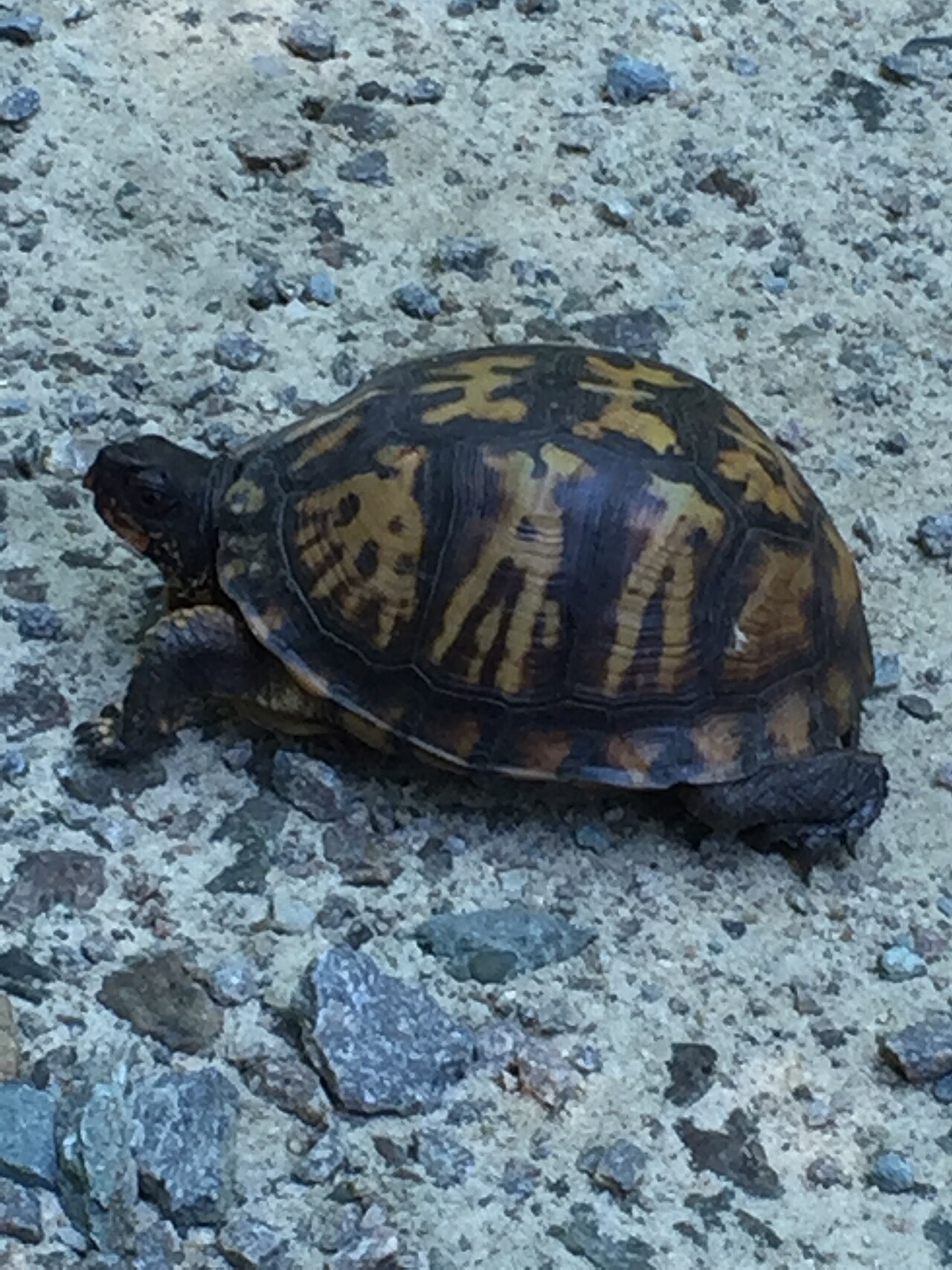
The subspecies occupies peninsular Florida from roughly the Georgia line south through the Keys, with a hybrid zone in the panhandle and north Florida where it intergrades with the eastern box turtle. It is the only box turtle found in the southern half of the state.
Habitat is moist and vegetated rather than dry. Florida box turtles favor hardwood hammocks, pine flatwoods with dense understory, marsh edges, and the moist margins of swamps. They need access to shallow water and leaf litter, and they avoid open sandy scrub where gopher tortoises thrive.
Home ranges are small, typically 2 to 5 acres, and individuals use them for life. This is why relocating a box turtle is so damaging: moved animals wander persistently trying to return, cross more roads, and frequently die within a year.
What do Florida box turtles eat?
They are true omnivores with a seasonal shift. Juveniles eat mostly animal matter, while adults take a roughly even mix of invertebrates, fungi, and plant material depending on what is available.
The animal portion includes earthworms, slugs, snails, beetles, grasshoppers, millipedes, and carrion. The plant portion is heavy on fallen fruit, especially saw palmetto berries, blackberries, and mulberries, plus tender greens and flowers. Mushrooms are a notable part of the diet, including species toxic to humans, which box turtles process without harm.
Feeding happens mostly in the morning and after rain, when invertebrates come to the surface. A box turtle sitting in the open on a humid morning after an overnight shower is foraging, not lost, and is best left alone.
Are Florida box turtles rare?
They are not rare in the sense of being formally endangered, but they are declining steadily and are far less common than they were 50 years ago. The IUCN lists the eastern box turtle species as Vulnerable, and Florida populations have thinned noticeably in developed regions.
Three pressures drive the decline. Habitat fragmentation cuts the small home ranges into pieces separated by roads; road mortality removes adults, the age class a slow-breeding species can least afford to lose; and collection for the pet trade, though now illegal, removed enormous numbers through the 1990s.
The demographic problem is structural. A female may lay only a few eggs per year, hatchling survival is very low, and replacement of a single breeding adult takes the better part of a decade. A population can look healthy while quietly failing to replace itself, because the adults you see may be 40 years old with no recruitment behind them.
Can I keep a Florida box turtle as a pet?
Not one taken from the wild. Florida Fish and Wildlife Conservation Commission rules prohibit the collection of box turtles from the wild, a measure introduced in 2018 in response to commercial poaching for overseas markets. Possession of wild-caught animals is not permitted regardless of how they were acquired.
Captive-bred box turtles from licensed breeders occupy a different legal position in many states, but they remain demanding animals. They need a large outdoor enclosure with deep leaf litter, humidity control, a shallow soaking pool, natural sunlight or full-spectrum UVB, and a commitment measured in decades rather than years.
The honest assessment is that box turtles make poor pets and excellent neighbors. They do not tolerate handling well, they hide constantly when kept indoors, and they carry a lifespan that outlasts most households. A backyard managed with leaf litter, native plants, and no pesticides supports them better than any enclosure.
Can I keep a box turtle I found in my yard?
No, and the ecological reason is stronger than the legal one. A box turtle in your yard is already inside its home range, a territory it has mapped over years and will not voluntarily leave. Taking it into captivity removes a breeding adult from a population that cannot easily replace it.
Turtles held for even a few weeks and then released often fail to resettle. They lose condition, may pick up pathogens from captive animals, and resume the same restless wandering seen in relocated individuals. The shelled equivalent of a lost dog does not exist; a box turtle in the open is where it means to be.
The one exception is an injured animal. A turtle hit by a car or attacked by a dog should go to a licensed wildlife rehabilitator, not into a box in the garage. Shell fractures heal remarkably well with professional treatment, and rehabilitated turtles are released at the exact site where they were found.
In what states are box turtles illegal to collect?
Most of the eastern United States now restricts or prohibits collection. Florida, Georgia, North Carolina, Virginia, Maryland, New York, New Jersey, Connecticut, Massachusetts, Michigan, Illinois, Indiana, and Ohio all limit taking box turtles from the wild, with several imposing outright bans.
The rules vary in form. Some states allow possession of a single animal acquired before a cutoff date, others require documented captive-bred origin, and several prohibit transport across state lines entirely. International trade is regulated under CITES Appendix II, which is what drove the wave of state-level protections after commercial export surged.
Check the current regulation in your own state before acquiring any box turtle, including from a breeder. The legal picture has tightened repeatedly over the past decade, and a rule that was permissive in 2015 may not be now.
What is the average lifespan of a Florida box turtle?
Forty to eighty years is the normal range in the wild, and verified individuals have passed 100. Box turtles are among the longest-lived reptiles in North America, and their slow, low-output reproduction is the evolutionary counterpart to that longevity.
Age estimation is imprecise after the first decade. Growth rings on the scutes are countable in young turtles but wear smooth and stop forming reliably once growth slows, so a turtle with a polished, featureless shell is simply old rather than any specific age.
Captive lifespans are usually shorter, not longer. Metabolic bone disease from inadequate UVB, respiratory infections from dry enclosures, and shell rot from poor substrate are common, and few captive box turtles reach the ages their wild counterparts routinely do. Hatchlings face the opposite problem; baby box turtles have very low survival rates in the wild and are almost never seen.
How bad does a box turtle bite hurt?
A Florida box turtle bite is a firm pinch that rarely breaks skin on an adult human. They have no teeth, using a sharp keratin beak instead, and the jaw strength of a 6 inch turtle is modest compared with a snapping turtle or even an adult painted turtle.
Bites are also uncommon. Box turtles default to withdrawing and closing the shell rather than defending themselves, which is precisely what the hinged plastron is for. A bite usually means the animal was handled roughly, cornered, or mistook a finger for food during hand-feeding.
Wash any broken skin regardless. Reptiles commonly carry Salmonella in their digestive tracts, and handwashing after any contact with a turtle, bite or not, is the standard precaution recommended by public health agencies.
Where do box turtles go at night and in winter?
At night, Florida box turtles form a shallow depression called a form, usually under leaf litter, in dense grass, or beneath a fallen log, and remain there until morning. The same site may be used repeatedly over a season.
Winter behavior depends on latitude. In north Florida, box turtles brumate through the coldest weeks, burying into leaf litter and loose soil a few inches deep and becoming inactive. In south Florida and the Keys, winters are mild enough that activity continues year round with only brief cold-weather pauses. The full seasonal picture is covered in our guide to turtle hibernation and brumation.
Summer heat triggers the opposite response. During dry, hot spells, box turtles retreat into mud, shallow water, or deep shade and reduce activity, emerging chiefly after rain. Anyone who tracks Florida backyard wildlife will notice the same pattern: activity concentrates in the hours after a storm.
Related reading: Florida Softshell Turtle.
Frequently Asked Questions
Can I keep a Florida box turtle as a pet?
Not one taken from the wild. Florida prohibits collecting box turtles from the wild, a rule tightened in 2018 after commercial poaching. Captive-bred animals from licensed breeders are treated differently in some states, but they need large outdoor enclosures and a commitment spanning decades.
Are Florida box turtles rare?
They are not formally endangered but are declining across their range. Road mortality, habitat fragmentation, and past collection for the pet trade have thinned populations, and the species reproduces too slowly to recover quickly. The IUCN lists eastern box turtles as Vulnerable.
How big does a Florida box turtle get?
Adults reach 4.5 to 6 inches (11 to 15 cm) in shell length and weigh 8 to 14 ounces. That makes it the smallest of the four US box turtle subspecies. Full size is reached at five to seven years, after which growth nearly stops.
How bad does a box turtle bite hurt?
It is a firm pinch that seldom breaks adult skin. Box turtles have no teeth, only a keratin beak, and they prefer closing their shell to biting. Wash any broken skin, since reptiles can carry Salmonella in their digestive tracts.
Can box turtles bond with humans?
They learn to associate a specific person with food and will approach that person, which is recognition rather than attachment. Long-term captives often lose fear entirely. There is no evidence of the social bonding seen in mammals, and most box turtles remain stressed by handling.
Where do box turtles go at night?
They settle into a shallow scrape called a form, hidden under leaf litter, dense grass, or a fallen log, and stay put until morning. The same resting spot is often reused. Box turtles are strictly daytime foragers and are most active after rain.
For current protections, range data, and conservation status of North American turtles, the US Fish and Wildlife Service publishes species profiles and the federal rules that govern interstate and international trade.