Bullfrog Tadpole: Size, Stages, and Time to Frog
A bullfrog tadpole is the largest tadpole in North America and the slowest to grow up. Where a wood frog tadpole is done in eight weeks, an American bullfrog (Lithobates catesbeianus) tadpole commonly spends one to three years in the water before it grows legs, reaching 4 to 6 inches (10 to 15 cm) long in the meantime.
That long larval stage is the reason ponds hold big olive tadpoles all winter, and it is also the reason bullfrog tadpoles are sold as pond stock and classroom animals. Buyers often expect a frog in a month and get a fish-sized larva that eats algae for two years instead.
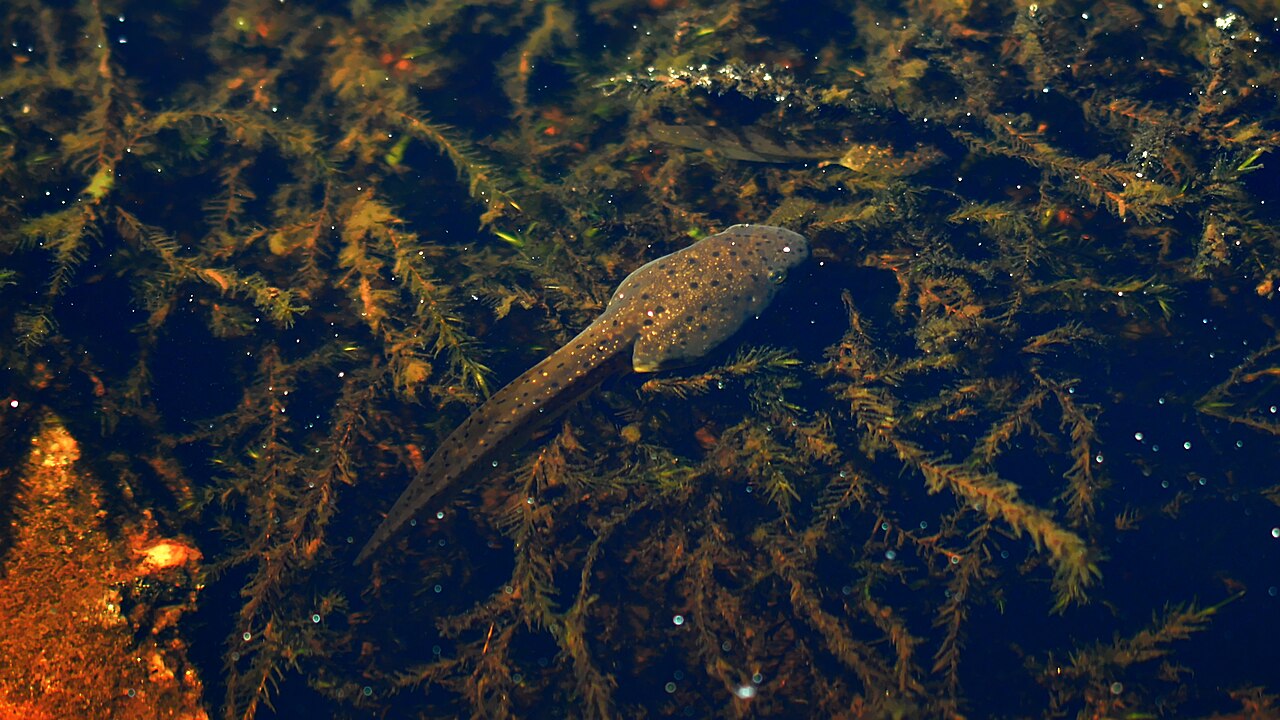
A bullfrog tadpole takes 1 to 3 years to become a frog, depending on water temperature and latitude, and grows to 4 to 6 inches (10 to 15 cm) before metamorphosis. It is olive green with fine black speckling, a pale belly and a broad tail fin, and it feeds mainly on algae and detritus.
| Quick fact | Bullfrog tadpole |
|---|---|
| Species | American bullfrog, Lithobates catesbeianus |
| Maximum length | 4 to 6 in (10 to 15 cm) including tail |
| Time to metamorphosis | 1 year in the South, 2 to 3 years in the North |
| Color | Olive to dark green, fine black speckles, cream belly |
| Diet | Algae, detritus, plant matter, occasional carrion |
| Overwinters as tadpole | Yes, under ice in most of the range |
How Long Does It Take a Bullfrog Tadpole to Turn Into a Frog?
A bullfrog tadpole takes one to three years to turn into a frog, and the number depends almost entirely on how warm and how long the growing season is. In Florida and along the Gulf Coast, a tadpole hatched in spring can metamorphose the following summer. In Michigan, Maine or southern Canada, two to three winters underwater is normal.
The sequence is slow and visible. Hind legs appear first, then front legs emerge through the skin, the mouth widens into a frog mouth, and the tail is absorbed as a nutrient source rather than shed. During tail absorption the animal does not feed at all, which lasts roughly a week.
Food supply matters as much as temperature. A crowded pond with thin algae growth stretches the timeline, while a warm, productive pond with few competitors shortens it. Tadpoles from the same clutch often metamorphose a full year apart.
How Big Does a Bullfrog Tadpole Get?
A bullfrog tadpole gets to 4 to 6 inches (10 to 15 cm) total length, with the largest recorded specimens near 7 inches (18 cm). Body alone is roughly 1.5 to 2 inches (4 to 5 cm), and the rest is a deep, muscular tail fin that makes the animal look more like a small fish than a larva.
That size is diagnostic on its own. No other North American frog or toad produces a tadpole anywhere near this large, so a tadpole longer than 3 inches (7.5 cm) in a US pond is almost certainly a bullfrog or the closely related green frog, which tops out smaller.
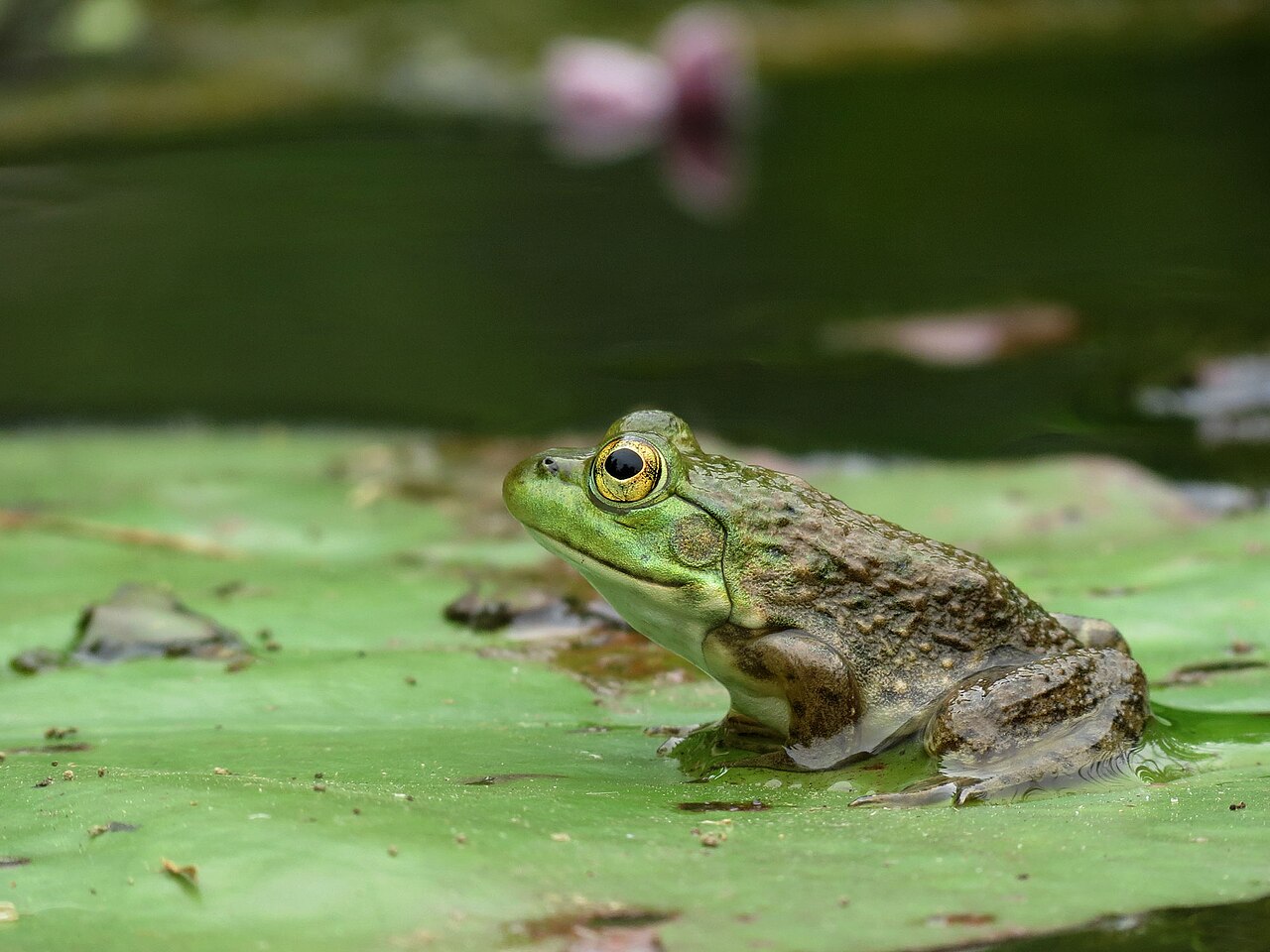
Size at metamorphosis does not track size as a tadpole neatly. A big tadpole shrinks noticeably as it converts, and a 5 inch (13 cm) larva typically leaves the water as a froglet under 2 inches (5 cm) snout to vent, which then grows into the adult described in our guide to the bullfrog call.
How to Identify a Bullfrog Tadpole
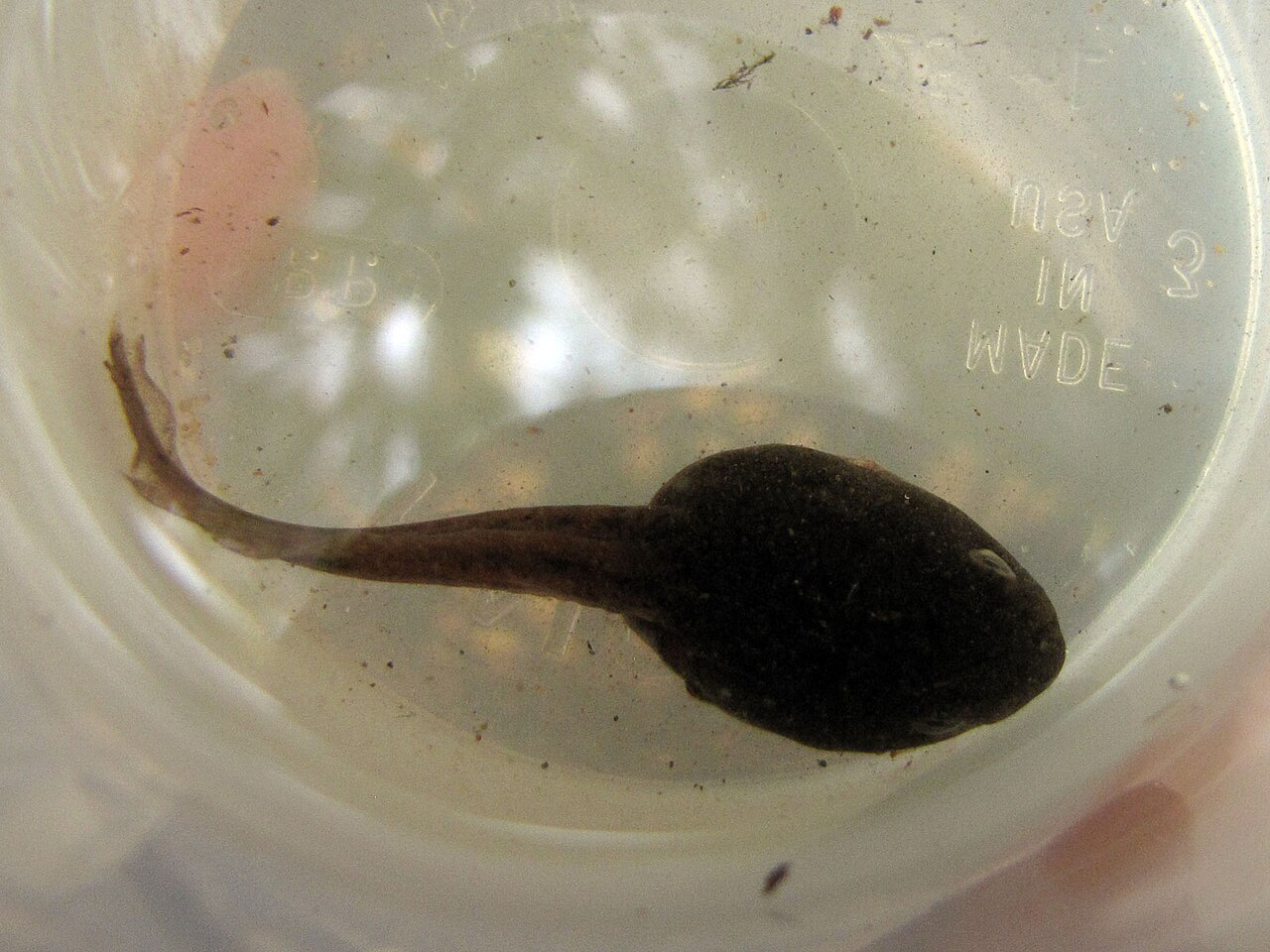
Color comes first: olive to dark green above, sprinkled with distinct small black dots, and a cream or yellowish belly that can look faintly iridescent. Green frog tadpoles look similar but are smaller and their spotting is less crisp, and both differ clearly from the dark, uniformly blackish toad tadpoles that swarm shallows in spring.
Shape is the second clue. Bullfrog tadpoles have a broad, rounded body and a tall tail fin that begins well forward on the back, with a bluntly pointed tip. The spiracle, the small breathing opening, sits on the left side. Eyes are set on top of the head rather than on the margins.
Behavior helps too. These tadpoles graze surfaces in open water and along the bottom rather than hiding constantly, and large ones are conspicuous. They share ponds with basking natives such as the eastern painted turtle, which readily eats the small ones.
What Bullfrog Tadpoles Eat
Bullfrog tadpoles are mainly herbivores and detritivores. They rasp algae off rocks, logs and plant stems with rows of tiny keratin teeth, and they filter suspended organic matter and consume decaying plant material on the pond bottom. In a healthy pond this makes them effective algae grazers.
They are not strict vegetarians. Large tadpoles scavenge dead fish and insects, take frog eggs including their own species, and in crowded conditions will nip at smaller tadpoles. Protein intake speeds growth, which is one reason tadpoles in nutrient-rich water metamorphose sooner.
In captivity the standard diet is boiled leafy greens, algae wafers, spirulina flakes and a sinking pellet, with a pinch of fish food for protein twice a week. The broader feeding picture for larval frogs is covered in our article on what tadpoles eat.
Can You Keep a Bullfrog Tadpole as a Pet?
You can keep a bullfrog tadpole as a pet, but it is a multi-year project that ends with a frog the size of a dinner plate’s center. One tadpole needs at least 10 gallons (38 L) of clean, dechlorinated, filtered water at 65 to 78 F (18 to 26 C), with gentle flow and regular partial water changes.
The critical detail is the exit ramp. Once hind legs appear, the animal must be able to climb out or it drowns during metamorphosis, since developing lungs replace the gills. A sloping rock, a floating platform or a half-filled tank with a land section solves it.
After metamorphosis the diet switches entirely to live prey, the adult reaches 3.5 to 6 inches (9 to 15 cm) body length, and it needs a large semi-aquatic enclosure for a decade. Keepers who want a big frog without the two-year wait usually go for an African bullfrog instead.
Where Can I Get Bullfrog Tadpoles?
Bullfrog tadpoles are sold by pond supply companies, biological supply houses that serve schools, and online live-animal vendors, usually shipped overnight in insulated bags by the dozen. Prices typically run 2 to 6 USD per tadpole, with bulk lots for pond stocking priced lower per animal.
Collecting from a local pond is legal in many states with a fishing license, but rules differ and some states restrict amphibian collection entirely. Check your state wildlife agency first, and never move tadpoles between watersheds: that is how ranavirus and chytrid fungus spread.
The bigger caution is geography. American bullfrogs are invasive across the western United States and much of the world, where they eat native frogs, fish and hatchling turtles. The USGS tracks their spread at usgs.gov. West of the Rockies, do not buy, release or keep them outdoors. Native alternatives such as the red-eyed tree frog pose no such risk since they cannot establish outside the tropics.
Frequently Asked Questions
Can you buy tadpoles at Petsmart or Petco?
Neither chain reliably stocks tadpoles, and most locations carry no amphibian larvae at all. Occasional stores sell African dwarf frogs or adult aquatic frogs instead. For bullfrog tadpoles specifically, pond supply retailers, biological supply companies and dedicated online amphibian vendors are the realistic sources.
How much do bullfrog tadpoles cost?
Expect 2 to 6 USD each from live-animal vendors, dropping toward 1 to 2 USD per animal in bulk lots of 25 or more intended for pond stocking. Overnight shipping usually adds 25 to 45 USD per order regardless of quantity, which makes small orders expensive per tadpole.
Can I buy live tadpoles online?
Yes, and online is the main source. Vendors ship overnight in insulated containers with oxygenated water. Order in mild weather, have the tank cycled and at temperature before arrival, and acclimate slowly by floating the bag. Confirm the seller ships legally into your state, since several western states prohibit bullfrog imports.
Why is my bullfrog tadpole not turning into a frog?
It is probably just young. Bullfrog tadpoles routinely spend one to three years as larvae, and cold water slows that further. Check that temperature sits in the 70s F (21 to 26 C) during the growing season and that food is plentiful. A tadpole that overwinters without changing is behaving normally, not failing.
Do bullfrog tadpoles survive winter under ice?
They do, across most of the species range. Tadpoles settle into bottom sediment and leaf litter, metabolism slows to a crawl, and they take in dissolved oxygen through skin and gills. As long as the pond does not freeze to the bottom and some oxygen exchange continues, they resume feeding in spring.