Blue Moth: 7 Species You Can Actually Find in the US
A blue moth is almost never truly blue. Moth scales produce pigment browns and whites easily and structural blues very rarely, so most blue moth sightings in the United States turn out to be a metallic blue body under dark wings, a blue sheen in direct sun, or a blue band hidden on the hindwing. Seven species account for nearly all of it, and none of them will hurt you.
That matters for identification, because the question “what is this blue moth” usually has a precise answer once you know where to look for the color. Danger first, then the seven species by the part of the animal that actually carries the blue, then the butterflies and tropical species that get mistaken for them.
No North American moth has fully blue wings. The blue in a blue moth sighting comes from an iridescent body, as in the giant leopard moth and Virginia ctenucha, from a blue gray wing wash in the bluish spring moth, or from a hidden hindwing band in the underwings. All are harmless to touch.
| Species | Wingspan | Where the blue is | Range | Flight season |
|---|---|---|---|---|
| Bluish spring moth | 0.8 in (20 mm) | Blue gray wash across the wings | Northeast and Great Lakes | May to June |
| Giant leopard moth | 3 in (76 mm) | Metallic blue abdomen | East of the Plains | May to September |
| Virginia ctenucha | 1.8 in (45 mm) | Iridescent blue body | Northeast, upper Midwest | June to August |
| Faithful beauty | 2 in (50 mm) | Blue black wings with white | South Florida only | Year round |
| Eight-spotted forester | 1.3 in (33 mm) | Blue black ground color | Eastern US | April to June |
| Underwing moths | 2 to 3 in (50 to 76 mm) | Band on the hidden hindwing | Widespread | July to October |
Why true blue moths are so rare
Blue in insects is usually structural rather than pigmented. The color comes from microscopic ridges on the scale surface that scatter short wavelengths, the same mechanism that makes a jay feather blue, and it is metabolically expensive to build. Butterflies that fly by day get a return on that investment because they use color to find mates in bright light. Most moths fly at night, where color signals nothing.
Moths that do carry blue are therefore the exceptions that behave like butterflies: day fliers, warningly colored species that want to be seen, or species where the blue sits on the body rather than the wing surface. That is the practical rule for identification. If a moth looks blue in daylight, check the abdomen first.
Are blue moths dangerous or poisonous?

No blue moth in the United States is dangerous to handle. Adult moths have no sting, no bite worth the name, and no venom. The scales rub off on your fingers and can irritate sensitive skin or eyes, which is the whole of the risk. Species with bright blue and red warning colors are advertising a bad taste to birds, not a threat to people.
The caterpillars deserve more care than the adults. Giant leopard moth larvae are black bristly woolly bears with red rings, and the bristles can cause mild irritation rather than a true sting, while unrelated stinging caterpillars like the saddleback and the puss caterpillar do have venomous spines. Handle any unfamiliar caterpillar with a leaf, not a finger.
Bluish spring moth: the one US moth named for blue

The bluish spring moth (Lomographa semiclarata) is the only common North American moth whose English name points at the color. It is small, about 0.8 in (20 mm) across, with chalky white wings crossed by dark gray bands and a distinct cool blue gray cast that shows best in flat shade. It belongs to the geometrid family, so it rests with wings spread flat.
Look for it in May and June in the Northeast, the Great Lakes region, and southern Canada, flying in the afternoon along woodland edges and in shrubby clearings. The larvae feed on woody plants including cherry and other shrubs. People usually find it on a porch wall and assume it is a worn white moth until the light shifts.
Giant leopard moth: black rings over a metallic blue body
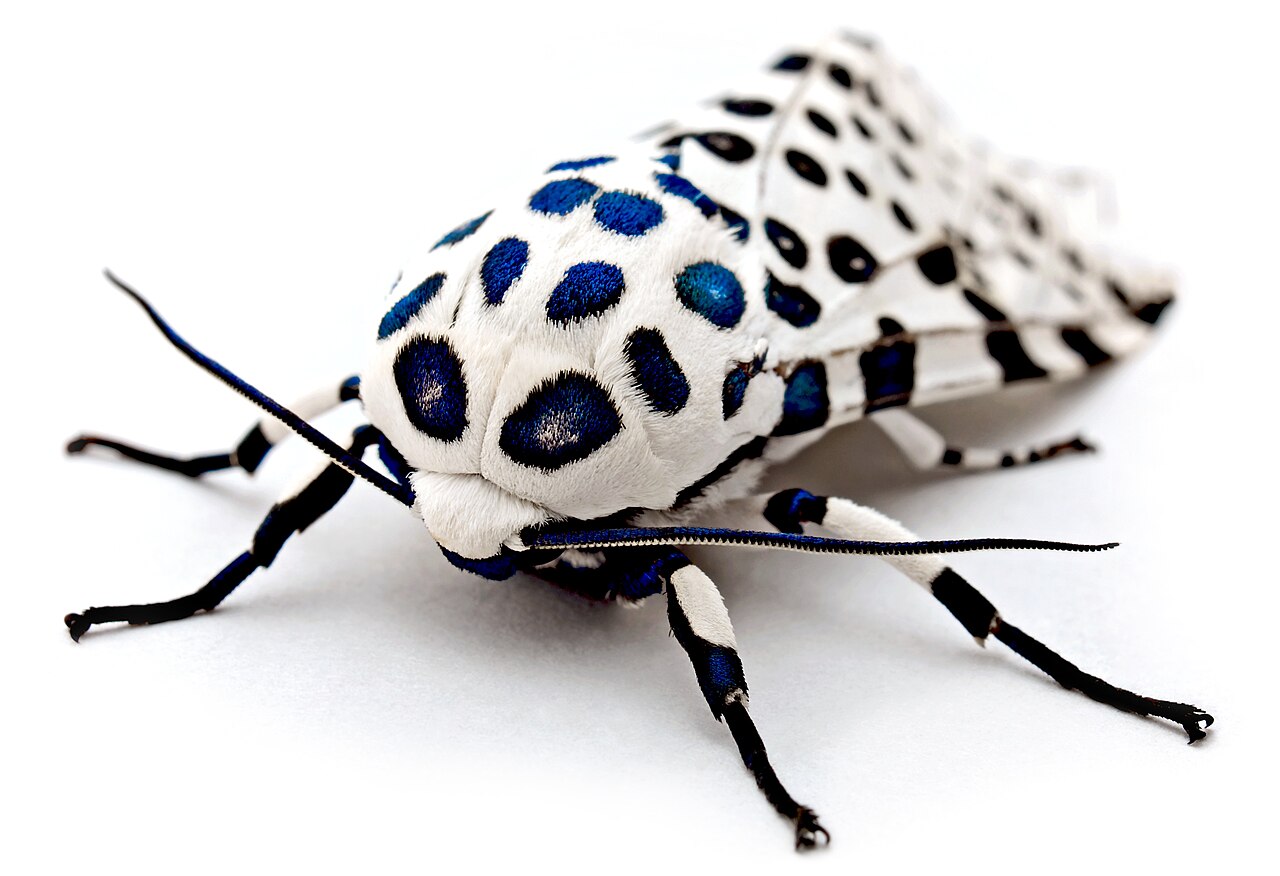
The giant leopard moth (Hypercompe scribonia) is the species behind most “blue moth” photographs from the eastern United States. The wings are bright white with hollow black rings and solid black dots, a pattern that reads as spotted rather than blue, but lift the wings and the abdomen is a deep iridescent blue with orange and black markings along the top.
It is large at up to 3 in (76 mm), flies from May into September, and comes readily to porch lights across the East. When threatened it curls and shows the blue abdomen while releasing a bitter yellow fluid. The ring and dot pattern is also why it gets filed with the species in our black and white moth guide.
Virginia ctenucha: metallic blue with an orange head
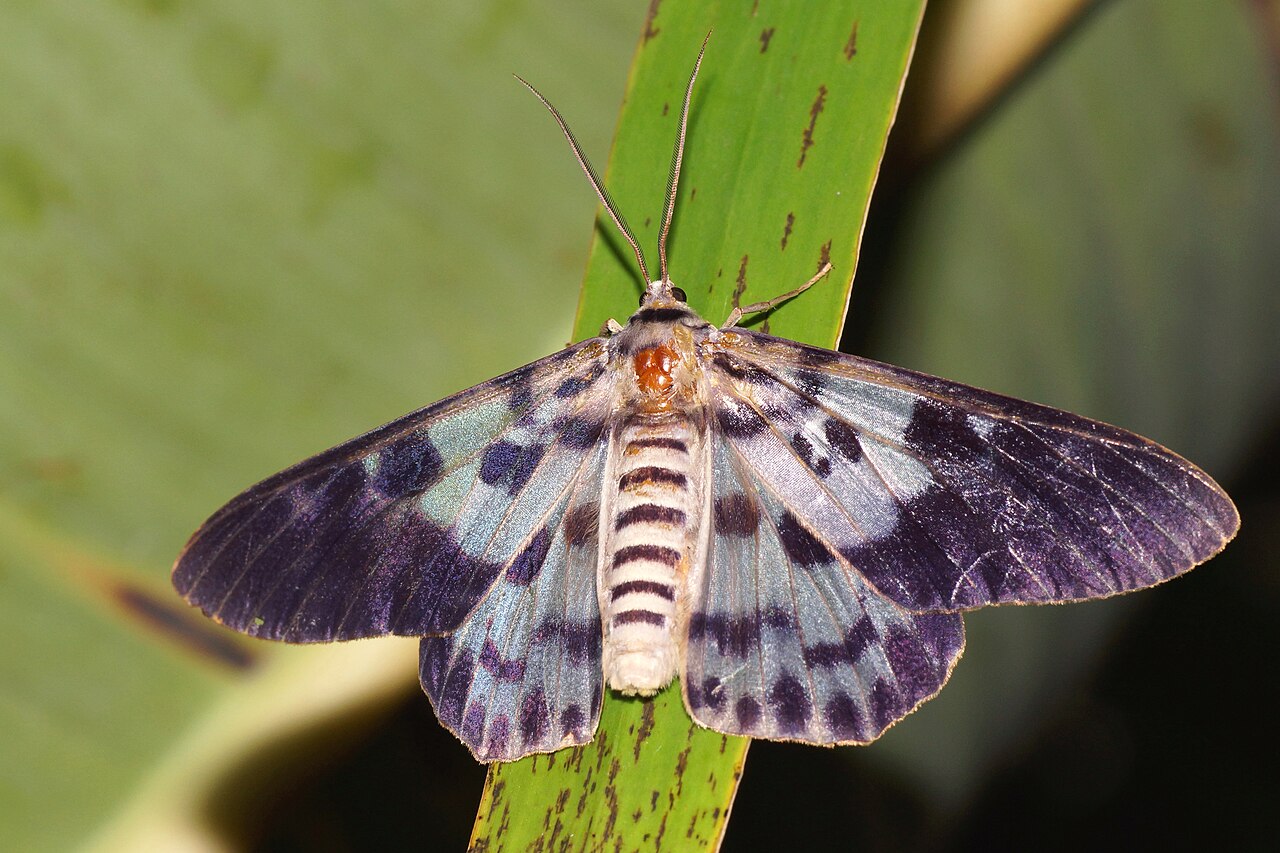
The Virginia ctenucha (Ctenucha virginica) looks like a wasp at first glance and like a blue moth on the second. The body is strongly iridescent blue, the head and the collar behind it are bright orange, and the narrow wings are smoky brown with a pale fringe. Wingspan runs to about 1.8 in (45 mm).
This is a day flier, which is why people meet it on flowers instead of on a window screen. Peak season is June through August across the Northeast and upper Midwest, usually in damp meadows and roadside grassland where the larvae feed on grasses and sedges. The combination of blue body, orange head, and daytime nectar feeding is diagnostic.
Faithful beauty: Florida’s blue and red day flier
The faithful beauty (Composia fidelissima) is the closest thing to a genuinely blue moth in the United States, and it is confined to the far south of Florida and the Keys. The wings are glossy blue black, scattered with white spots, with red at the wing bases and on the body. It flies by day, slowly and conspicuously, in the manner of a toxic species.
That slowness is the point. The larvae feed on devil’s potato and related vines in the dogbane family, and the adults carry the resulting bitter compounds, so they advertise rather than hide. Sightings run year round in frost free areas. North of Miami Dade County, a blue and red day flier is far more likely to be a butterfly.
Eight-spotted forester: blue black with pale patches
The eight-spotted forester (Alypia octomaculata) is a small day flying moth with a blue black ground color, two pale yellow patches on each forewing, two white patches on each hindwing, and bright orange tufts on its front legs. At about 1.3 in (33 mm) it is often reported as a blue butterfly because of the hovering flight and the orange leg scales.
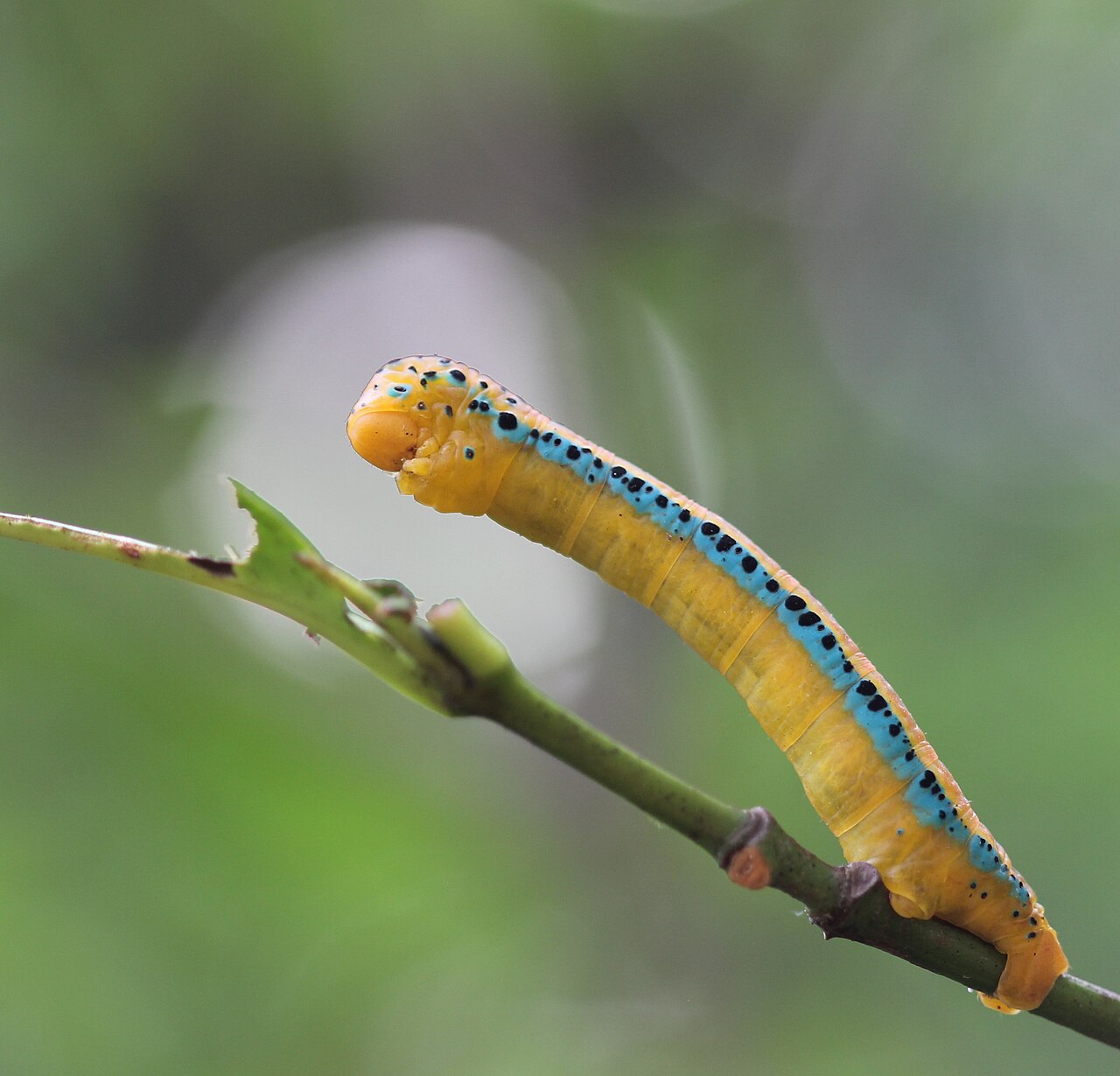
It appears early, from April into June, across the eastern United States wherever grape and Virginia creeper grow, since those vines are the larval hosts. Gardeners meet it most often on spring flowers. The caterpillar is banded in white, black, and orange, which puts it near the species collected in our blue caterpillar guide.
Blue underwings: the blue is on the hindwing
Underwing moths (genus Catocala) rest on bark with camouflaged gray forewings covering a brightly banded hindwing, and they flash it to startle a predator. The famous blue banded species is the Clifden nonpareil (Catocala fraxini) of Europe and Asia, which has no North American counterpart; the roughly 100 US underwings run to red, orange, yellow, and black and white bands instead.
The reason they belong in this list is that a startled underwing in flight produces a brief flash of banded color that observers often record as blue, especially in the white and black species at dusk. They fly from July into October, come to light and to bait, and are among the largest moths on a summer porch at 2 to 3 in (50 to 76 mm).
Blue tiger moth: probably not a US sighting
Search results for blue moths are dominated by the blue tiger moth, and that name does not belong to any species in the United States. It is used for day flying Asian moths in the genus Dysphania, which are large, boldly patterned in blue green and black, and common in India and Southeast Asia. Photographs of them circulate widely without a location.
The name also collides with the blue tiger butterfly (Tirumala limniace), an Asian milkweed butterfly with pale blue streaks on black. If an image search result looks nothing like anything in your yard, check the source country before trying to match it. For a North American sighting, work through the six species in the table instead.
Blue moths vs blue butterflies
Most true blue scaled insects in the United States are butterflies, not moths. The eastern tailed blue, spring azure, and the various hairstreaks are small and genuinely blue above, and the tropical blue morpho that appears in every image search is a butterfly as well. The species list is in our blue butterfly guide, and the dark patterned ones in our black and blue butterfly guide.
Three features separate the groups in the field. Butterflies have clubbed antennae, moths have feathered or thread like ones. Butterflies rest with wings closed above the back, most moths rest flat or tented. Butterflies fly by day; the blue moths on this list that fly by day are the exceptions that prove the rule.
Where and when to look for blue moths
Timing splits by species. For the day fliers, work flowers in sun: goldenrod and milkweed in July and August for the Virginia ctenucha, spring blooms near grape vines in April and May for the eight-spotted forester, woodland edges in May and June for the bluish spring moth. Bring nothing but a camera, since all three are approachable while feeding.
For the night fliers, a white sheet and a light left on until midnight will bring in giant leopard moths and underwings from May onward. Warm, humid, moonless nights produce the most. Other blue bodied insects arrive at the same lights, including the species covered in our blue dragonfly guide and the metallic blue flies that appear by day.
What it means when you see a blue moth
Ecologically, a blue bodied moth on your porch usually means mature trees and undisturbed ground nearby. Giant leopard moths need broadleaf weeds and shrubs for their larvae, underwings need oak, hickory, or willow, and the ctenucha needs unmown grassland. A run of sightings across one summer is a sign the habitat around a property is working, not that something is wrong.
In symbolism, moths are read as messengers and as signals of transformation, and blue is traditionally tied to calm and to truth, so blue moth sightings get interpreted as a call to trust an intuition. That is folklore rather than biology. The practical reading is simpler: a blue moth in daylight is a species worth photographing, because most of them are uncommon enough that the record has value.
Frequently Asked Questions
What is the rarest type of moth?
Among US species, several are so restricted that they are federally listed, including the Blackburn’s sphinx moth of Hawaii and the Kern primrose sphinx moth of California. Globally, many moths are known from a single specimen. For a backyard observer, the rarest realistic find is a day flying species outside its mapped range.
What is the deadliest moth in the world?
No adult moth kills anyone. The dangerous stage is larval: the caterpillars of the South American giant silkworm moth (Lonomia obliqua) carry venom that interferes with blood clotting and has caused human deaths. In the United States the puss caterpillar and the saddleback caterpillar deliver painful stings but are not lethal.
Why shouldn’t you touch moths?
Handling rubs scales off the wings, and a moth that has lost enough of them flies poorly and loses waterproofing. The scales can also irritate your eyes and skin. It is not that the moth will harm you; it is that a few seconds of contact can shorten a life that may last only a week.
Can I touch a harnessed tiger moth?
Yes, it is harmless. The harnessed tiger moth (Apantesis phalerata) has cream striped black forewings and pink hindwings, no sting, and no venom. Let it walk onto a leaf or a fingertip rather than pinching the wings. Its woolly bear caterpillar is bristly but not venomous, though the bristles can itch.
Are leopard moths harmful?
No. The giant leopard moth cannot bite or sting, and its bitter defensive fluid is aimed at birds. The caterpillar is a black woolly bear with red rings that curls into a ball when touched; the bristles may irritate skin but inject nothing. Neither stage damages gardens in any meaningful way.
What does it mean if you see a tiger moth?
Biologically it means a healthy patch of weedy host plants, since most tiger moth larvae feed on plantain, dandelion, and similar low growth. In folklore the bold black and red pattern is read as a warning or a reminder to pay attention. Many tiger moths also jam bat sonar with ultrasonic clicks, which is the more interesting fact.
Sources: Smithsonian Institution maintains the national Lepidoptera collections and species records used for North American moth identification.