Black Eyed Tree Frog: Size, Price, Care and Red Eyed Comparison
The black eyed tree frog is a leaf green Central American frog, Agalychnis moreletii, named for the solid dark iris that sets it apart from its famous red eyed cousin. It is nocturnal, arboreal, about the length of a thumb, and it is one of the few frogs in the US pet trade that is easier to find captive-bred than wild.
Most of what turns up in a search for this species is a sales listing, a video or a forum post, which leaves the basic questions unanswered: how big it gets, what it sounds like, whether it is poisonous, what it costs and whether it is legal to keep. Here are those answers, species by species and number by number.
The black eyed tree frog (Agalychnis moreletii), also called Morelet’s tree frog or the black-eyed leaf frog, is a 2 to 3 in (50 to 80 mm) nocturnal tree frog from Mexico through Honduras. It is not poisonous or venomous, lives 5 to 8 years in captivity, and costs roughly 50 to 120 USD captive-bred.
| Trait | Black eyed tree frog |
|---|---|
| Scientific name | Agalychnis moreletii |
| Other names | Morelet’s tree frog, black-eyed leaf frog |
| Adult size | Males 1.9 to 2.4 in (48 to 60 mm), females 2.4 to 3.1 in (60 to 80 mm) |
| Range | Southern Mexico, Belize, Guatemala, El Salvador, Honduras |
| Lifespan | 5 to 8 years captive, up to 10 reported |
| Toxicity | Not poisonous, not venomous |
| Price | 50 to 120 USD captive-bred juvenile |
What Is a Black Eyed Tree Frog?
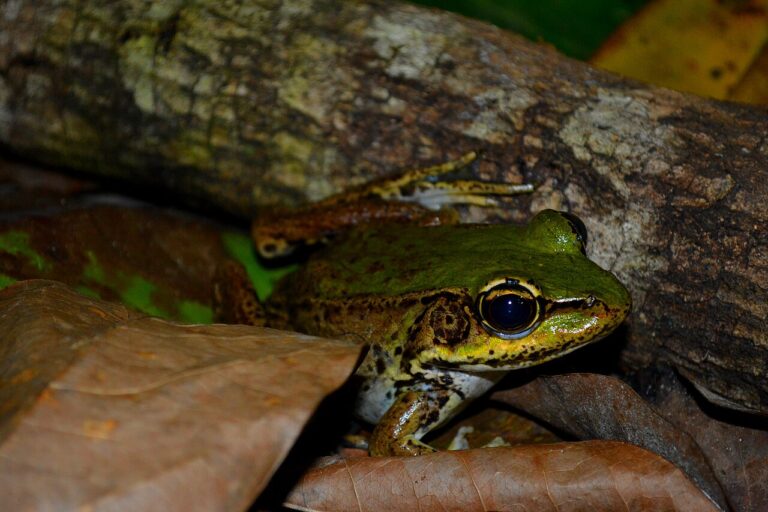
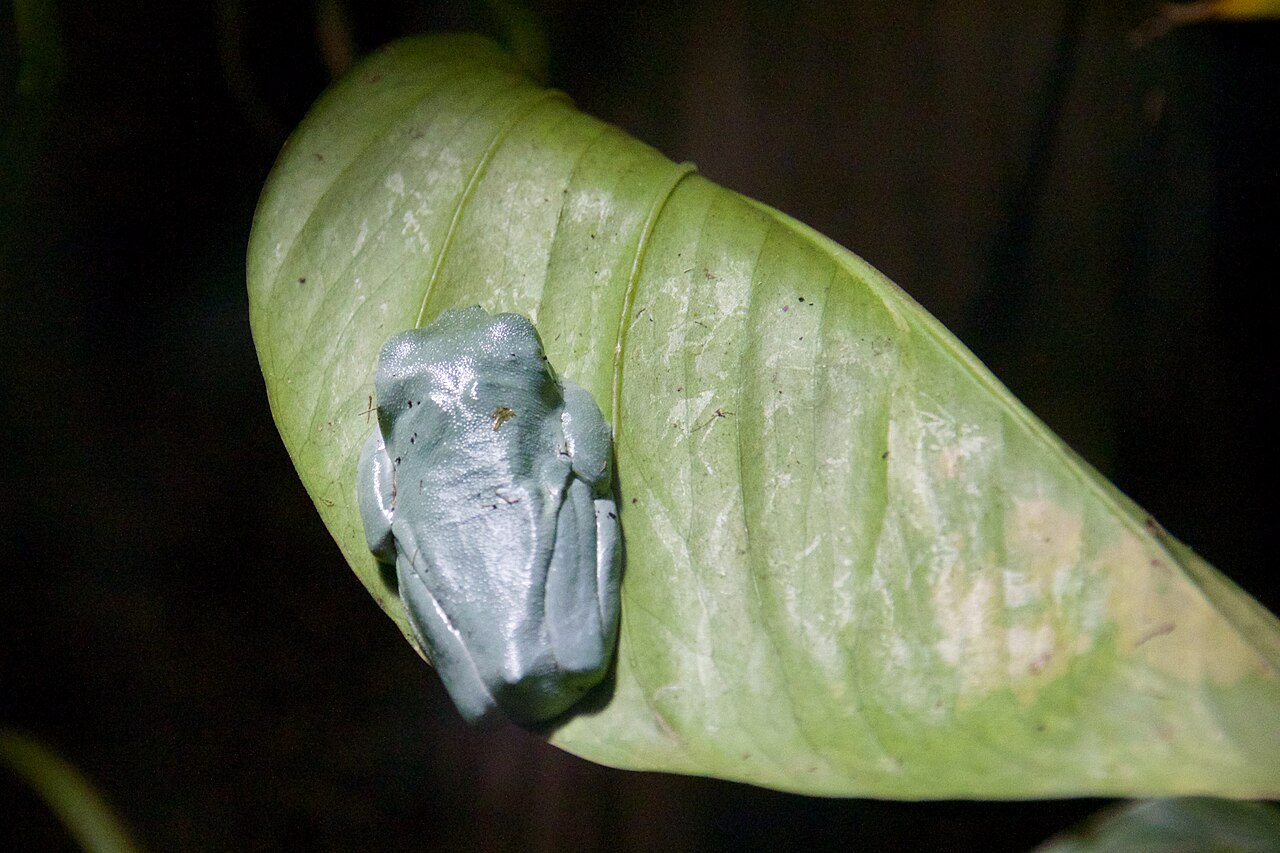
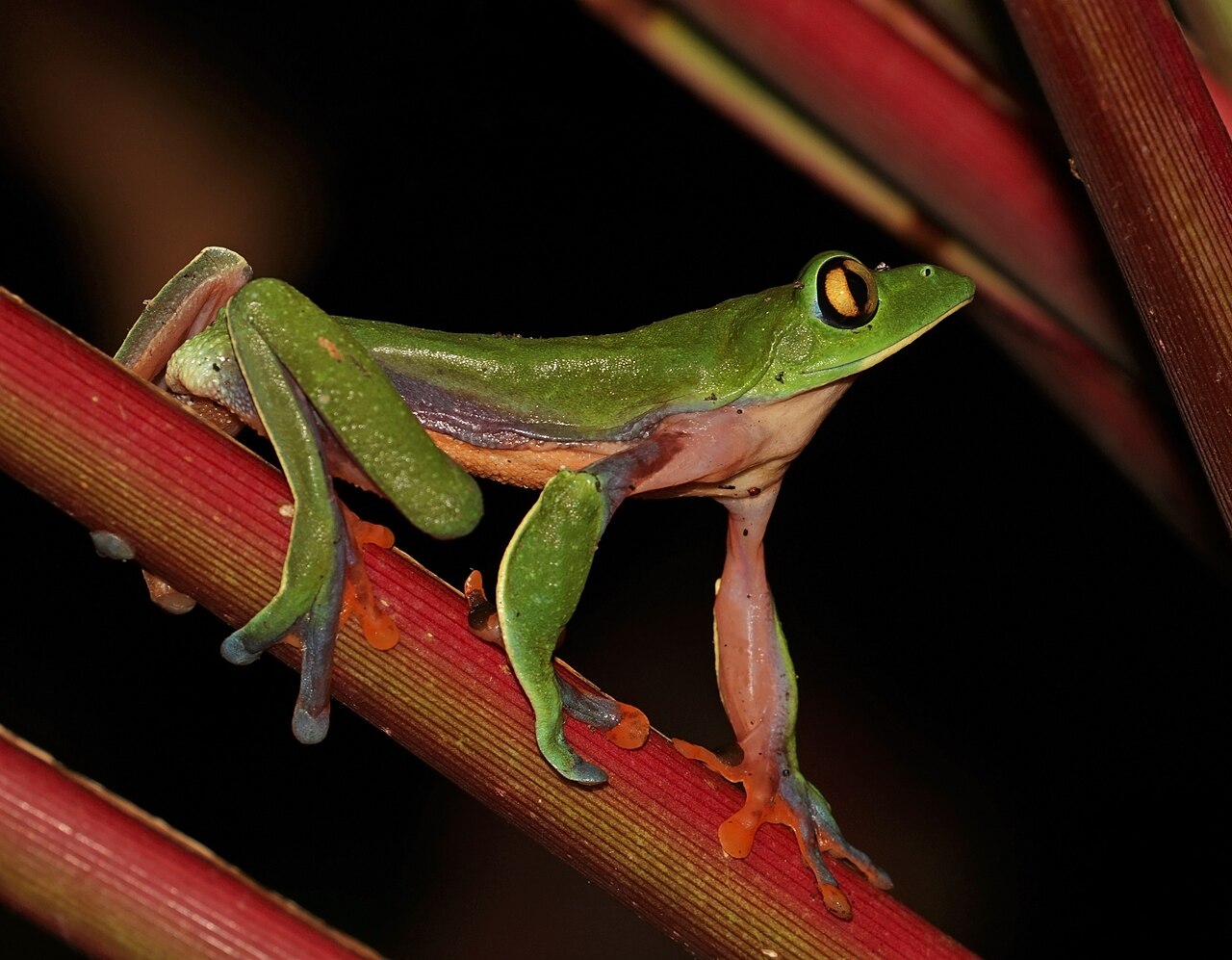
The black eyed tree frog is a member of the leaf frog family Phyllomedusidae, the same group that produces the red eyed tree frog and the golden eyed tree frog. The back is a flat leaf green, sometimes with scattered white flecks. The flanks, the inner thighs and the webbing between the toes shade from cream through orange to purplish brown, and the belly is plain white. The eye is the giveaway: a dark brown to black iris with no red, orange or gold ring.
Like other leaf frogs it walks rather than hops, gripping branches with opposable toes and moving hand over hand. By day it tucks its limbs under its body on the underside of a leaf and disappears. Everything interesting happens between dusk and about two in the morning.
Black Eyed Tree Frog vs Red Eyed Tree Frog
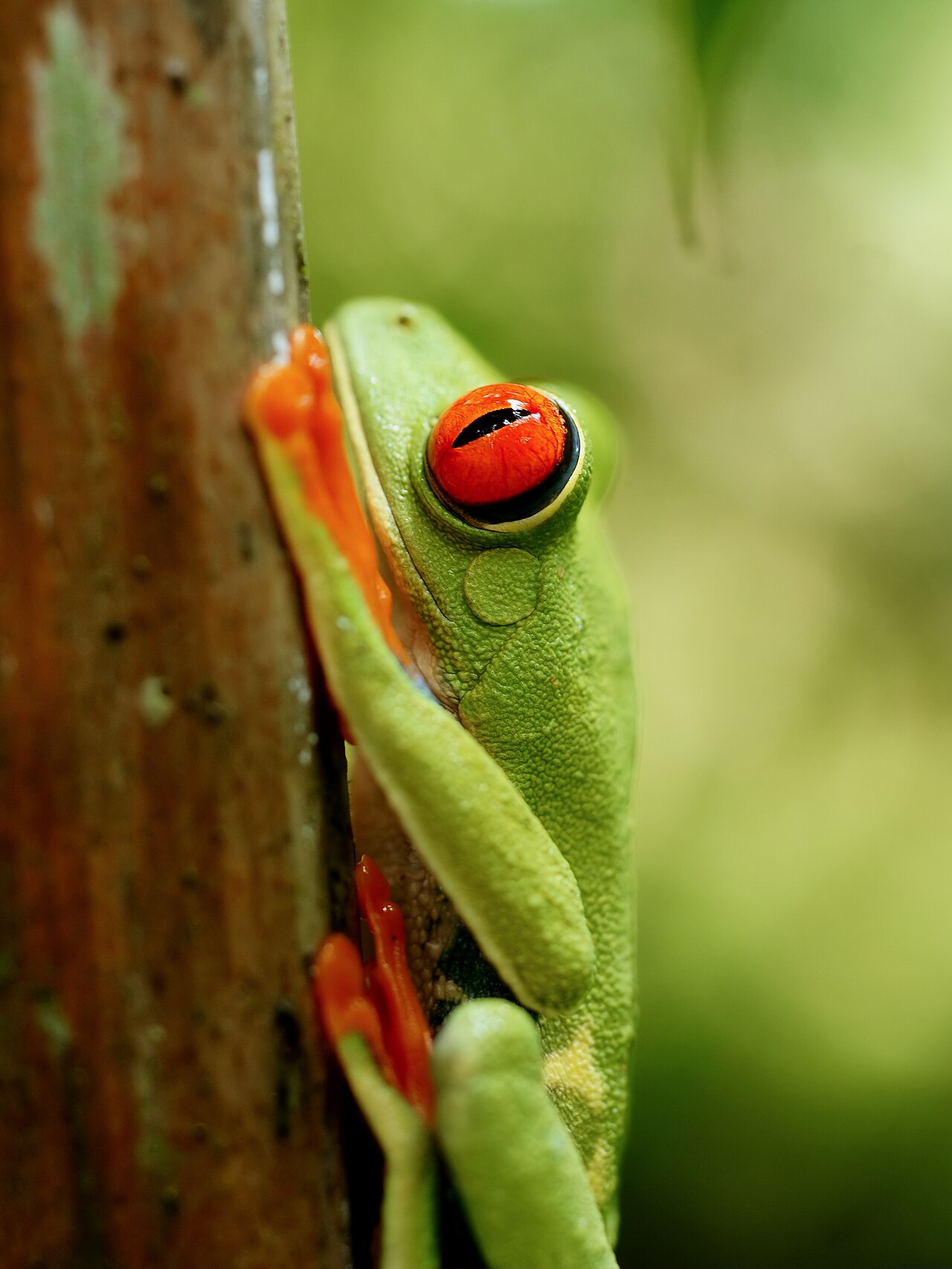
The two are close relatives and frequently confused in listings, so the comparison is worth making precisely. The red eyed tree frog, Agalychnis callidryas, has a crimson iris, bright blue and yellow bars on its flanks and orange feet. The black eyed tree frog has a dark iris, muted orange to purple flanks without the bold barring, and a slightly stockier build.
Range separates them too. A. callidryas runs from southern Mexico to Colombia and is overwhelmingly a lowland animal, while A. moreletii keeps to the northern part of that range and climbs much higher into wet montane forest. In a terrarium the black eyed species is the calmer of the two and slightly more forgiving of cool nights.
How Big Does a Black Eyed Tree Frog Get?
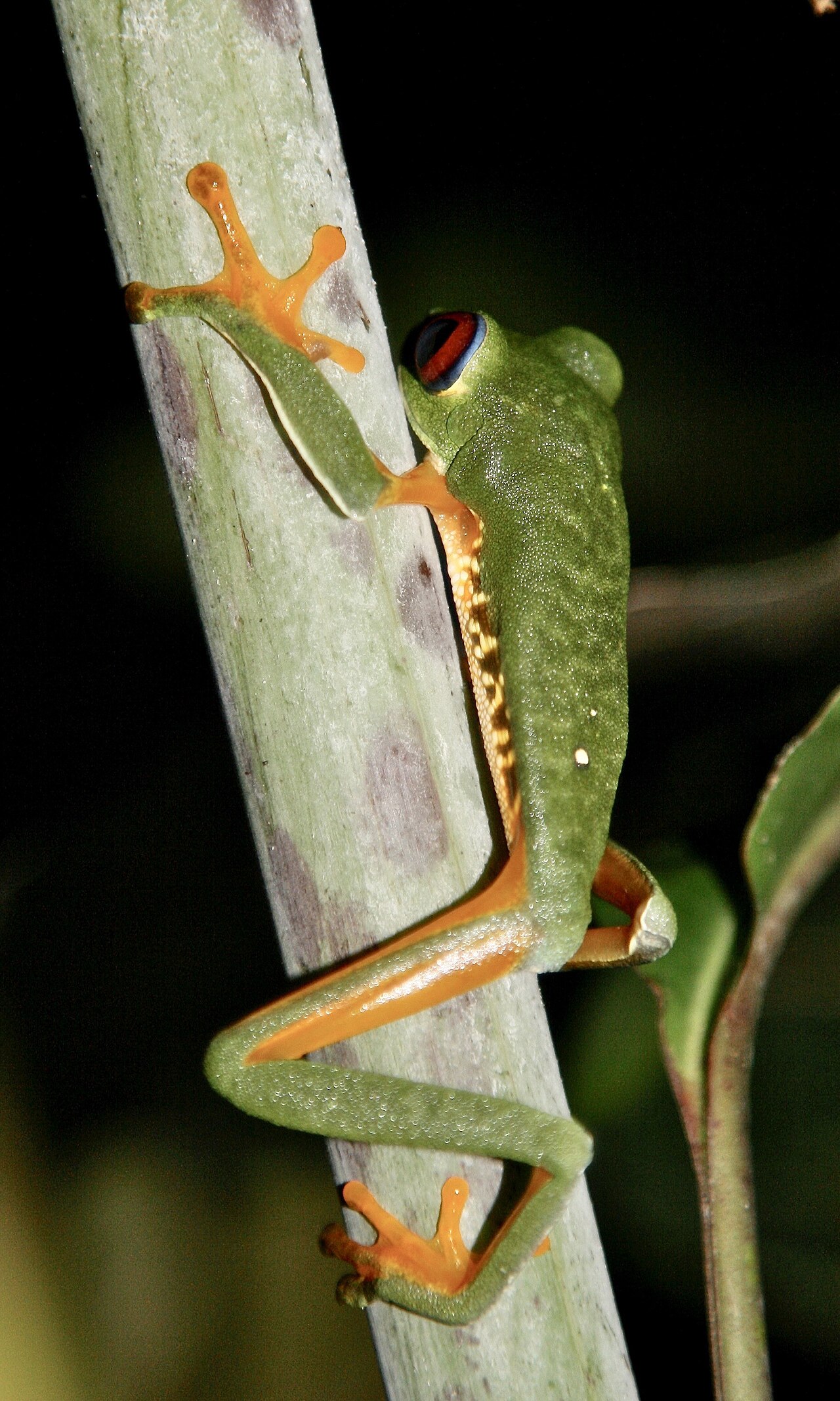
Females reach 2.4 to 3.1 in (60 to 80 mm) snout to vent, males 1.9 to 2.4 in (48 to 60 mm). The size gap is large enough that a paired adult female looks like a different animal next to her mate, which is the easiest way to sex them without handling. Weight for an adult female sits around 0.5 oz (14 g).
That puts the species at the upper end of what counts as a medium tree frog: bigger than a glass frog, smaller than a White’s tree frog. Juveniles sold at 0.8 in (20 mm) triple in length over roughly 8 to 12 months on a good feeding schedule, and growth then slows sharply.
Where Black Eyed Tree Frogs Live in the Wild
The species occupies the Atlantic and Pacific slopes of Central America from Veracruz and Guerrero in Mexico south through Belize, Guatemala and El Salvador into Honduras. It uses humid lowland forest, cloud forest and the edges of coffee plantations, roughly from 650 to 6,500 ft (200 to 2,000 m), and it needs standing water nearby for breeding.
Breeding sites are small: a forest pool, a flooded ditch, a cattle pond with overhanging vegetation. Adults spend the dry months high in the canopy and descend when the rains start, which is why field surveys in the same valley can find dozens of frogs one month and none the next. Nothing in that cycle resembles the way temperate frogs shut down for winter.
What Does a Black Eyed Tree Frog Sound Like?

Males produce a short, low, wooden cluck, usually written as a single wok or a doubled wok wok, repeated every few seconds from a perch a few feet above water. It is quieter and blunter than the sharp chack of a red eyed tree frog and carries less far. A large chorus after heavy rain sounds like knuckles rapping on hollow wood rather than the shrill trill people expect from a tree frog.
In a home terrarium a healthy male will call at night, particularly after a heavy misting or a drop in barometric pressure. It is not loud enough to carry through a closed door. For comparison across species, see our guide to tree frog sounds and what each call means.
Is a Black Eyed Tree Frog Poisonous or Venomous?
No. The black eyed tree frog is neither poisonous nor venomous, and neither is the red eyed tree frog. Is a red-eyed tree frog poisonous or venomous is one of the most searched questions about the whole family, and the answer for every Agalychnis is the same: their skin secretions contain mild peptides that irritate some predators and have no effect on human skin. There is no venom, because frogs have no fangs or spines to inject with.
That is a different situation from the poison dart frogs of the same forests, which sequester genuinely dangerous alkaloids from wild prey. Leaf frogs do not. The only real health concern is bacterial: wash your hands after any contact with the animal or its water.
Can You Touch a Black Eyed Tree Frog?
Can you touch a red-eyed tree frog, or a black eyed one, without hurting it? Briefly and with clean, wet hands, yes. Routinely, no. Amphibian skin absorbs whatever is on your fingers, so soap residue, hand sanitizer, lotion and salt all pass into the bloodstream of an animal that weighs half an ounce. Handling also strips the protective mucus layer and raises stress hormones for hours afterward.
The working rule among keepers is to move frogs with a clean deli cup during cleaning and otherwise leave them alone. If a frog has to be held, rinse your hands in dechlorinated water first, keep the contact under a minute, and stay low over a soft surface, because a startled leaf frog leaps hard.
Can You Have a Black Eyed Tree Frog as a Pet, and Is It Legal?
Can you have a black-eyed tree frog as a pet? Yes, and captive-bred stock is widely available in the US from specialist amphibian breeders. All Agalychnis species have been on CITES Appendix II since 2010, which regulates international trade rather than private ownership, so a legitimate seller can document where the animals came from.
Is it illegal to own a red-eyed tree frog is the same question with the same answer: legal federally, legal in most states, and worth checking against local exotic animal ordinances before you buy. A handful of jurisdictions restrict amphibians broadly. Wild-caught imports are the part to avoid, both because of chytrid and because the wild populations of this species have already been through one collapse.
Black Eyed Tree Frog Price
Captive-bred juveniles sell for roughly 50 to 120 USD each in the US, with adults and proven pairs from 150 USD upward. Specialist breeders price higher than general reptile shops and are usually the better source, because they can tell you the clutch date and the parents.
How much is a red-eyed tree frog from Petco is a common companion question, and the answer there is about 30 to 50 USD, since that species is bred in far greater volume. Budget for the enclosure rather than the frog: a planted 18 x 18 x 24 in vertical terrarium with lighting, misting and a feeder culture runs 250 to 450 USD before the animal arrives.
Terrarium Setup, Temperature and Humidity
A single adult needs a vertical enclosure of at least 18 x 18 x 24 in (45 x 45 x 60 cm), planted with broad-leaved plants such as pothos and bromeliads that give it flat surfaces to sleep on. Keep daytime temperatures at 75 to 82 F (24 to 28 C) and let nights fall to 65 to 72 F (18 to 22 C); that drop matters and is the most commonly skipped part of the setup.
Humidity should sit at 60 to 80 percent with real airflow, which means a screen top and a misting cycle rather than a sealed box. Provide a shallow water dish of dechlorinated water, a low-output UVB bulb at 2.0 to 5.0, and a 12 hour light cycle. Unlike a Pacman frog, this species uses vertical space almost exclusively and barely touches the floor.
What Black Eyed Tree Frogs Eat
Adults eat live insects: appropriately sized crickets, dubia roaches, small hornworms and the occasional moth. Feed adults every two to three days, juveniles daily, and offer as much as the frog clears in about 15 minutes. Dust prey with a calcium and D3 supplement at most feedings and a multivitamin once a week, since metabolic bone disease is the classic slow-motion failure in captive leaf frogs.
Prey size is the rule that keeps frogs alive: nothing wider than the space between the frog’s eyes. Wild diet is broader and includes flies, beetles, spiders and small moths taken off foliage, all hunted by sight with a short lunge rather than a long tongue strike.
Black Eyed Tree Frog Lifespan, Breeding and Conservation Status
Captive black eyed tree frogs live 5 to 8 years, with individual records near 10. Wild lifespan is not well documented and is probably closer to 3 to 5 years given predation. Breeding follows the rains from about May to October: females carry males to a leaf over water and lay 50 to 75 eggs in a jelly mass, the eggs hatch in 6 to 8 days, and the tadpoles drop into the pool below and metamorphose in 60 to 80 days.
Conservation status is where sources disagree and it is worth saying so. The species was listed as Critically Endangered in 2004 after steep chytrid-linked declines in Mexico and Guatemala, and later assessments and field reports describe partial recovery in several areas, so the label you find depends on which assessment you are reading. The US Geological Survey tracks the amphibian chytrid fungus behind those declines.
Related reading: Black Salamander.
Frequently Asked Questions
Are red-eyed tree frogs friendly?
Not in the sense people mean. Red eyed and black eyed tree frogs tolerate a keeper’s presence and will hunt in front of you, but neither seeks contact and both find handling stressful. They are display animals that reward watching. A frog sitting calmly on a leaf at eye level is comfortable, not affectionate.
What is the friendliest pet frog?
White’s tree frog, by common agreement: it is slow, bold, tolerant of short handling sessions and often waits at the glass. Tomato frogs come second for hardiness. Leaf frogs like the black eyed tree frog sit further down that list, since they are fast, nocturnal and best left untouched.
What is the most aggressive frog?
The African bullfrog, Pyxicephalus adspersus, which will lunge at hands and swallow prey nearly its own size, with horned frogs a close second. Leaf frogs show none of this. Male black eyed tree frogs do wrestle over calling perches during the breeding season, but that is competition, not general aggression.
Is it good to have tree frogs in your yard?
Yes. Native tree frogs eat mosquitoes, moths and beetles, and a calling chorus is a sign that your yard still has clean standing water and insect life. Skip pesticides, keep a shallow water feature, and leave leaf litter in place. Never release a captive frog outdoors, since it can seed disease into local populations.
Do black eyed tree frogs need a heat lamp?
Usually not. Room temperatures of 72 to 78 F (22 to 26 C) suit them, and a low-wattage bulb or heat mat on the side of the enclosure is only needed if the room drops below about 68 F (20 C). Overheating kills leaf frogs faster than cold does, so always verify with a thermometer at frog height.
How many black eyed tree frogs can live together?
Two to four adults of similar size share an 18 x 18 x 24 in enclosure well, and a group calls more readily than a single male. Never mix them with other species, never house a much smaller frog with a larger one, and add 25 percent more floor and perch space per extra animal.