Southern Leopard Frog: How to Identify It and Is It Poisonous?
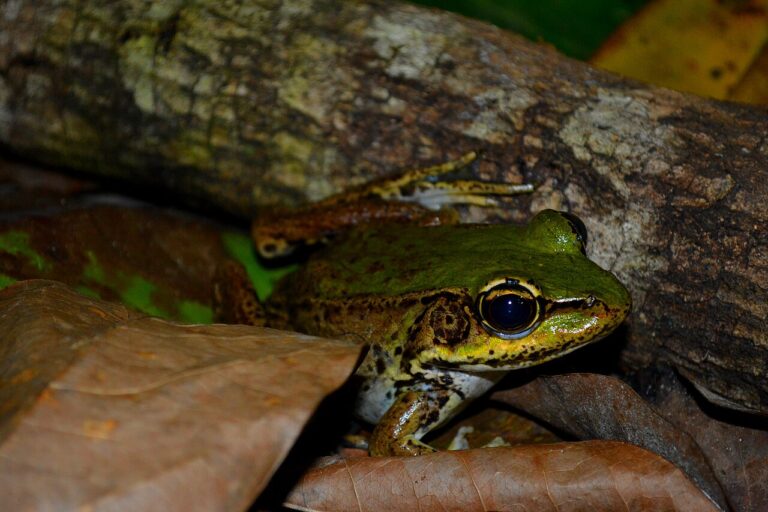
The southern leopard frog (Lithobates sphenocephalus) is a slender, sharp-nosed frog of the southeastern United States that is not poisonous and is completely safe to be around. It wears a green or brown coat scattered with dark, irregular spots, and it is one of the few North American frogs that tolerates slightly brackish water. If you hear what sounds like a person chuckling from a roadside ditch on a warm night, this is usually the animal making it.
Most people meet this frog in backyards, drainage ditches and flooded fields rather than in wilderness. It is common, adaptable and easy to identify once you know the one feature that separates it from its close relatives: a small pale dot in the middle of the eardrum.
The southern leopard frog is a medium, spotted frog measuring 2 to 3.5 in (5 to 9 cm) with a pointed snout, unbroken pale ridges down the back, and a light spot on the eardrum. It is not poisonous or venomous, it lives across the southeastern US, and its call sounds like a low chuckling laugh.
| Quick Facts | Southern Leopard Frog |
|---|---|
| Scientific name | Lithobates sphenocephalus (formerly Rana sphenocephala) |
| Size | 2 to 3.5 in (5 to 9 cm), females larger |
| Range | Southeastern US, from east Texas and Kansas to the Atlantic coast and Florida |
| Habitat | Shallow freshwater, ditches, marshes, floodplains, some brackish marsh |
| Call | Series of short chuckles, like a wet balloon being rubbed |
| Toxicity | Not poisonous, skin secretions are only mildly irritating |
| Lifespan | Around 5 years in the wild, longer in captivity |
Is a Southern Leopard Frog Poisonous?
No, a southern leopard frog is not poisonous, and it has no venom, fangs or toxic glands worth worrying about. Like all frogs it produces a thin mucus coating with mild antimicrobial compounds, but nothing in that coating will harm human skin. Are leopard frogs poisonous to touch? Not in any meaningful sense, though the film on the skin can sting if you rub your eyes afterward.
The real caution runs the other way. Amphibian skin absorbs whatever is on your hands, including soap residue, sunscreen, insect repellent and salts from sweat, so handling stresses the frog far more than it risks you. Frogs can also carry Salmonella, which is why wildlife agencies recommend washing your hands afterward.
How to Identify a Southern Leopard Frog
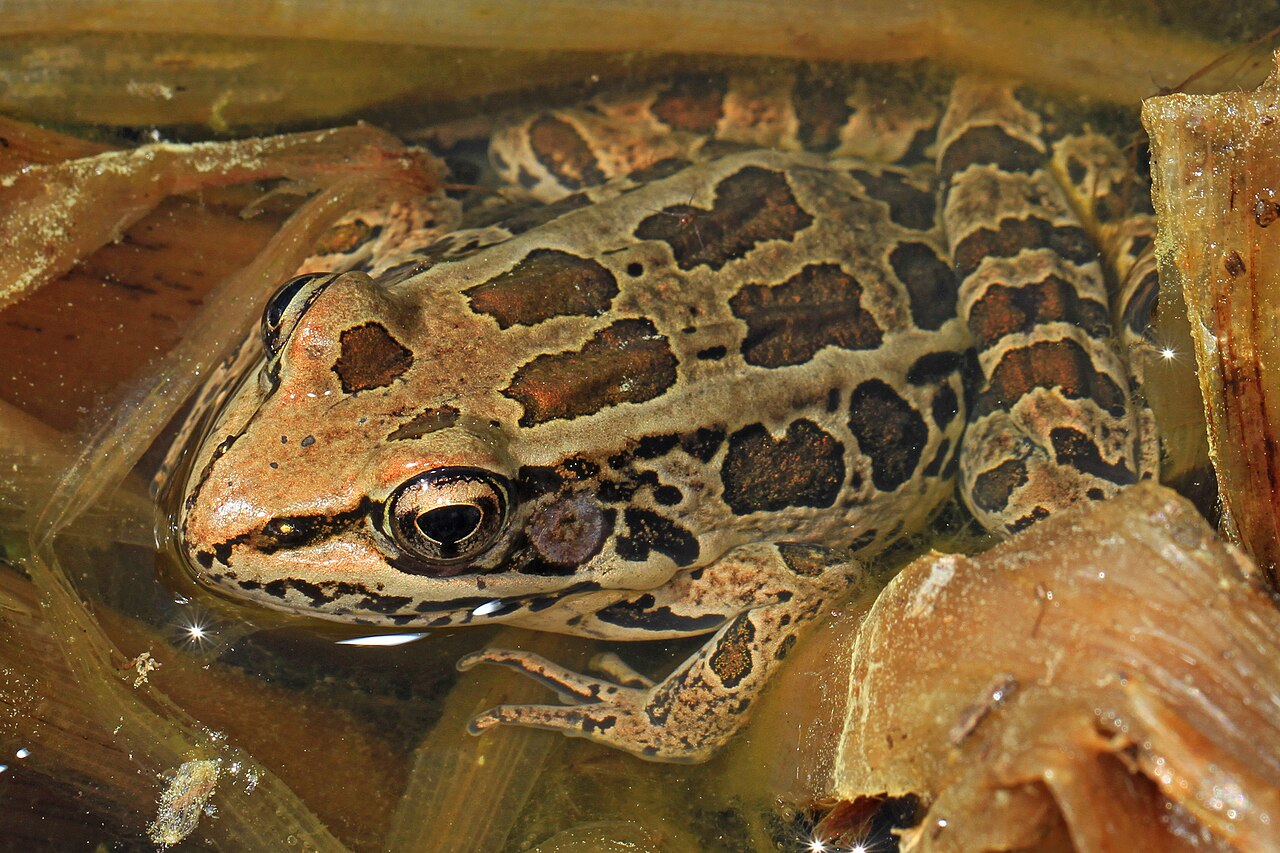
The giveaway is the head: a noticeably pointed snout and a small cream or white spot at the center of the round eardrum, a mark that other leopard frogs in the same range do not show. Behind the head, two pale ridges called dorsolateral folds run unbroken from the eye all the way to the groin.
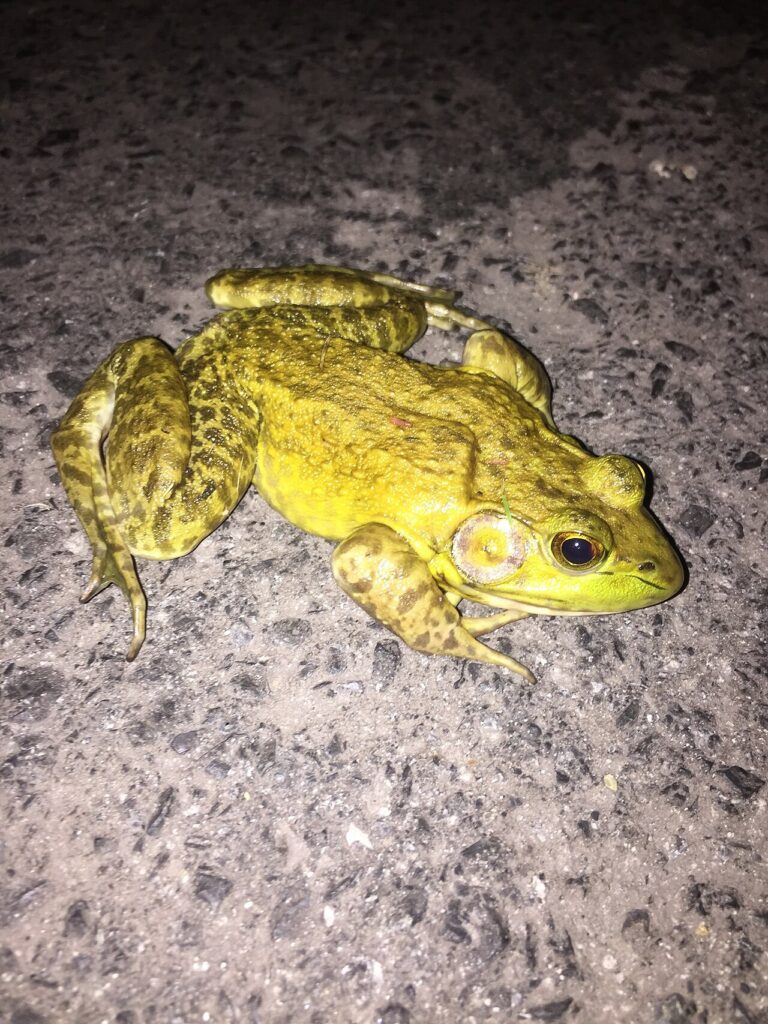
The ground color ranges from bright green to olive to tan, sometimes green in front and brown behind, and the dark spots are irregular in shape rather than neatly circular. Northern leopard frogs (Lithobates pipiens) carry rounder spots ringed with a pale halo and a blunter face. Compare the body plan with the flatter, sticky-footed green tree frog and the difference between a ground frog and a climber becomes obvious at a glance.
Southern Leopard Frog vs Pickerel Frog
Look at the spots and the inner thighs. The pickerel frog (Lithobates palustris) carries squarish dark blotches arranged in two tidy parallel rows and flashes bright yellow to orange pigment on the concealed surfaces of its hind legs. The southern leopard frog has scattered, randomly placed spots and plain whitish thighs.
The second difference matters in the field: the pickerel frog is mildly toxic, and predators including some snakes refuse it. The two overlap across much of the Southeast in the same ditches and springs, so the leg color is the check worth learning. A pickerel frog also lacks the pale eardrum dot.
Where Southern Leopard Frogs Live and What They Eat
Southern leopard frogs occupy almost any shallow, weedy water body in the Southeast, from cypress swamps and marsh edges to farm ponds, borrow pits and roadside ditches. Unusually for a North American frog, they tolerate slightly brackish coastal marsh, which is documented along the Chesapeake and Gulf shorelines. In summer they forage well away from water in damp fields, earning the old nickname meadow frog.
Diet is whatever fits in the mouth: beetles, crickets, flies, spiders, worms and the occasional smaller frog. Breeding runs from late winter into spring, with a second autumn chorus in the warmer parts of the range, and a female can deposit several thousand eggs in a firm cluster attached to submerged stems. Tadpoles transform in roughly 50 to 75 days. In the colder north of the range the adults overwinter underwater or in mud much like the species covered in our guide to frog hibernation, while Florida populations barely pause at all.
Frequently Asked Questions
Can you touch a southern leopard frog?
Yes, with wet hands and only briefly. Dry palms strip the protective mucus layer, and a frog held for several minutes loses moisture fast. Let it sit on a rinsed, cupped hand near the ground rather than squeezing it, and expect it to launch into the nearest water within seconds.
Are southern leopard frogs rare?
No, they are one of the most abundant frogs in the southeastern United States and are listed as Least Concern by the IUCN. They thrive in human-altered water such as ditches, retention ponds and flooded pasture. Local declines happen where wetlands are filled or where fish stocking removes the tadpoles.
Can you keep a leopard frog as a pet?
Yes, leopard frogs are kept in captivity, but they need a long tank rather than a tall one, a shallow water area, cool temperatures and a steady supply of live crickets. They are nervous jumpers and will bruise their snouts against glass. Check state wildlife rules before collecting any native amphibian.
What is the friendliest pet frog?
Calm, handleable species such as the White’s tree frog are usually called the friendliest, since they tolerate brief contact and sit still. Aquatic African dwarf frogs are easier again because they need no handling. A southern leopard frog is a watching animal, not a holding animal. Species like the blue poison dart frog should never be handled.
Do frogs get attached to humans?
Frogs do not form bonds the way a dog or a parrot does, but captive individuals clearly learn routines. Many recognize the keeper as the source of food and will approach the front of the enclosure at feeding time. That is conditioning rather than affection, and it disappears within days once feeding stops.
For range maps, call recordings and peer-reviewed accounts of this species, the herpetology program at the Savannah River Ecology Laboratory at the University of Georgia keeps one of the best regional references available.