Monarch Butterfly Life Cycle: Every Stage Explained
The monarch butterfly life cycle runs egg, caterpillar, chrysalis, adult, and takes about a month from start to finish in summer conditions. What makes it remarkable is not the timeline but what happens inside the chrysalis: the caterpillar’s body is largely dismantled into a soup of cells and rebuilt into an animal with wings, compound eyes, a proboscis instead of jaws, and a completely different diet.
The caterpillar also grows roughly two thousand times its hatching mass in under two weeks, moulting five times because the exoskeleton cannot stretch. This guide walks through each stage in order, what is actually happening biologically, how many generations run in a year, and what you can watch for at each point if there is milkweed nearby.
The monarch life cycle has four stages: egg (3 to 5 days), caterpillar through five instars (10 to 14 days), chrysalis (8 to 15 days), and adult. Egg to adult takes about a month. Inside the chrysalis the larval body is broken down and rebuilt from clusters of cells called imaginal discs. Four or five generations run each year.
| Stage | What Happens |
|---|---|
| Egg, 3 to 5 days | Laid singly under milkweed leaves |
| Instars 1 to 2 | Tiny, pale; cuts trench to drain latex |
| Instars 3 to 4 | Full banding; feeding accelerates |
| Instar 5 | Most of the total feeding; leaves plant |
| Chrysalis, 8 to 15 days | Body rebuilt from imaginal discs |
| Emergence | Wings expand and harden in 2 to 3 hours |
| Generations per year | 4 to 5 in the eastern population |
What Are the Four Stages?
Egg, larva, pupa, and adult, which is complete metamorphosis, the same pattern used by beetles, flies, bees, and all butterflies and moths. Each stage looks and behaves nothing like the others, and the transitions are abrupt rather than gradual.
The division of labour between stages is the point. The caterpillar exists to eat and grow, with chewing mouthparts, no wings, and no reproductive organs. The adult exists to disperse and reproduce, with a coiled feeding tube for liquids, wings, and functioning gonads. They share a genome and almost nothing else.
Because the two stages have completely different diets and habitats, they do not compete with each other, which is one of the leading explanations for why complete metamorphosis is so successful: it accounts for the large majority of all described insect species. The monarch butterfly guide covers the adult stage in full.
What Happens at the Egg Stage?
A female lays a single egg on the underside of a milkweed leaf, having first drummed the leaf with sensory receptors on her forelegs to confirm the plant. She lays several hundred over her life, spread across many plants and rarely more than one per leaf.
The egg is a creamy white ridged dome about 1.2 millimetres tall, roughly pinhead sized, and it develops over three to five days depending on temperature. The tip darkens a day before hatching as the caterpillar’s black head capsule becomes visible through the shell.
The first thing the hatched caterpillar does is eat its own eggshell, which supplies nutrients and appears to be necessary. It then begins on the leaf, chewing small holes rather than working from the edge. The monarch butterfly eggs guide covers finding and identifying them.
What Are Instars?
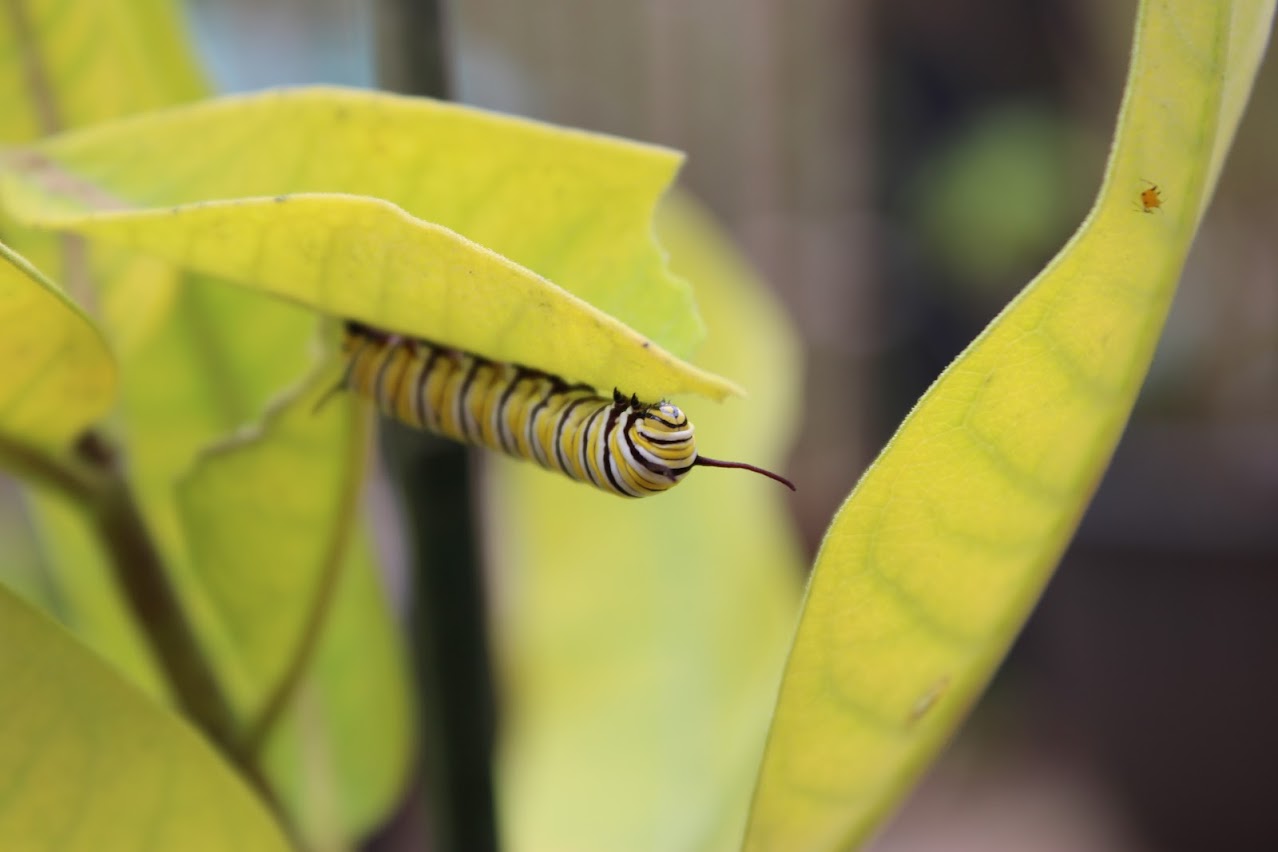
The stages between moults. A caterpillar’s exoskeleton cannot stretch, so growth happens in steps: the larva feeds until the cuticle is tight, forms a new one underneath, splits the old one and walks out of it. Monarchs pass through five instars over ten to fourteen days.
The changes are visible. First instars are pale greenish-grey, about two millimetres, with faint banding and short front tentacles. By the third instar the black, yellow, and white banding is fully developed, and by the fifth the caterpillar is about two inches long with prominent black tentacles at both ends, which are not antennae and have no sensory function beyond touch.
Growth is heavily back-loaded. The fifth instar accounts for the large majority of total milkweed consumed, which is why a plant can look untouched for a week and then be stripped in two days. Shed skins are usually eaten, and the black head capsule is left behind as a small dark bead. The monarch caterpillar guide covers each instar in detail.
How Does the Caterpillar Handle Milkweed?
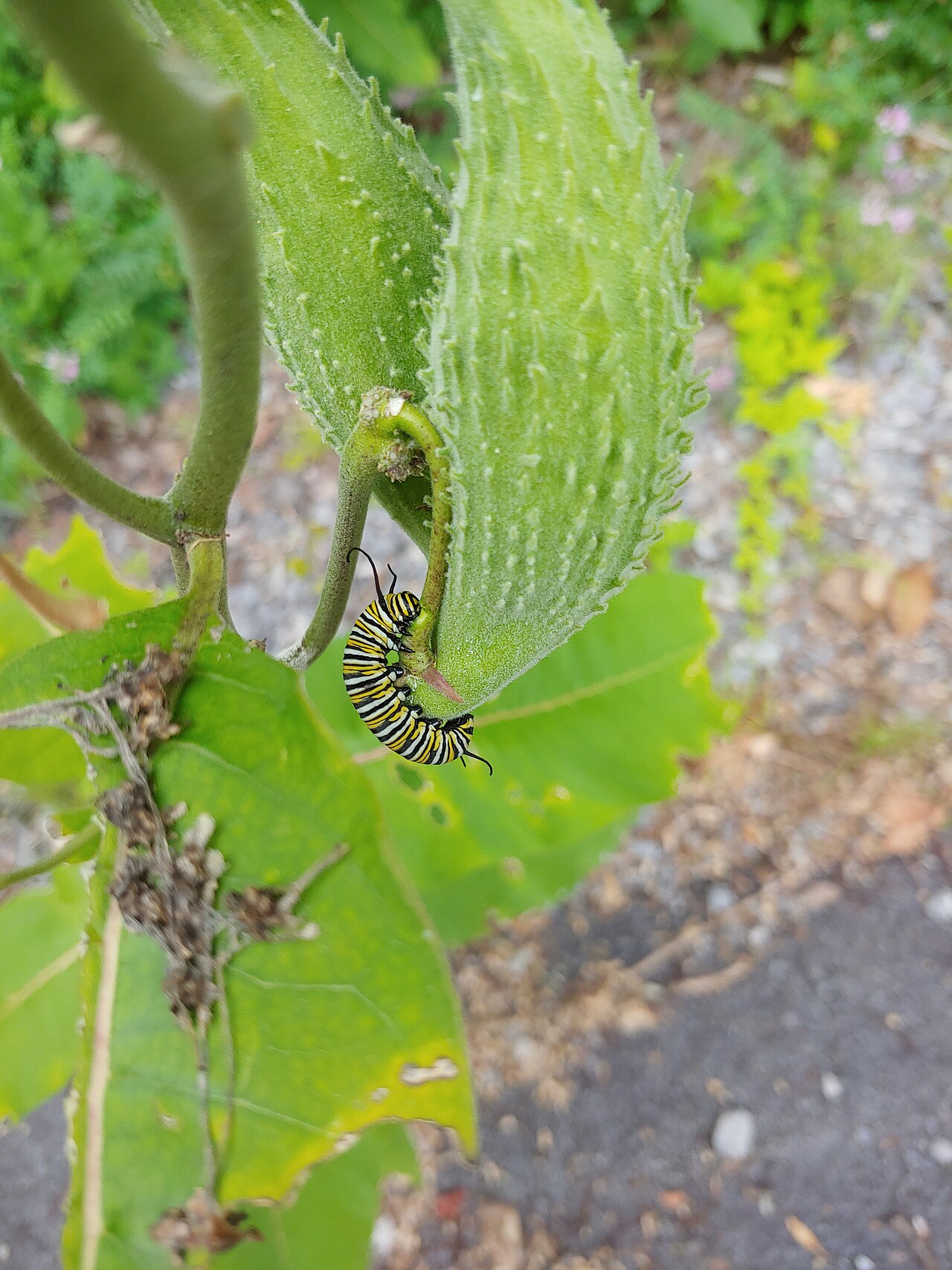
By cutting the supply line first. Milkweed leaves are pressurised with sticky white latex that can glue a small caterpillar’s mouthparts shut and kill it, and first instars deal with this by chewing a small circular trench in the leaf, which drains the latex from the area inside before they feed there.
Larger caterpillars use a different method, biting through the midrib at the base of the leaf so the whole leaf goes limp and depressurises. A milkweed with a leaf hanging down from a clean notch at the stem is a reliable sign that a late-instar monarch is on the plant.
The toxins themselves are the reason for all this. Milkweed contains cardiac glycosides that disrupt the sodium-potassium pump in animal cells, and monarchs carry mutations that make their own pumps insensitive, so they eat the plant, store the toxin, and become poisonous. That protection carries through every subsequent stage.
What Happens Inside the Chrysalis?
Nearly everything is rebuilt. The fifth instar leaves the milkweed, sometimes travelling several metres, spins a silk button on a horizontal surface, hooks into it with a structure called the cremaster, and hangs in a J shape for about a day before splitting its skin one last time to reveal the chrysalis underneath.
Inside, most larval tissues are broken down by enzymes into a nutrient-rich fluid. Clusters of cells called imaginal discs, present since the embryo and held in reserve throughout larval life, then use that material to build the adult structures: wings, legs, eyes, antennae, and reproductive organs. Some tissues, including parts of the nervous system, are retained and remodelled rather than destroyed.
That retention is why experiments have shown moths remembering associations learned as caterpillars. The chrysalis is jade green with a band of metallic gold dots, takes eight to fifteen days, and turns transparent in the final day, revealing the folded orange and black wings pressed against the wall.
What Happens at Emergence?
The chrysalis splits and the butterfly pulls itself out in a few minutes, with a swollen abdomen and small crumpled wings. It then hangs and pumps haemolymph from the abdomen into the wing veins, expanding the wings to full size over roughly an hour.
Hardening takes another one to three hours. The wings must dry and stiffen before flight, and during this period the butterfly is entirely defenceless, which is when the majority of post-emergence predation happens. A butterfly that falls during this window and cannot hang properly ends up with permanently deformed wings.
The first excretion is a reddish fluid called meconium, waste accumulated during pupation, and it alarms people who think the butterfly is bleeding. Once the wings are hard, the monarch flies, and within a few days a summer adult will mate and begin laying. The monarch butterfly life span guide covers what happens next.
How Many Generations Are There in a Year?
Four or five in the eastern population. The generation that overwintered in Mexico flies north in spring and lays in Texas and the Gulf states, and each successive summer generation moves further north, so the monarch reaching Canada in July is the great-grandchild of the one that left Mexico in March.
Each summer generation completes the whole cycle in about a month and lives two to six weeks as an adult. The final generation of the season is different: emerging in late August and September under shortening days and cooler temperatures, it enters reproductive diapause, does not mate, and lives eight or nine months.
That is the generation that flies to Mexico or the California coast, overwinters in clusters, and starts north again in late winter, breeding for the first time before dying. Its offspring restart the cycle. Non-migratory monarch populations in Florida, the Caribbean, Hawaii, and Australia breed continuously with no diapause generation at all.
Should You Let Monarch Caterpillars Eat Your Milkweed?
Yes, that is what the plant is for. Milkweed stripped to bare stems in August looks alarming but the plants are perennial, deeply rooted, and regrow, and a patch that gets eaten every year persists for decades. Damage to milkweed is the sign the planting worked.
Planting enough is the practical answer to the worry. A few stems support a handful of caterpillars; a patch of a dozen or more plants across two or three regionally appropriate species supports a population and absorbs the feeding without looking wrecked. Common milkweed, swamp milkweed, and butterfly weed cover most of the country.
What matters more is what the milkweed has been treated with. Nursery plants carrying systemic neonicotinoid insecticide kill the caterpillars they were bought to feed, and the residue persists in leaf tissue for a season or longer, so buying from native plant nurseries and asking directly is worth the effort. Conservation organisations such as the Xerces Society (xerces.org) publish regional planting guidance.
How Do You Watch the Cycle Yourself?
Find the eggs first, in the morning, on the undersides of young leaves near the top of the plant. Bending a whole stem over exposes twenty leaf undersides at once and picks up the raised dome and its shadow in low-angle light, which is much faster than turning individual leaves.
Then track the plant rather than the caterpillar. Frass on lower leaves, chewed leaf edges, and a limp leaf hanging from a notched midrib all indicate a caterpillar above, and late instars are usually found on the stem or the leaf undersides during the day. Marking the plant with a stake makes it easy to return.
Pupation is the part most people miss, because the fifth instar wanders away from the milkweed and often pupates on a fence, a shed wall, a deck rail, or under a leaf several metres away. Checking horizontal undersides within a few metres of a stripped plant finds most of them. Fewer than one in ten eggs reaches this point, so a chrysalis is worth the search. The guide to birds that eat caterpillars covers where most of the losses go.
Frequently Asked Questions
What are the four stages of the monarch life cycle?
Egg, caterpillar, chrysalis, and adult, which is complete metamorphosis. Each stage looks and behaves nothing like the others, and the caterpillar and adult have entirely different diets and body plans.
How long does the monarch life cycle take?
About a month in summer: three to five days as an egg, ten to fourteen days as a caterpillar through five instars, and eight to fifteen days as a chrysalis. Temperature sets the pace.
What are instars?
The stages between moults. The exoskeleton cannot stretch, so a caterpillar grows in steps, forming a new cuticle and shedding the old one. Monarchs pass through five, with the fifth doing most of the feeding.
What happens inside the chrysalis?
Most larval tissue is broken down by enzymes, and clusters of cells called imaginal discs use the material to build the adult. Parts of the nervous system are remodelled rather than destroyed.
How many generations of monarchs are there a year?
Four or five in the eastern population. Each summer generation lives weeks and moves further north; the final generation enters diapause, lives eight or nine months, and makes the flight to Mexico.
Should you let monarch caterpillars eat your milkweed?
Yes. Milkweed is perennial and regrows, and stripped stems mean the planting worked. Plant a dozen or more across two or three species so the feeding is absorbed without the patch looking wrecked.
Why does a caterpillar cut a trench in the leaf?
To drain the sticky latex that can glue its mouthparts shut. Larger caterpillars bite through the midrib instead, so a limp leaf hanging from a clean notch means a late-instar monarch is on the plant.

Similar Posts
Baby Ring-Neck Snake: The Tail-Curling Defense Explained
Baby ring-neck snakes hatch at 4-5 inches with a bright neck ring and curl their tail to flash a colorful underside as defense. Identification and habitat.
Ring Neck Snake: Identification, Venom Facts and Habits
The ring neck snake is a tiny, harmless garden snake with a bright collar and a famous belly-roll bluff. Here is how to identify it and what it eats.
Groundhog Sounds: The Whistle and Every Other Call Explained
Groundhog sounds decoded: the alarm whistle behind the whistle pig nickname, teeth chattering, distress squeals, and why night noise is almost never a groundhog.
Tiger Swallowtail Butterfly: ID, Dark Females, and Hosts
A large yellow butterfly with four black stripes, but some females are entirely black. Why the dark form exists, what the caterpillars eat, and how to attract them.
Orchid Mantis: Facts, Care, Size, and the Camouflage Myth
The orchid mantis does not actually hide in orchids. Here is what research found, plus size, life cycle, care, and why blue orchid mantises are fake.
Snake Poop: Identification & What It Looks Like
How to identify snake droppings, why they have a white chalky cap, and how to tell them apart from bird and rodent droppings.