Green Tree Frog: How to Identify One and Whether It Is Safe to Touch
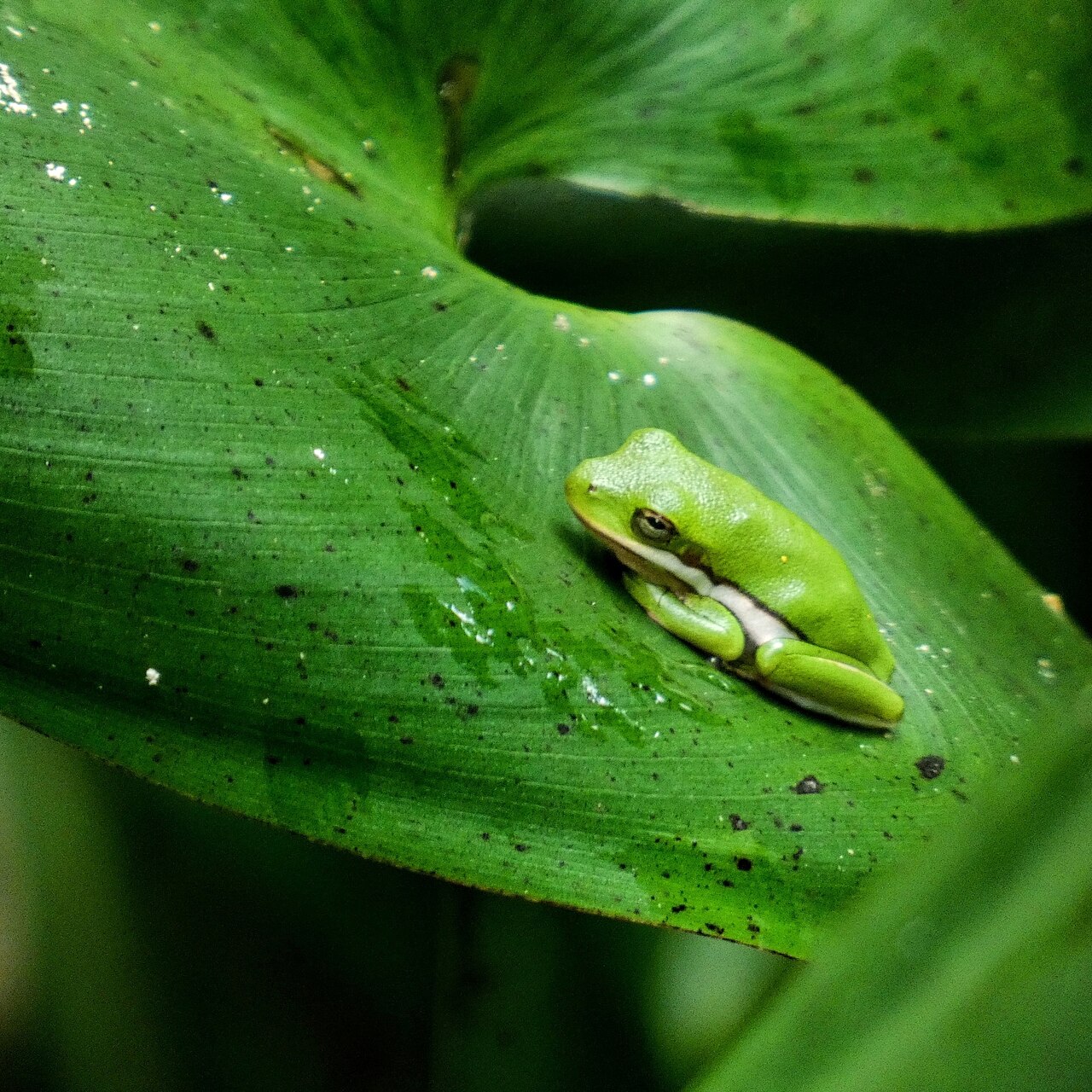
A green tree frog is a small, smooth skinned climbing frog with bright green coloring and sticky toe pads, and in the United States the name almost always means the American green tree frog (Hyla cinerea), a 1 to 2.5 in (2.5 to 6.5 cm) species of the Southeast. The same common name is used in Australia for a much larger frog, Litoria caerulea, sold in American pet stores as White’s tree frog.
Neither frog bites hard enough to break skin and neither is venomous, but both are harmed by being handled. Below are the field marks that separate a true green tree frog from its lookalikes, the states it lives in, the season that brings it out, what it eats, and an honest answer to whether it belongs in a tank.
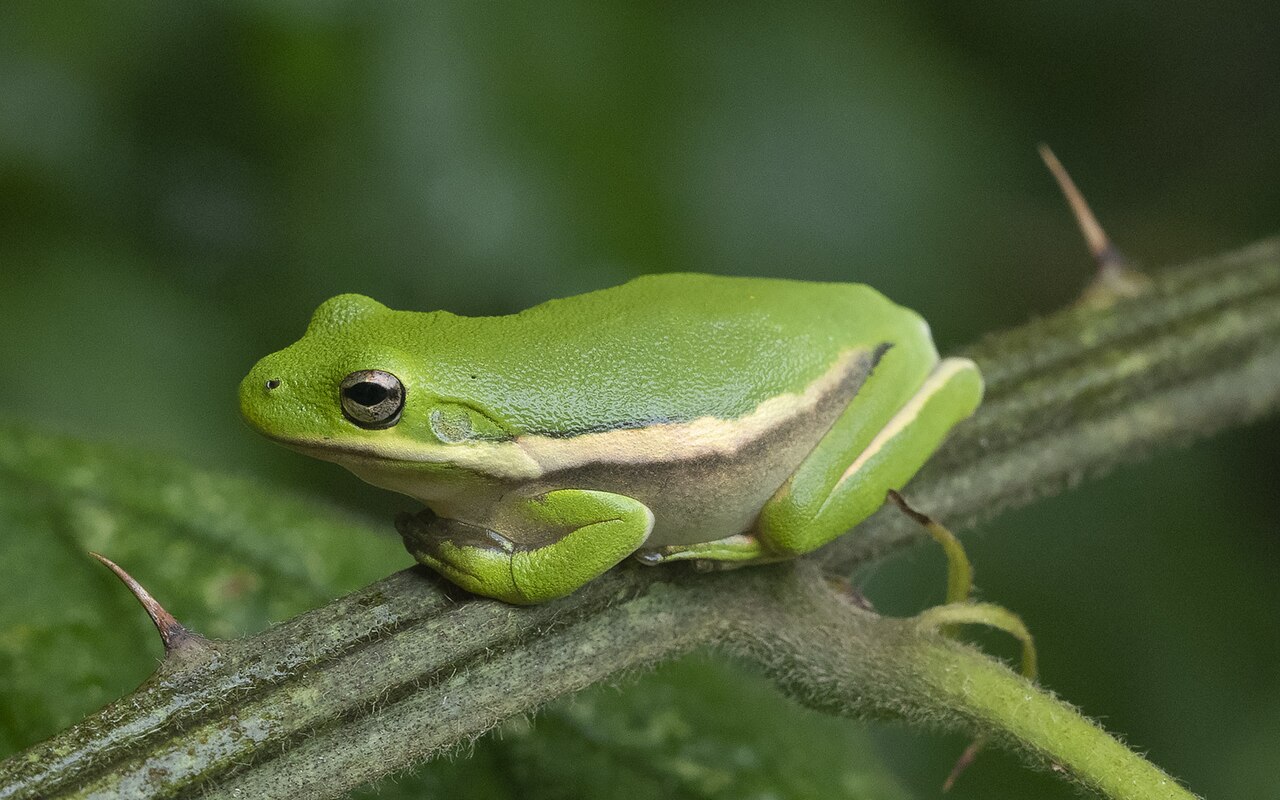
Green tree frogs are small, bright green climbing frogs with a pale stripe along each side and adhesive toe pads. The American species, Hyla cinerea, lives across the southeastern United States, grows to about 2.5 in (6.5 cm), eats insects, and is not venomous or poisonous to people, though its skin is easily damaged by handling.
| Quick fact | American green tree frog (Hyla cinerea) |
|---|---|
| Adult size | 1.25 to 2.5 in (3 to 6.5 cm) snout to vent |
| Color | Bright to olive green, gray in cold weather, with gold flecks |
| Best field mark | Crisp white or cream stripe from jaw down each side |
| Range | Coastal plain from Delaware to Texas, north up the Mississippi Valley |
| Active season | March to October, peaking on warm humid nights |
| Call | Nasal honking quonk, repeated up to 75 times a minute |
| Lifespan | 2 to 5 years in the wild, up to 6 in captivity |
What Is a Green Tree Frog?
A green tree frog is a member of the treefrog family Hylidae, built for climbing rather than hopping across open ground. The toes end in round adhesive discs that grip glass, bark, and painted siding, and the long legs fold tight against the body at rest. Next to a bullfrog or a leopard frog, the body is slim and the skin is smooth and slightly waxy.
Australians use the same common name for Litoria caerulea, a chunky, slow moving frog that reaches 4 in (10 cm) and has a drooping fold of skin over the eyes. That is the animal behind most pet care writing in English. If the frog in question is fat, calm, and the size of a small apple, it is the Australian species, and the care guide for White’s tree frogs covers it.
Green Tree Frog Identification: Size, Color, and Markings
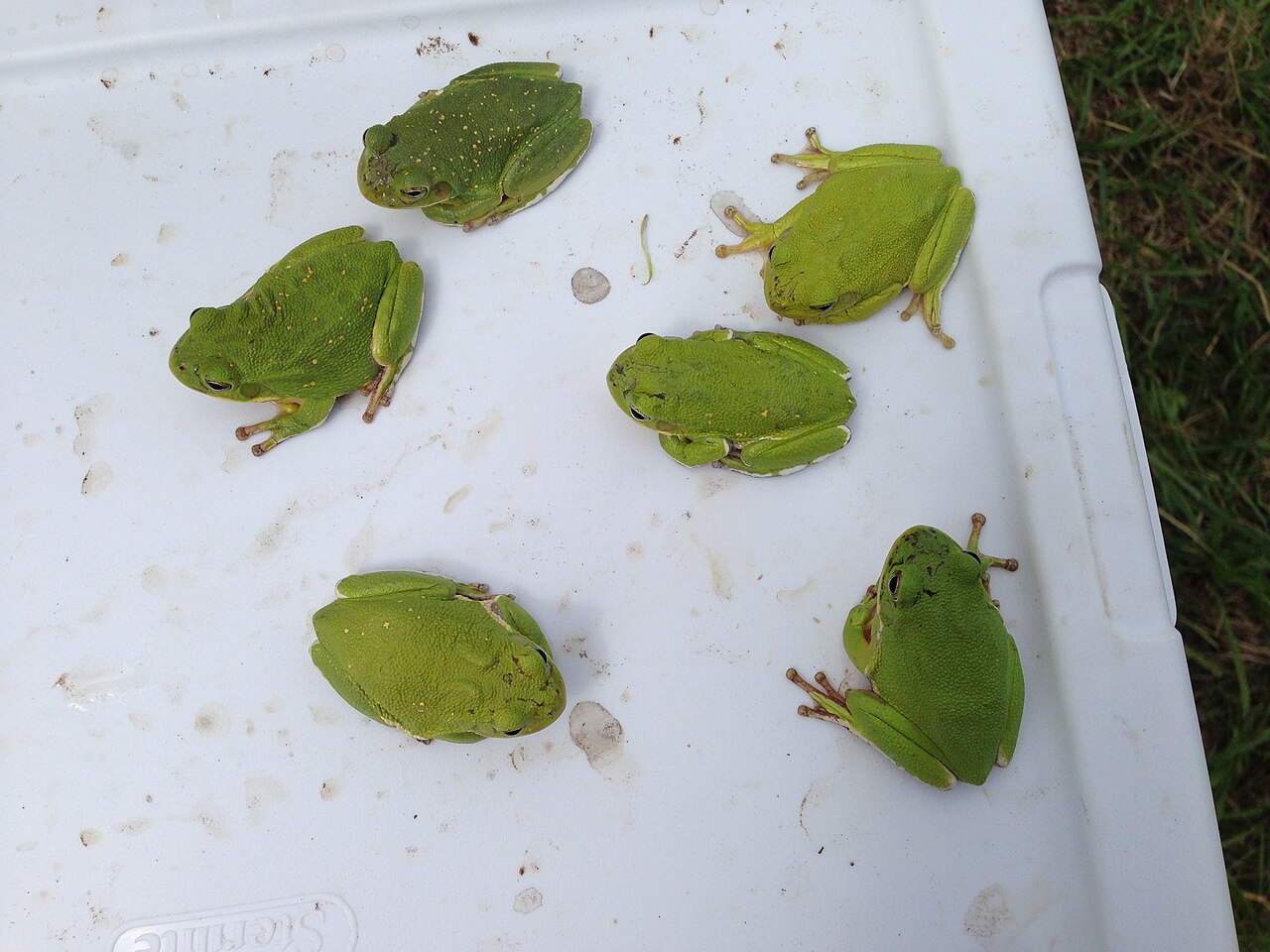
The most reliable mark on an American green tree frog is the pale lateral stripe. It starts at the upper jaw, runs along each side, and fades out somewhere over the hip. The stripe is sharply edged, cream to white, and often bordered below by a thin dark line. Frogs from the western part of the range sometimes have a short stripe or none at all.
Color alone is a trap, because these frogs shift from emerald to slate gray with temperature, activity, and background. Judge the stripe, the smooth skin, the pointed snout, and the size first. Anything much over 2.5 in (6.5 cm) and green in North America is more likely a barking treefrog or a bullfrog in poor light. The family overview at our guide to tree frogs shows how much variation the group holds.
American vs Australian Green Tree Frog
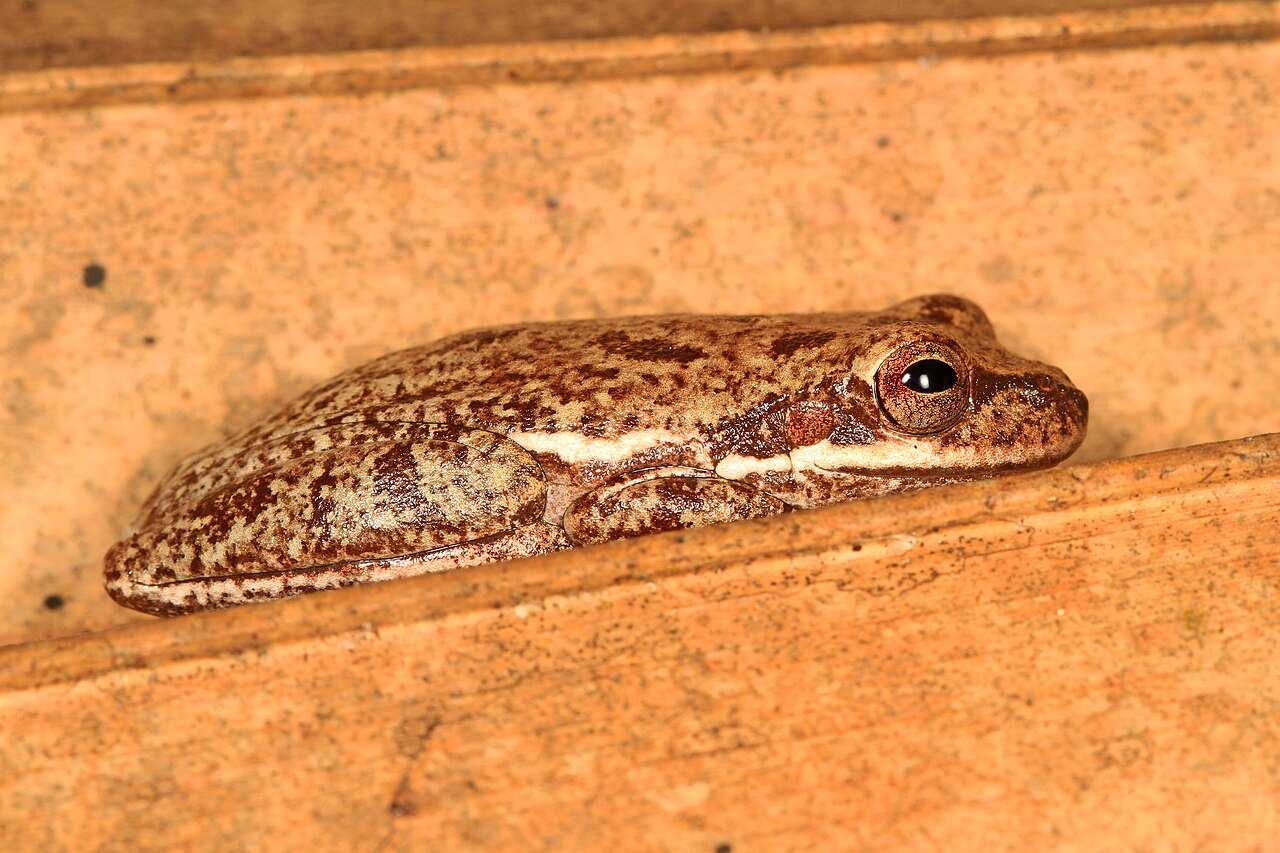
These two frogs share a name and almost nothing else. Hyla cinerea is slender, fast, and rarely tolerates handling. Litoria caerulea is heavy bodied, sits still, and has been a pet trade staple for decades. An adult Australian green tree frog weighs many times what an American one does and lives 15 years or more in captivity against 5 or 6.
Habits differ just as much. The American frog breeds in open marshes, ditches, and cypress swamps and spends the day flattened against a cattail blade. The Australian frog shelters in tree hollows, drainpipes, and mailboxes across northern Australia. Our separate profiles for the American green tree frog and the Australian green tree frog keep the two apart.
What States Do Green Tree Frogs Live In?
American green tree frogs live in roughly two dozen states across the Southeast and lower Midwest. The core range runs from Delaware and Maryland south through Virginia, the Carolinas, Georgia, and all of Florida, then west along the Gulf through Alabama, Mississippi, Louisiana, and eastern Texas, and north up the Mississippi floodplain into Arkansas, Tennessee, Kentucky, and southern Illinois.
Scattered populations reach southeastern Missouri, southern Indiana, and parts of Oklahoma. The species is absent from the Appalachian highlands, the Great Plains, the Rockies, and the entire West Coast, so any green climbing frog in California or Oregon is something else. The Savannah River Ecology Laboratory at the University of Georgia keeps detailed distribution notes for the species.
Green Tree Frog Habitat and Where to Find Them
Look for green tree frogs within a short hop of standing water, on vertical surfaces, at night. Cattails, pickerelweed, palmetto fronds, and the smooth undersides of broad leaves are the classic daytime perches. After dark the frogs move to whatever surface collects insects, which in suburbs means window screens, porch columns, and the glass around outdoor lights.
During dry spells and cold snaps they disappear into leaf litter, root cavities, and the crowns of bromeliads and banana plants. They are not hibernating in the mammal sense, they simply shut down until the weather turns. A warm rain after a dry week will bring dozens back to a pond that seemed empty the night before.
What Month Do Tree Frogs Come Out?
In the Deep South green tree frogs are active from March through October, and in Florida they can call in any month that stays warm and wet. Farther north, in Tennessee or southern Illinois, first calls come in late April or May, the chorus peaks in June and July, and the pond is silent by early October.
The trigger is warmth plus humidity. Nights above 68 F (20 C) with rain in the forecast produce the biggest choruses, which is why the species is called a rain frog across much of its range. Breeding runs from April into August, females lay 400 to 1,000 eggs in floating clusters, and tadpoles need 5 to 10 weeks to transform.
Green Tree Frog Sounds and What They Mean
The advertisement call is a nasal, honking quonk, repeated quickly and often described as a cowbell or a distant duck. A single male can repeat it 75 times a minute, and a full chorus at a Gulf Coast marsh carries half a mile. That call is a male advertising to females and holding a perch against other males.
Two other sounds matter. A short, sharp squawk given when a frog is seized by a snake or a hand is a distress call, and a dry rattling trill from high in a tree on humid evenings is the so called rain call, given outside the breeding chorus. Recordings alongside other regional species sit in our breakdown of tree frog sounds.
Is It Okay to Touch a Green Tree Frog?
You can touch a green tree frog without hurting yourself, but you will likely hurt the frog. Amphibian skin is permeable and doubles as a respiratory and water absorbing organ, so salts, soap residue, sunscreen, insect repellent, and hand lotion pass straight through it. Even clean, dry hands strip the protective mucus layer and leave the animal open to infection.
If a frog must be moved, off a driveway or out of a pool skimmer, wet your hands with dechlorinated or bottled water first, scoop rather than grip, and set it down in shaded vegetation a few feet away. Wash afterward, because amphibians can carry Salmonella on their skin, a hygiene issue that soap and water handle completely.
Are Green Frogs Harmless? Toxicity and Bites
Green tree frogs are harmless to people. They are not venomous, they have no fangs, and their tiny jaws cannot break human skin. A frog that feels threatened will urinate, flatten itself, or leap rather than fight, and the worst outcome of a handling attempt is a startled frog and a wet palm.
The word poisonous needs a more careful answer. Like most frogs they produce skin secretions containing antimicrobial peptides, and those can sting in the eyes or an open cut. They are enough to make a dog drool, paw at its mouth, and vomit after mouthing one. The frogs that genuinely threaten pets in the United States are cane toads in Florida and southern Texas, not tree frogs.
What Is a Tree Frog’s Favorite Food?
Green tree frogs eat live insects, and moths, flies, and small crickets make up the bulk of the diet. They hunt by sight and take anything moving that fits in the mouth, including mosquitoes, midges, leafhoppers, small beetles, and the occasional spider. A frog on a lit window is not there for the light, it is there for the insects the light attracts.
Captive animals are usually fed crickets dusted with calcium and vitamin D3, plus roaches, black soldier fly larvae, and the occasional waxworm. Wild caught insects risk pesticide exposure. Nothing dried, dead, or plant based will be taken, because these frogs respond to movement rather than smell.
What Is a Frog’s Worst Enemy? Predators and Threats
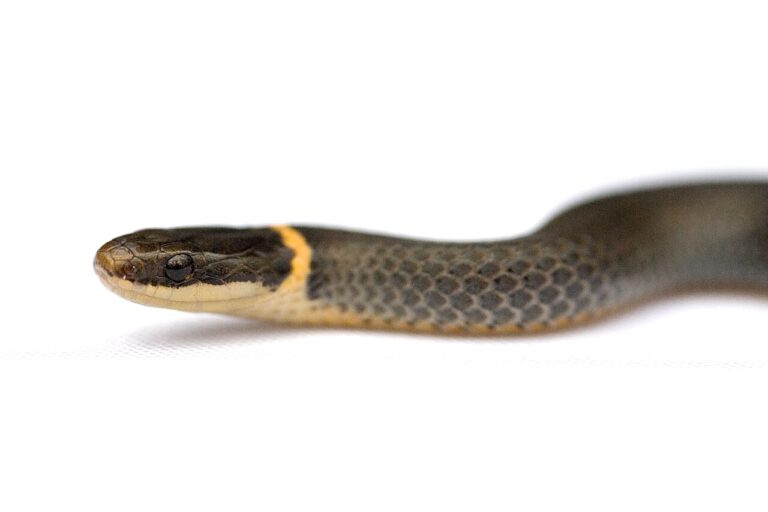
Snakes are the most consistent predator of adult green tree frogs. Ribbon snakes, garter snakes, and rat snakes hunt the same pond edges and climb the same vegetation, and a snake can follow a calling male straight to its perch. Herons, screech owls, raccoons, opossums, and larger frogs, bullfrogs included, take their share as well.
Tadpoles face dragonfly larvae, diving beetles, giant water bugs, and any fish stocked in the pond, which is why these frogs breed in shallow, fish free water whenever they can. The larger threat is habitat: wetland drainage, shoreline clearing, road mortality on rainy nights, and pesticide runoff cost more frogs than any predator.
Do Green Tree Frogs Make Good Pets?
American green tree frogs make reasonable display pets and poor handling pets. They are inexpensive, hardy in a planted 10 to 20 gallon vertical tank, and their nightly calling is either a feature or a regret depending on where the tank sits. They need 70 to 85 F (21 to 29 C), high humidity, live insects several times a week, and a shallow dish of dechlorinated water.
Leave wild frogs wild. Captive bred animals adjust better, carry fewer parasites, and do not remove a breeding adult from a local population, and collecting is regulated in several states. Keepers who want more drama on display often compare these frogs with the invasive Cuban tree frog, which should never be kept or released in Florida.
Frequently Asked Questions
What does it mean if you see a green tree frog?
Folklore across the South treats a green tree frog on the window as a sign of coming rain, and there is something to it: the frogs call and move most on humid nights ahead of storms. In ecological terms it means clean, permanent water is nearby, since these frogs are sensitive to pollution.
What smells do tree frogs hate?
Frogs avoid vinegar, strong citrus, coffee grounds, and salt, and all four are commonly recommended as repellents. All four also burn permeable amphibian skin, and salt is lethal. If frogs on the patio are a problem, turn off the light that draws their insects instead, which works better and harms nothing.
Are green tree frogs poisonous to touch?
No. Their skin secretions contain antimicrobial peptides that can irritate eyes or open cuts, but handling one poses no meaningful risk beyond washing your hands afterward for Salmonella. The greater risk runs the other way, since lotions, soap residue, and repellent on human skin pass straight into the frog.
How long do green tree frogs live?
Wild American green tree frogs typically live 2 to 5 years, with predation and winter mortality taking most animals well before that. Captive individuals reach 6 years with steady temperatures and regular feeding. The Australian green tree frog is the outlier among green climbing frogs, commonly reaching 15 years in captivity.
Can green tree frogs change color?
Yes, within a range. Pigment cells let them shift between bright green, olive, and gray brown in response to temperature, light, stress, and background over minutes to hours. A cold frog at dawn often looks gray, and the same animal can be vivid green by midnight, which regularly confuses identification.
Do green tree frogs bite?
They can close their jaws on a finger during a feeding mistake, but those jaws hold no teeth capable of breaking skin and the sensation is closer to a pinch. Bites are rare because the frog’s first response to a hand is to jump. Feeding with tongs avoids the confusion entirely.