Ant Spiritual Meaning: Good Omen or Warning Sign?
Seeing an ant is a good omen in most traditions that interpret it, and the ant spiritual meaning comes down to four ideas: work, patience, community, and planning ahead. Ants show up in kitchens, gardens, and scripture alike, and because they are so common, people wonder whether a sudden sighting carries a message meant for them. The sign turns into a warning when ants swarm your home or bite you.
Everything below is belief and personal reflection, drawn from scripture, folklore, and modern spirit-animal practice, and none of it predicts the future. Where the ant turned up matters more than the ant itself.
Seeing an ant is a good omen: a sign that patient, steady work and leaning on your community will pay off. The omen turns into a warning when ants swarm your home or bite you, which points to something you have been neglecting. Even then the message is a task rather than a curse.
| Where you see the ant | Common spiritual reading | Omen tone |
|---|---|---|
| Kitchen | Provision and household order | Neutral |
| Bedroom | Rest and unspoken tension in a relationship | Warning |
| Trail through the house | Something crept in unnoticed | Warning |
| Crawling on you | Call to notice small things | Neutral |
| Ant bite | Set a boundary, face a conflict | Warning |
| Garden | Growth and long-term building | Positive |
| Window or doorway | Transition, something asking to come in | Positive |
| At night | Hidden progress | Positive |
| Repeated sightings | The same message, louder | Neutral |
| Dead ant | A finished phase, or exhaustion if many | Neutral |
| In a dream | Small worries adding up | Neutral |
| Flying ant | Departure and a fresh start | Positive |
What Does It Mean When an Ant Visits You?
An ant that visits you brings four messages at once: keep working, keep your patience, lean on your people, and set something aside for later. Those four ideas run through Hebrew scripture, Greek fable, and present-day spirit-animal guides without much variation. The ant is one of the few creatures whose symbolism barely changes across cultures. What changes is the emphasis. A student sees the patience, and someone behind on bills sees the storing up.
The message about small steps comes straight from ant biology. Worker ants can carry loads several times their own body weight, and they do it in a column, one crumb at a time, until a whole carcass or a whole seed cache has moved. The symbolic lesson follows directly: you can carry more than you think, and the way to carry it is in pieces. A visiting ant tells you to stop measuring the whole task and pick up the next crumb.
Repeated sightings do not bring a new message. Many modern spirit guides read a second and third ant in the same week as the first message turned up louder, so the question to ask is which open matter in your life the ant keeps pointing at: a stalled project or money. The same ant means different things to the same person in different years, which is the limit of any animal sign.
Are Ants a Good or Bad Omen?
Ants are a good omen far more than a bad one. Modern totem guides list the ant under diligence and order, and across traditions that address the ant at all, the default tone is approval: here is a creature that plans and finishes.
The omen flips to a warning in a few situations. A trail of ants marching into your house, an ant that bites you, and a sudden mass of ants where there were none yesterday each carry the sense that small problems have piled up while you looked elsewhere. Ants do not arrive in numbers without a reason, so a crowd of them stands for a cause you have not dealt with. Even here, the warning is a push to act and no prophecy of misfortune.
Work itself carries a double edge in ant symbolism. The same diligence that earns praise tips into overwork, and an ant that will not stop mirrors a person who has forgotten how to rest. That shadow pairs the ant with the beaver, another builder whose message includes the cost of building without pause.
What Does the Bible Say About Ants?
The Bible says to study the ant and learn from it. Proverbs 6:6 to 8 in the King James Version reads, “Go to the ant, thou sluggard; consider her ways, and be wise: Which having no guide, overseer, or ruler, Provideth her meat in the summer, and gathereth her food in the harvest.” The ant works without a supervisor and stores food in the season of plenty for the season of lack, and the verse holds that up as the cure for laziness.
The second passage, Proverbs 30:24 to 25, lists the ant among four things “which are little upon the earth, but they are exceeding wise,” with the note that “the ants are a people not strong, yet they prepare their meat in the summer.” Christian commentators read these two passages together as a lesson in diligence and foresight, and as a reminder that wisdom has nothing to do with size.
Ant as a Spirit Animal
People who feel drawn to the ant as a spirit animal are described as team players who plan far ahead and finish what they start. The ant spirit animal shows up in the lives of organizers and caregivers, people who prefer a steady role in a group over a solo spotlight. In this framework a spirit animal appears for a season, when its qualities are the ones you need, and then steps back.

Weaver ants (Oecophylla smaragdina) make the point visibly: chains of workers pull leaf edges together while others bind them with larval silk, and no single ant could build the nest alone. The ant spirit animal person is the one who shows up every week, keeps the shared calendar, and remembers whose turn it is.
Ant Totem and Power Animal
As a totem, a lifelong companion animal, the ant stands for loyalty to the group and for self-discipline. The shadow of the totem is subordination to the point of self-erasure, and ant totem people describe real difficulty deciding anything without checking with the group first.
A power animal is called on deliberately, and people invoke the ant when a long project needs stamina more than inspiration: a degree or a recovery. The nearest comparison is the bee, the other collective insect in symbolism. Both stand for cooperation, but the bee leans toward abundance and pollination, while the ant leans toward storage and defense. If your question is about plenty, look to the bee. If it is about getting through the winter, the ant is your animal.
Spiritual Meaning of Ants in the House
Ants in the house mean that something in your domestic life wants attention, and the room tells you which part. In the kitchen, folk interpretation treats ants as a sign of provision, since they come where food is stored, and at the same time as a comment on household order, since they come where food is left out. Both can be true in the same week, and the honest question is which one fits.
Ants in the bedroom are tied to the matters that belong to that room: rest and the things two people have not said to each other. A single ant on the nightstand is a small prompt. A line of them along the baseboard suggests a tension that has been building for a while, the kind both partners notice and neither names.
A trail that runs through the house, room to room, carries the strongest house message. It points to something that slipped in unnoticed and now has a route: a spending habit or a worry that grew. Ants indoors also have a plain cause, which the guide on getting rid of ants covers. You can wipe the counter, caulk the crack, and still ask what the trail was pointing at.
Ants Crawling on You
An ant crawling on your skin is a call to pay attention to small things you have been brushing off. The crawl itself is the message: a tiny, persistent pressure that is hard to ignore and easy to dismiss. People who notice an ant on their arm during a conversation remember what was being said at that moment, and the modern interpretation says that is no accident.
Where the ant lands on your body adds a layer. Ants on the hands point to your work and what you are building, ants on the feet to the path you are walking and whether it is still yours. This body map is a recent addition, borrowed from how palmistry and reflexology divide the body, and it has no root in older folklore, which treated an ant on the skin as simply an ant on the skin.
What an Ant Bite Means
A bite sharpens the message into a warning. Modern interpreters treat an ant bite as a signal to set a boundary or to stop postponing a conflict, on the logic that an ant only bites when something has crossed into its space. One ant on you is personal, a message about your own habits. A dozen ants on you shift the subject to the group around you: family or team. In that case the question is who in your circle has been carrying weight you have not noticed.
Ants in the Garden
Ants in the garden are the brightest sighting of all, a sign of growth and of seeds taking hold. Small black ants of the genus Lasius build their nests under paving stones and along plant roots: the black garden ant (Lasius niger) in Europe, and close relatives such as the cornfield ant (Lasius neoniger) in the United States. The anthill itself is the image here: a structure raised grain by grain over seasons, invisible work that eventually shows above ground.

Ants at the Window or at Night
An ant on the windowsill or the threshold stands at a boundary, and the meaning follows the location. Something is asking to come in, and you get to decide whether to let it. Windows and doors carry transition symbolism across cultures, so an ant at the frame is a decision point about what you admit into your life, from a new commitment to a new person. Ants that have already crossed in move the question to the house section above.
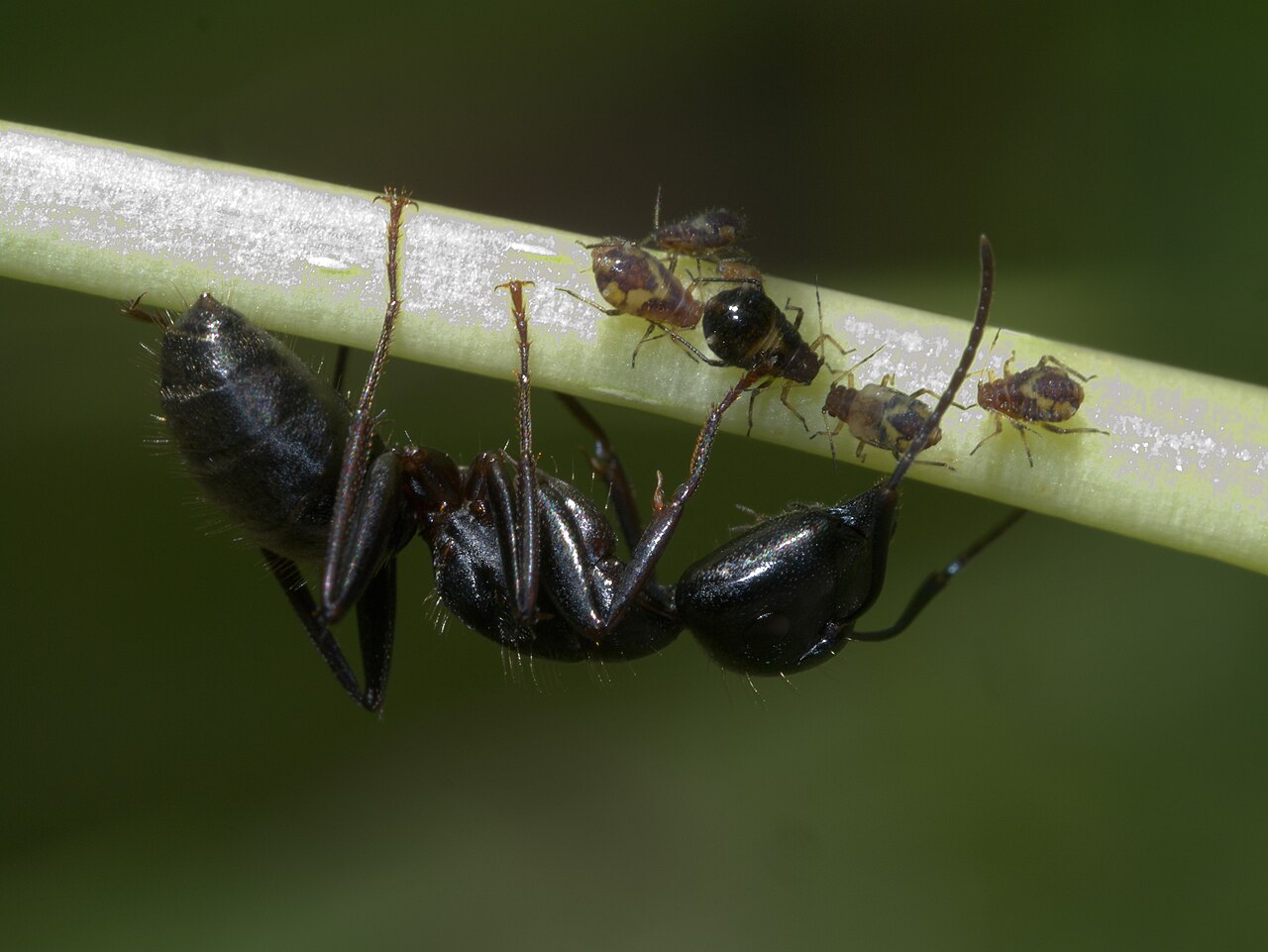
Ants seen at night point to progress you cannot see yet. Carpenter ants forage mostly after dark, and the colony keeps working while the household sleeps. The night sighting takes its meaning from that: effort is paying off below the surface. Garden, window, and night sightings carry a positive tone.
What It Means to Find Dead Ants
A dead ant means a phase has ended and a piece of work is done. The single dead ant on the windowsill or the kitchen counter is a quiet sign: whatever the ant stood for, a task or a long effort, has run its course and can be set down without guilt, a far gentler reading than a dead bird gets. A scattering of dead ants carries a sharper message. Modern interpreters read dead workers in numbers as exhaustion, the colony’s labor taken past what it could sustain, and name it plainly as a burnout warning. If you find dead ants in your own workspace, the question is whether you have been running your own colony the same way.
Dead ants on the doorstep get a protective meaning in recent interpretation: something tried to enter and was turned back. That idea is new and carries no weight in older sources.
Ants in Dreams
Ants in a dream stand for the small, countable worries of waking life, and the dream’s mood decides whether they are a comfort or a weight. Watching ants work in a dream, calmly, from a distance, reflects satisfaction with your own effort. Watching the same ants with a knot in your stomach reflects pressure, a sense that the work never ends and that you are one of the ants. Ants crawling on your body in a dream are small concerns adding up: not one crisis but twenty minor obligations, each too small to mention and together enough to wake you. A giant ant in a dream is a small problem you have inflated, and the dream is showing you how large you have let a minor issue grow.

Black and Red Ants: What the Color Means
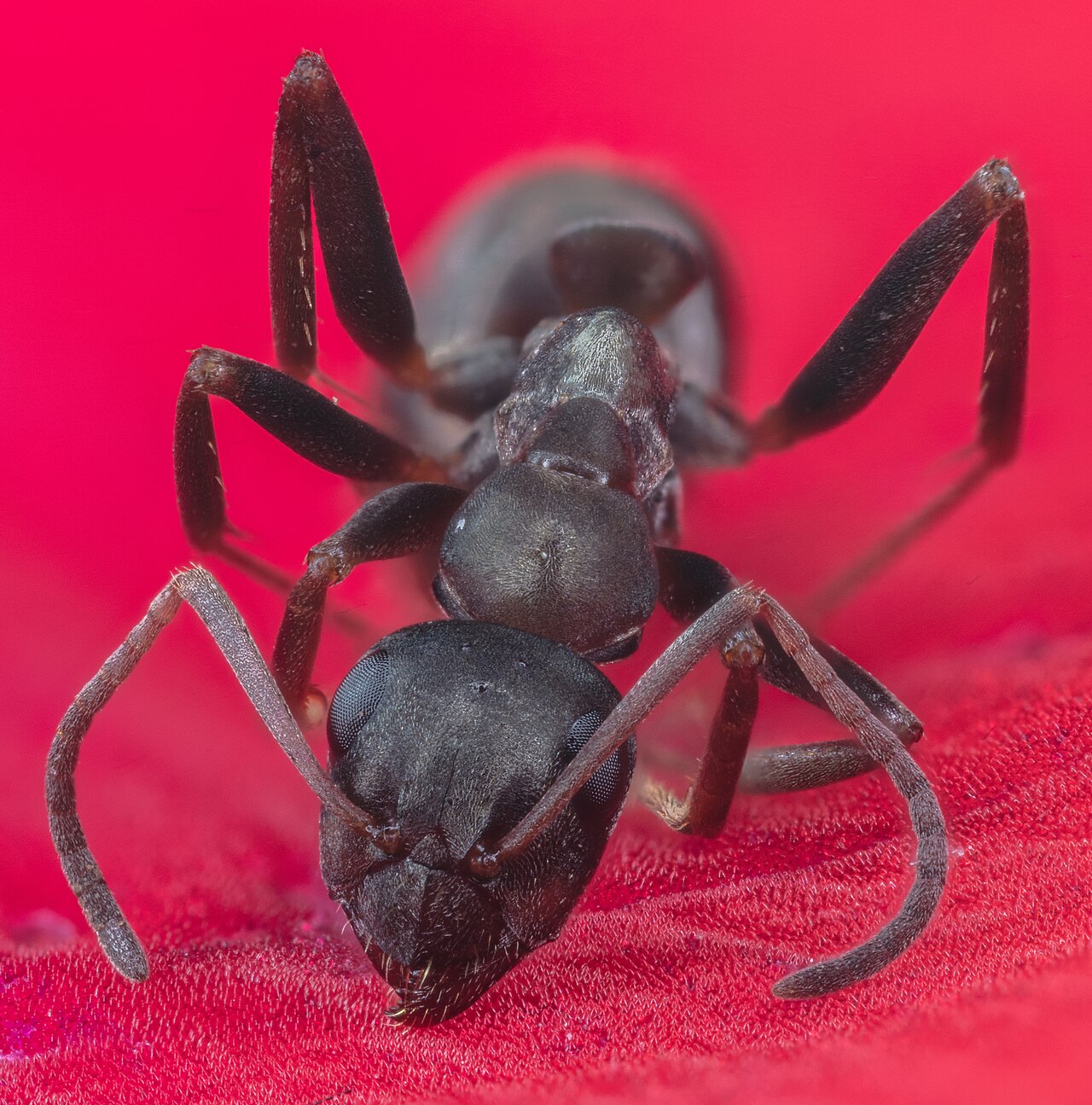
A black ant means grounding, protection, and endurance, and it is the color people search for first because black ants are the ones they meet. Black stands for earth and stability in color symbolism, so the black ant doubles the message of steady work with a message of staying rooted. A black ant on your desk is encouragement to keep going exactly where you are.
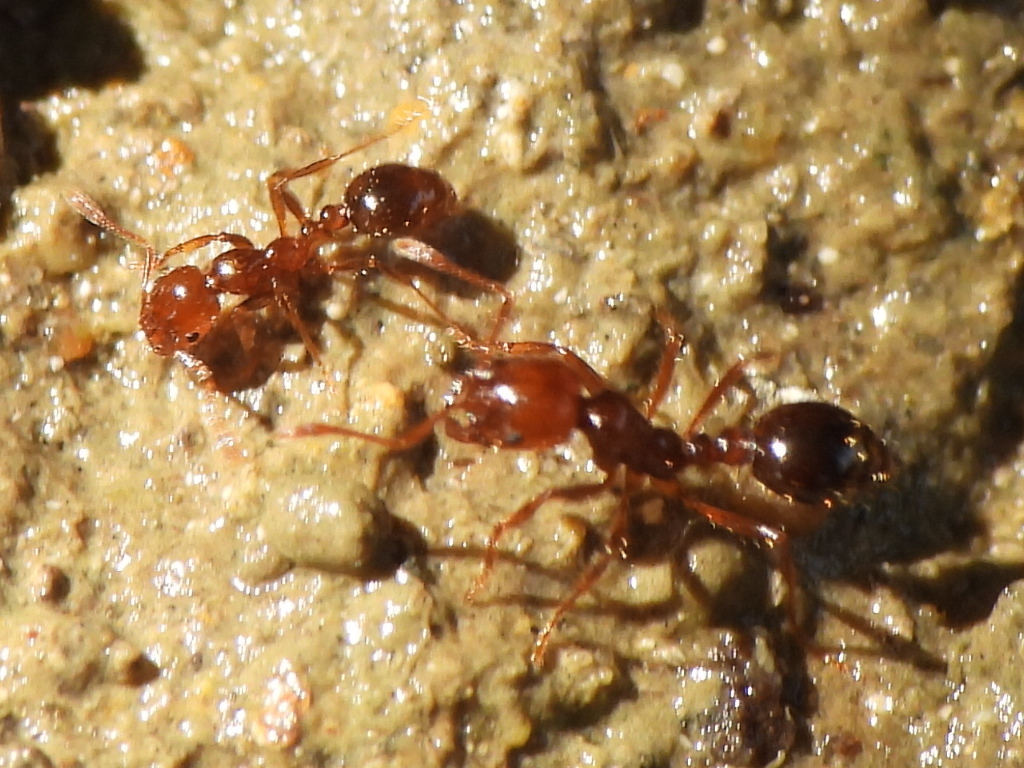
A red ant carries passion and assertiveness, and also anger and conflict. That second edge comes from real experience: red imported fire ants (Solenopsis invicta) sting, and a sighting of red ants brings the memory of pain with it. The red ant asks whether your drive has turned into aggression, or whether someone else’s has turned on you.
Brown Ants and Big Ants
A brown ant points to the ordinary: stability and routine, the household running as it should. Brown is the color of soil and wood, and the brown ant message is the calmest of the set, a reminder that the daily round has its own value. A big ant, such as a carpenter ant (Camponotus), stands for strength and a large task ahead. Carpenter ants are among the largest ants a US homeowner will meet, and the size shifts the message from “one more crumb” to “you are the one who carries the beam.”
Most color meanings are modern additions written for spirit-animal and tarot-style guides. The one older exception is Indian folk belief, which reads black ants in the house as a sign of prosperity and red ants as a sign of trouble or expense. None of the color meanings appears in scripture.
Ants in Native American Traditions
In Hopi tradition, the story goes that the Ant People sheltered humans underground when the world above was being destroyed, feeding them from their own stores until it was safe to return. In the version popularized by Frank Waters’ Book of the Hopi, the ants gave up so much of their own food that their waists grew thin. An older Hopi story recorded by H. R. Voth in 1905 gives a different reason for the narrow waist. The story makes the ant a rescuer and a host, with generosity and foresight as its defining traits.
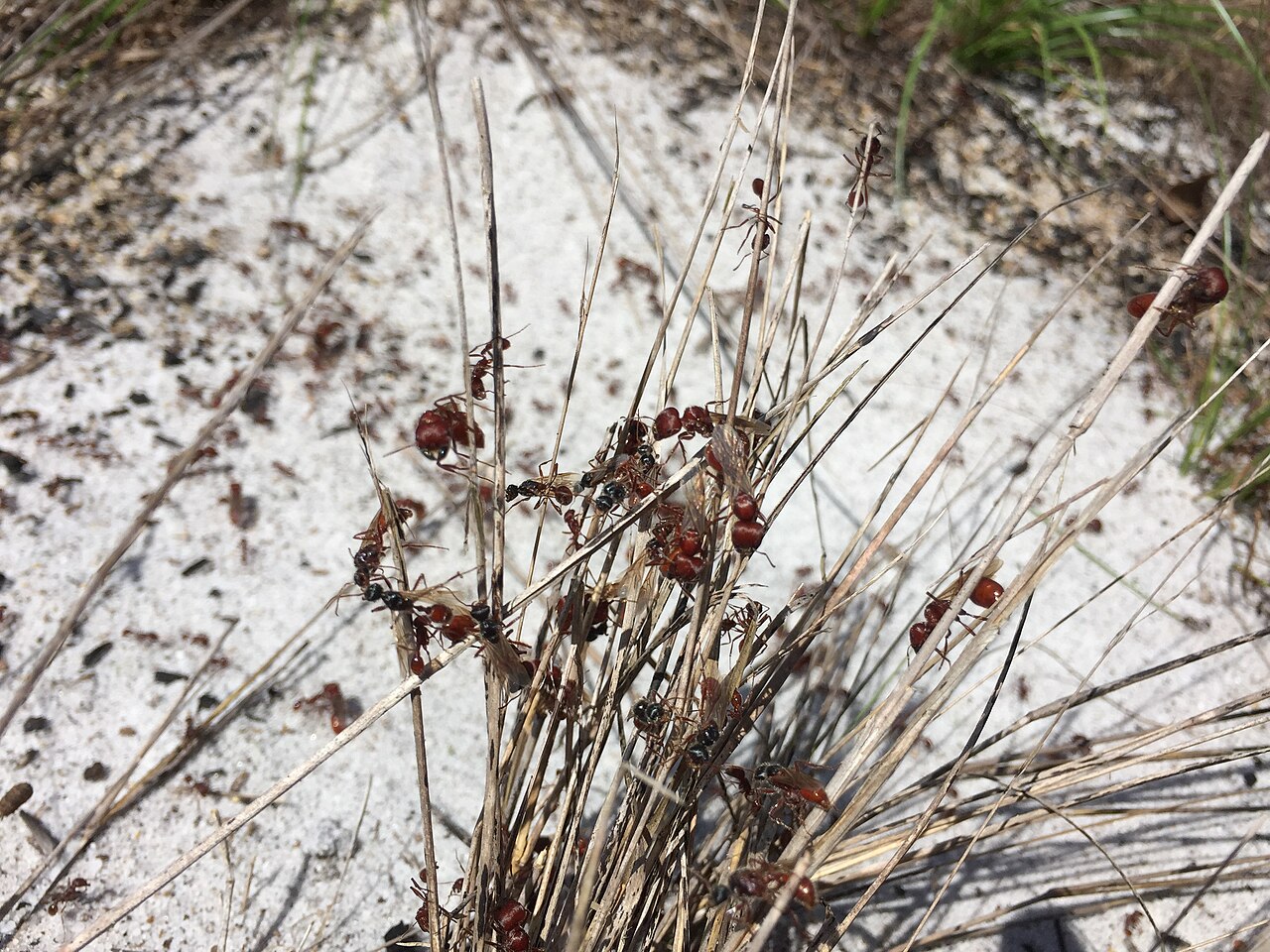
Among the ants the Hopi and their Southwestern neighbors live with are harvester ants (Pogonomyrmex), which carry seeds across open desert ground and pile them in underground granaries. That real behavior sits behind the themes that recur in the Southwest: community and living in step with a dry land that rewards storing and punishes waste. The harvester ant is also a stinging ant, and the respect in these stories carries a note of caution.
Native American symbolism is not one thing. Hundreds of nations hold distinct traditions, and the ant has a central role in a few and no role in others, so any blanket statement about what “Native Americans” believe about ants is an invention. Where the ant does appear, its message is the one already met in Proverbs and in modern totem guides: the small creature that survives by planning.
Ants in Chinese, Islamic, and European Traditions

The Chinese character for ant, 蟻, contains the character 義 (righteousness), but only as a sound element. Modern writers often read virtue and order into it, while classical Chinese sayings use the ant mainly as a warning that small things, like an ant hole in a dike, can cause great collapse. In Islam the ant has its own chapter of the Quran, Surah An-Naml, “The Ant.” Verses 27:18 to 19 describe an ant warning her colony to enter their dwellings so that Solomon’s army would not crush them unknowingly, and Solomon, who understood the speech of animals, smiles at her words. Muslim readers draw from it the lesson that the smallest creature can show care for its people and be heard.
Europe’s contribution is the fable. Aesop’s “The Ant and the Grasshopper” sets the ant, who stores food all summer, against the grasshopper, who sings and starves, and it is the root of the Western habit of treating the ant as industry itself.
Frequently Asked Questions
Do ants bite as a spiritual sign?
No. An ant bites to defend itself or its nest, and fire ants sting rather than bite. The reading of a bite as a warning to set a boundary is a modern layer on top of that behavior.
What does it mean when you see flying ants?
Flying ants are the colony’s reproductive males and queens leaving the nest to mate and found new colonies. A swarm of them usually means a warm, humid day after rain, which is when most species launch their nuptial flight.
Is it bad luck to kill an ant?
No, not in most traditions. Proverbs praises the ant without protecting it, but some religions forbid killing ants outright, which is a moral rule rather than a luck belief: Buddhism’s first precept against taking life extends to insects, Jainism’s nonviolence covers even the smallest creatures, and a hadith in Sunan Abu Dawud reports that the Prophet Muhammad forbade killing ants.
What does an ant tattoo symbolize?
An ant tattoo symbolizes perseverance, teamwork, or the idea of being small but strong. A line of several ants is a common design for a team or a family.
What is God’s purpose for ants?
Biblically, to teach diligence (Proverbs 6:6 to 8), and ecologically, to loosen soil and carry plant seeds to new ground, which many believers read as the ant’s place in the created order. Harvester ants and woodland ants both move seeds into underground stores, where a share of them sprout.
Are ants a sign of money or wealth?
No, with one exception. Indian folk belief reads black ants carrying food into the house as a sign of coming prosperity, on the logic that the ants bring provisions where provisions will be needed.
Sources
- Bible Gateway, Proverbs 6:6 to 8 (King James Version)
- Bible Gateway, Proverbs 30:24 to 25 (King James Version)
- Quran.com, Surah An-Naml 27:18 to 19
- Sunnah.com, Sunan Abu Dawud 5267
- PubMed Central, PMC8993915 (Lasius niger distribution)
- H. R. Voth, The Traditions of the Hopi (1905), sacred-texts.com
Explore more: Insect Spiritual Meanings: 15 Bugs and What They Signal