How to Get Rid of Ants: 4 Steps That Kill the Whole Colony
The fastest way to get rid of ants is to stop killing the ones you can see and let them carry a slow acting bait back to the colony instead. Sprays wipe out the foragers crossing your counter, but the queen keeps laying eggs, and a fresh trail shows up a day or two later. Bait travels to the nest, and the nest is where the infestation actually lives.
This guide covers how to get rid of ants in a kitchen, a bathroom, or an entire house, starting with what works in the first hour and finishing with the sealing work that keeps them out. It also sorts the home remedies that hold up from the ones that only smell like they are doing something.
To get rid of ants, set a slow acting gel bait directly on the trail, leave the foragers alone for 3 to 7 days while they carry it back to the nest, then wash the trail with soapy water and seal the entry point. Baiting reaches the queen. Spraying only kills scouts.
Why Do I Suddenly Have So Many Ants?
Ants appear suddenly because a single scout found food and laid a chemical trail that every other forager can follow. One ant on a counter is a scout. Forty ants twelve hours later means that scout reported back, and the colony has now committed a work crew to your kitchen.
Weather drives the timing. Heavy rain floods shallow nests and pushes colonies toward dry foundations, while a long dry spell sends them indoors hunting for moisture under sinks and around dishwashers. Spring and late summer are the two peaks in most of the United States, and a warm winter simply moves the first wave earlier.
What Gets Rid of Ants Immediately?

Nothing legal kills an entire colony immediately, but you can clear a visible trail in minutes with a spray bottle of water and a few drops of dish soap. The soap breaks down the waxy coating on the ants and destroys the pheromone trail at the same time, which stops the next wave from finding the same route.
Treat that as cleanup, not control. If you only ever kill the ants you see, the colony reads the losses as a dangerous food source and sends foragers along a different path, often into a second room. The immediate fix and the permanent fix are two separate jobs, and doing the first one alone is why most ant problems drag on for weeks.
Why Bait Beats Spray Every Time

A worker ant is not the target. A mature colony holds thousands of workers and at least one queen who can replace every forager you kill within a week, so the arithmetic of spraying never works in your favor. Slow acting bait flips the problem around: the worker survives long enough to walk home and feed the poison to the brood and the queen through trophallaxis, the mouth to mouth food sharing that keeps a colony running.
That is also why a bait station looks like a failure on day two. More ants gathering at the bait is the treatment working, not spreading. Understanding what ants actually eat helps you pick the right bait, because a colony feeding on grease will walk straight past a sugar gel.
Which Ants Are You Actually Dealing With?

Identification changes the treatment more than any other single decision. Odorous house ants (Tapinoma sessile) and pavement ants take sugar baits readily and die out in a week or two. Carpenter ants (Camponotus pennsylvanicus) nest inside damp wood and need the moisture problem solved along with the bait, or they simply come back next season.
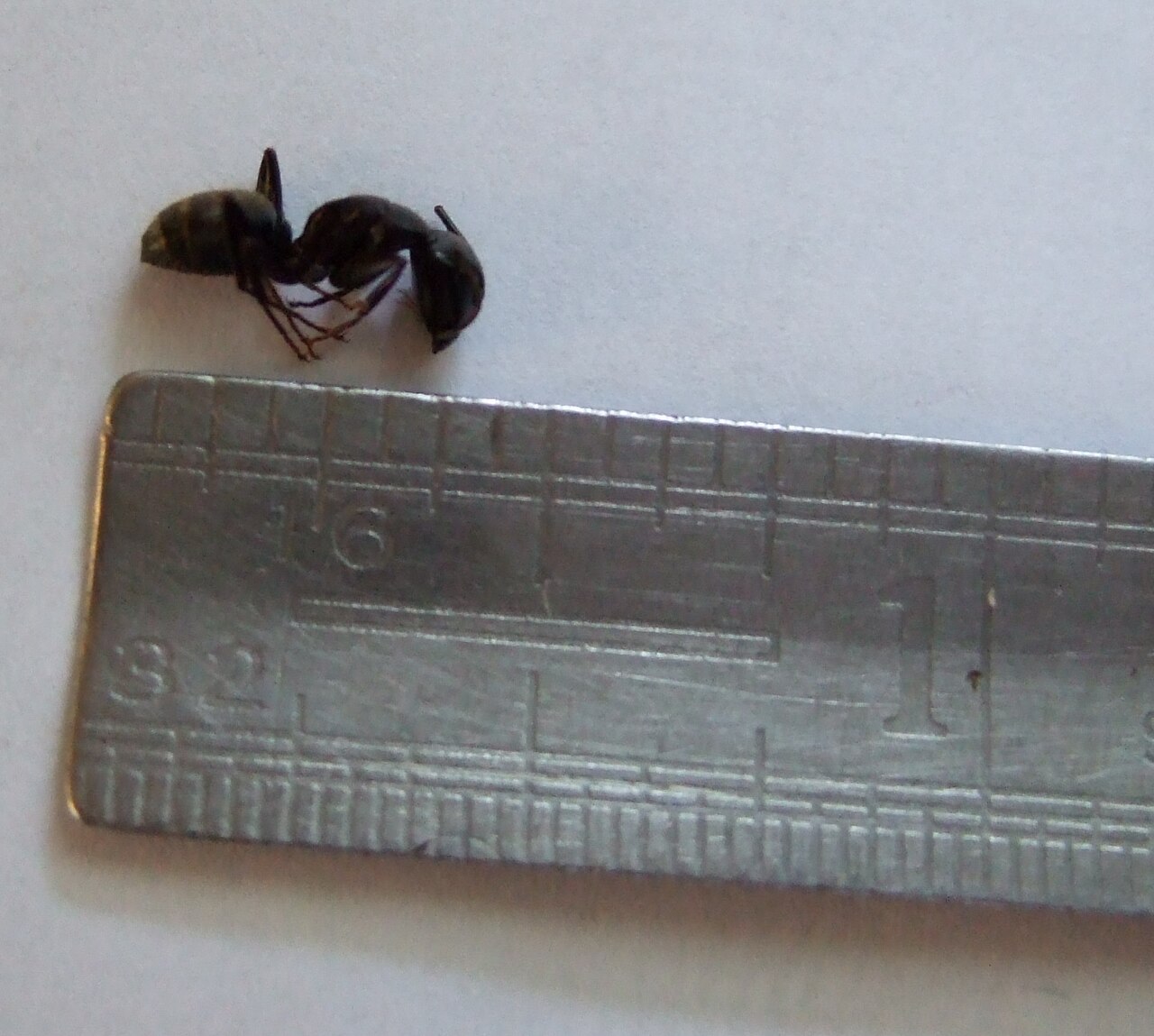
Crush one and smell it: odorous house ants give off a sharp coconut or blue cheese odor. Size helps too, since carpenter ants run 0.25 to 0.5 in (6 to 13 mm) while most kitchen invaders are under 0.13 in (3 mm). A carpenter ant bite pinches hard enough to notice, while sugar ants rarely bite at all.
| Ant | Size | Where It Nests | Best Bait |
|---|---|---|---|
| Odorous house ant | 0.1 in (2.5 mm) | Wall voids, under sinks | Sugar gel |
| Pavement ant | 0.13 in (3 mm) | Under slabs and driveways | Sugar and protein mix |
| Argentine ant | 0.1 in (2.5 mm) | Mulch, supercolonies outdoors | Liquid sugar bait, many stations |
| Carpenter ant | 0.25 to 0.5 in (6 to 13 mm) | Damp or damaged wood | Protein gel plus moisture repair |
| Pharaoh ant | 0.08 in (2 mm) | Warm wall voids, hospitals | Bait only, never spray |
| Little black ant | 0.06 in (1.5 mm) | Masonry cracks, soil | Sugar gel |
How to 100% Get Rid of Ants
A complete removal runs in four steps and takes about two weeks. First, place two to four bait stations directly on the active trail, never a foot away from it. Second, stop cleaning that trail while the bait works, because wiping it destroys the road the workers need to carry poison home.
Third, on day 7 to 10, when traffic has dropped to nothing, scrub every trail surface with soapy water or a vinegar solution to erase the pheromones. Fourth, seal the entry points and fix the conditions that invited them. Skipping step four is why the same kitchen gets the same ants every June.
What Kills Ants Permanently Naturally?
Boric acid mixed into sugar water is the one home remedy that genuinely kills colonies, and it is the active ingredient in several commercial baits. A working ratio is roughly half a teaspoon of boric acid in a cup of warm sugar water, soaked into a cotton ball and set inside a covered container. It has to stay weak enough that the worker survives the walk home.
Diatomaceous earth works differently and more slowly, abrading the ant’s exoskeleton until it dehydrates. It only works dry, so it belongs in crawl spaces and wall voids rather than on a damp counter. Keep both away from pets and children, and follow the label guidance the EPA publishes on safe pest control.
Does Dawn Dish Soap Really Kill Ants?
Yes, Dawn dish soap really kills ants on contact, but only the ants it touches. The surfactant strips the waxy cuticle that holds moisture in, and the ant dies of dehydration within a minute or two. A mix of one tablespoon of dish soap in a cup of water in a spray bottle does the job as well as any branded contact killer.
What it cannot do is reach the nest. Soap leaves no residue that a worker can carry, so the queen never sees it and the colony replaces the dead within days. Use it to clear a counter and erase a trail, then let bait handle the part that matters.
What Scent Will Keep Ants Away?
Peppermint oil is the most reliable repellent scent, with clove, tea tree, and cinnamon leaf oil close behind. Ten to fifteen drops in a cup of water, sprayed along thresholds and window tracks, disrupts the pheromone trail and makes the route unreadable. White vinegar does the same job at lower cost, though the smell fades faster.
Repellents redirect ants, they do not remove them. A scent barrier across a doorway can push a colony to a different wall and hand you a second trail in a room you were not watching. Use scent to protect a specific area, such as a pet bowl, while the bait works elsewhere.
What Do Ants Absolutely Hate?
Ants absolutely hate anything that destroys their chemical navigation: vinegar, citrus oil, strong mint, cinnamon, and plain soapy water. They also avoid dry, sealed, crumb free surfaces, which is the least exciting answer and the most effective one. A colony follows resources, and a counter with nothing on it is not a resource.
Physical barriers rank alongside smells. Petroleum jelly around a post, a moat of water, or a strip of double sided tape stops foragers cold because they will not cross a surface they cannot grip. The same trick is how people keep ants out of a hummingbird feeder without touching the nectar.
What Is an Ant’s Worst Enemy?
An ant’s worst enemy outdoors is another ant. Territorial wars between neighboring colonies kill more ants than any predator, and Argentine ant supercolonies displace native species across the southern United States by sheer numbers. Indoors, the worst enemy is a bait the colony trusts enough to eat.
Beyond rival colonies, flickers, sapsuckers, and other birds that eat ants take a steady toll, as do spiders, antlions, and parasitic phorid flies that target fire ants specifically. None of that helps a kitchen problem, but it explains why an outdoor colony near active predators tends to stay small.
Sealing the House So They Cannot Come Back
Every long term fix ends at the building envelope. Caulk the gaps where pipes and wires pass through walls, replace failed weatherstripping under exterior doors, and screen the weep holes in brick veneer with fine mesh rather than sealing them shut. Ants use openings as thin as a credit card edge.
Outside, pull mulch back 6 to 12 in (15 to 30 cm) from the foundation, cut back branches that touch the roof, and fix the downspout that keeps a corner of soil permanently wet. Damp wood is an invitation to carpenter ants, and it is also where flying ants appear when a mature colony starts producing swarmers.
Why Shouldn’t You Squish Ants?
You should not squish ants during treatment because crushing one releases alarm pheromones that tell the colony a route is dangerous. The practical result is that the remaining foragers reroute, often into a wall void or a second room, and you lose the single trail that made baiting easy. A visible trail is a target, not a problem.
There is also the smell. Odorous house ants release the coconut like compound they are named for when crushed, and a crushed line of them on a counter leaves a residue that other ants investigate. Spray with soapy water instead, which kills without broadcasting an alarm.
When to Call a Professional
Call an exterminator when the species is pharaoh ant, when carpenter ants are active inside structural wood, or when two full bait cycles have failed. Pharaoh ants respond to over the counter sprays by budding, meaning the colony splits into several new ones, so amateur treatment genuinely makes the situation worse.
A professional also has access to non repellent perimeter products that homeowners cannot buy, which matters for Argentine ant supercolonies running along an entire block. Expect a treatment plan of two to three visits rather than a single spray, and ask specifically whether the plan includes the nest or just the perimeter.
Frequently Asked Questions
How long does it take to get rid of ants with bait?
Most sugar feeding colonies collapse in 3 to 10 days once workers start carrying bait home. Carpenter ants and pharaoh ants take two to four weeks because the nests are larger and often split across several sites. If traffic has not dropped at all by day 10, the bait type is wrong for that colony.
Why are there more ants after I put out bait?
A spike in numbers around the bait station in the first 48 hours means the colony has accepted the food and is recruiting workers to haul it back. That is the treatment working. Leave the station alone, resist cleaning the trail, and the numbers usually fall off sharply between day 4 and day 7.
Do ants ever go away on their own?
Indoor trails sometimes vanish when the weather changes or the food source disappears, but the colony is still nesting nearby and will return. Seasonal disappearance is not removal. If ants show up in the same spot each spring, the nest survived the winter in a wall void, under a slab, or in the soil against the foundation.
Is vinegar or bleach better for erasing ant trails?
Vinegar is better. A 1 to 1 mix of white vinegar and water breaks down pheromones without the fumes, the surface damage, or the risk of mixing bleach with an ammonia based cleaner. Bleach erases trails too, but it offers no advantage here and creates a hazard that vinegar does not.
Are ants in the house a sign of a dirty kitchen?
Not necessarily. Ants forage constantly and will follow moisture, a pet bowl, a leaking pipe, or a single grape under the fridge into a spotless home. Sanitation makes a house less rewarding and shortens an infestation, but a clean kitchen with a gap under the door will still get scouts.
Can I use bait safely around pets and children?
Use enclosed bait stations rather than open gel dots, and place them behind appliances, under sinks, and inside cabinets where a child or a dog cannot reach them. Read the label for the specific active ingredient, since borate baits and pyrethroid products carry different handling rules and different re entry guidance.