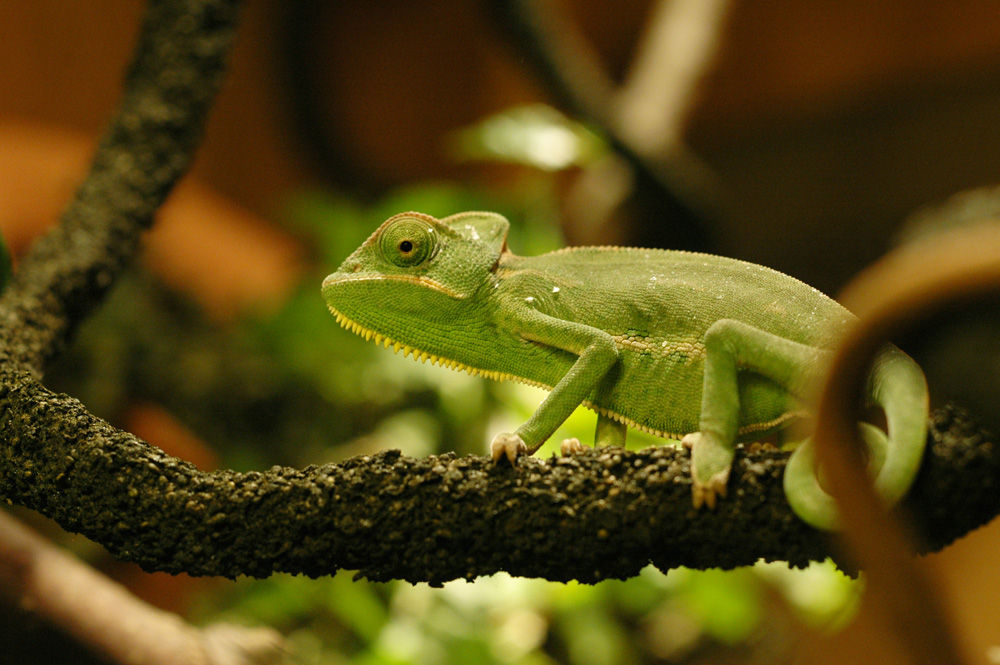
Veiled Chameleon: Care, Setup, and Honest Drawbacks
The veiled chameleon (Chamaeleo calyptratus) is the most widely kept chameleon in the world, a large green and banded lizard from Yemen and Saudi Arabia with a tall bony crest on the head called a casque. Males reach 17 to 24 in including the tail and females 10 to 14 in, and they live roughly five years for males and less for females.
They are also frequently sold to people expecting a handleable pet, which they are not. Veiled chameleons are solitary, territorial, and visibly stressed by handling, and a female kept without a laying site will die of egg binding whether or not a male has ever been present. This guide covers the setup they actually need, the drinking behavior that catches keepers out, the egg-laying issue, and whether the species suits a first-time reptile keeper.
| Quick Facts | Veiled Chameleon |
|---|---|
| Origin | Yemen and southwestern Saudi Arabia |
| Size | Males 17 to 24 in, females 10 to 14 in |
| Lifespan | Males around 5 to 8 years, females 4 to 6 |
| Enclosure | Screen, minimum 24 by 24 by 48 in for an adult male |
| Drinking | Only from moving droplets, never standing water |
| Handling | Tolerated at best, stressful for the animal |
What a Veiled Chameleon Is
Veiled chameleons come from the mountainous coastal regions of Yemen and southwestern Saudi Arabia, an environment considerably more variable than the humid rainforest people associate with chameleons. That origin explains their hardiness relative to other species and their tolerance of a wider temperature range.
The casque is the defining feature, a tall bony ridge running along the top of the head that reaches around 2 in in adult males and is smaller in females. It probably functions in water collection, channeling condensation down toward the mouth, and in display.
Coloration runs to green with bands of yellow, blue, and brown, brighter and more contrasting in males. Introduced populations have established in Hawaii and Florida from released and escaped pets, where they are considered invasive and are subject to control efforts, which is one reason releasing an unwanted animal is never an acceptable option.
Color Change: What It Actually Means
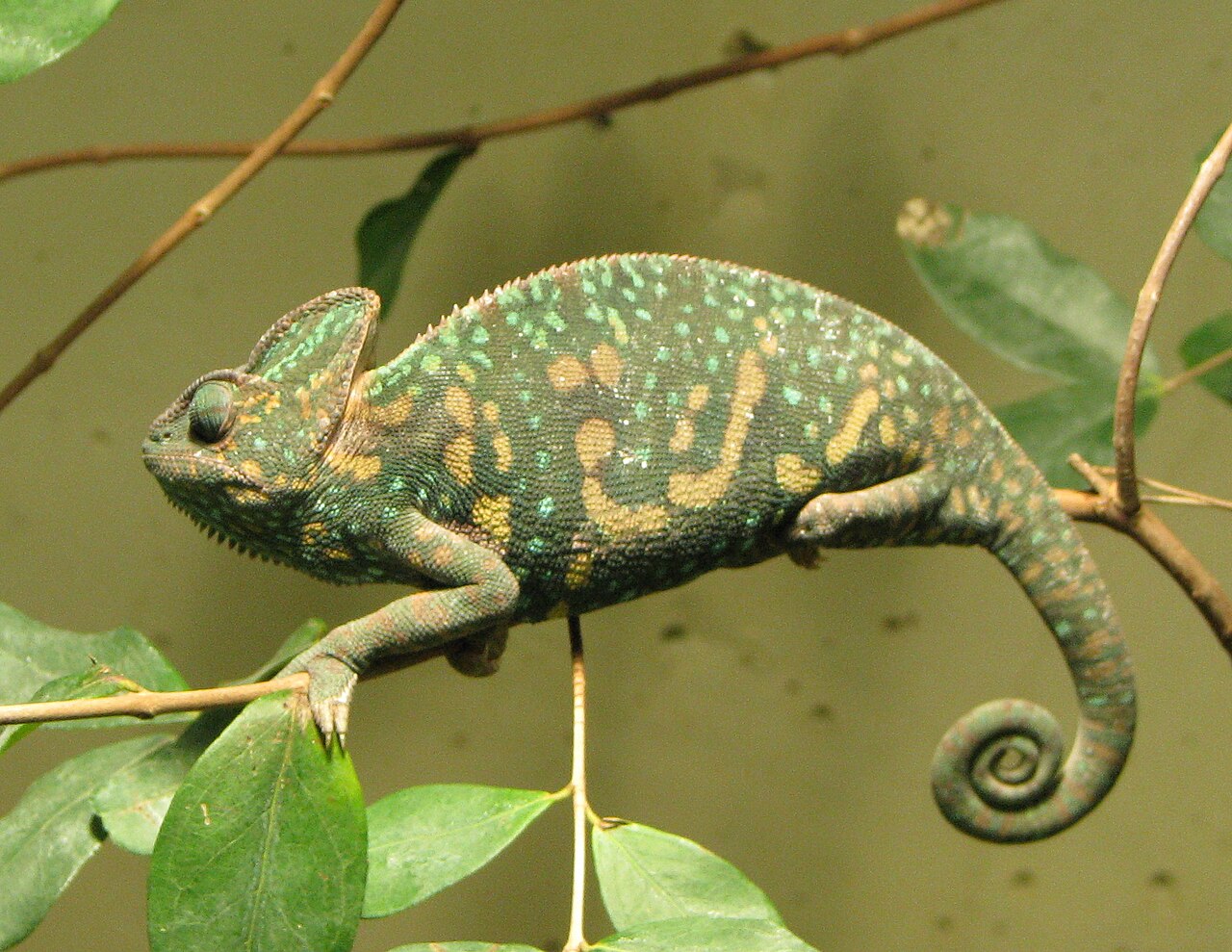
Chameleons do not change color to match their surroundings, and this myth persists despite being wrong. Color change communicates mood, temperature regulation, and reproductive state, and it happens through specialized cells called iridophores containing nanocrystals that the animal can space closer or further apart to shift which wavelengths are reflected.
For a keeper, color is a diagnostic tool. A relaxed veiled chameleon shows bright green with clear banding, while dark brown or black usually signals stress, cold, or illness. Pale washed-out coloring often accompanies shedding, and a very dark animal basking is warming itself by absorbing heat.
Females signal reproductive state clearly. A receptive female shows light coloring, while a gravid or non-receptive female develops dark coloration with bright blue or yellow spots and will display it aggressively toward males. Learning to read these signals tells you more about your animal’s condition than almost anything else.
Enclosure Requirements
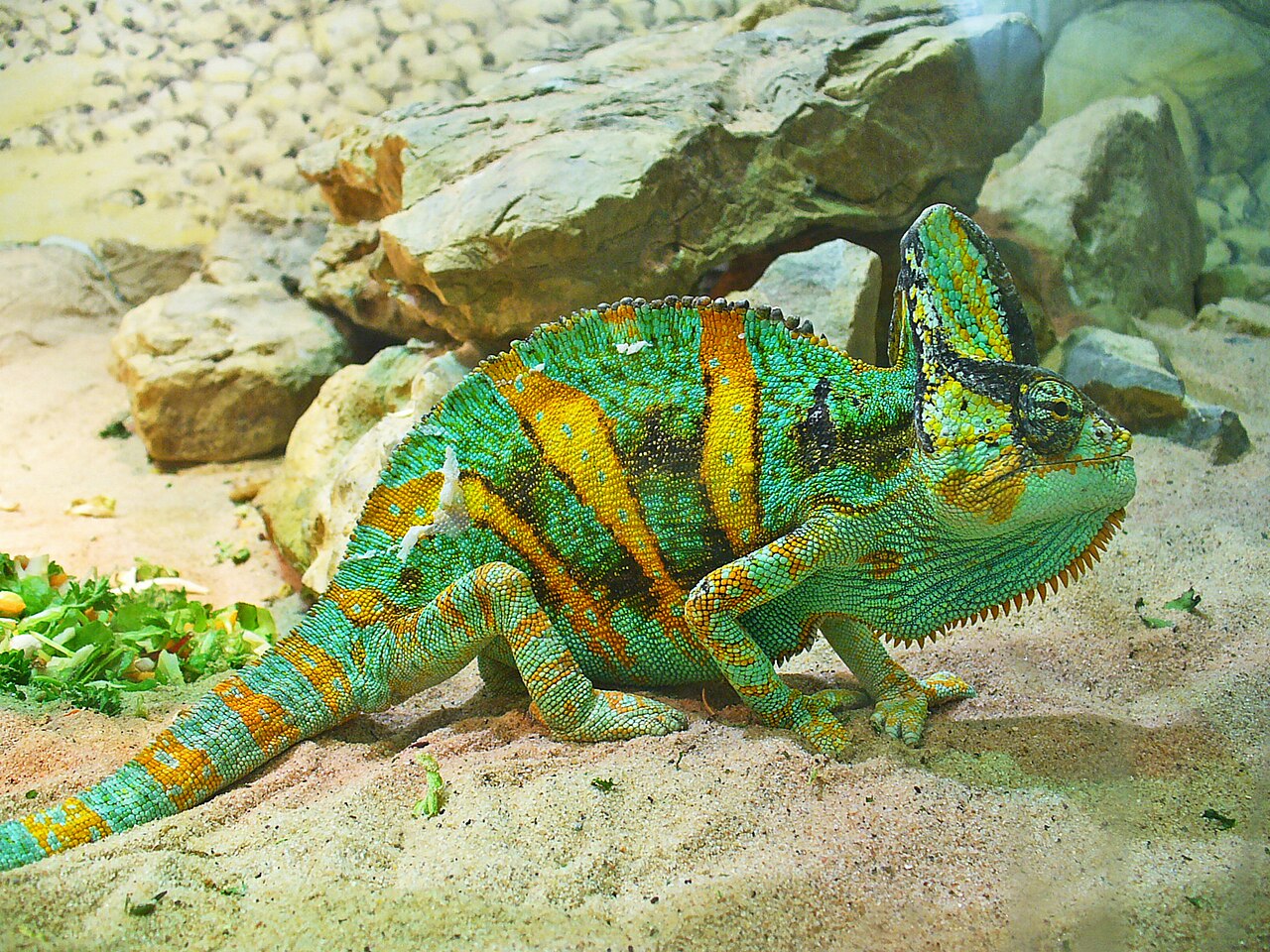
Screen enclosures are standard because airflow matters enormously. Glass tanks trap stagnant humid air, which causes respiratory infections in a species adapted to breezy mountain conditions, so a fully screened cage or a hybrid with at least two screen sides is the norm.
Size is larger than most people expect. An adult male needs a minimum of 24 by 24 by 48 in, and bigger is genuinely better, while females can use slightly smaller but still need substantial height. Chameleons are arboreal and use vertical space rather than floor area.
Fill it densely with climbing structure. Branches of varying diameter at multiple heights, plus heavy foliage from live plants such as pothos, ficus, and schefflera or artificial equivalents, give the animal secure routes and hiding places. A chameleon that can always see out in every direction is a chameleon under constant low-level stress, and visual barriers matter as much as branches.
Heat, Light, and UVB
Three separate requirements need meeting and none substitutes for another. A basking spot of 85 to 95 F for adults, produced by a halogen or incandescent bulb positioned so the animal cannot touch it, with the rest of the enclosure in the mid to high 70s and a night drop into the 60s.
UVB is non-negotiable. Chameleons need it to synthesize vitamin D3 and process calcium, and without it metabolic bone disease develops within months. Use a linear T5 UVB tube spanning much of the enclosure length rather than a compact coil, position it above the screen accounting for the mesh blocking a share of the output, and replace it every six to twelve months since output falls long before the light stops working.
Supplementation completes the picture. Dust feeder insects with calcium without D3 at most feedings, calcium with D3 roughly twice a month, and a multivitamin twice a month, adjusting to the specific products used. Getting UVB and supplementation right is the difference between a chameleon that lives its full span and one that develops bone disease, the same issue our guide to crested gecko lifespan identifies as a leading preventable cause of early death.
Water and Hydration
Veiled chameleons do not recognize standing water as something to drink. In the wild they take water from dew and rain running off leaves, and a bowl of water in an enclosure is invisible to them, which is why dehydration is one of the most common causes of illness and death in captive chameleons.
Misting is the standard answer and it needs to be substantial. Mist heavily two or three times a day for several minutes each time, ensuring leaves are visibly wet, and a dripper running slowly onto foliage for several hours a day provides the moving droplets that trigger drinking. Automated misting systems make this manageable.
Check hydration by looking at the eyes and the urate. Sunken eyes indicate dehydration, and the white urate portion of the droppings should be white or very pale, with orange or yellow indicating the animal needs more water. Because the enclosure is screen and heavily misted, drainage matters, and standing water in the base breeds bacteria and mold.
Diet
Insects form the bulk of the diet, offered daily to juveniles and every other day to adults. Crickets, dubia roaches, silkworms, hornworms, and black soldier fly larvae all work, with mealworms and waxworms too fatty for regular use.
Gut-loading the feeders matters more than most keepers appreciate, because a chameleon eats what its insects ate. Feed the feeders a quality diet of vegetables and grain for at least 24 hours before offering them, which our guide to what crickets eat covers in detail.
Veiled chameleons are unusual among chameleons in eating plant matter too. They take leaves, flowers, and fruit opportunistically, which is why any live plant in the enclosure must be non-toxic, and pothos, hibiscus, and ficus are common safe choices. Offering small amounts of collard greens, dandelion, or berries is optional but harmless, and the plant eating is thought to contribute to hydration in their dry native range. Our guide to what lizards eat places this in the wider context of lizard diets.
The Egg Laying Problem
This kills more captive female veiled chameleons than anything else and it is entirely preventable. Females produce eggs whether or not they have ever met a male, in the same way a chicken lays unfertilized eggs, and they begin doing so at around six to nine months.
A female without a suitable laying site becomes egg bound, a condition in which she retains eggs she cannot pass. It causes visible distress, loss of appetite, lethargy, and death, and it requires emergency veterinary intervention that is frequently unsuccessful.
The prevention is a laying bin, and it should be in the enclosure before it is needed. Provide a container at least 12 in deep filled with slightly damp washed play sand or a sand and soil mix, deep enough for the female to dig a tunnel and turn around in. Overfeeding also drives excessive clutch production, so many keepers deliberately reduce feeding frequency for adult females to lower the number and size of clutches. Anyone acquiring a female should treat the laying bin as basic equipment rather than an optional extra.
Temperament and Handling
Veiled chameleons are solitary and territorial, and this is a species characteristic rather than an individual quirk. They must be housed alone, since two chameleons in one enclosure results in chronic stress and often injury, and even visual contact between neighboring enclosures causes problems.
Handling is tolerated at best. Chameleons do not habituate to it the way a bearded dragon or a corn snake does, and dark coloration, gaping, hissing, and lateral body flattening are all stress displays telling you to stop. Some individuals are calmer than others, but none genuinely enjoys being held.
The realistic model is a display animal that you observe and interact with at a distance, occasionally hand-feeding from tongs, which many keepers find is the one interaction chameleons accept willingly. Anyone wanting a reptile to handle regularly should look at a bearded dragon, a corn snake, or the species in our guide to the crested gecko instead.
Are Veiled Chameleons Good First Reptiles?
They are the hardiest chameleon and the most forgiving of the group, which is why they dominate the trade. Compared with panther or Jackson’s chameleons they tolerate a wider range of conditions and are more readily available as captive-bred animals.
Compared with reptiles generally, though, they are demanding. The equipment list is long and expensive, the misting and feeding schedules are daily commitments, they cannot be handled, and the specific failure modes of dehydration, metabolic bone disease, and egg binding all kill within months rather than giving a keeper time to notice and correct course.
The honest summary is that a veiled chameleon suits someone who wants to observe a genuinely remarkable animal and is willing to build and maintain the environment it needs. Buy captive-bred rather than wild-caught, find a veterinarian experienced with reptiles before you need one, and if the goal is a first reptile that tolerates handling and forgives mistakes, choose differently. Our guides to the Pacman frog and the Gila monster cover other species where enthusiasm and suitability frequently diverge.
Frequently Asked Questions
How big do veiled chameleons get?
Males reach 17 to 24 in including the tail and females 10 to 14 in. Males live around five to eight years and females four to six, with the shorter female lifespan largely attributable to the physical demands of repeated egg production.
Do chameleons change color to camouflage?
No. Color change communicates mood, temperature, and reproductive state through iridophore cells containing nanocrystals that shift spacing to change reflected wavelengths. Bright green means relaxed, dark brown or black means stressed or cold, and gravid females show dark colors with bright spots.
Why won’t my chameleon drink from its water bowl?
Because they do not recognize standing water. In the wild they drink dew and rain running off leaves, so they need heavy misting two or three times daily plus a dripper providing moving droplets. Dehydration is a leading cause of death in captive chameleons.
Do female veiled chameleons lay eggs without a male?
Yes, starting at six to nine months, like a chicken laying unfertilized eggs. Without a laying bin at least 12 in deep filled with damp sand, a female becomes egg bound, which causes death and requires emergency veterinary care. The bin is basic equipment, not an extra.
Can you handle a veiled chameleon?
Tolerated at best. They do not habituate to handling, and dark coloration, gaping, hissing, and body flattening are stress signals. Hand-feeding from tongs is the interaction most chameleons accept willingly. They must also be housed alone, since they are solitary and territorial.
What kind of enclosure does a veiled chameleon need?
A screen enclosure of at least 24 by 24 by 48 in for an adult male, densely furnished with branches at varying heights and heavy foliage. Glass traps stagnant humid air and causes respiratory infections. Visual barriers matter as much as climbing routes.
Are veiled chameleons good for beginners?
They are the hardiest chameleon but demanding compared with reptiles generally. The daily misting and feeding, the expensive equipment, the inability to handle them, and the rapid failure modes of dehydration, bone disease, and egg binding all count against a first reptile.