Snapping Turtle: How to Identify One and What to Do If It Is in Your Yard
A snapping turtle is a large freshwater turtle with a rough shell, a long tail, and a hooked beak that can deliver a serious bite on land. North America has two of them: the common snapping turtle (Chelydra serpentina), which ranges from southern Canada to Florida and west to the Rockies, and the alligator snapping turtle (Macrochelys temminckii), which lives in rivers draining into the Gulf of Mexico. Most of the animals people meet crossing a road or digging in a lawn are common snappers.
The reputation is half earned. In water a snapping turtle almost always retreats. On land, where it cannot swim away and its shell is too small to hide in, it will lunge. Knowing which situation you are in is the whole difference between a harmless sighting and a trip to urgent care.
Snapping turtles are non venomous freshwater turtles that bite defensively only when they are out of water and cornered. Common snappers reach 8 to 18 inches (20 to 46 cm) of shell and 10 to 35 pounds (4.5 to 16 kg). They are not aggressive swimmers, they do not chase people, and a turtle in your yard is almost always a female looking for a place to nest.
| Feature | Common Snapping Turtle | Alligator Snapping Turtle |
|---|---|---|
| Shell length | 8 to 18 in (20 to 46 cm) | 15 to 26 in (38 to 66 cm) |
| Weight | 10 to 35 lb (4.5 to 16 kg) | 35 to 175 lb (16 to 80 kg) |
| Shell ridges | Low, worn smooth with age | Three tall spiked keels, kept for life |
| Head | Smooth, eyes visible from above | Massive, eyes set on the sides |
| Hunting style | Active forager and ambusher | Sit still and wiggle a worm shaped tongue lure |
| Range | Most of the eastern and central US | Gulf Coast drainages only |
| Lifespan in the wild | 30 to 50 years | Often 80 years or more |
How Do You Tell If It Is a Snapping Turtle?
Look at the tail first. A snapping turtle has a thick, muscular tail as long as its shell, lined with a saw of raised scales, and no other North American freshwater turtle has anything like it. Next check the plastron, the underside: on a snapper it is a small cross shaped plate that leaves the legs and neck exposed, which is exactly why the animal bites instead of tucking in.
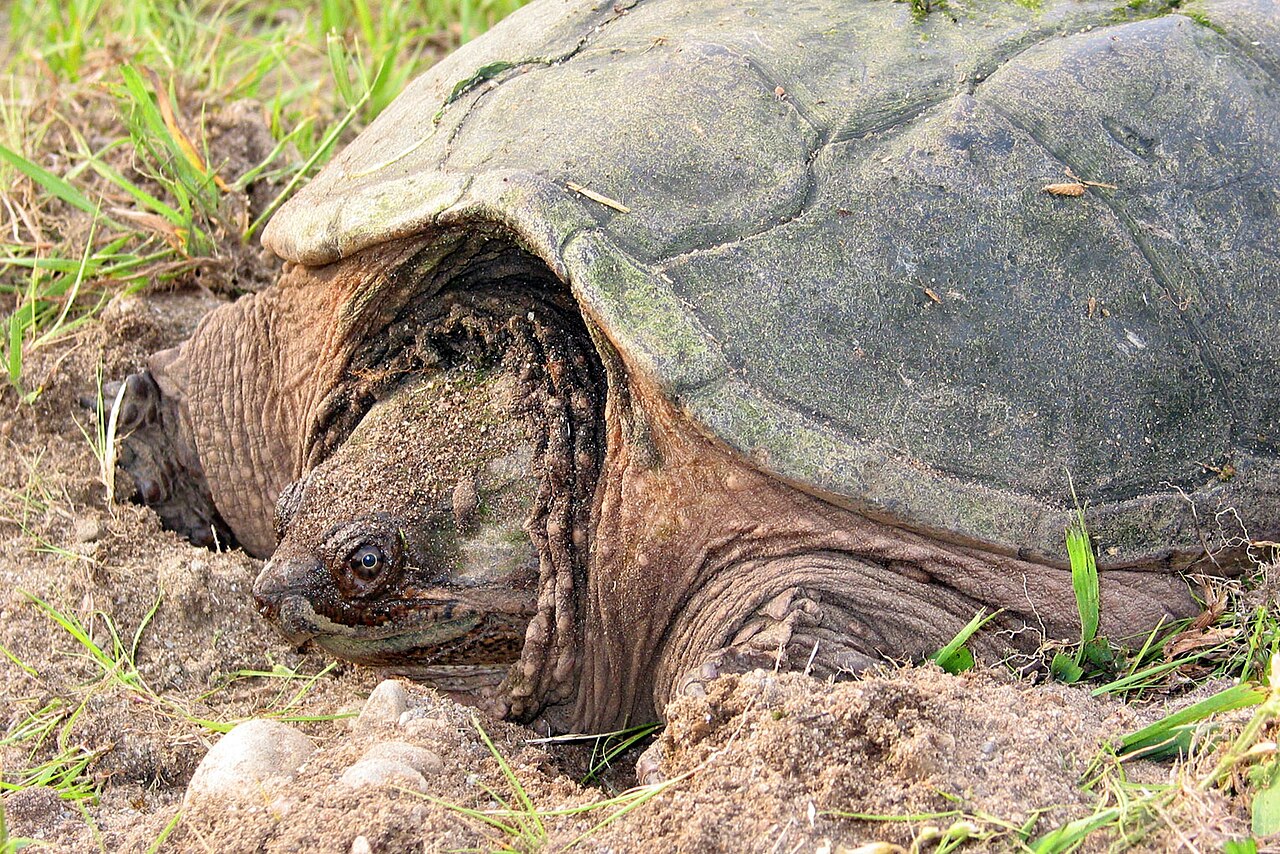
The shell itself is dull brown to olive, often coated in algae, with three rows of low ridges that flatten as the turtle ages. The head is oversized and cannot be pulled fully inside. If you are comparing it to a painted turtle sunning on a log, the difference is obvious within a second: painted turtles are smooth, glossy, and edged in red, and they slide into the water when you approach.
Common Snapping Turtle vs Alligator Snapping Turtle
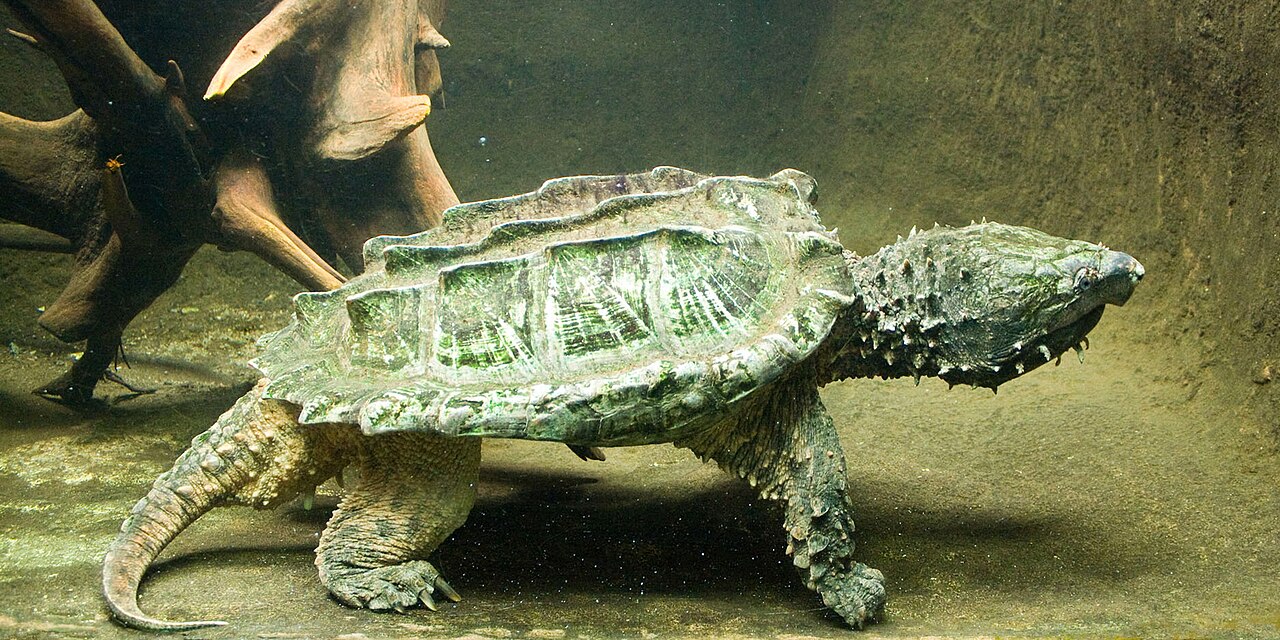
These two get mixed up constantly, and the names do not help. The alligator snapping turtle is the heavier animal by far, and its shell carries three tall spiked keels that look like a row of small mountain ranges. Those spikes stay sharp through life. On a common snapper the keels are already wearing down by the time the turtle is a few years old, and old adults can look almost smooth.
The head settles it. An alligator snapper’s eyes sit on the sides of the skull, framed by fleshy points, so you cannot see both eyes when you look down at the animal from above. A common snapper’s eyes face partly upward and are visible from directly overhead. Range narrows it further, since alligator snappers occur only in rivers that drain to the Gulf of Mexico, from Texas east to Florida and north to Illinois.
Size is a weaker clue than people think, because a young alligator snapping turtle is smaller than an adult common snapper. Use the spikes and the eye placement, not the scale. For a side by side of the hatchlings, our guide to the baby snapping turtle covers the first year of both species.
Is a Snapping Turtle Aggressive?
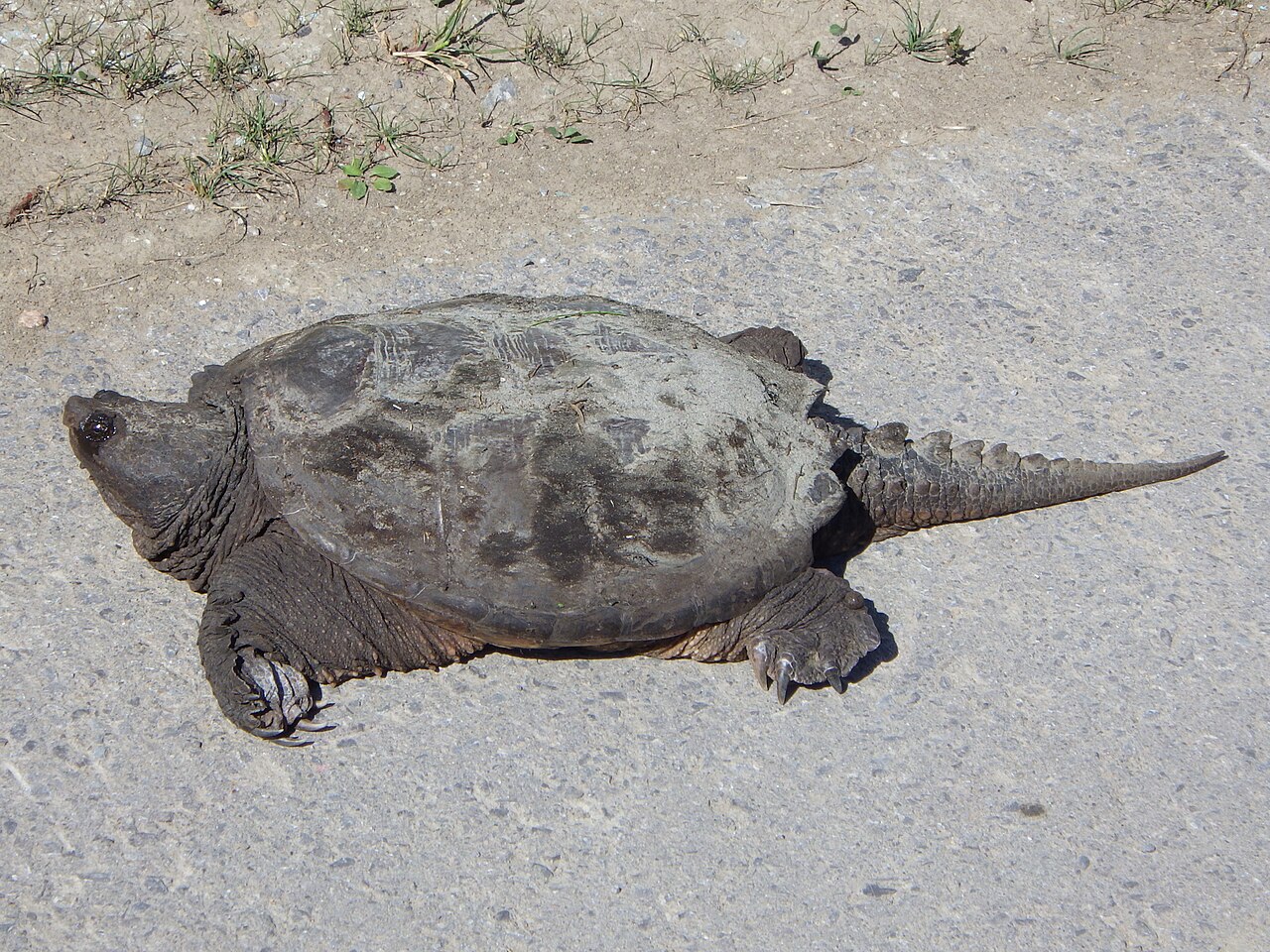
In water, no. Divers and swimmers share ponds with snapping turtles constantly without incident, and the animal’s first response to a person in the water is to sink into the sediment and wait. The same turtle that struck at a researcher on the bank goes passive the moment it is back in its element.
On land the calculation changes. A snapper cannot retract into its shell, cannot run, and cannot swim away, so its only defense is the strike: a fast forward lunge with the neck extended far further than the body length suggests. Assume the reach is about two thirds of the shell length, and never handle one from the front or the sides.
That is defense, not aggression, and the distinction matters when you decide what to do. The bite itself is powerful enough to cause deep lacerations and broken fingers but it is not venomous; our page on the snapping turtle bite covers force numbers and first aid in detail.
What Do Snapping Turtles Eat?
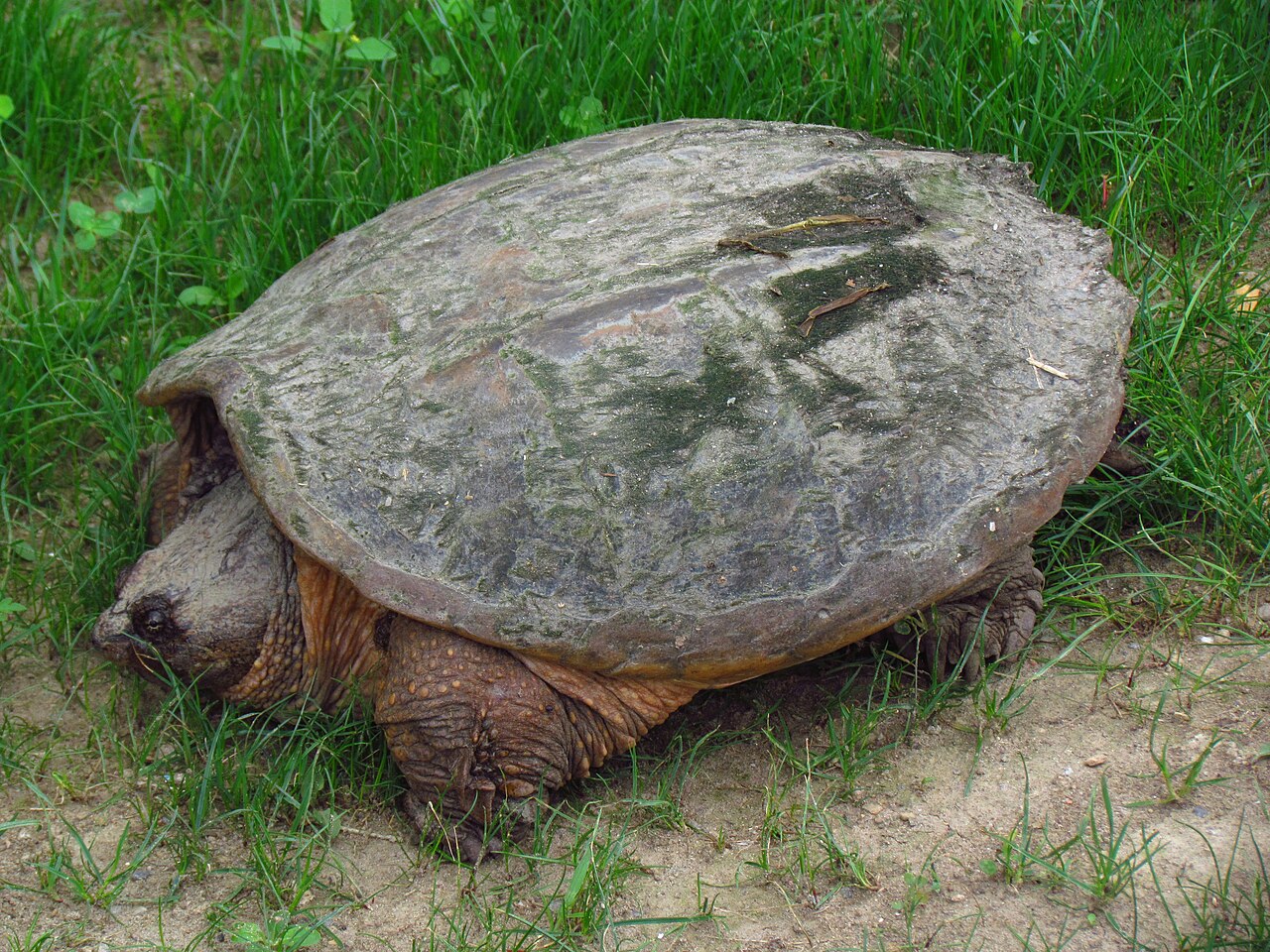
Snapping turtles are opportunistic omnivores, and the diet is broader than the reputation suggests. Studies of stomach contents repeatedly find that aquatic plants make up a third to a half of the volume, alongside fish, crayfish, insects, frogs, snails, and carrion. They are effective scavengers and clear dead fish from ponds faster than almost anything else in the water.
The hunting that gets attention is the ambush. A common snapper buries itself in soft bottom sediment with only the head exposed and takes whatever passes within reach. Alligator snappers go further and wave a pink worm shaped appendage on the tongue as a lure, then close the jaws when a fish investigates.
Where Do Snapping Turtles Go During the Day?
Most of the day is spent underwater, motionless, in mud or dense vegetation at depths of 1 to 6 feet (0.3 to 1.8 m). A snapper can hold its position for 40 to 50 minutes between breaths in warm water, and far longer when the water is cold, surfacing just enough to push the nostrils clear. That is why a pond can hold several large turtles that nobody has ever seen.
Winter is different again. From roughly October to April across the northern range, snapping turtles settle into mud or under banks and shut down, absorbing some oxygen directly through tissues in the throat and cloaca. The full mechanism is covered in our guide to whether turtles hibernate.
What to Do If You See a Snapping Turtle in Your Yard
Leave it alone and it will leave. A snapper in a yard is almost always a female in late May to early July, walking from water to a patch of loose sandy soil to lay 20 to 40 eggs, and she will head back to the water within hours of finishing. Keep dogs and children indoors for that window and the problem solves itself.
If the turtle is in a road and you choose to help, move it in the direction it was already heading, never back the way it came. Never lift a snapper by the tail, which dislocates vertebrae and can cripple the animal. The safe method is to slide a car mat or a flat shovel under it and drag it clear, or to grip the very back of the upper shell above the rear legs with both hands, keeping the head pointed away.
Relocating a snapping turtle to a new pond is a bad idea and is illegal in many states. Adults have a home range they know, and displaced turtles wander across roads trying to get back, which is a far larger source of mortality than anything in the water.
What Is a Predator of a Snapping Turtle?
Adults have almost no natural predators, which is why the species can afford a slow reproductive strategy. A full grown snapper’s size, shell, and bite put it out of reach of everything except an alligator, a very determined black bear, or a car. Road mortality among nesting females is the single biggest pressure on most populations.
The eggs and hatchlings are another story. Raccoons, skunks, foxes, coyotes, crows, and herons take an enormous share, and survey after survey finds nest predation rates above 70 percent. Of the hatchlings that reach water, most are eaten by bass, herons, bullfrogs, and larger turtles before their shells harden.
That arithmetic explains why losing adult females matters so much. A snapper may need 15 to 20 years to reach breeding age, and the population depends on individual females nesting for decades. Other freshwater species such as the softshell turtle face the same math.
How Long Do Snapping Turtles Live?
Common snapping turtles commonly reach 30 to 50 years in the wild, and captive animals have passed 60. Alligator snappers live longer still, with credible estimates of 80 to 100 years or more for large individuals, though ages above 70 are hard to confirm because the shell growth rings stop being readable in old adults.
Longevity comes with a catch. Because snapping turtles sit high in the food web and live for decades in the same sediment, they accumulate mercury and PCBs, which is why many states advise limits on eating them. Check your state wildlife agency before harvesting; the University of Georgia’s herpetology program at SREL Herpetology keeps accessible species accounts with the underlying research.
Frequently Asked Questions
Can snapping turtles be friendly?
They do not form bonds with people the way a dog or even a pet tortoise might, but captive snapping turtles do learn that a keeper means food and become noticeably calmer over time. That is habituation, not affection. A wild snapper handled on land will always treat you as a threat, and it should.
How rare is it to see a snapping turtle at your house?
Not rare at all if you live within about half a mile of a pond, marsh, slow river, or even a large drainage ditch in the eastern or central US. Sightings cluster tightly in late May through early July, when females travel overland to nest, and drop to near zero the rest of the year.
What scares snapping turtles away?
Very little, because their defense is to stand and strike rather than to flee. Spraying water from a hose usually gets a nesting female moving, and simply giving the animal an unobstructed path back toward water works better than trying to drive it off. Repellent granules and ultrasonic devices do nothing.
What is the most aggressive turtle?
Among North American species the common snapping turtle is the quickest to strike on land, and the alligator snapping turtle delivers the harder bite. Neither is aggressive in the sense of seeking confrontation. Both simply lack the option of hiding in the shell, so the mouth becomes the only defense they have.
Is a snapping turtle bite poisonous?
No. Snapping turtles are not venomous or poisonous, and the danger of a bite is purely mechanical: crushing force and deep tearing wounds from the hooked beak. Infection risk is real, since the mouth carries aquatic bacteria including Salmonella, so wash any bite thoroughly and see a doctor if the skin is broken.