Giant Moth: The World’s Largest Species and How to ID Them
The largest moths in the world span roughly 10 to 12 in, and the title depends on how you measure. The atlas moth and the white witch compete for the greatest wingspan, the Hercules moth of Australia holds the record for total wing surface area, and the giant wood moth is the heaviest. In North America the biggest is the cecropia moth at 5 to 7 in.
Most people asking about giant moths, though, have found something specific and want a name for it. This guide works through the giants by region, covers the giant leopard moth that generates more searches than any other, explains why so many of these species cannot eat as adults, and sorts out what to do when one lands on your porch.
| Species | Size and Range |
|---|---|
| Atlas moth | Up to 10 in, Southeast Asia |
| White witch | Up to 12 in wingspan, Central and South America |
| Hercules moth | Greatest wing area, up to 11 in, Australia |
| Cecropia moth | 5 to 7 in, largest in North America |
| Polyphemus moth | 4 to 6 in, across North America |
| Black witch | Up to 7 in, southern US and tropics |
The largest moths span 10 to 12 inches. The atlas moth and white witch compete on wingspan, the Hercules moth holds the wing-area record, and North America’s largest is the cecropia at 5 to 7 inches. None of them bite or sting, and most cannot eat at all.
What Counts as the Largest Moth?
Three different measurements produce three different champions, which is why sources disagree. Wingspan measures tip to tip, wing surface area measures the total area of the wings, and mass measures weight, and no single species leads in all three.
The white witch (Thysania agrippina) of Central and South America holds the wingspan record, with verified specimens reaching roughly 12 in. It is a slender-bodied moth with intricate grey and brown marbling, and despite the span it is far lighter than the bulkier giants.
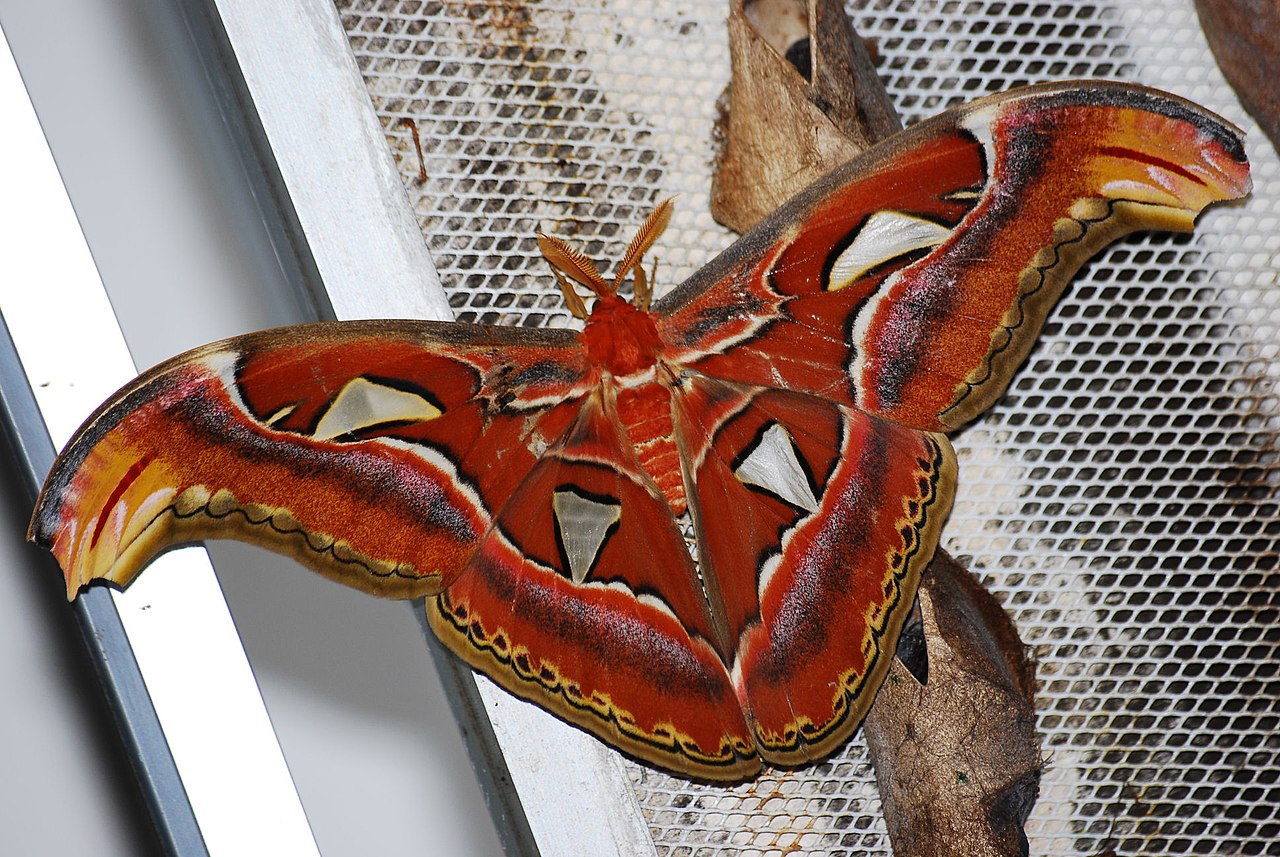
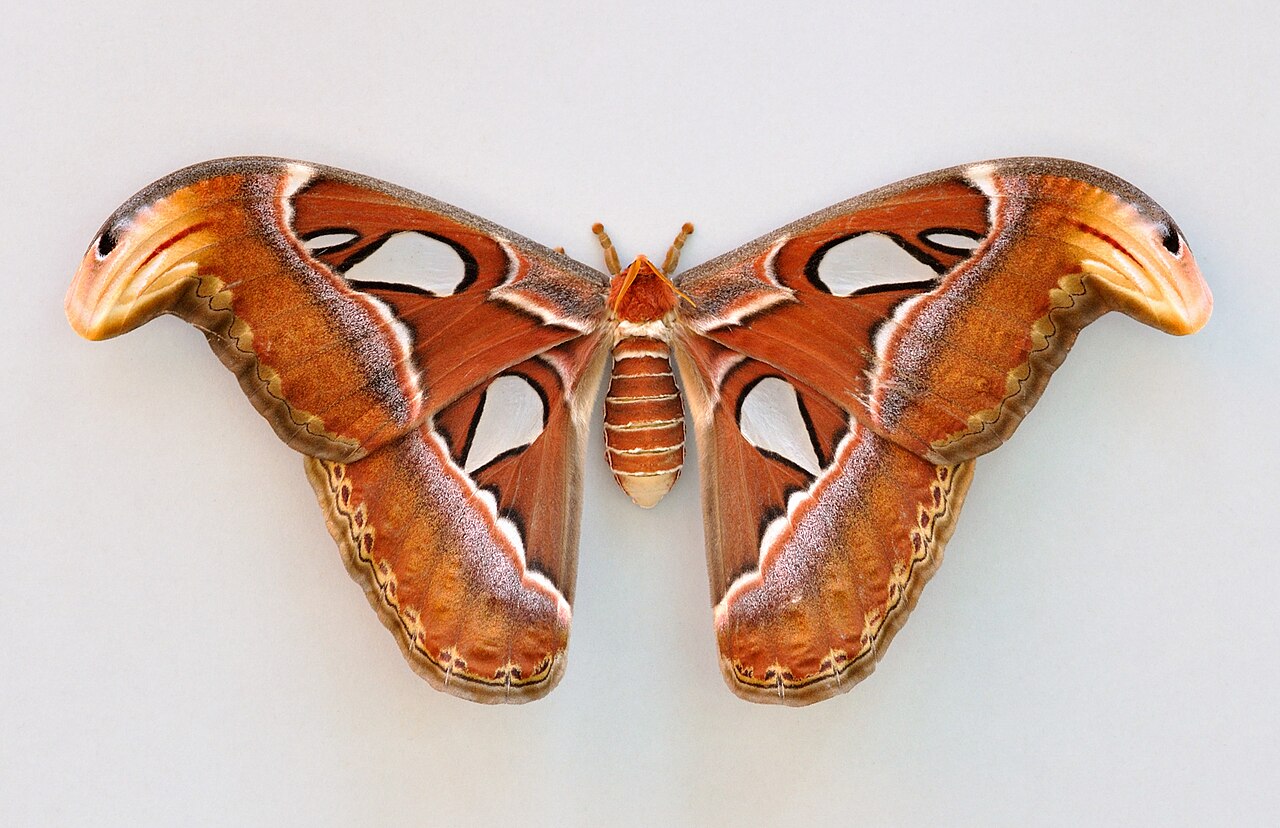
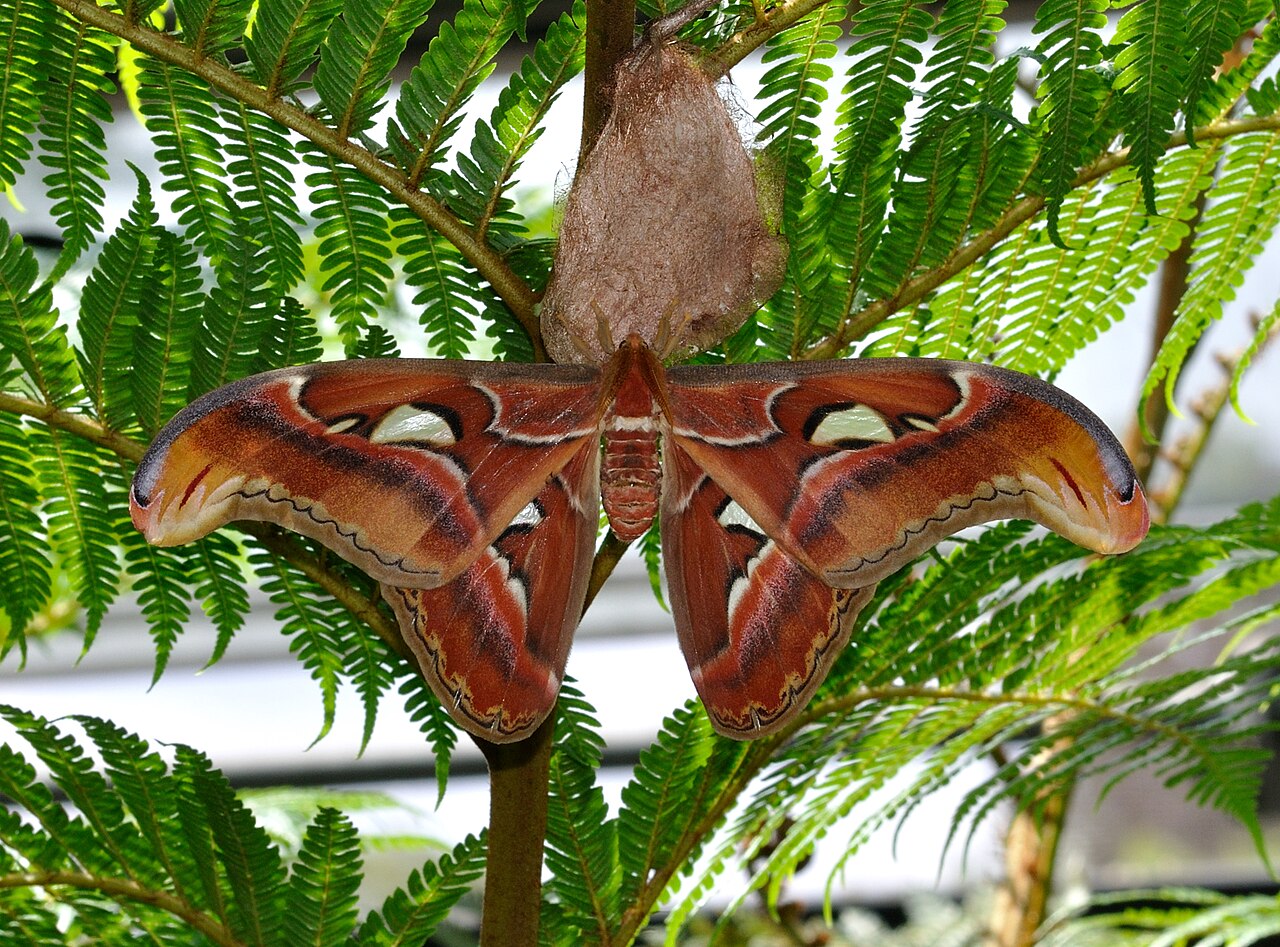
The atlas moth (Attacus atlas) of Southeast Asia reaches about 10 in with much broader wings, and the Hercules moth (Coscinocera hercules) of northern Australia and New Guinea holds the record for total wing surface area, with females exceeding 11 in and carrying enormous hindwing tails. The giant wood moth of Australia, at up to 1 oz, is the heaviest known moth by a wide margin.
The Giant Leopard Moth
This species drives more searches than any other giant moth, and it is worth clarifying that it is not actually among the giants. The giant leopard moth (Hypercompe scribonia) has a wingspan of 2 to 3.6 in, which is large for a tiger moth but modest next to the true record holders.
It earns the attention through appearance. The adult is bright white with a pattern of black rings and solid spots, and the abdomen is iridescent blue with orange markings, so a resting moth looks almost artificially designed. It occurs across the eastern and central United States and south into Central America.
The caterpillar generates its own search traffic. It is jet black with stiff bristles and shows brilliant red bands between the segments when it curls into a defensive ball, and it is completely harmless despite looking otherwise. It overwinters as a caterpillar, which is why people find them crossing pavement in autumn and on warm winter days. Our guide to the black caterpillar covers it alongside the other dark larvae it gets confused with.
North America’s Giant Silk Moths
The giant silk moths, family Saturniidae, are the true North American heavyweights. The cecropia moth is the largest at 5 to 7 in, reddish-brown and grey with white crescent marks and dark eyespots, occurring across the eastern and central states.
The polyphemus moth follows at 4 to 6 in, tan to reddish-brown with dramatic eyespots on the hindwings that flash when the moth is disturbed, and it has the widest distribution of any North American giant silk moth. The luna moth is the most recognizable, pale sea-green with long sweeping tails and a span up to 4.5 in.
Promethea, io, and imperial moths round out the group, all with wingspans between 2 and 6 in. Regional searches reflect where people encounter them: the moths reported from Texas, Ohio, Florida, and Arizona are almost always one of these species or a large sphinx moth. Our guide to the cecropia moth covers the largest of them in detail.
Why Giant Moths Cannot Eat
Every giant silk moth shares a startling trait: the adults have vestigial mouthparts and no functional digestive system. They cannot drink nectar, water, or anything else, and the entire adult stage runs on fat stored during the caterpillar’s feeding.
This explains almost everything about their behavior. There is no reason to search for food, no territory worth holding, and no benefit in living long, so selection has optimized purely for finding a mate fast. Adults live one to two weeks, sometimes less.
The mate finding runs on pheromones. Females release a species-specific compound after midnight and wait, and males detect it with enormous feathered antennae carrying tens of thousands of receptors, following the plume upwind over distances exceeding a mile. It is an elegant system and it is exactly what artificial lighting disrupts, since a male orienting to a bright bulb stops following scent.
Giant Sphinx and Hawk Moths
Sphinx moths are the other group people report as giants, and they are built quite differently. Where silk moths are broad-winged and slow, sphinx moths have narrow swept-back wings and heavy torpedo bodies built for fast powerful flight.
Several are large. The giant sphinx reaches about 6 in, the white-lined sphinx 2.5 to 3.5 in, and various tropical species exceed both. Unlike the silk moths, sphinx moths do feed as adults, using a long proboscis to drink nectar while hovering, and in some species that proboscis is extraordinarily long.
Sphinx moths also fly with unusual precision, hovering in place at a flower while extending the proboscis, and several species migrate long distances. Charles Darwin made a famous prediction from one of them. On seeing a Madagascan orchid with a nectar spur nearly 12 in deep, he argued that a moth with a proboscis of matching length must exist to pollinate it, and such a moth was described decades later. Our guide to the hummingbird moth covers the day-flying members of this family that people mistake for birds.
The Black Witch and Other Large Dark Moths
The black witch (Ascalapha odorata) reaches up to 7 in and is the largest moth in the continental United States by some measures, dark brown with intricate patterning and a comma-shaped mark on each forewing. It is a strong migrant, breeding in the tropics and dispersing north as far as Canada in late summer.
It carries unusually heavy folklore. In parts of Mexico and Central America it is called mariposa de la muerte and is associated with death or misfortune when it enters a house, while in parts of the Caribbean and Texas the same moth is read as good luck, sometimes as a sign of coming money. The same insect carries opposite meanings a short distance apart.
Other large dark moths get reported as giants regularly. The imperial moth, various underwings, and the largest sphinx moths all produce alarmed sightings, and none of them can bite, sting, or harm anything. Moths have no biting mouthparts capable of breaking skin and no venom of any kind.
Are Giant Moths Dangerous?
No. Adult moths cannot bite or sting, and the giant silk moths cannot even eat. There is no North American moth that poses a physical threat to a person, and handling one harms the moth far more than the person, since touching the wings removes the scales it needs to fly.
Caterpillars are where genuine caution belongs, and even there the giants are mostly harmless. Cecropia, polyphemus, and luna caterpillars are safe to handle despite their size and colorful tubercles. The io moth caterpillar is the exception among the giant silk moths, carrying venomous spines that produce a painful sting.
The general rule covers it: look at caterpillars rather than handling them, since a few unrelated species including the puss caterpillar and saddleback cause real pain requiring medical attention. Our guide to the fuzzy caterpillar sorts the harmless from the few that sting.
Why Giant Moths Are Getting Rarer
Populations of giant silk moths have declined substantially across much of North America, and several causes are well documented. The Xerces Society for Invertebrate Conservation tracks moth and butterfly declines alongside its better-known pollinator work, and university entomology departments have published repeatedly on this particular group. The most specific is Compsilura concinnata, a parasitoid fly introduced in 1906 to control spongy moth, which attacks a wide range of native caterpillars and parasitizes large percentages of giant silk moth larvae in some regions.
Light pollution compounds it by disrupting the pheromone navigation the entire reproductive system depends on. A male drawn to a streetlight spends his short adult life circling it, and studies of insect declines increasingly identify artificial light at night as a significant driver rather than a minor one.
Habitat loss and pesticides finish the list. These species need mature host trees, leaf litter for pupation, and dark nights, and suburban landscaping removes all three. Bacillus thuringiensis sprayed against spongy moth kills giant silk moth caterpillars indiscriminately, since it does not distinguish between species. Leaving leaf litter, planting native trees, and switching to amber outdoor lighting are three changes that genuinely help, and they help the smaller species in our guide to the white moth at the same time.
Related reading: Giant Millipede.
What Are Those Huge Moths Called?
In North America, a very large moth at a porch light in early summer is almost always one of the giant silk moths, family Saturniidae. The cecropia is the biggest, reddish-brown with white crescent marks and a 5 to 7 inch span. The polyphemus is tan with large eyespots on the hindwings. The luna is the pale green one with long trailing tails, and the promethea and io moths round out the group.
A second group accounts for most of the rest. Sphinx or hawk moths are heavy-bodied, narrow-winged and fast, and include the hummingbird clearwing that hovers at flowers in daylight and gets reported as a tiny hummingbird. The black witch is a large dark tropical moth that wanders north each year and is often mistaken for a bat.
Worldwide the record holders are elsewhere: the atlas moth of Asia and the white witch of Central and South America both approach 12 inches across, and the Hercules moth of Australia and New Guinea has the largest total wing surface. The Smithsonian’s moth information sheet covers where the giant silkworm moths sit within the wider group.
Frequently Asked Questions
What is the largest moth in the world?
It depends on the measurement. The white witch has the greatest wingspan at roughly 12 in, the Hercules moth of Australia the greatest wing surface area, the atlas moth reaches 10 in with much broader wings, and the giant wood moth is the heaviest at up to 1 oz.
What is the largest moth in North America?
The cecropia moth, with a wingspan of 5 to 7 in. The polyphemus moth follows at 4 to 6 in, and the black witch reaches up to 7 in but is a migrant rather than a resident breeder across most of the range.
Is the giant leopard moth actually giant?
Not by world standards. It spans 2 to 3.6 in, which is large for a tiger moth but far below the record holders. It draws attention for its striking white wings with black rings and its iridescent blue abdomen, and for its jet black caterpillar that shows red bands when curled.
Why do giant moths only live a week or two?
Because adult giant silk moths have vestigial mouthparts and cannot eat at all. The entire adult stage runs on fat stored during the caterpillar’s feeding, so selection favors finding a mate quickly rather than living long.
Are giant moths dangerous?
No. Adult moths cannot bite or sting, and the giant silk moths cannot even feed. Most of their caterpillars are harmless too, with the io moth being the notable exception among the giants, since it carries venomous spines that sting.
What does a black witch moth mean?
The symbolism reverses by region. In parts of Mexico and Central America it is called the butterfly of death and read as an omen of misfortune, while in parts of the Caribbean and Texas the same species is considered good luck and sometimes a sign of coming money.
Why are giant moths becoming rare?
A parasitoid fly introduced in 1906 against spongy moth attacks native caterpillars heavily, light pollution disrupts the pheromone navigation males rely on, habitat loss removes host trees and pupation sites, and Bacillus thuringiensis sprayed against spongy moth kills their caterpillars too.