Buckeye Butterfly: ID, Eyespots, and Host Plants
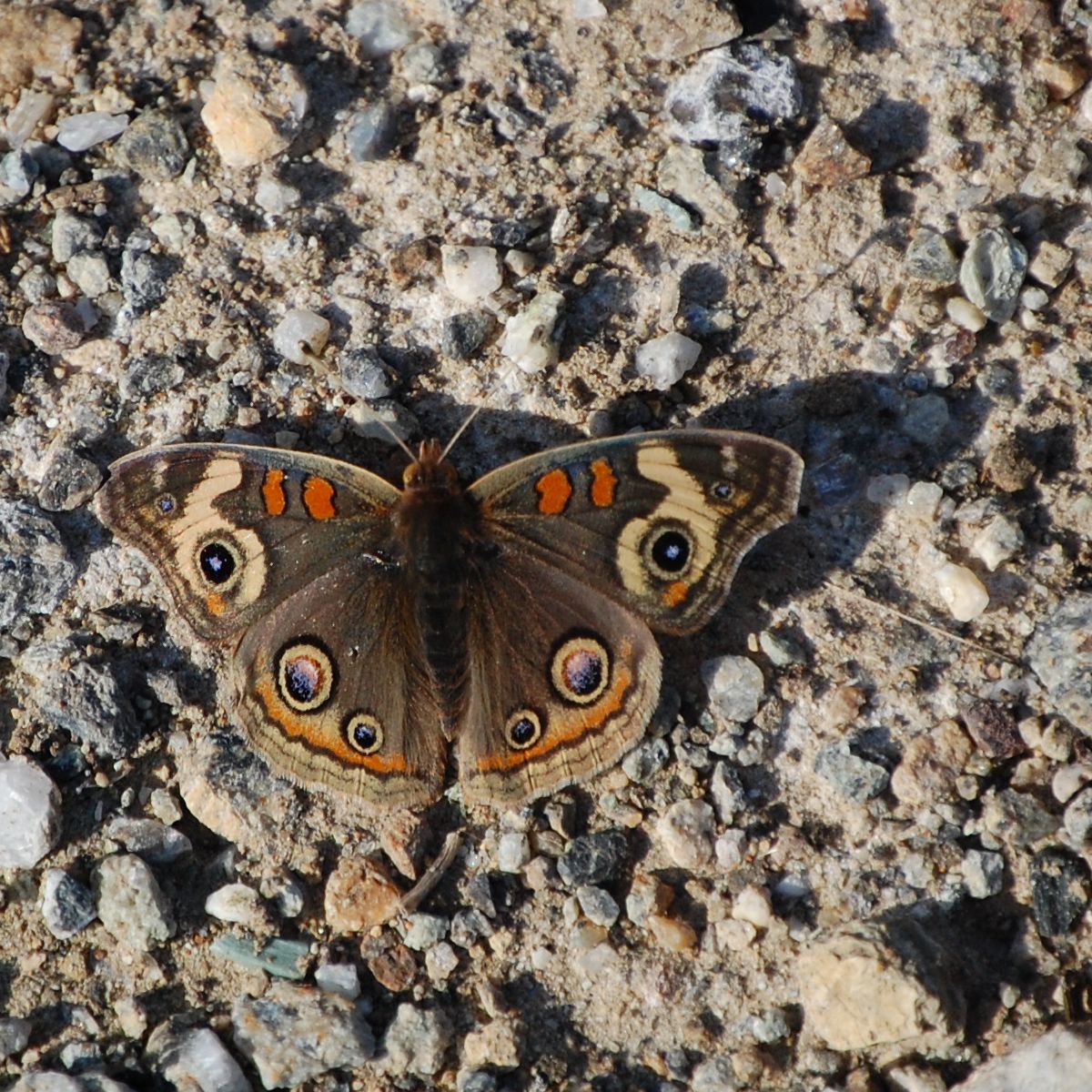
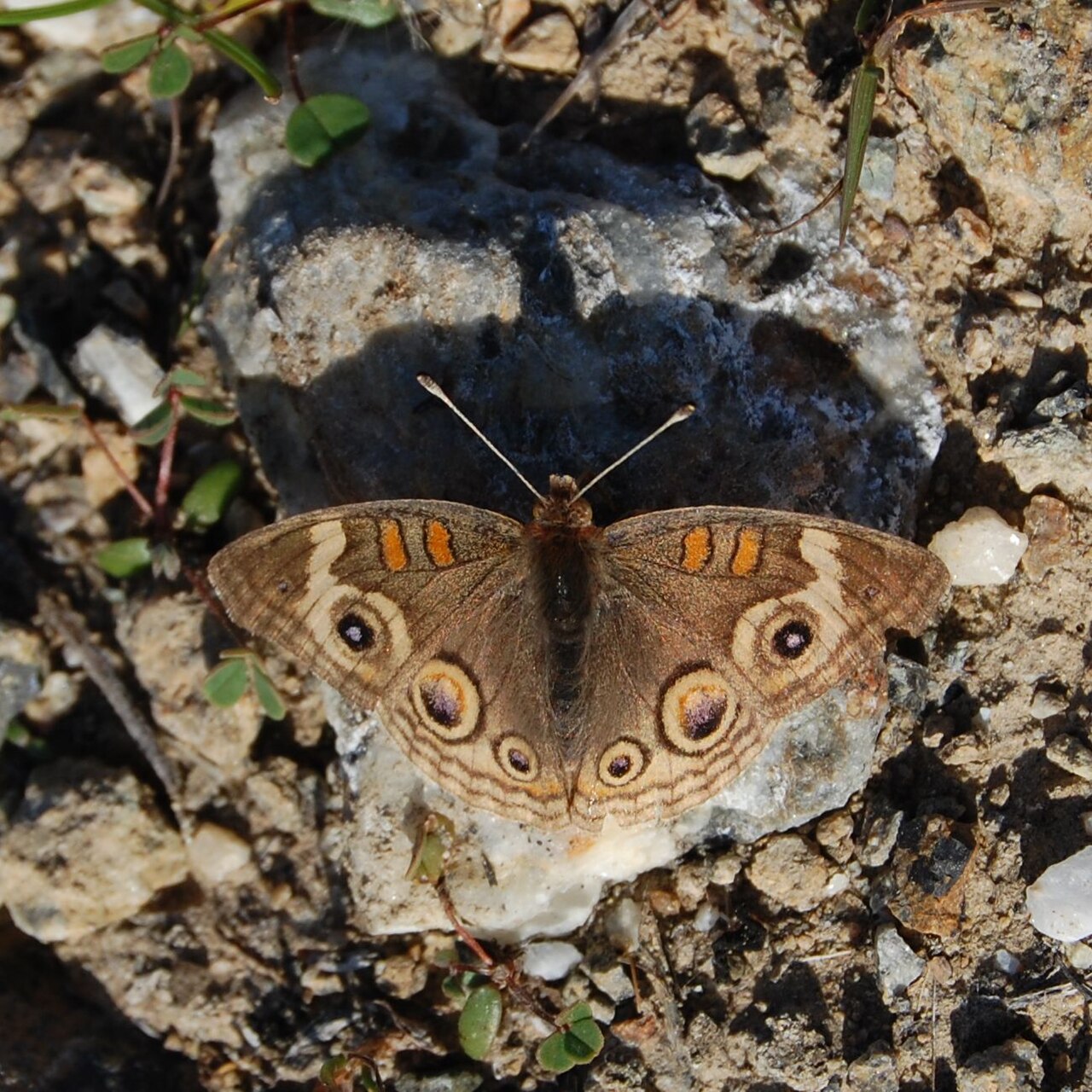
The common buckeye is a medium brown butterfly marked with six large eyespots, two orange bars on each forewing, and white bands, spanning about 1.6 to 2.7 inches. It is one of the most widespread butterflies in the United States, found in open sunny ground from coast to coast, and it is instantly recognisable because nothing else in North America carries eyespots that big and that round.
Those eyespots are the whole point of the animal. They deflect bird attacks away from the body and startle predators that get close, and the butterfly opens and closes its wings deliberately to flash them. Buckeyes are also unusually pugnacious for butterflies, with males holding open patches of bare ground and chasing off anything that enters. This guide covers identification, host plants, the eyespot function, symbolism, and how to attract them.
The common buckeye is a brown butterfly with six large eyespots, orange forewing bars, and white bands, spanning 1.6 to 2.7 inches. Caterpillars feed on plantain, toadflax, snapdragon, and false foxglove. Eyespots deflect bird attacks and startle predators. Adults live about two weeks and cannot survive hard freezes, so northern populations recolonise each year.
| Feature | Common Buckeye |
|---|---|
| Scientific name | Junonia coenia |
| Wingspan | 1.6 to 2.7 in |
| Marking | Six eyespots, two orange forewing bars |
| Host plants | Plantain, toadflax, snapdragon, false foxglove |
| Habitat | Open bare ground, fields, roadsides, dunes |
| Adult lifespan | About 10 to 14 days |
| Winter | Cannot survive hard freeze; recolonises north each year |
What Does a Buckeye Butterfly Look Like?
A buckeye is brown above with a bold pattern that reads clearly even in flight. Each forewing carries a large eyespot near the outer edge, a smaller one nearer the tip, a broad white band crossing the wing, and two orange bars in the cell. Each hindwing carries one large eyespot and one small one, along with an orange submarginal band.
The eyespots are large, round, and multicoloured, with a black outer ring, an iridescent blue or purple centre, and often a white highlight, which makes them look convincingly like vertebrate eyes. Six of them across the four wings is far more than most North American butterflies carry.
Underneath the picture changes completely. The hindwing underside is plain tan, brown, or in autumn a strong rosy pink, with the eyespots reduced or absent, so a settled buckeye with closed wings looks like a dead leaf. That switch between conspicuous and camouflaged is the core of its defence. The orange and black butterfly guide covers the species it gets grouped with by colour.
What Are the Eyespots For?
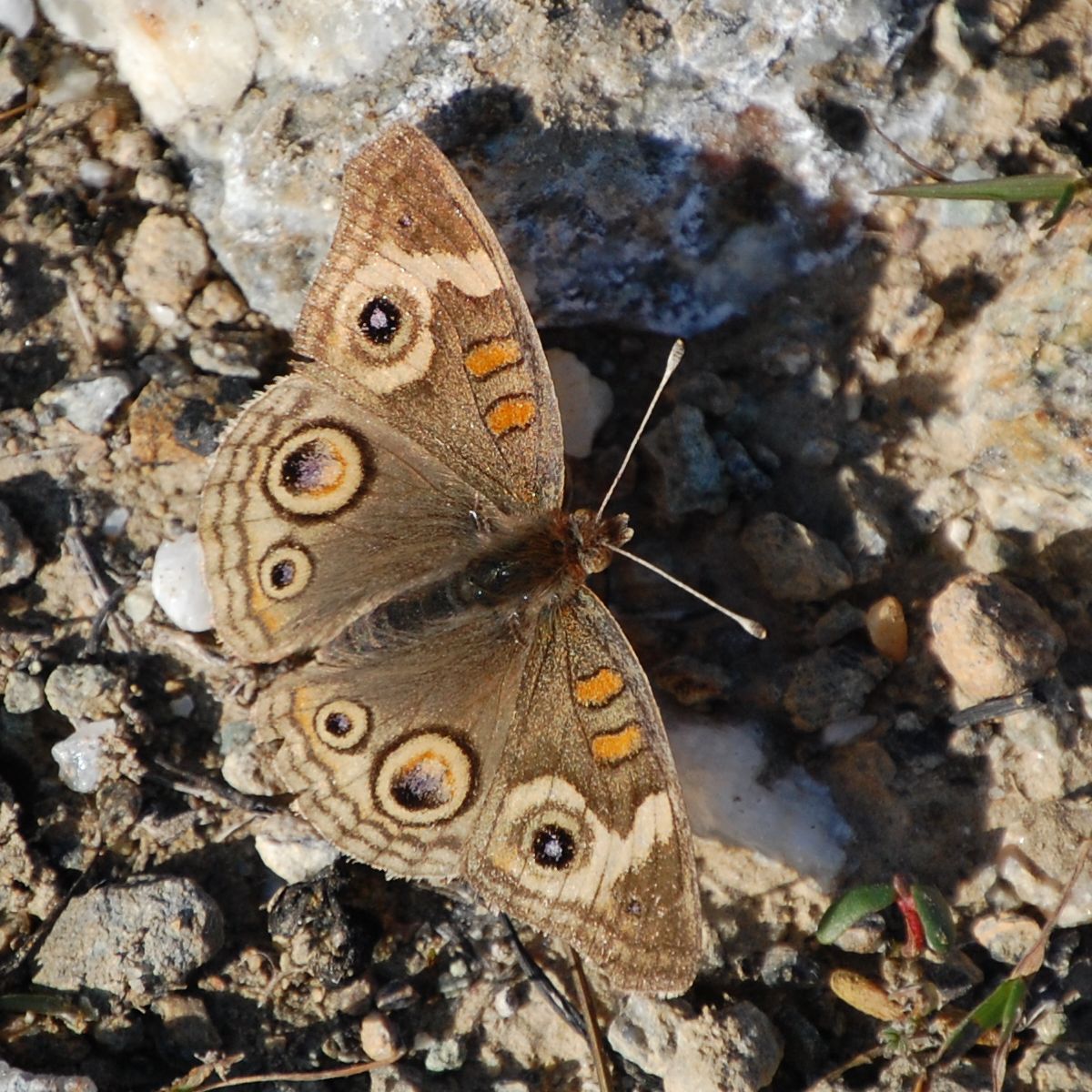
Two things, and they work at different distances. Small eyespots near the wing margin deflect attacks, drawing a bird’s strike to the edge of the wing rather than the body, which is why so many butterflies are found with beak-shaped chunks missing from the wing edge and are otherwise unharmed. A butterfly can fly perfectly well with damaged wing margins.
The large eyespots serve the opposite function, which is startle. A buckeye that is approached closely will suddenly open its wings, flashing what look like the eyes of a much larger animal, and experiments on birds have shown that large conspicuous eyespots genuinely delay or abort attacks. The pause is often enough for the butterfly to escape.
The behaviour is deliberate rather than passive. Buckeyes bask with wings open, close them when settled and undisturbed, and flick them open when something approaches. The combination of a cryptic underside and a startling upperside gives the butterfly two defences that work in sequence rather than one that has to cover everything.
What Are the Host Plants for Buckeye Butterflies?
Caterpillars feed on plants containing iridoid glycosides, principally common plantain and English plantain, along with toadflax, snapdragon, false foxglove, wild petunia, vervain, and several related species. Plantain is the one that matters most in practice, because it grows in every lawn, verge, and waste patch in the country.
That is why buckeyes are common in places nobody plants for butterflies. A neglected corner of a yard with plantain in it is a buckeye host patch, and the species thrives in disturbed open ground, roadsides, vacant lots, dunes, and fields far more than in gardens or woodland.
The caterpillar is dark, spiny, and marked with orange, white, and blue-black, with branched spines along the body and two orange-based spines on the head. It looks alarming but is harmless, and the spines do not sting. Like the monarch, the buckeye sequesters compounds from its host plant, which gives it some chemical protection. The black caterpillar guide covers what else looks like it.
Where Do Buckeye Butterflies Live?
Across most of the United States and into southern Canada and Mexico, wherever there is open sunny ground with bare patches. Buckeyes are strongly associated with disturbed habitat: roadsides, fields, dunes, gravel lots, trail edges, and overgrazed pasture, and they are much less common in woodland or dense vegetation.
The distribution shifts through the year. Buckeyes cannot survive hard freezes at any life stage, so the permanent population is in the south, and each spring and summer they push north in waves, recolonising the northern states and Canada. By late summer they are often abundant far north of where any overwintered.
In autumn there is a return movement. Buckeyes migrate south in numbers along the Atlantic coast and elsewhere in September and October, sometimes in loose streams alongside monarchs, and the autumn-brood adults develop the rosy pink hindwing underside associated with that generation. The migration is real but far less studied than the monarch’s. The monarch butterfly guide covers the migration that shares the same corridors.
Are Buckeye Butterflies Aggressive?
Males are territorial and behave more like small hawks than the general image of a butterfly. A male picks a patch of bare sunlit ground, basks with wings open, and launches at anything that flies over, including other buckeyes, larger butterflies, bees, dragonflies, and occasionally birds, then returns to the same spot.
They also patrol, flying low and fast over open ground in short bursts with rapid wingbeats and short glides, which is a distinctive flight style once you have seen it. Buckeyes are notably fast and difficult to follow compared with most butterflies of similar size.
None of this involves any capacity to harm. Butterflies have no bite, sting, or defence beyond flight, and the chases are display. What the behaviour does mean practically is that a buckeye holding a patch of driveway or trail will usually return to the same spot within a minute of being disturbed, which makes it one of the easier butterflies to photograph.
What Does It Mean to See a Buckeye Butterfly?
Buckeyes are read within general butterfly symbolism as transformation and renewal, with the eyespots adding a specific reading about perception, watchfulness, and being seen. Eyes in symbolism carry protection and awareness across many traditions, and a butterfly covered in them collects those associations.
There is no distinct traditional folklore attached to this species, which is worth saying directly. Butterfly symbolism in North America is largely generic, and readings specific to the buckeye online are modern constructions rather than inherited belief. That does not make them useless to the person who finds them meaningful, but they are not old.
Practically, a buckeye in a yard indicates open sunny ground with plantain or a related host nearby, which is to say a slightly untidy patch. It is a butterfly of neglected corners rather than manicured beds. The guide to a butterfly landing on you covers the broader symbolism of the encounter.
How Long Do Buckeye Butterflies Live?
Adults live roughly ten to fourteen days in summer, which is typical for a mid-sized butterfly and short enough that a garden population turns over several times through a season. The autumn migratory generation lives longer, since it has to complete the flight south and overwinter as an adult in the far south.
The full cycle from egg to adult takes about a month in warm conditions. Eggs are laid singly on host plant leaves and hatch in about a week, the caterpillar feeds through five instars over two to three weeks, and the chrysalis stage takes seven to ten days. Multiple generations run through the season.
Buckeyes have become a laboratory model species because they are easy to rear on plantain, complete a generation quickly, and show clear seasonal wing forms. Research on eyespot development and on seasonal polyphenism uses Junonia coenia extensively, and the U.S. Department of Agriculture (usda.gov) and university entomology programmes both maintain rearing protocols.
Why Do Autumn Buckeyes Look Different?
Because of seasonal polyphenism, the same phenomenon that produces two forms of the zebra swallowtail. Buckeyes developing under the short days and cooler temperatures of late summer produce the rosa form, with a strong rosy pink or reddish hindwing underside, while summer-brood butterflies have a plain tan underside.
The trigger is day length and temperature experienced during the larval and pupal stages, not the adult’s own conditions, and the change is developmental rather than genetic. Autumn adults are also often slightly larger and more heavily marked above.
The likely function is thermal and cryptic. A darker underside absorbs more heat while basking with wings closed, which matters in cooler weather, and rosy brown matches autumn leaf litter better than pale tan does. A pink-bellied buckeye in October is not a different species and is not rare. The purple emperor guide covers another case where wing appearance shifts with conditions.
How Do You Attract Buckeye Butterflies?
Leave a patch untidy and sunny. Buckeyes want bare ground and low disturbed vegetation, so a mown lawn edge with plantain left in it, a gravel path, or a corner of the yard left rough will do more than a formal border. Removing plantain from a lawn removes the host plant.
For nectar, buckeyes favour short composite flowers close to the ground, including aster, gumweed, chicory, tickseed, knapweed, dogbane, and peppermint. They rarely use tall garden perennials or tubular flowers, which is why butterfly borders designed for swallowtails often miss them entirely.
Bare ground matters as much as flowers. Males need open sunlit patches to hold territory and to bask, and a garden with total ground cover has nowhere for them to sit. A few square feet of gravel, sand, or bare soil in full sun, kept damp occasionally for puddling, is the single most effective addition. The painted lady guide covers a species with almost identical habitat preferences.
Frequently Asked Questions
What does a buckeye butterfly look like?
Brown with six large round eyespots, two orange bars on each forewing, and white bands, spanning 1.6 to 2.7 inches. The underside is plain tan or rosy pink and looks like a dead leaf.
What are the host plants for buckeye butterflies?
Plantain above all, plus toadflax, snapdragon, false foxglove, wild petunia, and vervain. All contain iridoid glycosides, and plantain grows in almost every lawn and roadside verge.
What are the eyespots for?
Small ones deflect bird strikes to the wing edge; large ones startle predators when the butterfly suddenly opens its wings. Experiments show large eyespots genuinely delay or abort bird attacks.
Is a buckeye a moth or a butterfly?
A butterfly, in the brush-footed family Nymphalidae. It flies by day, has clubbed antennae, and rests with wings either open for basking or closed above the back.
How long does a common buckeye live?
About ten to fourteen days as an adult in summer, with the autumn migratory generation living longer. The full cycle from egg to adult takes roughly a month in warm conditions.
Why are autumn buckeyes pink underneath?
Seasonal polyphenism. Short days and cool temperatures during larval development produce the rosa form with a rosy hindwing underside, which likely helps with heat absorption and autumn camouflage.
Are buckeye butterflies aggressive?
Males are territorial and chase other butterflies, bees, dragonflies, and occasionally birds from a patch of bare ground, then return to the same perch. They cannot harm anything.