Red-Spotted Purple Butterfly: ID, Mimicry, and Host Plants
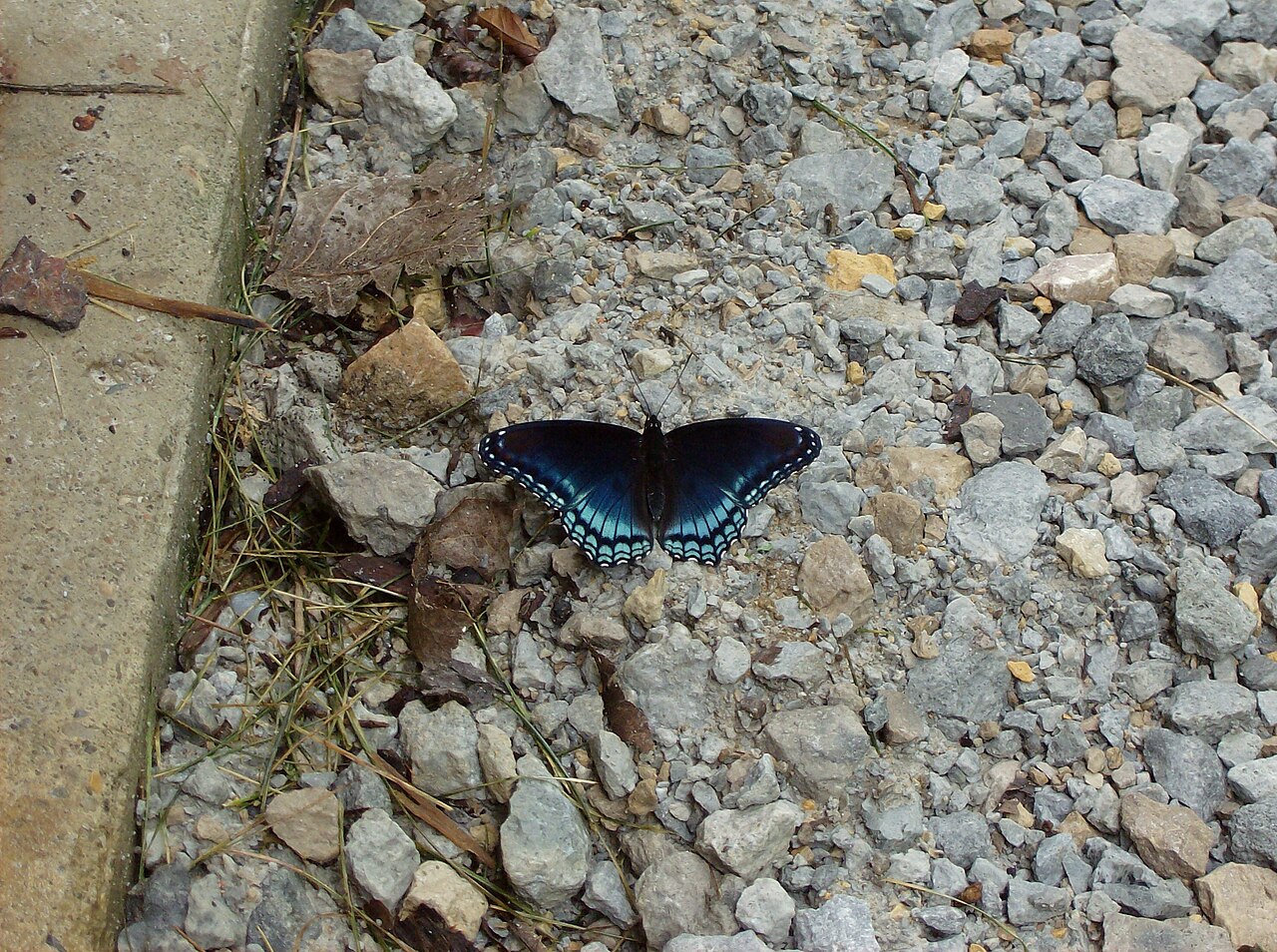
The red-spotted purple is a large black butterfly with iridescent blue on the outer half of the hindwings and a row of orange-red spots on the underside. It is not rare: it occurs across the eastern United States from Florida to New England and west into the Great Plains, and it is common in wooded suburbs, forest edges, and along shaded trails. What makes it hard to find is behaviour rather than scarcity, because it feeds on sap, rotting fruit, and animal droppings rather than on flowers.
The most interesting thing about the species is that it is a mimic. The red-spotted purple, Limenitis arthemis astyanax, closely resembles the toxic pipevine swallowtail, and where the pipevine swallowtail is absent the same species appears instead as the white admiral, with a broad white band across both wings. Both are the same butterfly, and they interbreed freely where their ranges meet.
| Feature | Detail |
|---|---|
| Scientific name | Limenitis arthemis astyanax |
| Wingspan | Roughly 7.5 to 10 cm |
| Range | Eastern US west to the Great Plains |
| Mimics | Pipevine swallowtail, which is toxic |
| Host plants | Wild cherry, willow, poplar, birch |
| Adult food | Sap, rotting fruit, dung, not flowers |
| Broods | Two to three per year |
What a Red-Spotted Purple Looks Like
Upper surface first: the wings are black to very dark brown across the inner half, shading to a strong metallic blue or blue-green over the outer part of the hindwings and the outer edge of the forewings. The intensity of that blue shifts with the viewing angle, since it comes from structural colour in the scales rather than from pigment.
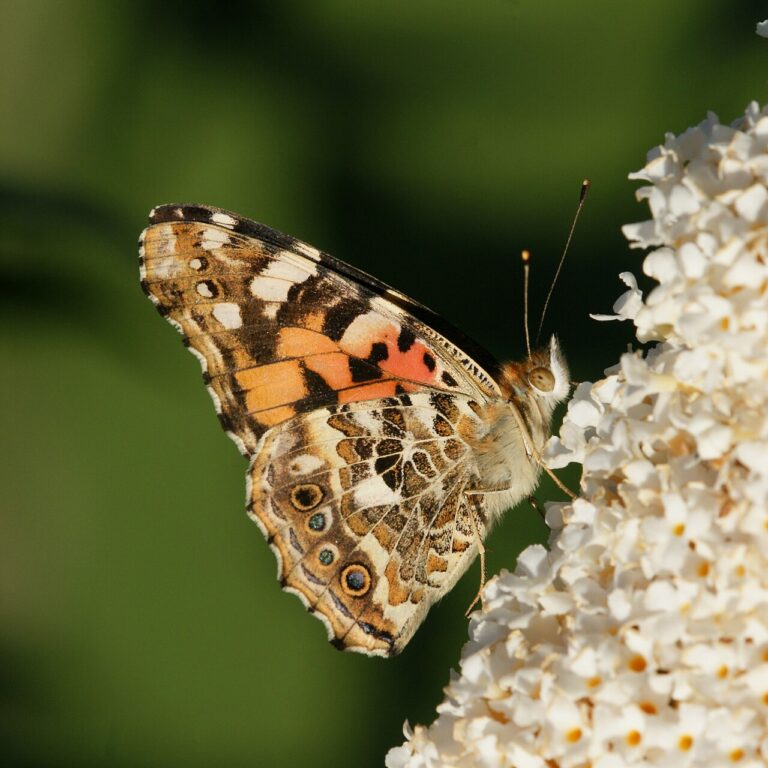
The underside is where the name comes from. It carries a row of orange-red submarginal spots along the hindwing edge and several more near the base of the forewing, set against a browner ground colour. Since the butterfly usually rests with wings held flat and open, the underside spots are visible mainly when it perches on a vertical surface or feeds head-down.
Wingspan runs roughly 7.5 to 10 cm, which puts it among the larger butterflies in eastern North America, comparable to a swallowtail. Unlike swallowtails it has no tails on the hindwings, and the outer margin is smoothly scalloped. Our guide to the purple butterfly covers the other species people search for under that colour.
The Mimicry That Defines the Species
The red-spotted purple is a Batesian mimic, meaning it is harmless but resembles a species that predators have learned to avoid. Its model is the pipevine swallowtail, which accumulates aristolochic acids from its host plants and is genuinely toxic. Birds that have tried one avoid anything with that dark blue-black appearance afterwards.
The evidence for the relationship is geographic. The red-spotted purple form dominates where pipevine swallowtails are common, and it is replaced by the white admiral form in the northern parts of the range where pipevine swallowtails do not occur and the mimicry would provide no benefit.
The two forms are subspecies of the same species, Limenitis arthemis, and they hybridise freely in a broad zone across the northern states and southern Canada. Hybrids show intermediate features, typically a partial or broken white band on an otherwise red-spotted purple pattern, and they are common enough that anyone butterflying in that zone will encounter them.
Genetic work has narrowed the switch between the two forms to a small region of the genome, which is why the change is so abrupt rather than gradual. A single gene complex flips the wing pattern between mimic and non-mimic, and the geographic boundary between the forms tracks the northern edge of the pipevine swallowtail’s range closely.
Red-Spotted Purple vs Pipevine Swallowtail
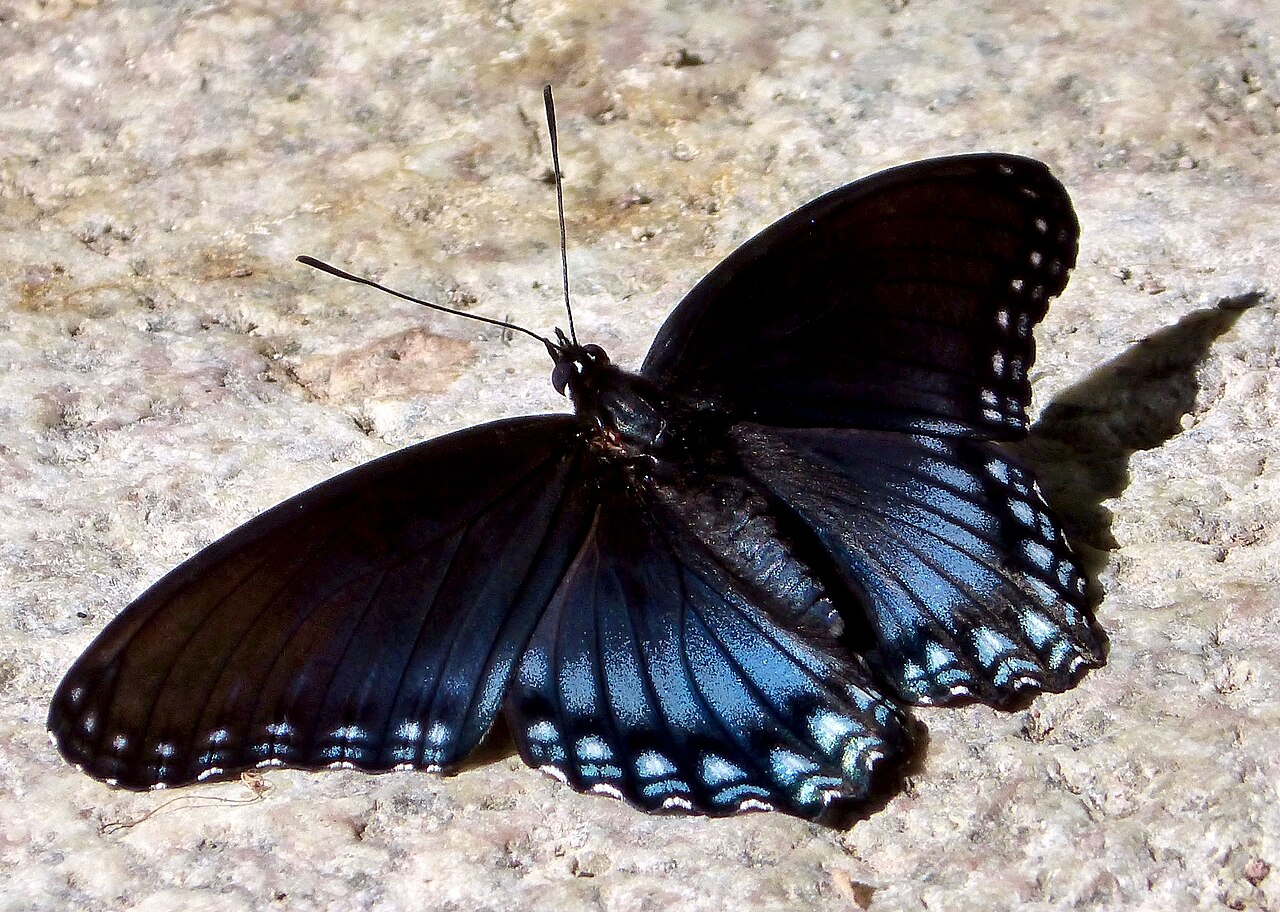
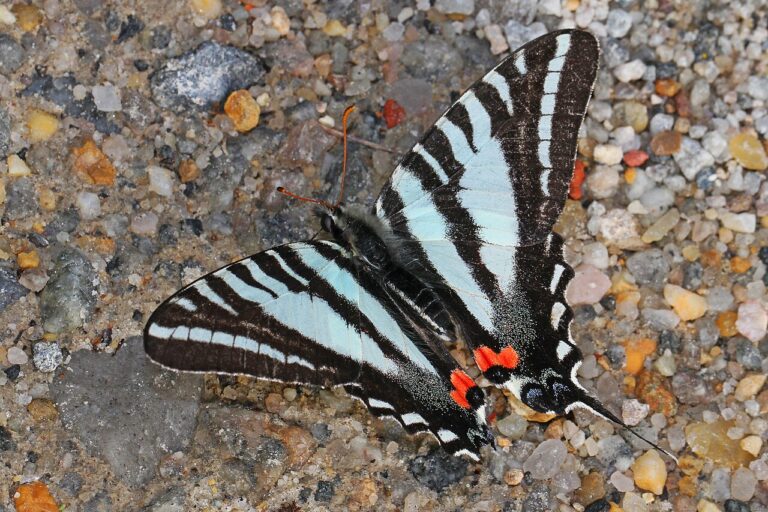
Telling model from mimic is straightforward once you know where to look. The pipevine swallowtail has tails on the hindwings. The red-spotted purple has none, and the absence is obvious in any photograph or reasonable view.
Spot pattern separates them further. The pipevine swallowtail carries a single arc of pale cream or orange spots on the hindwing underside plus a distinctive iridescent blue-green wash on the male’s upper hindwing. The red-spotted purple carries orange-red spots that continue onto the forewing base, which the swallowtail lacks.
Flight style helps at distance. Pipevine swallowtails flutter almost constantly, even while nectaring, while red-spotted purples glide extensively with wings held flat and settle to feed on the ground. A large dark butterfly gliding along a woodland trail and landing on bare earth is far more likely to be the mimic. Our guide to the swallowtail butterfly covers the model group.
Host Plants and Caterpillars
Females lay single eggs on the tips of leaves of wild cherry, black cherry, willow, poplar, aspen, birch, and occasionally hawthorn, oak, and apple. Cherry and willow are the most important across most of the range, which is why the butterfly is common in second-growth woodland and along stream corridors.
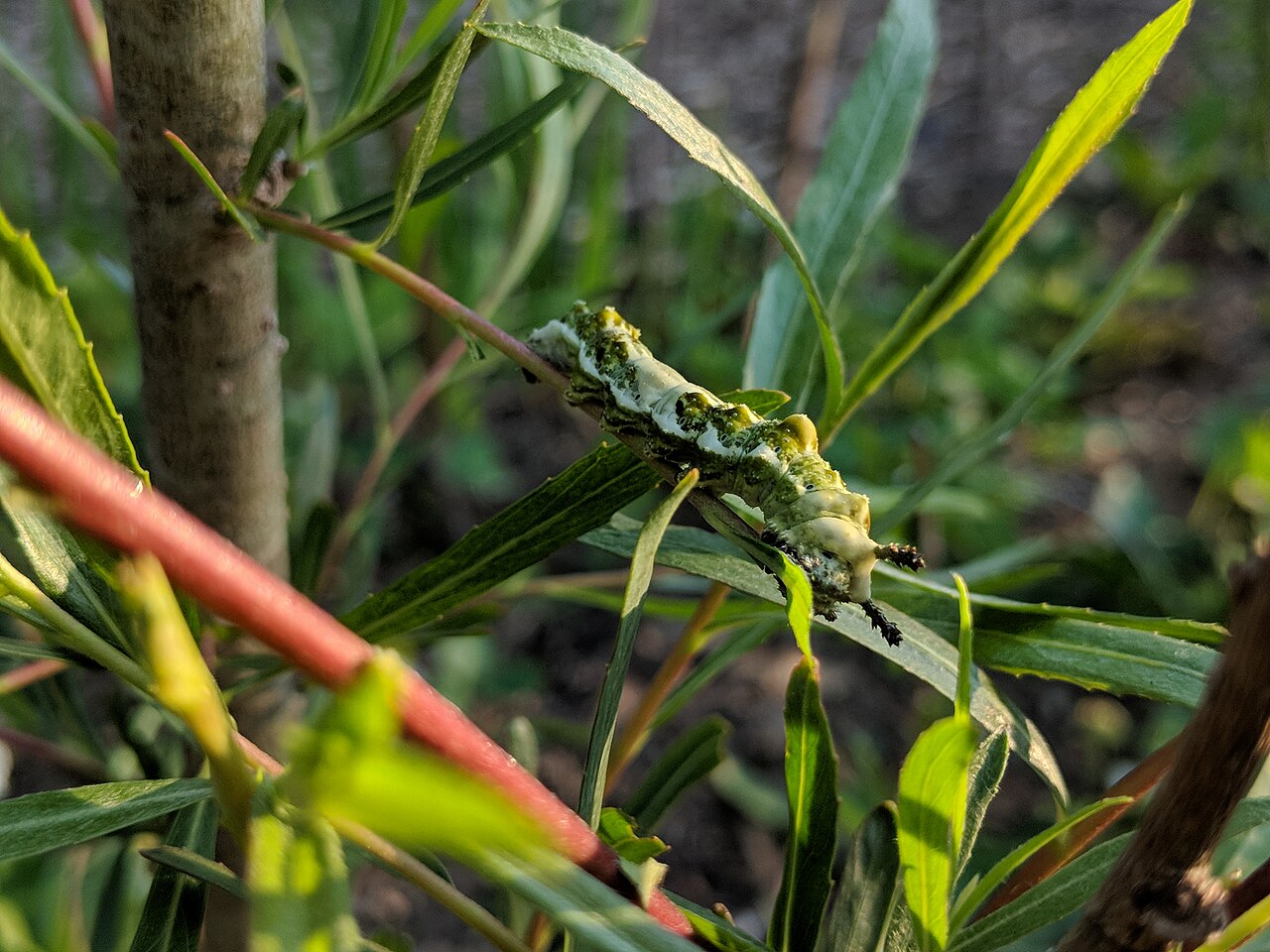
The caterpillar is one of the more remarkable in North America. It is mottled brown, white, and olive, humped and irregular in outline, and it looks convincingly like a bird dropping. Two prominent bristly horns sit behind the head. The disguise is effective enough that most people who find one assume it is debris on the leaf.
Overwintering happens in a hibernaculum, a shelter the young caterpillar builds by rolling a leaf section around itself and securing it to the twig with silk so the leaf does not fall. The caterpillar spends the entire winter inside and resumes feeding when the tree leafs out in spring, which is an unusual strategy among North American butterflies.
What Red-Spotted Purples Eat
Adults very rarely visit flowers, and this is the single biggest reason gardeners planting for butterflies never see one. Their food is tree sap running from wounds, fermenting fallen fruit, carrion, dung, and moisture drawn from damp soil, a behaviour called puddling that supplies sodium and other minerals.
Rotting fruit is the most practical attractant. A shallow dish of overripe banana, peach, or watermelon in a shaded spot near woodland will draw them where nectar plants will not, and the same setup attracts question marks, commas, and hackberry emperors, which share the habit.
Puddling groups on damp gravel and mud along shaded roads and trail edges are the most reliable place to find them, especially on warm afternoons after rain. Males puddle far more than females because the sodium contributes to the spermatophore transferred during mating. Our guide to what it means when a butterfly lands on you covers the folklore behind an encounter many people find striking.
How to Attract Them to a Yard
Host plants matter more than anything else. A wild cherry, black cherry, or willow on or near the property gives females somewhere to lay, and without one the butterfly will only ever be a visitor. These are common enough in eastern suburbs that many properties already have them without the owner realising.
The feeding setup is the second lever. A fruit feeding station in dappled shade, refreshed every few days, works reliably from midsummer onward. Adding a shallow damp gravel area or simply letting one patch of bare soil stay wet provides puddling habitat, which is more attractive to males than any food source.
Structure completes it. Red-spotted purples favour woodland edges, trails, and clearings rather than open lawn, and they perch on sunlit leaves at head height to watch for passing females. Leaving an unmown edge with some shrub layer and a few sunlit gaps does more than any planting choice. Our guides to the viceroy and the painted lady cover species that respond to different habitat.
Are Red-Spotted Purples Rare?
No. The species is widespread and locally common across the whole eastern United States, and it is not listed as threatened anywhere in its range. The perception of rarity comes from three things that all reduce how often people see it.
It does not visit flowers, so it is absent from the places most people look for butterflies. It favours woodland edge rather than open gardens. And it spends much of its time perched high on sunlit leaves or feeding on the ground where it is easy to walk past. None of these make it scarce, only inconspicuous.
Where numbers have declined it tracks habitat rather than any specific threat to the species. Loss of second-growth woodland, removal of wild cherry and willow, and broad-spectrum insecticide use all reduce local populations. Anyone in the eastern states who spends a few afternoons on shaded woodland trails in July will find them.
What a Red-Spotted Purple Means Symbolically
Purple butterflies carry a broadly consistent set of associations across contemporary folklore: transformation, spiritual growth, and a message from someone who has died. The colour purple adds royalty, dignity, and intuition to the general butterfly symbolism of change and rebirth.
The most specific modern usage is not folklore at all. The purple butterfly has been adopted as a symbol for bereaved parents of multiple-birth children, used on hospital cots to indicate that a surviving baby lost a sibling, and it appears in awareness campaigns for epilepsy, lupus, and pancreatic cancer.
Anyone reading meaning into a specific sighting should know that the red-spotted purple is common in eastern woodland from June through September, and that the butterfly landing on a person is usually seeking salt from perspiration rather than delivering anything. Both readings can be held at once. Our guide to the butterfly tattoo meaning covers the symbolism in more depth.
Related reading: Purple Emperor Butterfly.
Related reading: Red Admiral Butterfly.
Frequently Asked Questions
Are red-spotted purple butterflies rare?
No. They are widespread and locally common across the eastern United States and are not listed as threatened. They seem rare because they do not visit flowers, favour woodland edges over gardens, and feed on the ground or perch high on sunlit leaves where people rarely look.
What is the host plant for a red-spotted purple butterfly?
Wild cherry and black cherry are the most important, along with willow, poplar, aspen, and birch, with occasional use of hawthorn, oak, and apple. Females lay single eggs on leaf tips, and young caterpillars overwinter inside a rolled leaf shelter attached to the twig.
What attracts a red-spotted purple butterfly?
Rotting fruit, tree sap, dung, and damp soil rather than flowers. A dish of overripe banana or peach in dappled shade works reliably, and a patch of damp gravel provides the puddling habitat males seek for sodium. Nectar plants attract almost none.
What is the difference between a red-spotted purple and a pipevine swallowtail?
Tails. The pipevine swallowtail has hindwing tails, the red-spotted purple has none. The mimic also shows orange-red spots continuing onto the forewing base, and it glides with flat wings and settles on bare ground, while the swallowtail flutters almost constantly.
Is the white admiral the same butterfly?
Yes, they are two subspecies of Limenitis arthemis. The red-spotted purple form dominates where the toxic pipevine swallowtail occurs and the mimicry pays off, while the white-banded admiral form replaces it further north where the model is absent. They hybridise freely where the ranges meet.
What does it mean when you see a purple butterfly?
Contemporary folklore associates purple butterflies with transformation, spiritual growth, and messages from someone who has died. The purple butterfly is also a formal symbol used on hospital cots for surviving multiple-birth babies who lost a sibling, and in several awareness campaigns.
Do red-spotted purple butterflies bite or sting?
No. Butterflies have no biting mouthparts and no sting, and the red-spotted purple is entirely harmless. Its whole defence is looking like a toxic species. One landing on your skin is drawing salt from perspiration, which is normal feeding behaviour.