Painted Lady Butterfly: Identification, Life Cycle, and Migration
The painted lady butterfly (Vanessa cardui) is the most widespread butterfly on Earth, found on every continent except Antarctica and South America, and it is almost certainly the orange butterfly you raised in a classroom cup as a kid. Painted ladies are medium-sized, about 2 to 2.9 inches across, with salmon-orange wings marked by black patches, white spots near the wingtips, and a row of small eyespots on the underside of the hindwing. They are famous for two things: thriving on more than 100 host plants, and staging one of the longest insect migrations known, a multigenerational loop that can span 9,000 miles.
This guide covers how to identify a painted lady and separate it from the American lady and the monarch, what the spiky caterpillar looks like, the full life cycle from egg to chrysalis, what they eat, how the migration works, and how to bring them to your yard. The short version: find thistles, and you will find painted ladies.
| Scientific name | Vanessa cardui |
| Wingspan | 2 to 2.9 in |
| Key field marks | Orange-black wings, white wingtip spots, 4 small hindwing eyespots |
| Host plants | Thistles first, plus mallows, hollyhock, legumes (100+ species) |
| Adult lifespan | About 2 to 4 weeks |
| Range | Every continent except Antarctica and South America |
How to Identify a Painted Lady Butterfly
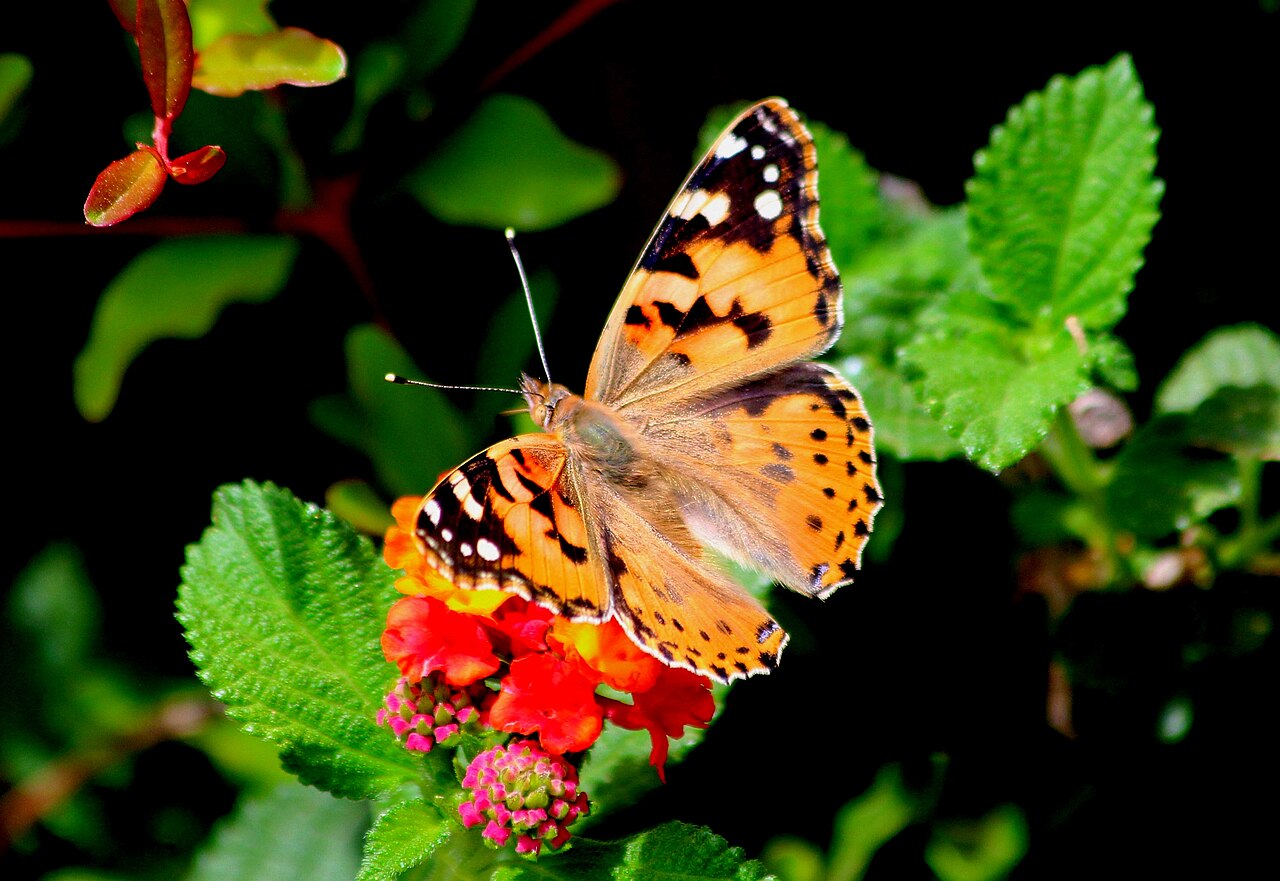
Start with the upper side of the wings. A painted lady shows warm salmon-orange ground color broken by heavy black blotches, and the black forewing tips are studded with clean white spots. The overall effect is busier and more mottled than the tidy stained-glass pattern of a monarch. Size helps too: at 2 to 2.9 inches, a painted lady is clearly smaller than a monarch and flies with a faster, more erratic, gliding-and-flapping style.
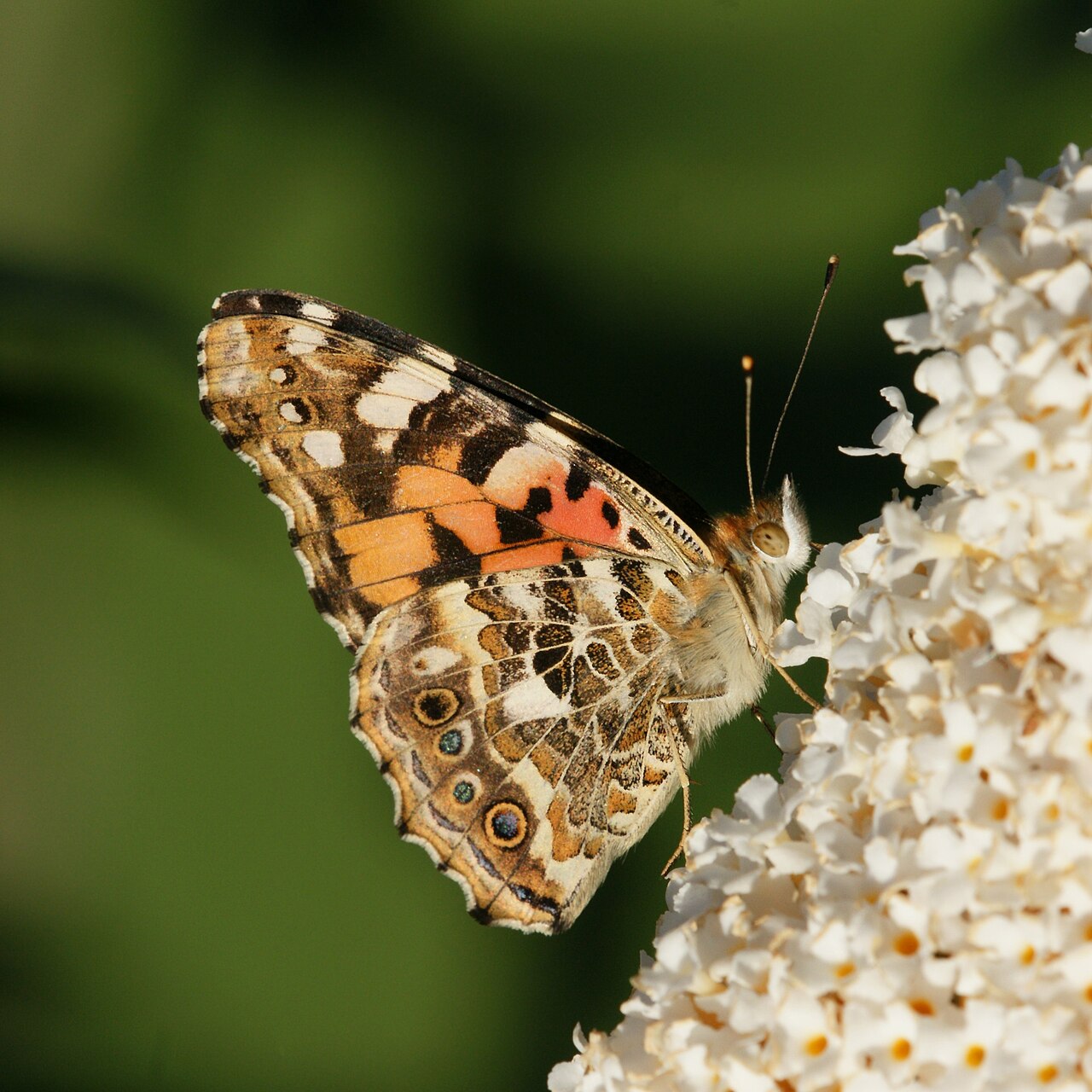
The underside is where the species really identifies itself. The hindwing below is an intricate marbling of brown, gray, and white crossed by a web of fine lines, with a row of four small eyespots along the outer edge. Those four small, roughly equal eyespots are the signature. When the butterfly closes its wings on a flower head, that cryptic underside makes it vanish against dry vegetation, which is exactly the point.
Painted ladies also behave distinctively. They are sun-lovers of open ground: gardens, fields, roadsides, dunes, vacant lots, almost anywhere with composite flowers. Males perch on bare ground or low shrubs in late afternoon and dart out at anything that passes, including other butterfly species, birds, and people. If a mid-sized orange butterfly rockets off a dirt patch to inspect you and returns to the same perch, painted lady is a strong bet. For the broader lineup of lookalikes, our orange and black butterfly guide puts all the common confusion species side by side.
Painted Lady vs American Lady: The Two-Eyespot Trick
The American lady (Vanessa virginiensis) is the painted lady’s nearly identical cousin and the number one source of misidentifications in North America. Both are orange with black-and-white forewing tips, both love the same gardens, and both perch with wings closed. The fastest separator is on the hindwing underside: the American lady has two large eyespots, while the painted lady has four small ones. Two big eyes, American; four small eyes, painted. It works at binocular distance.
If you get a look at the open wings, two more marks help. The American lady usually shows a tiny white dot sitting inside the orange field of the forewing, a mark the painted lady lacks. And the American lady’s hindwing above carries a hint of blue in its eyespots, most visible on fresh individuals. The painted lady reads as slightly larger, grayer-pink beneath, and colder-toned overall, though lighting makes single-mark judgments risky; the eyespot count is the reliable one.
There is also a third Vanessa in the mix, the West Coast lady (Vanessa annabella), mostly west of the Rockies, with an orange (not white) bar on the black forewing tip and blue-centered hindwing spots. Range narrows the problem: coast to coast, painted lady and American lady are the everyday pair, and the four-versus-two eyespot check settles nearly every backyard debate. Habitat leans the odds too, with American ladies tied more tightly to their pussytoes and everlasting host plants while painted ladies wander everywhere.
Painted Lady vs Monarch: Telling Them Apart
People raised on classroom butterfly kits often assume the orange butterfly in the garden is a monarch, but painted ladies outnumber monarchs in most yards in most years. The size gap is the first tell: monarchs span 3.5 to 4 inches, a painted lady barely reaches 2.9. In the air, a monarch sails with slow, deep wingbeats and long glides on flat wings; a painted lady flies fast and low with a jittery flap-glide rhythm that looks caffeinated by comparison.
Pattern differences are just as clear up close. A monarch’s orange is divided into neat panes by bold black veins, like stained glass, with white-dotted black borders. A painted lady’s orange is smudged with irregular black patches and lacks that clean vein work entirely. The monarch also has no eyespots beneath, showing instead a paler echo of its upper pattern, while the painted lady’s marbled underside with four small eyespots looks like a different animal.
The caterpillars remove all doubt. Monarch caterpillars are smooth with yellow, black, and white rings and live only on milkweed, as covered in our monarch caterpillar guide. Painted lady caterpillars are spiny, dark, and web-building, mostly on thistles. If a spiky larva is eating your hollyhock inside a silk shelter, no milkweed anywhere in sight, the ID was never really in question. Viceroys add one more orange lookalike to the mix, and our viceroy butterfly guide covers the single line that separates them from monarchs.
The Painted Lady Caterpillar
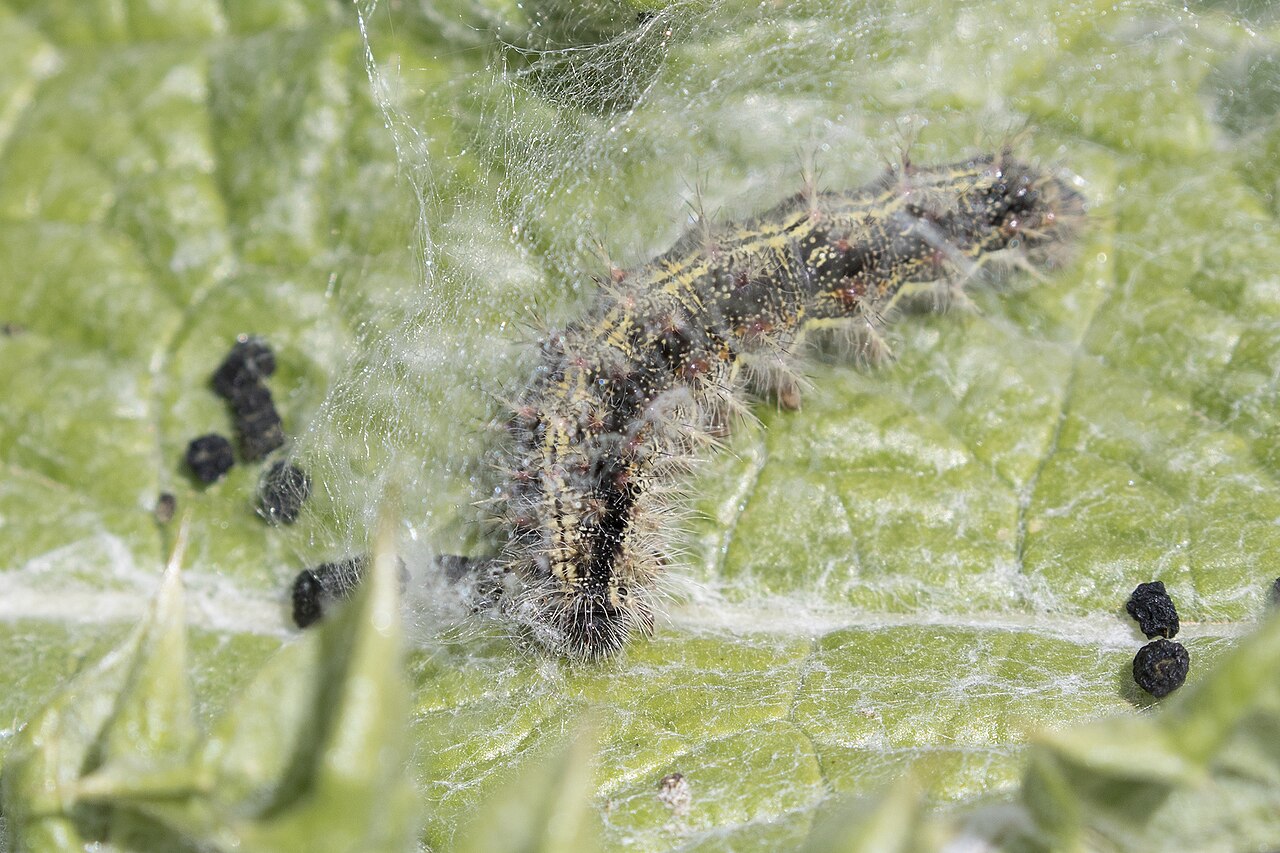
Painted lady caterpillars look nothing like the elegant adult. A full-grown larva is about 1.25 inches long, charcoal to black with a broken yellow side stripe, and covered in branched, bristly spines that give it a hedgehog look. Color varies a lot between individuals, from nearly black to gray-lavender with bold yellow banding, which routinely confuses people into thinking they have several species. The spines look fierce but are harmless to handle; they carry no venom.
The behavioral signature is the silk. A painted lady caterpillar ties leaves together into a loose, messy web shelter and feeds inside it, decorating the tent with droppings as it grows. Find a thistle or hollyhock with silked-together leaves and a spiny occupant, and you have your ID. This webbing habit separates painted lady larvae instantly from monarch caterpillars, which feed in the open, and from most other garden caterpillars, as our black caterpillar identification guide breaks down.
The larva passes through five instars in roughly 12 to 18 days depending on temperature, molting between each and building a fresh shelter as it outgrows the old one. Late instars eat aggressively and can skeletonize sections of a host plant, though in a garden the damage is usually cosmetic and short-lived. When it is ready to pupate, the caterpillar typically leaves its web, wanders, and hangs head-down from a stem or ledge in a J-shape before shedding into a chrysalis.
Life Cycle: Egg, Chrysalis, and the Four-Week Sprint
Painted ladies run one of the fastest life cycles of any large butterfly, a big reason they are the standard classroom species. Females lay pale blue-green, barrel-shaped eggs singly on the tops of host leaves, each about the size of a pinhead with fine vertical ribs. A single female can lay several hundred eggs across many plants, hedging her bets rather than clustering them. Eggs hatch in 3 to 5 days in warm weather.
The chrysalis stage is a small marvel. The pupa hangs upside down, about an inch long, molded in lavender-gray to brownish tones with rows of gold-tipped bumps that flash metallic in sunlight. Inside, the transformation takes 7 to 10 days. In the final day the shell turns translucent and the folded orange-and-black wing pattern becomes visible through it, a moment classroom kits are engineered to deliver. The adult emerges, pumps fluid into its crumpled wings, and needs an hour or two of hardening before its first flight.
Add it up and the whole cycle, egg to flying adult, runs about 3 to 4 weeks in summer heat, and adults then live roughly 2 to 4 weeks more. That speed lets painted ladies stack multiple generations into a single season and explains their boom-and-bust years: when winter rains flush desert host plants, a spring generation can multiply into millions within two months. Population explosions in the Southwest, with butterflies streaming past at highway speed for days, are painted lady signature events.
What Painted Ladies Eat and Their Host Plants
The painted lady’s scientific name, Vanessa cardui, literally references thistle (Carduus), and “thistle butterfly” is its old common name. Thistles are the core caterpillar host, but the real story is breadth: painted lady larvae are documented on more than 100 plant species across many families, including mallows, hollyhock, sunflower, burdock, knapweed, and various legumes like soybean. That generalist diet is the engine behind the species’ global range; almost anywhere has something a painted lady can eat.
Adults are equally unfussy nectar feeders with a documented preference for composite flowers, the daisy family, especially in the 3 to 6 ft bloom zone. Thistles again top the list, joined by asters, blazing star, cosmos, zinnias, joe-pye weed, ironweed, buttonbush, and red clover. Unlike many butterflies, painted ladies readily visit gardens far from any host plant, fueling up mid-journey during migration; a nectar-rich yard in April can host dozens of travelers that were in Mexico two weeks earlier.
According to the Smithsonian Institution, the painted lady is the most widely distributed butterfly in the world, and its diet is a primary reason. For gardeners, the practical upside is that supporting painted ladies takes no redesign: let a few thistles stand at the property edge, plant hollyhocks or mallows, and keep composite flowers blooming from spring through fall. The species handles the rest, and the same flower bed will pull in swallowtail butterflies as a bonus.
The Painted Lady Migration: Nine Generations Around the Map
Painted ladies migrate on a scale that took scientists decades to fully map. In the Old World, the species runs an annual circuit between sub-Saharan Africa and northern Europe, up to 9,000 miles round trip, the longest known butterfly migration. No individual flies the whole loop. The journey is relayed across as many as 8 to 10 generations per year, each leg flown by butterflies that have never seen the destination, navigating by inherited programming, sun compass, and favorable high-altitude winds up to 3,000 ft.
North America has its own version. Painted ladies overwinter and breed in northern Mexico and the desert Southwest, then surge north in spring waves that can reach Canada by early summer, breeding as they go. In banner years following wet desert winters, the northbound flights become spectacles, with observers along a single front counting thousands of butterflies per hour for days. A quieter, higher-altitude southbound movement in fall closes the loop, often invisible from the ground.
Unlike monarchs, painted ladies have no fixed overwintering groves and no true winter dormancy; they simply keep breeding wherever conditions allow and die where frost catches them. That strategy means the northern two-thirds of the continent gets fully restocked from the Southwest every single year. It also means seeing a painted lady in May in Minnesota is witnessing the grandchild of a butterfly that wintered near the border, one relay leg of a continental journey with no single hero and no finish line.
Lifespan, Season, and Bringing Them to Your Yard
An adult painted lady lives about 2 to 4 weeks in the wild, a little longer in cool weather, and the species compensates with volume: multiple overlapping generations from spring through fall. In most of the US the first migrants appear between March and May, numbers build through summer, and the last locally bred adults fly until hard frost. There is no winter life stage in cold climates at all, which makes every northern painted lady a descendant of that spring’s immigration.
The attraction formula is simple: nectar density plus host plants plus sun. Mass plantings of zinnias, cosmos, asters, and blazing star will pull migrants out of the sky, and a tolerated thistle patch or mallow bed lets them stay and breed. Skip insecticides during the season, leave some bare sunny ground for males to perch on, and expect company: the same setup feeds every butterfly in the neighborhood. And if one lands on you while you work the flower bed, our guide to the meaning when a butterfly lands on you covers the folklore side of that little moment.
Frequently Asked Questions
How long does a painted lady butterfly live?
Adults live about 2 to 4 weeks. The full cycle from egg to adult takes only 3 to 4 weeks in warm weather, so several generations fly each year, and the species survives winter by continuously breeding in the far South rather than hibernating.
Is a painted lady the same as a monarch?
No. Painted ladies are smaller (2 to 2.9 inches versus 3.5 to 4), mottled orange without the monarch’s bold black veins, and their spiny caterpillars eat thistles and mallows, not milkweed.
How do I tell a painted lady from an American lady?
Check the hindwing underside: four small eyespots means painted lady, two large eyespots means American lady. The American lady also usually shows a tiny white dot in the orange of the forewing above.
What do painted lady caterpillars eat?
Thistles are the classic host, but larvae accept more than 100 plants, including hollyhock, mallows, sunflower, burdock, and legumes. They feed inside messy silk shelters tied from leaves.
How far do painted ladies migrate?
The African-European circuit spans up to 9,000 miles round trip, the longest known butterfly migration, relayed across 8 to 10 generations. North American populations run a similar multigenerational loop between the Southwest and Canada.
Why are they called painted ladies?
The name dates to 17th and 18th century England, when the butterfly’s rouged salmon-and-black pattern evoked a heavily made-up face. The scientific name Vanessa cardui ties it to its thistle host plants.
Are painted lady butterflies rare?
No, they are the most widespread butterfly on Earth, found on every continent except Antarctica and South America. Numbers swing wildly between years, though, with desert rainfall driving spectacular boom migrations.