Imperial Moth: ID, Caterpillar, and Underground Pupation
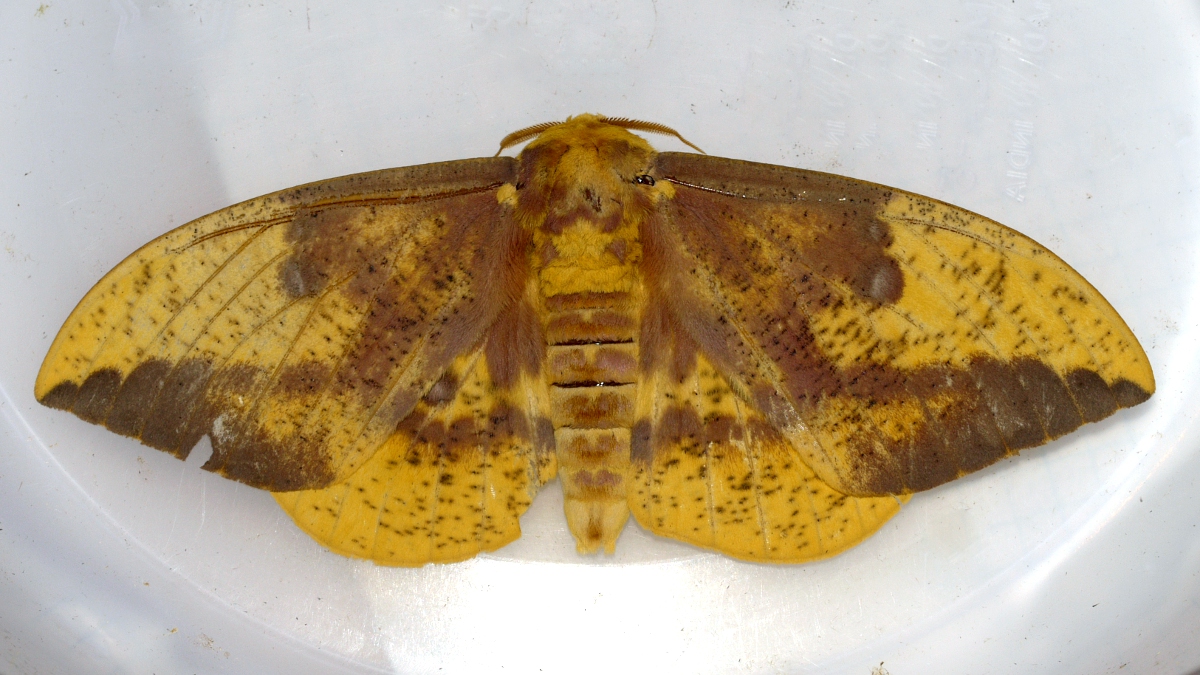
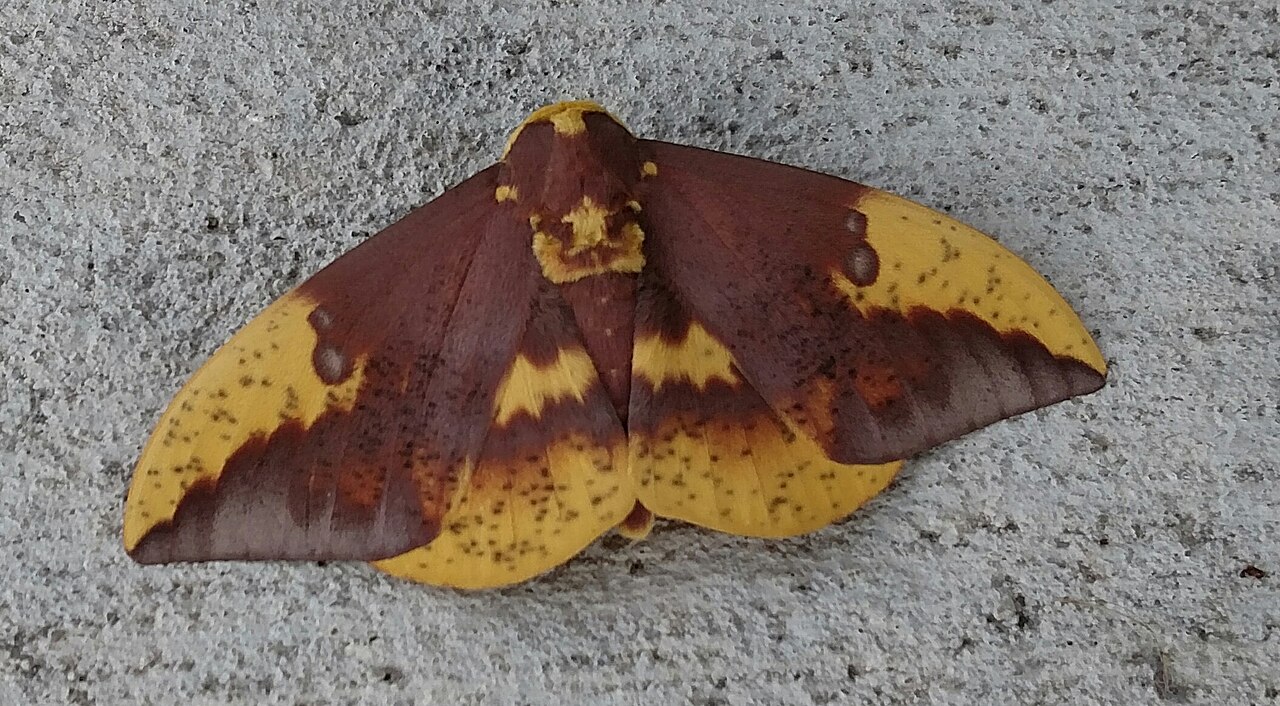
The imperial moth (Eacles imperialis) is a large yellow giant silk moth with purple-brown blotches and speckling, spanning 3 to 7 in across, and it is one of the most striking insects that comes to porch lights in eastern North America. Females are larger and yellower, males smaller and more heavily marked, and neither can eat.
It also pupates differently from its famous relatives. Where cecropia and polyphemus moths spin conspicuous silk cocoons on branches, the imperial moth caterpillar burrows into the soil and pupates underground with no cocoon at all, which is why people find the adults and the caterpillars but almost never the pupae. This guide covers identification, the sexes, the variable caterpillar, the underground pupation, and why the species has vanished from parts of its former range.
| Quick Facts | Imperial Moth |
|---|---|
| Scientific name | Eacles imperialis |
| Wingspan | 3 to 7 in, females larger |
| Adult lifespan | About one week, cannot feed |
| Caterpillar | Up to 4 in, green, brown, or burgundy |
| Pupation | Underground, no cocoon |
| Generations | One per year in the north, two in the far south |
The imperial moth (Eacles imperialis) is a yellow giant silk moth with purple-brown blotches, spanning 3 to 7 inches. Its large horned caterpillar is not poisonous and does not sting. Adults have no working mouthparts, cannot feed at all, and live only about a week.
Identifying the Imperial Moth
The ground color is bright yellow, sometimes closer to lemon and sometimes deeper, overlaid with blotches, bands, and speckling in purple-brown to reddish-brown. No other large North American moth combines that yellow base with purple-brown marking in the same way.
Size varies enormously within the species. Wingspans run from around 3 in in small males to nearly 7 in in large southern females, and northern populations tend to be smaller than southern ones. Even a modest individual is a substantial insect that people notice.
The body is thick and furry like all giant silk moths, and the wings are held roof-like or spread flat when at rest on a wall. It belongs to the family Saturniidae alongside the cecropia, polyphemus, and luna moths, and our guides to the cecropia moth and the giant moth group cover the wider family.
Male vs Female
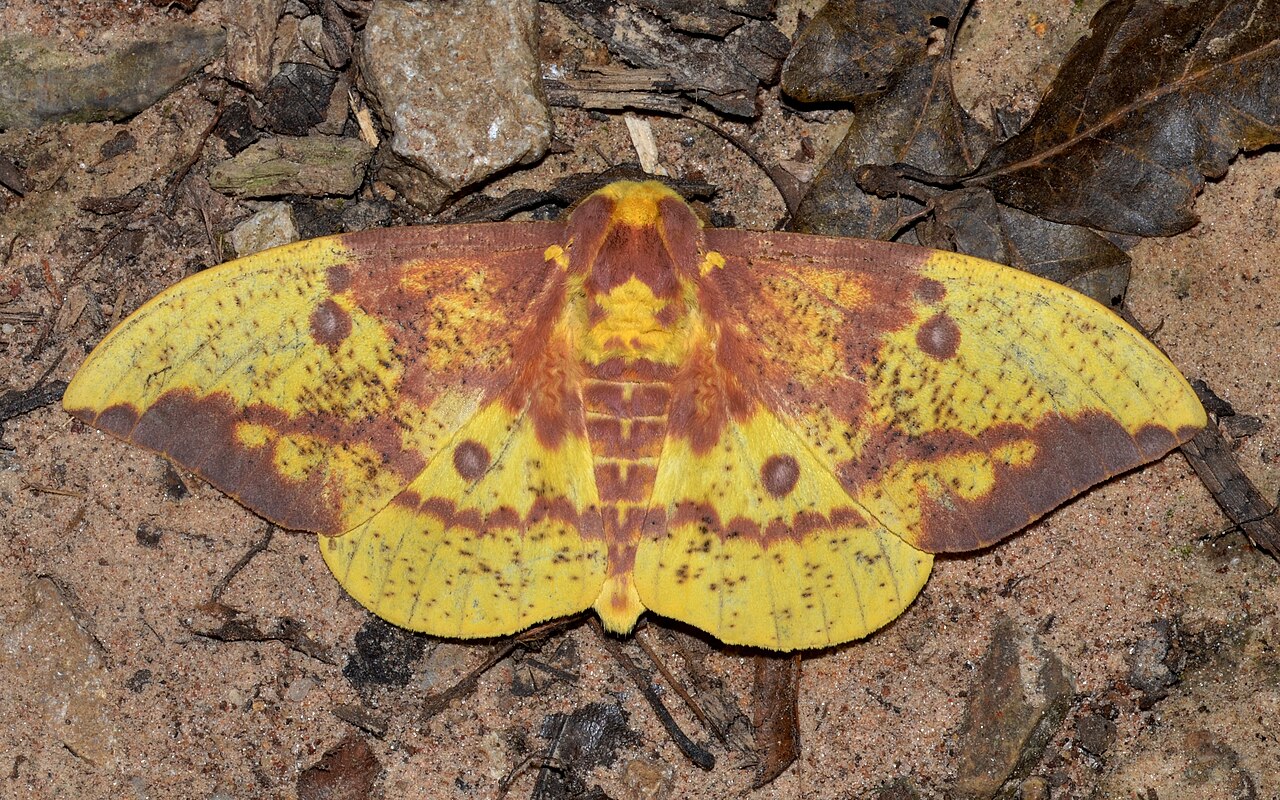
The sexes are distinguishable at a glance once you know what to look for, which is unusual among moths. Females are noticeably larger and more heavily built, and their yellow is more dominant with the purple-brown markings reduced to scattered blotches and a band along the wing margins.
Males are smaller and darker. The purple-brown marking covers considerably more of the wing surface, sometimes obscuring much of the yellow, and the overall impression is of a browner moth with yellow patches rather than a yellow moth with brown patches.
Antennae settle any remaining doubt. Male imperial moths have broadly feathered antennae packed with receptors for detecting female pheromones, while female antennae are thin and thread-like. That difference is consistent across the giant silk moths and reflects the same mate-finding system, in which females release pheromone and wait while males navigate upwind toward it.
The Caterpillar
Imperial moth caterpillars are large and variable enough that they are frequently reported as several different species. A full-grown larva reaches about 3 to 4 in and comes in green, brown, burgundy, or nearly black color forms, all with the same structural features.
Those features are consistent regardless of color. The body carries long white hairs, prominent orange or yellow spiracles ringed in black along the sides, and short spiny horns behind the head. The overall impression is shaggy and slightly alarming, which prompts most of the questions about them.
They are harmless. Despite the hairs and horns, imperial moth caterpillars have no venom and no stinging spines, and handling one causes nothing worse than mild irritation in sensitive people. The genuinely stinging caterpillars, including the puss caterpillar and saddleback, look quite different, and our guide to the fuzzy caterpillar sorts out which hairy larvae to avoid.
Pupation Underground
This is where the imperial moth diverges from its better-known relatives. Cecropia, polyphemus, and promethea caterpillars spin tough silk cocoons attached to branches, which is why people find them on bare winter twigs. Imperial moth caterpillars do none of that.
When fully fed, the larva leaves its host tree and burrows into loose soil or leaf litter, hollowing out a chamber several inches down and pupating there naked, with no silk covering. The pupa is dark brown, thick, and roughly 2 in long, with a forked spine at the tip.
It overwinters underground and the adult emerges the following summer, digging up through the soil. This habit has a practical implication for anyone hoping to help the species: soil disturbance, heavy mulching, and paving all destroy pupation sites, and areas of undisturbed leaf litter and loose soil beneath host trees are what the life cycle actually requires.
Adults Cannot Eat
Like all giant silk moths, imperial moth adults emerge with vestigial mouthparts and no functional digestive system. They cannot drink nectar or water, and the entire adult stage runs on fat stored during the caterpillar’s feeding.
Adult life is correspondingly short, typically about a week. Everything about that week is oriented toward reproduction: females release pheromone shortly after emerging, usually in the hours after midnight, males detect it with their feathered antennae and navigate to the source, mating occurs before dawn, and the female lays eggs over the following nights.
Eggs are laid singly or in small groups on host plant leaves and hatch in one to two weeks. In the northern part of the range there is a single generation per year, with adults flying from roughly June through August, while the far south may produce two. The moths are strictly nocturnal, which is why almost all sightings happen at lights.
Host Plants and Where They Live
Imperial moth caterpillars are broad generalists, which is unusual for such a large larva. Pine, maple, oak, sweetgum, sassafras, sycamore, cedar, and box elder all serve as host plants, and the caterpillar’s color form varies somewhat with what it has been feeding on.
That flexibility supports a wide range. The species occurs across much of eastern North America, from southern Canada through the eastern and central United States and south into Mexico and beyond, occupying deciduous and mixed forest, woodland edges, parks, and suburbs with mature trees.
Despite the range, the moth is rarely seen. Adults live a week, fly only at night, and do not feed, so there is no reason for them to appear anywhere except at a light, and the caterpillars feed high in trees until they descend to pupate. Most people who see one see it once.
Why Imperial Moths Are Declining
Populations have contracted noticeably, most visibly in the northeastern United States where the species has largely disappeared from New England despite remaining reasonably common further south. Several causes combine.
The parasitoid fly Compsilura concinnata is the most specific. Introduced in 1906 to control spongy moth, it attacks a wide range of native caterpillars, and studies have documented heavy parasitism of native giant silk moth larvae. It is a textbook case of biological control causing collateral damage.
Light pollution compounds it directly, since the entire mate-finding system depends on males following pheromone plumes through dark air, and a male circling a streetlight is a male that will not reproduce during his single week of life. Habitat loss removes both host trees and the undisturbed soil needed for pupation, and broad-spectrum insecticide plus Bacillus thuringiensis applied against spongy moth kills the caterpillars indiscriminately.
Imperial Moth Symbolism
Large striking moths attract meaning, and the imperial moth carries the general symbolism attached to moths alongside associations drawn from its color. Moths broadly represent transformation because of complete metamorphosis, and attraction to light is widely read as the pursuit of truth or as vulnerability to distraction.
Yellow adds its own layer. In most Western symbolic traditions yellow carries associations with sunlight, optimism, clarity, and intellect, so a large yellow moth is commonly interpreted as a sign of insight or of a positive shift arriving unexpectedly.
The naturalist reading is narrower and arguably more useful. An imperial moth at your light means mature oak, maple, pine, or sweetgum stands within flight range, and undisturbed soil beneath them where a caterpillar pupated the previous year. That is genuine information about the land around you, which no symbolic interpretation provides.
Helping Imperial Moths
Three changes make a genuine difference and all are within reach of an ordinary property. The first is lighting: switching outdoor bulbs to warm amber tones, fitting motion sensors, and turning porch lights off when not needed reduces the disruption to pheromone navigation substantially.
The second is soil. Leaving areas of undisturbed leaf litter and loose soil beneath mature trees preserves pupation habitat that heavy mulching, landscape fabric, and paving eliminate. Autumn raking of every leaf removes the overwintering stage of this species along with many others.
The third is restraint with insecticide. Avoiding broad-spectrum spraying, and particularly avoiding Bacillus thuringiensis applications on non-target trees, protects the caterpillars directly. Beyond that, keeping mature native trees of the host species standing is the foundation, since a landscape with no oaks, maples, or pines cannot support the moth regardless of what else is done. Our guides to the monarch caterpillar and the hummingbird moth describe the same habitat-first approach for other Lepidoptera.
Are Imperial Moth Caterpillars Poisonous?
Imperial moth caterpillars are not poisonous and they do not sting. Despite reaching four inches long and carrying prominent horns behind the head plus a dense coat of white hairs, the larva has no venom glands and no urticating spines. It can be picked up safely, and the horns are display structures rather than weapons.
The species gets its reputation by association. Several other large caterpillars in the same habitats do cause reactions, including the io moth caterpillar, which is green with branched spines that deliver a genuine sting, and the hickory tussock caterpillar, whose hairs cause a rash in sensitive people. The imperial moth larva shares the size and the alarming look without the chemistry.
Two sensible caveats remain. Any dense-haired caterpillar can cause mild mechanical irritation on sensitive skin, and people vary. And a caterpillar found wandering across pavement in late summer is looking for soil to pupate in, so the kindest handling is a short move to bare ground under a tree. The Smithsonian’s moth information sheet covers where the giant silkworm moths sit in the wider group.
Frequently Asked Questions
How big is an imperial moth?
Wingspan runs from about 3 in in small males to nearly 7 in in large southern females. Northern populations tend to be smaller than southern ones, and females are consistently larger and more heavily built than males.
How do you tell male from female imperial moths?
Females are larger with yellow dominating and purple-brown reduced to scattered blotches, while males are smaller and much more heavily marked. Antennae confirm it: males have broadly feathered antennae for detecting pheromones, females thin thread-like ones.
Are imperial moth caterpillars poisonous?
No. Despite the long hairs and short horns they have no venom or stinging spines, and handling causes at most mild irritation in sensitive people. They reach 3 to 4 in and come in green, brown, burgundy, or nearly black forms.
Do imperial moths make a cocoon?
No, and this sets them apart from their relatives. The caterpillar burrows into loose soil or leaf litter and pupates underground with no silk covering at all, overwintering there before the adult digs its way out the following summer.
How long do imperial moths live?
About one week as adults. They emerge with vestigial mouthparts and cannot eat or drink, so the entire adult stage runs on fat stored during the caterpillar’s feeding and is devoted to finding a mate and laying eggs.
What do imperial moth caterpillars eat?
Pine, maple, oak, sweetgum, sassafras, sycamore, cedar, and box elder among others. They are unusually broad generalists for such a large larva, which is part of why the species occupies such a wide range across eastern North America.
Why are imperial moths disappearing?
Mainly the parasitoid fly Compsilura concinnata, introduced in 1906 against spongy moth, which heavily parasitizes native giant silk moth larvae. Light pollution disrupts pheromone-based mate finding, habitat loss removes host trees and pupation soil, and insecticides kill the caterpillars.