Rabid Wolf Spider: Size, Bite, and Why the Name Misleads
The rabid wolf spider (Rabidosa rabida) is not rabid, not venomous to people in any meaningful sense, and not a spider that hunts you down. The name describes its frantic, darting run across open ground, which early naturalists thought looked like an animal with rabies. It is one of the most commonly encountered large spiders in the eastern and central United States, and almost every report of one involves a spider sprinting away from a person, not toward them.
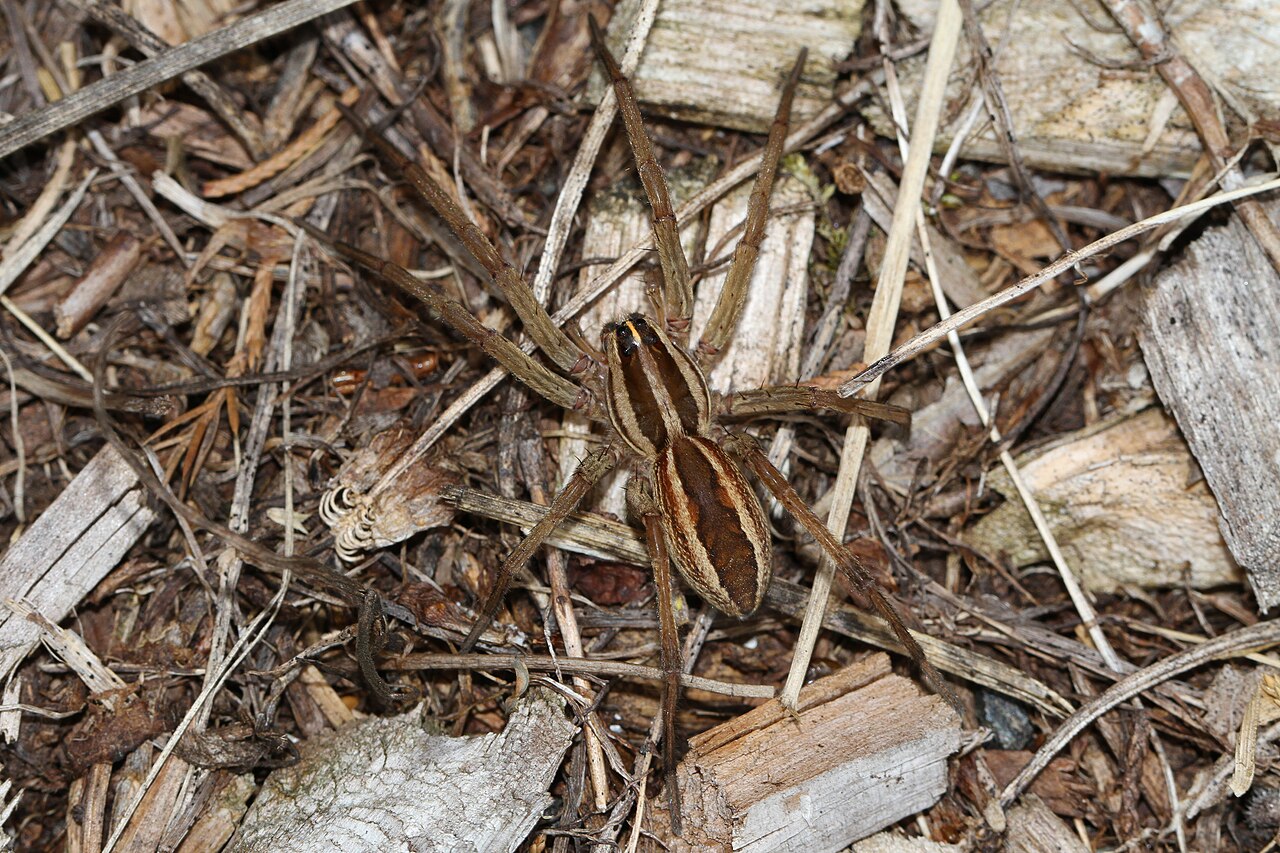
Adults are big enough to startle anyone: a leg span near 2 in (5 cm) on a body of 0.4 to 0.8 in (10 to 21 mm), with two dark brown stripes running the length of the carapace and a single dark stripe down the abdomen. That striping is the fastest way to separate it from the other wolf spiders sharing the same lawns and fields.
A rabid wolf spider is harmless to humans. It has venom for subduing insects, but a bite produces only brief pain and local redness similar to a bee sting without the swelling. It cannot transmit rabies, it does not chase people, and it builds no web. The name refers to its erratic sprinting, not its temperament.
| Trait | Rabid wolf spider (Rabidosa rabida) |
|---|---|
| Body length | 0.4 to 0.8 in (10 to 21 mm), females larger |
| Leg span | Up to about 2 in (5 cm) |
| Markings | Two dark stripes on carapace, one on abdomen |
| Range | Eastern and central US, Maine to Texas |
| Habitat | Tall grass, field edges, gardens, leaf litter |
| Web | None; active ground hunter |
| Danger to people | None; bite comparable to a pinprick |
Is a rabid wolf spider poisonous?
No. It is venomous, as nearly all spiders are, but the venom is not medically significant to humans and the spider is not poisonous to touch, eat, or have in the house. A bite, which requires you to trap or squeeze the spider, causes a sharp pinch, a red mark, and mild itching that fades within a day. State wildlife agencies treat the species as harmless; the Missouri Department of Conservation covers it among its non hazardous spiders at mdc.mo.gov.
The species that actually warrant caution in the same range are the brown recluse and the black widow, both of which look nothing like this spider. The differences are laid out in wolf spider vs brown recluse, and the short version is that recluses are small, uniformly tan, and have a violin mark, while wolf spiders are bulky, striped, and hairy.
Why is it called a rabid wolf spider?
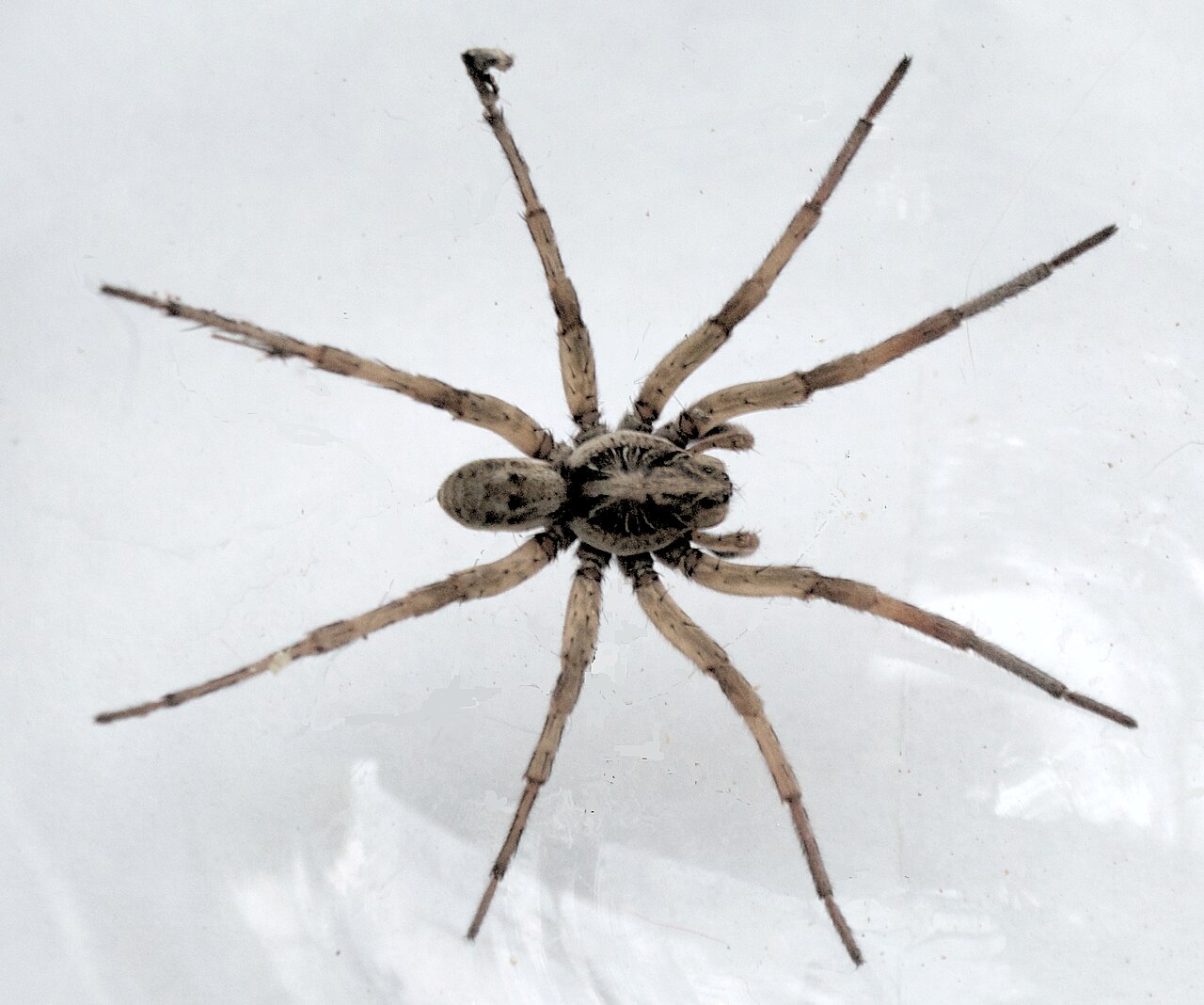
The epithet rabida is Latin for raging or mad, and it was applied because of how the spider moves. Disturbed in leaf litter, it explodes into a zigzag sprint, stops abruptly, then bolts again, a jerky pattern that reads as unhinged rather than purposeful. Nothing about its biology involves disease.
Spiders cannot carry or transmit rabies, which is a mammalian virus. The name is a 19th century description of behavior that has survived in the field guides, and it does more to scare homeowners than any trait of the animal justifies.
Rabid wolf spider size and identification
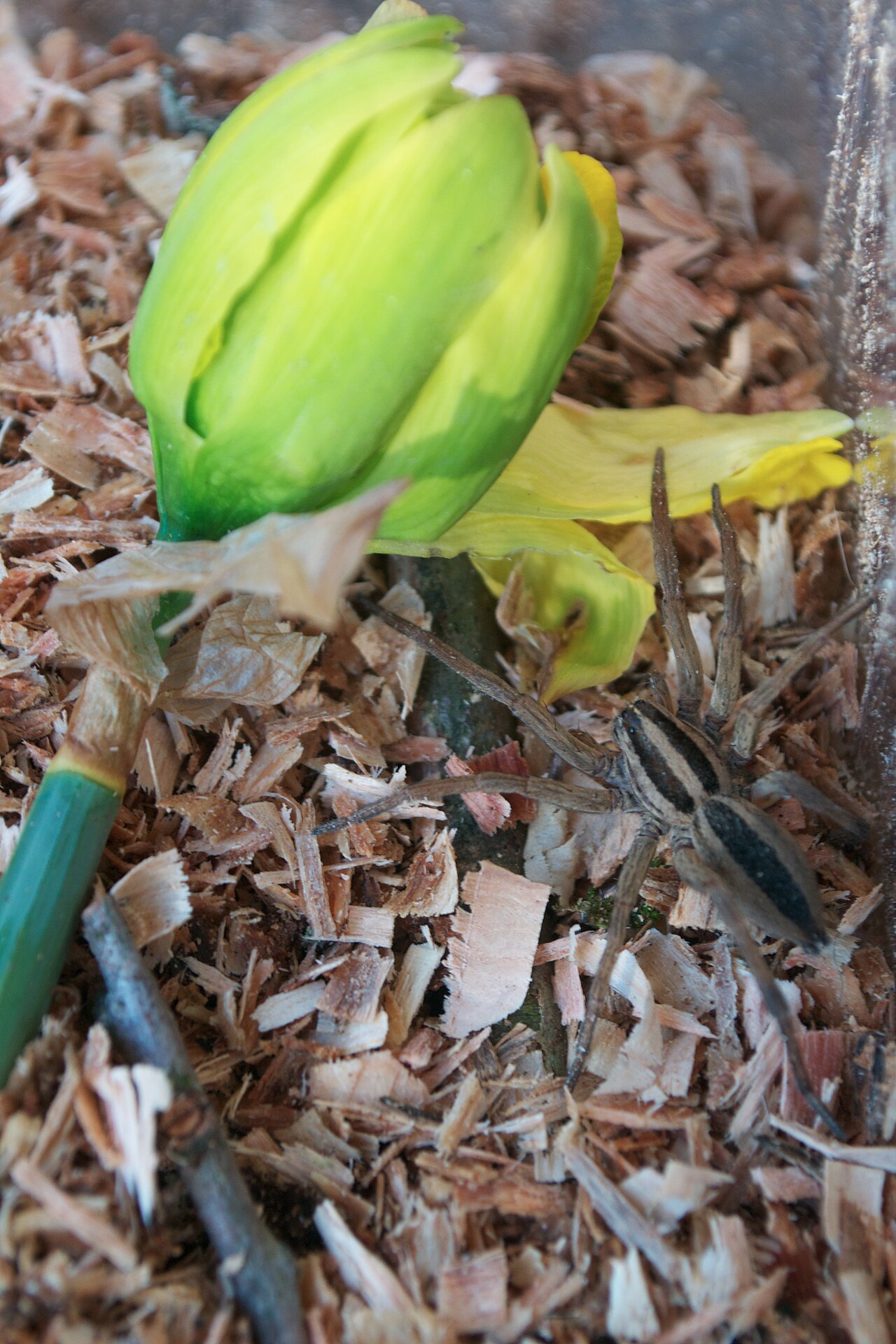
Look at the stripes. Rabidosa rabida has two parallel dark brown bands on the carapace and one continuous dark band down the middle of the abdomen. Its close relative Rabidosa punctulata is nearly identical from above but carries a row of black spots on the pale underside of the abdomen, so flipping a specimen in a clear cup settles it.
Eye arrangement confirms the family: four small eyes in a row low on the face, two large eyes above them, and two more set back on top of the head. Those two big forward eyes throw back eyeshine in a flashlight beam at night, which is the easiest way to find them in a lawn. Unlike a jumping spider, it does not stalk in short hops, and unlike a grass spider it leaves no funnel web behind.
Will a wolf spider run at you, and do they come indoors?

A wolf spider will not run at you. What people interpret as a charge is a fleeing spider that picked a bad direction, or a cornered one facing the threat with its front legs raised. Given any exit it takes it. There is no territorial behavior toward large animals.
They do come inside, mainly in autumn when males wander and when cool nights push them toward foundations. They are transients, not residents: no web, no egg cluster in the ceiling corner, and nothing to eat indoors beyond the occasional cricket. Sealing door sweeps and clearing mulch and tall grass from the foundation cuts the traffic more than any spray, as it does for a southern house spider or a hobo spider.
Why shouldn’t you smash a wolf spider?

Because a female may be carrying her brood. Wolf spider mothers tow an egg sac attached to the spinnerets, then carry dozens to hundreds of newly hatched spiderlings on their backs for a week or more. Crushing one can scatter the whole clutch across your floor, which is the practical reason behind the advice, not a superstition. A spider described online as pregnant is almost always a female with an egg sac.
The other reason is straightforward pest control. A single adult eats crickets, roaches, earwigs, moths, and caterpillars all season, working the ground at night where nothing else does. Cup and release is faster than cleanup anyway, and if you are curious what the young look like, baby wolf spider covers the stage that rides on the mother.
Frequently Asked Questions
What do rabid wolf spiders eat?
Ground dwelling insects, mostly crickets, roaches, earwigs, beetles, caterpillars, and moths, plus smaller spiders. They hunt by ambush and short pursuit at night rather than trapping prey in a web. Adults can take prey close to their own body size.
What happens when you step on a wolf spider?
Usually nothing to you, since the spider is crushed before it can bite through a shoe. If the spider is a female carrying spiderlings, the young disperse across the floor. Barefoot contact may produce a defensive bite, which amounts to a brief sting and a red spot.
Rabid wolf spider vs wolf spider, what is the difference?
There is no difference in kind. The rabid wolf spider is one species within the wolf spider family Lycosidae, which includes hundreds of North American species. Compared with the larger Carolina wolf spider (Hogna carolinensis), Rabidosa rabida is slimmer, more slender legged, and more clearly striped.
What is the deadliest house spider in the US?
The brown recluse (Loxosceles reclusa) and the black widow (Latrodectus mactans) are the only US house spiders with medically significant venom, and deaths from either are extremely rare. Wolf spiders, grass spiders, and cellar spiders are not in that category despite their size.