Black Bumble Bee: What You Are Actually Seeing
A large all-black bee that looks like a bumble bee is almost always an eastern carpenter bee, not a bumble bee at all. The reliable difference is the abdomen: carpenter bees have a shiny, hairless, black abdomen, while bumble bees have a fuzzy abdomen covered in hair, even in the darkest species.
Genuinely black bumble bees do exist. Several species including the black-and-gold bumble bee and the two-spotted bumble bee have extensive black on the abdomen, and dark colour forms occur in others, but a bee with no visible hair on the rear half is a carpenter bee. This guide covers telling them apart, whether they sting, the wood damage question, and why it matters for the garden.
Most large all-black bees are eastern carpenter bees, identified by a shiny hairless black abdomen. Bumble bees always have a fuzzy hairy abdomen even when mostly black. Neither is dangerous: male carpenter bees hover aggressively but cannot sting, and females sting only if handled. Both are important pollinators.
| Feature | Carpenter Bee vs Bumble Bee |
|---|---|
| Abdomen | Carpenter: shiny bare. Bumble: fuzzy |
| Nesting | Carpenter: bores into wood. Bumble: ground cavities |
| Social | Carpenter: solitary. Bumble: small colonies |
| Male face | Carpenter males have a white or yellow face patch |
| Sting | Males of both cannot sting; females rarely do |
| Honey | Neither makes usable honey |
| Pollination | Both important; bumble bees buzz pollinate |
Is There Such a Thing as a Black Bumble Bee?
Yes, but they are less common than the sightings suggest. Several North American bumble bees carry extensive black, including the black-and-gold bumble bee, the two-spotted bumble bee, and the American bumble bee, and some individuals within variable species are far darker than the type.
Melanism also occurs, producing individuals with much more black than usual, and worn late-season workers lose hair and look darker and shinier than fresh ones. Bumble bee colour patterns vary regionally within a single species, which makes identification by colour alone unreliable.
What no bumble bee has is a bare abdomen. Bumble bees are covered in branched hairs over the whole body, and even the darkest species shows a distinctly fuzzy rear end. If the back half of the bee is glossy and reflects light like polished plastic, it is a carpenter bee. The guide to ground bees covers the nesting differences.
How Do You Tell Them Apart?
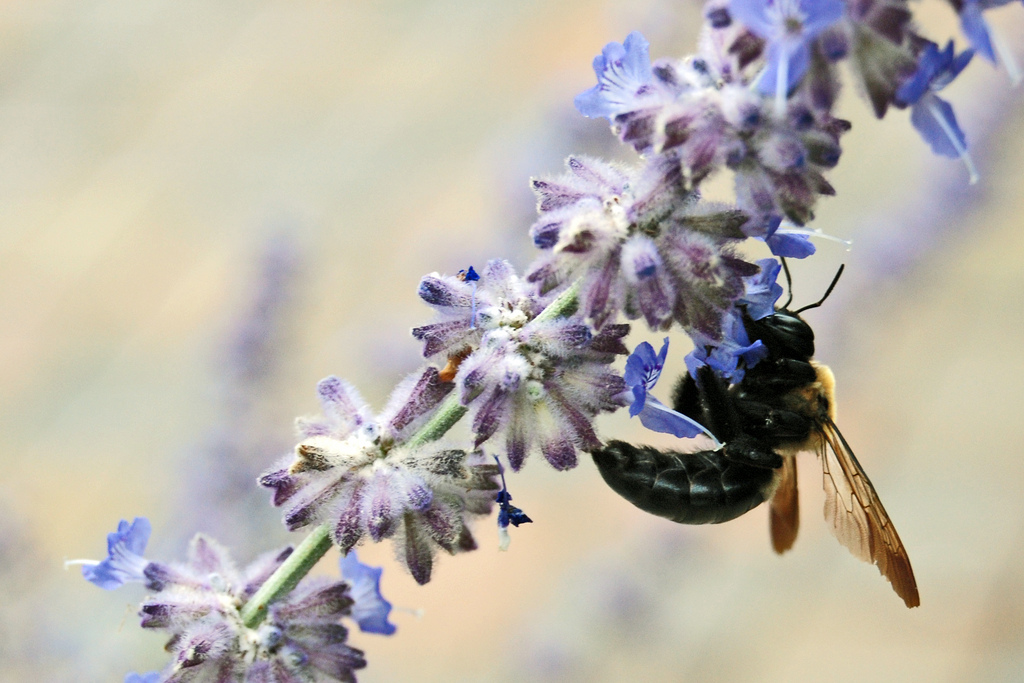
Look at the abdomen first and everything else second. Carpenter bee abdomens are hairless, black, and shiny; bumble bee abdomens are hairy and usually banded in yellow, orange, or white even when much of the bee is black.
Behaviour is nearly as reliable. Male carpenter bees hover in one spot near eaves, deck rails, and fence posts, darting at anything that passes and returning to the same position, which bumble bees never do. Bumble bees move from flower to flower and do not patrol.
Face markings settle the sex. Male carpenter bees have a distinct white or pale yellow patch on the face; females have an all-black face. That is worth knowing because the hovering bee that frightens people is always a male and is physically incapable of stinging. The guide to a bee landing on you covers the encounter people report most.
Are Black Bumble Bees Harmful?
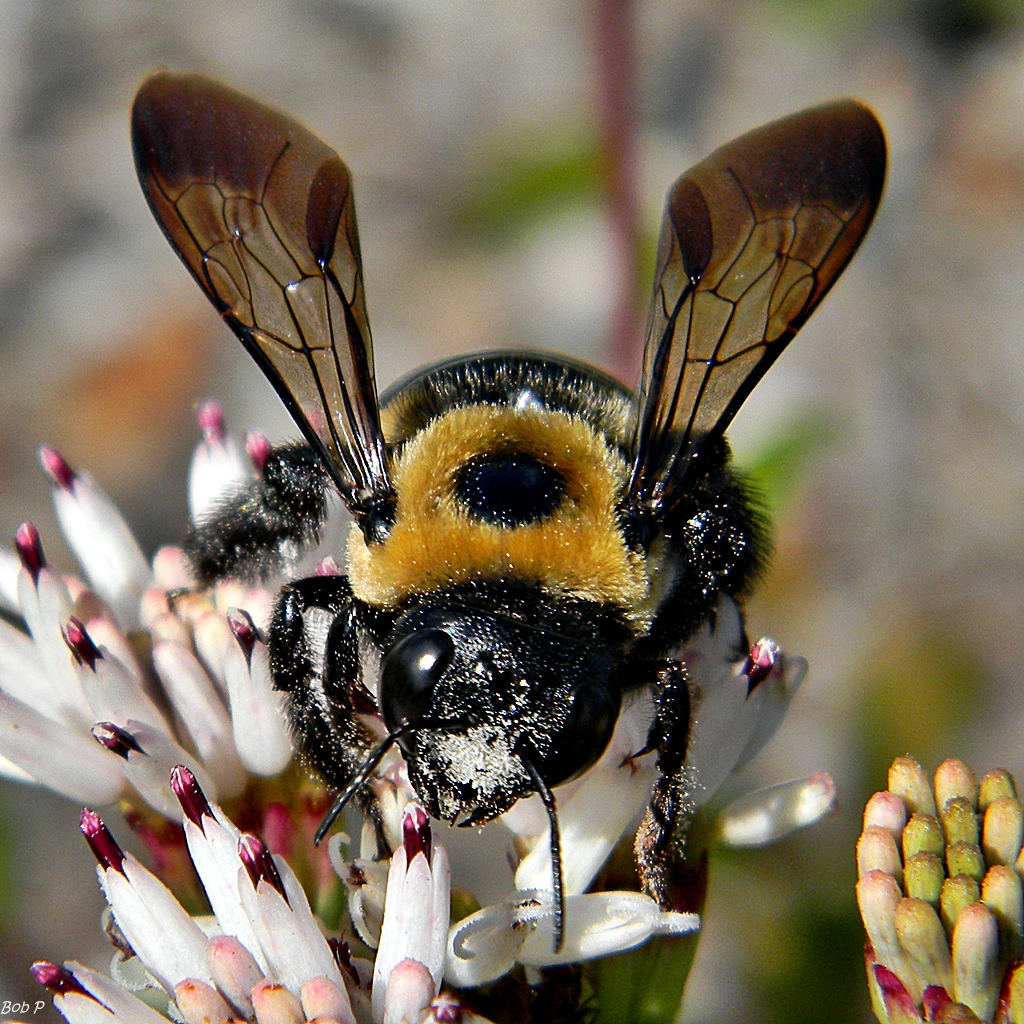
Not to people. Male carpenter bees have no stinger at all, which is true of male bees generally since the stinger is a modified ovipositor, so the aggressive hovering and dive-bombing that carpenter bees are known for is pure bluff.
Females can sting but rarely do. A female carpenter bee stings only if grabbed or trapped against skin, and the same applies to bumble bees, which are among the least defensive bees and generally have to be handled or have their nest disturbed before stinging. Neither loses the stinger, so both can sting more than once.
Neither species swarms defensively the way honey bees or wasps do. Carpenter bees are solitary, so there is no colony to defend, and bumble bee colonies are small, typically fifty to a few hundred workers rather than tens of thousands. Anyone with a known bee sting allergy should still take normal precautions. The guide to birds that eat bees covers their natural predators, and the hornet vs wasp guide covers the insects that genuinely do sting readily.
Do They Damage Wood?
Carpenter bees do, bumble bees do not. Female carpenter bees bore a perfectly round hole about half an inch across into bare or weathered softwood, then tunnel along the grain to create a gallery where they lay eggs in cells separated by chewed wood pulp.
A single season’s tunnel is minor. The problem is reuse and expansion: females return to the same wood year after year, extending existing galleries and adding new ones, and after many years a fascia board, deck rail, or pergola beam can be extensively riddled. Woodpeckers then enlarge the holes chasing the larvae, which causes more visible damage than the bees did.
They strongly prefer bare, unpainted, weathered softwood: cedar, redwood, pine, cypress, and fir. Painted surfaces are much less attractive and hardwoods largely ignored, so keeping exposed softwood painted or varnished is the single most effective preventive measure. Filling old holes in autumn with wood filler or dowel and then painting prevents reuse.
Do Black Bumble Bees Make Honey?
Not usefully. Bumble bees produce a small amount of honey-like material to feed the colony over a few days of bad weather, stored in waxy pots rather than combs, but the quantity is tiny and the colony consumes it. There is no surplus to harvest.
Carpenter bees produce none at all. They are solitary, and the female provisions each egg cell with a loaf of pollen mixed with nectar, which the larva eats as it develops. Nothing is stored beyond the immediate needs of the brood.
Only honey bees store honey in quantity, and that is because a honey bee colony overwinters as a colony and needs months of food. Bumble bee colonies die out in autumn with only new queens surviving to hibernate alone, and carpenter bees overwinter as adults in their tunnels, so neither has any reason to stockpile.
Are They Good for the Garden?
Both are valuable, and bumble bees are among the most important pollinators there are. They fly in cooler weather and lower light than honey bees, work earlier and later in the season, and perform buzz pollination, vibrating their flight muscles to shake pollen loose from flowers that will not release it otherwise.
Tomatoes, peppers, aubergines, blueberries, and cranberries all depend on buzz pollination, which honey bees cannot do, and commercial bumble bee colonies are used in greenhouses specifically for tomato crops. A garden without bumble bees produces measurably worse fruit set on those plants.
Carpenter bees pollinate too, though less efficiently on some flowers because they sometimes rob nectar by slitting the base of a tubular bloom rather than entering it. They are still substantial pollinators of open-flowered plants and native species, and the wood damage has to be weighed against that rather than treated as the only consideration.
Are Bumble Bees Declining?
Several species are, sharply. The rusty patched bumble bee was listed as endangered in the United States in 2017, the first bee in the continental US to receive federal protection, after declining by around 87 percent, and Franklin’s bumble bee was listed in 2021 and may already be extinct.
The causes are the familiar set: habitat loss, pesticides particularly neonicotinoids, pathogen spillover from commercially reared bumble bees used in greenhouses, climate change compressing suitable range, and reduced floral diversity in agricultural landscapes.
What helps is straightforward and works at garden scale. Plant a succession of flowers from early spring through autumn, favour single rather than double blooms, leave patches of rough grass and bare ground for nesting queens, skip insecticides, and leave leaf litter and stems over winter where queens hibernate. The Xerces Society (xerces.org) coordinates bumble bee monitoring and publishes regional plant lists. The bee tattoo meaning guide covers the cultural side.
Where Do They Nest?
Carpenter bees nest alone in wood. A female bores a round entrance hole, turns ninety degrees, and tunnels along the grain for several inches, then provisions a series of cells with pollen and nectar, laying one egg in each and sealing them with chewed wood pulp. Larvae develop through summer and emerge as adults in late summer.
Bumble bees nest in cavities in or on the ground. Old rodent burrows, compost heaps, dense tussocks of grass, spaces under sheds and decking, and occasionally bird boxes are all used, and a queen founds the colony alone in spring before workers take over the foraging.
Neither reuses the nest across generations in the way honey bees do. Bumble bee colonies die out entirely in autumn with only mated queens surviving to hibernate alone in leaf litter and loose soil, and carpenter bees overwinter as adults inside their tunnels, emerging in spring to mate and start again.
What Should You Do About Carpenter Bees?
Usually nothing, and that is a defensible answer given the pollination value. A few holes in a fence post or a garden structure are cosmetic, and the bees will be gone within weeks of the spring emergence period.
Where structural wood is affected, the approach is exclusion rather than killing. Paint or varnish exposed softwood, fill old holes in late autumn once the bees have left, cap the ends of deck rails and pergola beams with metal or trim, and consider replacing badly riddled boards rather than treating them.
Insecticide dust in active tunnels is the standard treatment where it is genuinely warranted, applied in the evening, followed by plugging the hole a few days later. Timing matters: sealing a tunnel with larvae inside means they chew out somewhere else, and treating during the spring nesting period is far more effective than in midsummer. Extension programmes such as Virginia Tech (vt.edu) publish current guidance.
Related reading: Sweat Bee.
Related reading: Pink Bee.
Frequently Asked Questions
Is there such a thing as a black bumble bee?
Yes, several species carry extensive black and dark colour forms occur, but a bee with a shiny hairless abdomen is a carpenter bee. Bumble bees are always fuzzy on the abdomen.
How do you tell a carpenter bee from a bumble bee?
The abdomen: shiny and bare on a carpenter bee, hairy on a bumble bee. Carpenter bee males also hover in one spot patrolling, which bumble bees never do.
Are black bumble bees harmful?
No. Male carpenter bees have no stinger and their hovering is bluff. Females and bumble bees sting only if handled, and neither swarms defensively the way wasps or honey bees do.
Do black bumblebees make honey?
Not in usable amounts. Bumble bees store a few days of food in waxy pots and carpenter bees store none at all. Only honey bees stockpile honey, because only they overwinter as a colony.
Do they damage wood?
Carpenter bees do, boring half-inch round holes into bare weathered softwood and reusing the galleries yearly. Bumble bees nest in ground cavities and damage nothing.
Are black bumble bees rare?
Genuinely black bumble bee species are less common than the sightings suggest, because most reports are carpenter bees. Several bumble bee species are in serious decline for other reasons.
Should you get rid of carpenter bees?
Usually not. A few holes in garden timber are cosmetic and the bees are useful pollinators. Where structural wood is affected, paint the surfaces and fill old holes in autumn.

Similar Posts
Mountain Lion Scat: Identification and What It Means
Mountain lion scat is segmented with blunt ends and packed with fur. How to tell it from coyote and bobcat scat, why it is rarely found, and what to do if you find it.
Deer Lifespan: How Long Deer Live in the Wild vs Captivity
Wild deer average 2 to 3 years while captive deer reach 15 to 20. Lifespan by species and sex, what kills deer young, and the oldest deer on record.
What Is a Group of Rabbits Called? Colony, Warren, and Fluffle
A group of rabbits is called a colony or warren, and a herd if domestic. Why fluffle is a modern invention, what a litter of kits is called, and how rabbit social groups really work.
Baby Rattlesnake: Identification & Danger Guide
How to identify a baby rattlesnake, the truth about whether they’re more dangerous than adults, and safety steps.
Turkey Poop: How to Tell a Tom From a Hen by Droppings
Male turkey droppings are J-shaped, female droppings are coiled. How to read freshness, roost sites and scratchings, plus safe cleanup and disease risk.
No See Ums: The Bug You Cannot See and How to Stop the Bites
No see ums are 1 to 3 mm biting midges that walk through window screens. What they are, when they bite, and what actually keeps them off you.