Pink Bee: 7 Insects Behind the Sighting and How to Tell Them Apart
There is no truly pink bee species in North America, so if you saw a pink bee, you almost certainly saw one of five things: a rosy maple moth, a bee carrying pink or brick red pollen, a black and red blood bee, a rust colored cuckoo bee, or an old bee that has rubbed most of its hair off. All five are harmless to handle at a distance, and all five are easy to separate once you know which body parts to look at.
The confusion is understandable. Pink is a rare pigment in bees, but it is common in pollen, common in cuckoo bee cuticle, and spectacularly common in one fuzzy pink moth that flies at porch lights all summer in the eastern US. This guide works through the real candidates in order of how often they get reported, with size, range, and the one feature that settles each identification.
No bee in the United States is naturally pink. Reported pink bees are usually rosy maple moths (Dryocampa rubicunda), which are pink and cream and genuinely fuzzy, or bees dusted with pink pollen. Red and pink cuckoo bees and blood bees are the closest real bees, and none of them are aggressive.
| What you saw | Size | Where the pink is | Stings? |
|---|---|---|---|
| Rosy maple moth | 1.25 to 2 in (3.2 to 5 cm) wingspan | Whole wings and legs | No, moths cannot sting |
| Blood bee (Sphecodes) | 0.2 to 0.4 in (5 to 10 mm) | Abdomen only, nearly hairless | Rarely, very weak |
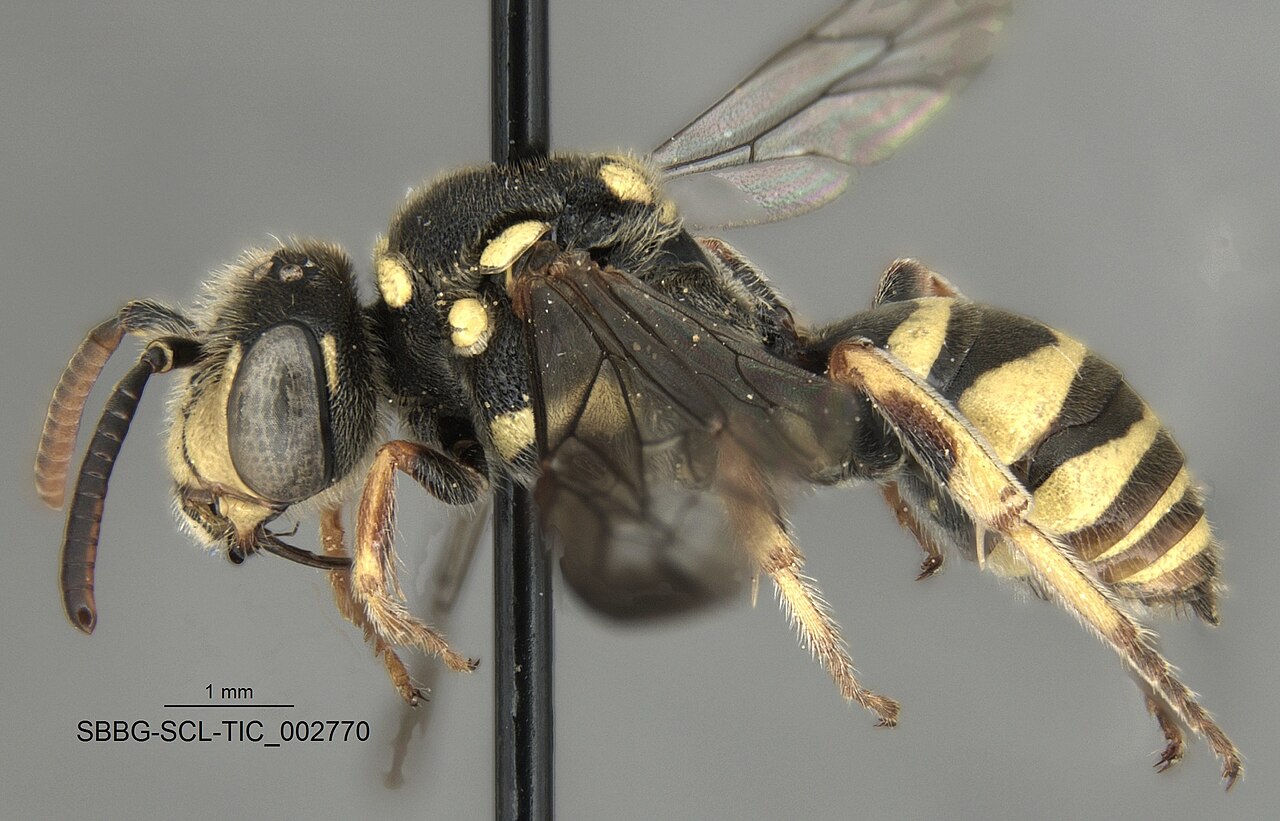
| Cuckoo bee (Nomada) | 0.25 to 0.5 in (6 to 13 mm) | Whole body, rust to rose | Rarely, very weak |
| Leafcutter bee with pollen | 0.3 to 0.6 in (8 to 15 mm) | Underside of abdomen | Only if squeezed |
| Bumble bee with pollen | 0.5 to 1 in (13 to 25 mm) | Two lumps on the hind legs | Only if provoked |
| Worn honey bee | 0.5 in (13 mm) | Shiny bald abdomen | Yes, once |
| Pink katydid | 0.6 to 2 in (1.5 to 5 cm) | Entire insect | No |
Are There Any Truly Pink Bees in the United States?
No. Of roughly 4,000 native bee species in the US, none are pink in the way a flamingo or a rosy maple moth is pink. Bee coloration comes from cuticle pigment and hair, and bee cuticle runs black, brown, amber, metallic green and metallic blue, while bee hair runs white, yellow, orange, brown and black. Pink sits outside both palettes.
What does exist is a band of reds and rusts that photograph pink. Cuckoo bees in the genus Nomada and blood bees in the genus Sphecodes both carry red abdomens, and in direct sunlight, or through a phone camera that pushes warm tones, red reads as rose. That is the single most common way a real bee ends up reported as pink.
The second route is pollen. A bee is a flying brush, and whatever color the pollen is, that is the color the bee becomes for an afternoon. Horse chestnut (Aesculus hippocastanum) pollen is brick red, mallow pollen is white to pale pink, and a bee loaded with either can look convincingly pink across the belly or the legs.
Is a Pink Bee Dangerous? Sting and Bite Risk First
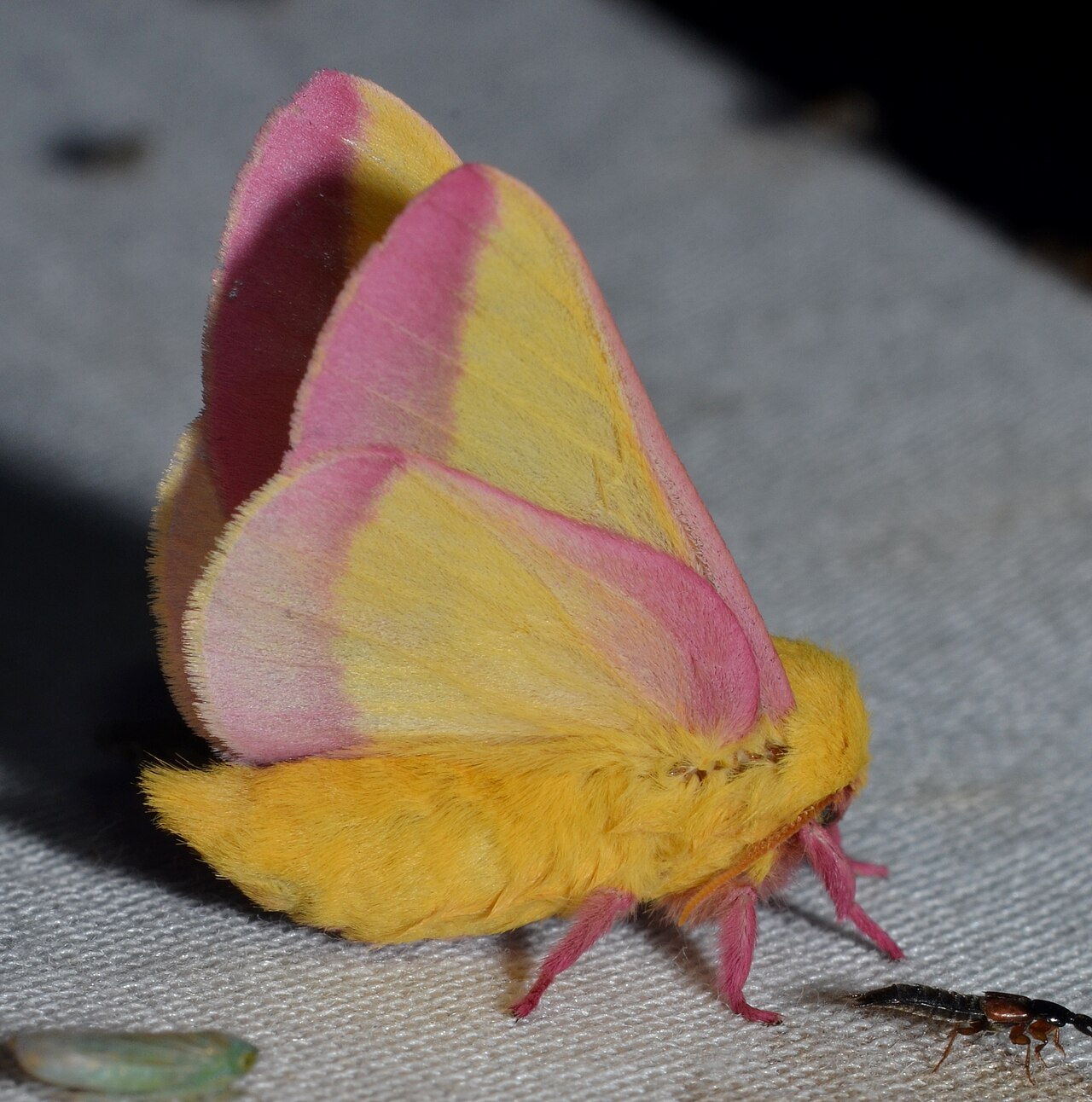
Almost none of the pink candidates can hurt you. The rosy maple moth has no sting, no bite and no venom; adult moths in this family do not even have functional mouthparts, so the fuzziest and pinkest insect on the list is the safest thing in your yard. Pink katydids and pink flower crab spiders are equally harmless to people.
Cuckoo bees and blood bees do have stingers, because all female bees do, but both are small, solitary and almost impossible to provoke. They have no nest and no stored honey to defend, which removes the main reason bees sting. Reports of being stung by either are rare enough that most field guides do not bother warning about it.
The real sting risk sits with the ordinary bees that happen to be carrying pink pollen. A honey bee can sting once, and a bumble bee can sting repeatedly, but neither does so away from the nest unless it is grabbed or trapped against skin. If you are weighing risk by species rather than by color, whether carpenter bees sting is the more useful comparison.
Rosy Maple Moth: The Pink “Bee” Most People Actually Saw

The rosy maple moth (Dryocampa rubicunda) is the answer to most pink bee searches, and once you see one the reason is obvious: it is bright pink and creamy yellow, densely furred across the thorax and legs, and about the size of a large bumble bee at 1.25 to 2 in (3.2 to 5 cm) across the wings. Nothing else in a US backyard looks remotely like it.
It ranges across the eastern US and southern Canada, from Maine and Minnesota south to Florida and eastern Texas, wherever maples grow. Caterpillars feed on red maple, silver maple and sugar maple, and in the South there can be two or three generations a year, so adults turn up from April into September. Farther north there is a single flight in late spring and early summer.
The giveaway features are the antennae and the wings. A moth has feathery or threadlike antennae and holds four broad wings in a tent or triangle over its body at rest. A bee has clubbed or elbowed antennae, a visible narrow waist, and folds two pairs of narrow wings flat along its back. If the insect is sitting still on a screen door at night with wings spread flat and pink all over, it is this moth.
Blood Bees (Sphecodes): Black and Red Bees That Read as Pink

Blood bees are the closest thing the US has to a genuinely pink bee. They are small, 0.2 to 0.4 in (5 to 10 mm), nearly hairless, and the front half to two thirds of the abdomen is bright blood red against a black head and thorax. In full sun, especially on a pale flower, that red bleaches toward rose in both photographs and memory.
Their lifestyle explains the bald look. Sphecodes are cleptoparasites that lay eggs in the nests of sweat bees and other small ground nesters, so they have no need for pollen collecting hair and have lost most of it. A hairless, wasp slick body is a strong clue that you are looking at a parasitic bee rather than a foraging one.
Blood bees occur across most of the continental US and are easiest to find in late spring and summer around bare, sandy soil where their host bees nest. They sit on low flowers and patrol nest aggregations at a hover. They are not dangerous and not a pest; their presence actually signals a healthy population of host bees nearby.
Cuckoo Bees (Nomada): Rust and Rose in Direct Sun

The genus Nomada is the largest group of cuckoo bees in North America, with more than 300 US species, and many of them are rust red to amber with yellow or ivory markings on a slender, wasp like body. They measure 0.25 to 0.5 in (6 to 13 mm). Photographed in warm afternoon light against a yellow flower, the rust shifts visibly toward pink.
Like blood bees they are hairless and parasitic, in their case mostly on mining bees in the genus Andrena. You see them flying slowly and low over bare ground in early spring, searching for host burrows rather than visiting many flowers. That low, methodical searching flight is itself an identification clue, because no pollen collecting bee flies that way.
If the insect you saw had long legs, a hard shiny body, no visible fuzz and a reddish tone, a Nomada is the most likely real bee on the list. They are present nationwide, with the greatest diversity in the arid West. Nothing about them requires management, and they cannot damage wood or structures the way carpenter bees nesting in wood can.
Leafcutter Bees (Megachile): A Pink Belly Full of Pollen
Leafcutter bees carry pollen in a dense brush of hair on the underside of the abdomen rather than on the legs, which means the whole belly takes on the color of whatever they are working. On mallows, hollyhocks and hibiscus, that pollen is white to pale pink, and a loaded female flying belly down looks like she has a pink stripe underneath.
North America has more than 130 Megachile species, typically 0.3 to 0.6 in (8 to 15 mm), stocky, with a broad head and strong jaws used to cut the neat half circles out of rose and redbud leaves that give the group its name. They nest in hollow stems and cavities, not in wood they excavate themselves, and they are important pollinators of alfalfa and blueberries.
To confirm pollen rather than pigment, watch the bee rather than freeze it in a photo. Pollen color sits only where the brush is, changes within an hour as she unloads at the nest, and often looks patchy or streaked. True cuticle color is even, symmetric and does not wash off.
Bumble Bees With Pink Pollen Baskets
Bumble bees pack pollen into corbiculae, smooth concave plates on the hind legs, and a full load shows up as two bright lumps riding on the back legs. Horse chestnut and buckeye pollen is brick red to orange, and a common eastern bumble bee (Bombus impatiens) with full baskets off a chestnut looks like it is carrying two pink saddlebags.
The pollen is also not the only pink. Older bumble bee queens lose thoracic hair in a bald patch, and the exposed cuticle underneath has a reddish brown sheen that reads pink in photographs. A queen that has overwintered and spent spring excavating a nest site can look noticeably faded and pinkish by June.
Bumble bees in the US run 0.5 to 1 in (13 to 25 mm) and are the one group on this list worth giving space to, since they will defend a nest. Otherwise they are no more aggressive than any other foraging bee. A genuinely dark bee with no pink at all is probably one of the species covered in the black bumble bee guide.
Honey Bees and Worn Bees: Why an Old Bee Looks Pink
Honey bees (Apis mellifera) are the most abundant bee in most US yards, and they turn pink two ways. A forager on horse chestnut, redbud or mallow carries visibly warm pollen on her hind legs. A forager at the end of her three to six week adult life has worn her hair down to almost nothing, and the bald amber abdomen beneath catches light as a dull rose.
Worn bees are easy to recognize once you have seen a few: ragged wing edges, a shiny rather than fuzzy abdomen, and slower flight. Beekeepers call them old foragers, and they are a normal part of a healthy colony rather than a sign of disease. The US Geological Survey native bee program publishes detailed reference photography of both fresh and worn specimens.
Pink Insects That Are Not Bees at All
Four pink arthropods account for most remaining reports. The pink katydid is a rare color morph of the common true katydid, entirely rose pink, caused by a recessive pigment condition, and roughly 1 in 500 katydids shows it. The pink spotted hawkmoth (Agrius cingulata) has bright pink bands on its hindwings and a fat furry body that passes for a bee in flight.
The flower crab spider (Misumena vatia) can shift between white and yellow and often sits on pink flowers, and the oleander hawkmoth and various plant bugs add a few more. If the insect had eight legs, it was a spider, which rules out a bee immediately. The same color trap shows up in pink spider sightings and pink ladybug reports.
Pink Bee vs Rosy Maple Moth: The Three Second Check
Two features decide it faster than color ever will. Look at the antennae: a moth carries thick, feathery or threadlike antennae, while every bee carries a thin antenna with a visible elbow bend. Then look at the waist, because a bee has a pinched junction between thorax and abdomen and a moth has none.
Behavior confirms the call. Rosy maple moths sit motionless on walls, screens and bark, often for hours, and fly only at night. Cuckoo bees and blood bees are active in daylight and rarely sit still for more than a few seconds. If the pink insect let you walk up and take a sharp photo in daylight, it was a resting moth.
| Feature | Rosy maple moth | Cuckoo bee (Nomada) |
|---|---|---|
| Antennae | Feathery, thick | Elbowed, threadlike |
| Wings at rest | Four, spread flat or tented | Two pairs, folded along back |
| Body surface | Dense pink and cream fur | Hard, shiny, nearly hairless |
| Waist | None visible | Narrow, clearly pinched |
| Activity | Night, at lights | Day, low over bare soil |
| Can sting | No | Yes, rarely and weakly |
Where and When to Look for Pink Bees and Their Lookalikes
Timing separates the candidates almost as well as anatomy. Cuckoo bees fly earliest, from March in the South and April farther north, when mining bee hosts are active. Blood bees peak in May through August around sandy ground. Leafcutters are midsummer insects, strongest in July. Rosy maple moths fly at night from April in Florida to July in the Upper Midwest.
Habitat helps too. For real pink toned bees, look at bare sunny soil, sand paths and the edges of driveways rather than at flowers, because the parasitic species spend their time near host nests. For pollen pinked bees, go to the plants: horse chestnut and buckeye in spring, hollyhock and hibiscus from midsummer on.
Porch lights are the fastest route to a rosy maple moth. Leave a white light on near maples on a warm, still night in late spring and check the wall at dawn. Birds take advantage of the same concentrations, which is part of why birds that eat bees patrol those same structures in the morning.
What to Do If a Pink Bee Shows Up in Your Yard
Leave it alone, in every case on this list. None of the pink candidates nest in structures, none damage plants as adults, and the parasitic bees among them are indicators of a healthy native bee population rather than a problem. A rosy maple moth on a wall will be gone by the following night without any intervention.
If a moth is stranded indoors, move it on a sheet of paper rather than by hand, because the wing scales rub off and cannot be replaced. For a bee you want out of the house, trap it under a glass against a window and release it outside. Neither insect needs food or water in the meantime.
Frequently Asked Questions
Is there such a thing as a pink bee?
Not as a species. No bee in North America has naturally pink hair or pink cuticle. The closest real bees are blood bees and cuckoo bees, which have bright red abdomens that photograph pink in sunlight. Any strongly pink insect reported as a bee is far more likely to be a rosy maple moth.
What is the little pink fuzzy bee?
It is a rosy maple moth, Dryocampa rubicunda, common across the eastern US wherever maples grow. It is pink and creamy yellow, 1.25 to 2 in (3.2 to 5 cm) across, and densely furred, which is exactly why it gets called a bee. It cannot sting or bite and adults do not feed at all.
Are pink bee photos real or edited?
Both circulate. Genuine images show rosy maple moths, red abdomened cuckoo bees and pollen dusted foragers. Edited images usually give the whole bee an even candy pink, including the eyes, wings and legs, which no real insect shows. Uniform pink across transparent wings is the clearest sign of a retouched photo.
Do pink bees sting?
The pinkest candidate, the rosy maple moth, has no stinger at all. Cuckoo bees and blood bees can sting in theory but are tiny, solitary and effectively harmless. Only the ordinary honey bees and bumble bees that happen to be carrying pink pollen present any real sting risk, and only near a nest or if handled.
What flowers make bees look pink?
Horse chestnut and buckeye produce brick red pollen that reads pink on hind legs, and mallows, hollyhocks and hibiscus produce white to pale pink pollen that coats a leafcutter’s belly brush. The effect lasts only until the bee unloads at her nest, so the same individual can look pink in the morning and ordinary by noon.
Is the rosy maple moth rare?
No, it is common throughout its range, though it is easy to miss because it flies at night and rests on bark during the day. Numbers follow maple abundance, so suburban neighborhoods with mature red or silver maples often have high densities. Sightings concentrate on porch lights and lit windows in late spring.