Baby Possum Guide: Age, Size Test & What to Do
Finding a baby possum, called a joey, usually raises one urgent question: does it need rescuing, or is it already old enough to be on its own? State wildlife agencies use a simple size and weight test to answer that, and getting it right matters, because both over-intervening and under-intervening can hurt the animal. This guide walks through identifying a baby possum, how it develops from a bee-sized embryo to an independent juvenile, the exact size threshold wildlife agencies use, and what to do at each stage.
The animal is the Virginia opossum (Didelphis virginiana), North America’s only marsupial. Like kangaroos and koalas, opossums raise their young in a pouch, which explains both their unusual newborn size and why the rescue guidelines differ from those for other backyard mammals.
| Size (nose to base of tail) | Weight | Status | Action |
|---|---|---|---|
| Under 8 inches | Under ~200g / 7.25 oz | Dependent, likely orphaned | Contact a licensed rehabilitator |
| Eyes still closed | Any | Very young, fragile | Keep warm, no food or water, call immediately |
| 8+ inches | Over ~200g / 7.25 oz | Independent | Leave it alone |
| Any size | Any | Injured or cat-caught | Contact a wildlife veterinarian right away |
How Big Is a Baby Possum at Birth?
Virginia opossums are pregnant for only 10 to 12 days, an extraordinarily short gestation even among marsupials. At birth, the babies are barely developed: hairless, blind, roughly the size of a honeybee, and weighing about a tenth of a gram. They must immediately crawl, unaided, from the birth canal up into the mother’s pouch, a journey only some manage to complete. Once inside, each joey latches onto one of the mother’s thirteen teats, and the teat swells in its mouth to keep the baby attached for the following weeks.
Finding droppings can also help confirm opossum activity in an area even without a direct sighting; see our guide to possum poop identification for what to look for.
Baby Possum Growth Stages
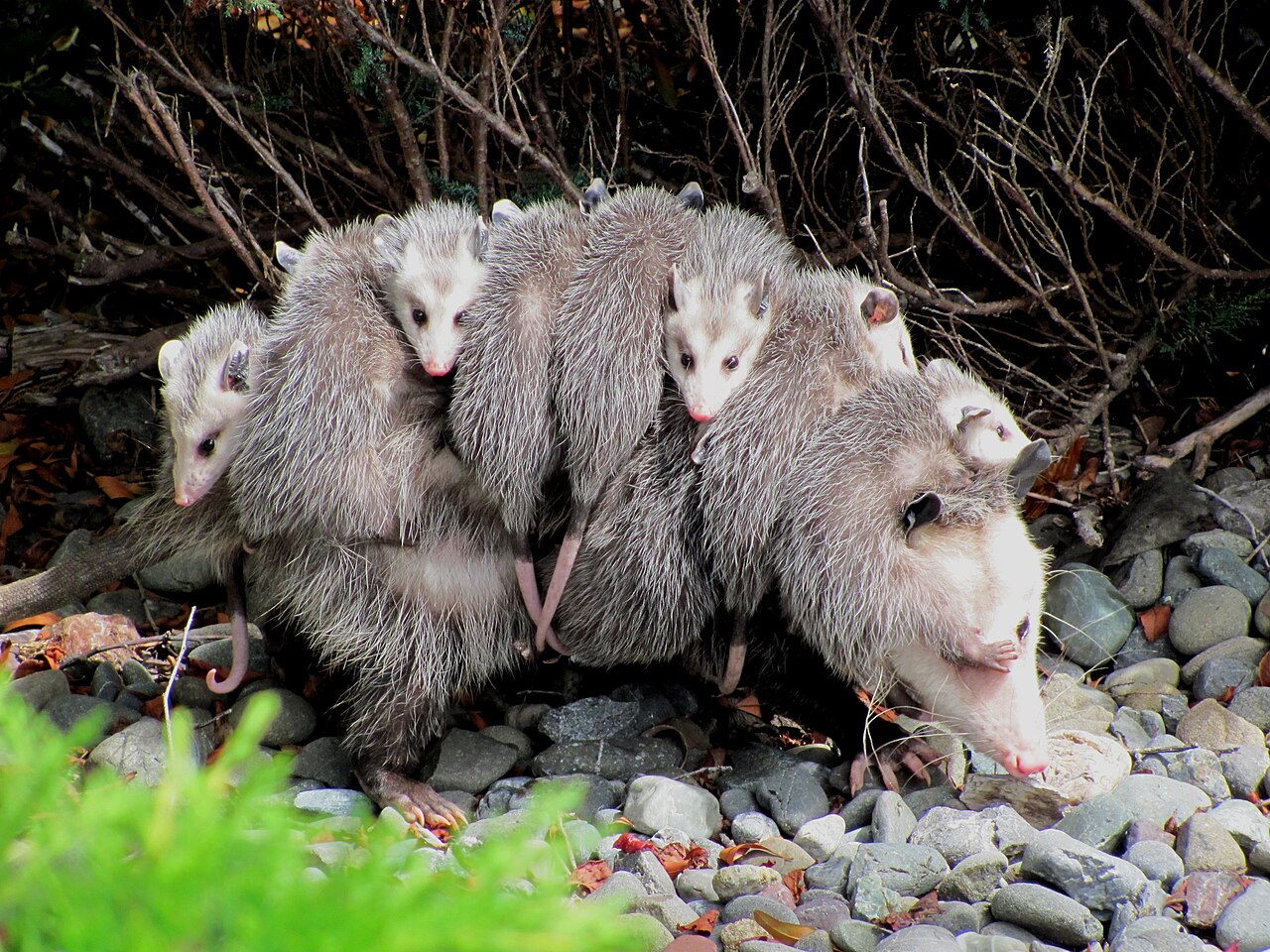
A litter typically contains six to nine surviving young, though a female may give birth to many more than that. The joeys nurse continuously in the pouch for about two months, and their eyes open somewhere between 55 and 70 days of age, around the time they reach the size of a mouse. From roughly two to four months, they leave the pouch to ride on the mother’s back while she forages at night, gripping with claws, feet, and that distinctive prehensile tail. This is the riskiest stage for accidental separation: a joey can slip off unnoticed and end up alone in a yard or driveway, which is how many “orphaned” babies are actually found. Compare this timeline with other commonly found backyard young, such as cottontail kits or red fox pups, since the right response varies considerably by species.
The Size Test: Does This Baby Possum Need Help?
State wildlife agencies including Virginia’s Department of Wildlife Resources and the Wildlife Center of Virginia use a consistent measurement: an opossum measuring at least 8 inches from the tip of the nose to the base of the tail, and weighing more than roughly 200 grams (7.25 ounces), is old enough to survive independently and does not need human help, even if it looks small. Below that size, or if the eyes have not yet opened, the animal is still dependent and needs a licensed rehabilitator or wildlife veterinarian.
Before doing anything, check the surrounding area quietly. Opossums do not reliably return for a fallen joey the way some mammals search for their young, but littermates are often nearby, and young opossums make a soft sneezing sound to signal the mother, so finding one frequently means there are others close by.
What to Do If You Find a Baby Possum
If the animal is under the size threshold, has closed eyes, is injured, or has had any contact with a cat or dog, it needs professional help. Put on thick gloves, since all wild mammals should be handled carefully regardless of temperament, and place the joey gently into a ventilated box lined with a soft cloth. Secure the lid, because even young opossums climb well, and keep the box somewhere warm, dark, and quiet.
Do not offer food or water unless a rehabilitator instructs you to, and never give cow’s milk, which opossums cannot digest properly and which can cause fatal complications. Then contact your state wildlife agency or a licensed wildlife rehabilitator directly; most states maintain a searchable list. Any joey that has been in a cat’s or dog’s mouth needs veterinary attention immediately, even with no visible wound, since bacteria from the bite can be lethal to small wildlife within hours. The same urgency applies to other young wildlife encounters, whether it is a possum, a raccoon kit, or a nest of other small creatures people find in the yard.
Baby Possum vs Baby Rat: Telling Them Apart
Small grey joeys are frequently mistaken for rats, but a few features make the difference clear. Baby possums have a distinctly pointed pink nose, grizzled grey-white fur, dark round eyes, thin rounded ears, and that unmistakable thick, hairless prehensile tail used for grip and balance. Rats have a blunter face, more uniform brown or grey coloring, and a thinner tail without the same grasping function. Behavior is another clue: a startled joey tends to freeze, gape, or drool rather than bolt the way a rat typically would. If you are still unsure, most wildlife rehabilitators can confirm the species from a quick photo before you transport the animal anywhere.
Why Backyard Opossums Are Worth Leaving Alone
It is easy to assume any wild mammal in the yard is a problem, but an independent opossum passing through is usually doing free pest control. As opportunistic omnivores, adult opossums eat large numbers of slugs, snails, and insects, along with fallen fruit and carrion that would otherwise attract less welcome visitors. They are also unusually resistant to rabies compared with many other mammals. The best outcome for a healthy, independent-sized juvenile is almost always to simply let it continue on its route rather than intervening, reserving actual help for the genuinely young, injured, or endangered animals covered above.
How Long Do Opossums Live?
Opossums live fast for a mammal their size. In the wild, most survive only one to two years, worn down by predators, vehicle strikes, and disease, which is a sharp contrast to the multi-year lifespans of animals like other backyard wildlife encounters in the same neighborhood. A short lifespan paired with frequent breeding, typically two to three litters a year, is the species’ actual survival strategy rather than a sign of fragility; it is one of the oldest reproductive strategies among North American mammals, having persisted largely unchanged for tens of millions of years.
What Do Baby Possums Eat?
Before weaning, joeys drink only their mother’s milk. Afterward, opossums become true omnivores and opportunistic feeders, eating insects, slugs, other small pests, earthworms, carrion, fallen fruit, and the occasional small rodent. That appetite for garden pests and ticks makes wild opossums genuinely useful neighbors rather than nuisances. If you are briefly caring for a joey while waiting for pickup, do not attempt to feed it yourself: incorrect food, temperature, or technique can easily cause aspiration in a young animal, which can be fatal, and rehabilitators use specific milk-replacement formulas rather than anything found in a kitchen.
Why Raising a Baby Possum Yourself Is a Bad Idea
Keeping and hand-raising a wild opossum without a permit is illegal in most states and genuinely risky for the animal. Joeys have precise, stage-specific needs for temperature, hydration, and formula that are hard to replicate outside a rehabilitation setting, and errors are frequently fatal, particularly in animals still nursing. Licensed rehabilitators carry the training, equipment, and legal authority to give an orphaned joey a real chance at survival and eventual release, which is why the fastest path to a rehabilitator is also the kindest one for the animal.
Do Opossums Help Control Ticks?
Opossums have a reputation, sometimes exaggerated online, as tick-eating machines. The reality is more modest but still genuine: as they groom themselves and forage on the ground, opossums do consume a meaningful number of ticks compared with some other mammals, simply as a side effect of how much time they spend low to the ground grooming and foraging. Combined with their appetite for slugs, snails, and overripe fruit, this makes an adult opossum passing through a yard a net positive far more often than not.
Is a Baby Possum Dangerous to Handle?
Opossums are among the least aggressive mammals you are likely to encounter. Their main defenses are bluffing, including hissing, drooling, and baring their roughly 50 teeth, more than any other North American land mammal. When genuinely frightened, an opossum can enter an involuntary shock-like state known as playing possum, appearing dead for anywhere from a few minutes to several hours before recovering on its own; give one space and time rather than assuming the worst. Rabies is very rare in opossums, likely related to their unusually low body temperature, though like any wild animal they can carry parasites, so gloves and hand-washing after contact remain sensible precautions.
Related reading: Baby Rabbit.
Related reading: Baby Rabbit.
Related reading: Baby Rabbit.
Related reading: Baby Rabbit.
Related reading: Baby Rabbit.
Related reading: Baby Rabbit.
Related reading: Baby Rabbit.
Related reading: Baby Rabbit.
Related reading: Baby Rabbit.
Related reading: Baby Rabbit.
Related reading: Baby Rabbit.
Related reading: Baby Rabbit.
Related reading: Baby Rabbit.
Related reading: Baby Rabbit.
Related reading: Baby Rabbit.
Opossum Size by Age: Month by Month
Because opossums are marsupials, their growth timeline looks nothing like a puppy’s or kitten’s. Use these rough benchmarks alongside the 8-inch rule above:
| Age | Approximate Size | Stage |
|---|---|---|
| Newborn | Honeybee-sized, under 1 gram | Crawls into the pouch |
| 2 months | Mouse-sized, 1 to 2 ounces | Eyes open, still in the pouch |
| 3 months | Rat-sized, 5 to 7 inches body | Rides on mother’s back |
| 4 months | 7 to 9 inches body, around 1 pound | Independent, passes the 8-inch rule |
| 6 months | 10 to 13 inches body | Juvenile living alone |
| 8 to 12 months | 15 to 20 inches body, 4 to 14 pounds | Adult, females breeding |
So a “4 month old opossum” is already a fully independent animal, even though it looks small next to an adult. If the body (not counting the tail) is longer than your smartphone, it does not need rescuing.
Frequently Asked Questions
How do I know if a baby possum needs help?
Wildlife agencies use size as the test: if it measures at least 8 inches from nose to tail base and weighs more than about 200 grams, it is independent and should be left alone. Smaller, closed-eyed, injured, or cat-caught joeys need a licensed rehabilitator.
What do baby possums eat?
Before weaning, joeys drink only their mother’s milk. Afterward, opossums are omnivores eating insects, slugs, snails, earthworms, carrion, and fruit. Never feed a found joey yourself, and never give cow’s milk, which can be fatal.
Is it legal to raise a baby possum at home?
In most states, raising a wild opossum without a rehabilitation permit is illegal, and their specific care needs make home-raising genuinely risky for the animal. The right step is always contacting a licensed rehabilitator.
Why does a baby possum play dead?
Playing possum is an involuntary, shock-like reaction to a serious threat, not a conscious choice. The animal appears lifeless for anywhere from minutes to several hours before recovering, so give it quiet space rather than assuming it has died.
Do baby possums carry rabies or other diseases?
Rabies is very rare in opossums, possibly linked to their low body temperature, though they are not risk-free and can carry parasites like any wild animal. Wearing gloves when handling one and washing your hands afterward is sensible.
How long do baby possums stay with their mother?
Joeys nurse in the pouch for about two months, then ride on the mother’s back for another one to two months while foraging, becoming fully independent at around four months old when they reach roughly 8 inches long.
What size possum can survive on its own?
State wildlife agencies use roughly 8 inches from nose to the base of the tail, combined with a weight over about 200 grams, as the threshold for independence. Below that size, the animal still needs its mother or a rehabilitator.