Caterpillars That Look Like Snakes: 5 Species and How to Tell
Yes, there are caterpillars that look like snakes, and in the United States you are almost certainly looking at a swallowtail caterpillar with two large fake eyespots behind its head. A caterpillar that looks like a snake is using mimicry to scare off birds, and none of the American species can bite you or inject venom.
The confusion is easy to understand. A spicebush swallowtail caterpillar in a folded leaf has a swollen front end, a pale belly, and two black and yellow eyespots that look exactly like a small viper staring back. Below are the species you will actually find and the two second test that settles it.
Caterpillars that look like snakes are harmless caterpillars with false eyespots, mostly swallowtails and sphinx moths. In the US the spicebush swallowtail, eastern tiger swallowtail, and pandorus sphinx are the common ones. None is venomous or poisonous to touch, and a caterpillar always has stubby prolegs along its belly, which no snake has.
Is the Snake Caterpillar Poisonous or Dangerous?
No. Every snake mimicking caterpillar in North America is safe to handle. The species that carry eyespots have no stinging spines and no toxic hairs. Swallowtail caterpillars defend themselves with an osmeterium, a forked orange gland that flips out behind the head and smells faintly of rancid citrus. It will not burn skin.
Venomous caterpillars look completely different, which is the useful part of this question. The ones that sting in the US are bristly or fuzzy: the puss caterpillar, the saddleback, the io moth larva, and the hickory tussock moth all carry hollow spines connected to venom glands. Smooth skin plus big false eyes means safe, dense spines or fur means hands off. The same logic sorts reptiles, which is why the coral snake and king snake comparison comes down to band order rather than color.
Spicebush Swallowtail (Papilio troilus)
The spicebush swallowtail is the caterpillar most Americans photograph and post as a snake. Late instars reach about 2 in (5 cm), are green or yellow green with a swollen thorax, and carry two black eyespots ringed in yellow with a convincing white glint. A second, smaller pair sits just behind them, which reads as nostrils.
It lives wherever spicebush and sassafras grow, across the eastern US from New England to Florida and west to Texas. The caterpillar folds a leaf into a silk tube and rests inside by day, so people find it when they open the leaf. Just before pupation it turns orange, and the eyespots stay visible.
Eastern Tiger Swallowtail (Papilio glaucus)
The eastern tiger swallowtail is the second common offender, roughly 2 in (5 cm) and plain bright green with a thick, humped front end and yellow eyespots with a blue black pupil. A thin yellow and black band crosses the body behind the thorax, which the spicebush lacks.
It occurs across the eastern and central United States and feeds on wild cherry, tulip tree, ash, and birch. It also rests in a silk lined leaf shelter, so the first sight of it is often a green snake head peering out of a curled cherry leaf at eye level.
Snake Mimic Hawkmoth (Hemeroplanes triptolemus)
This is the caterpillar behind the viral photographs, and it is not a US species. The snake mimic hawkmoth lives in Central and South America, grows to about 3 in (8 cm), and goes much further: when disturbed it lets go with its front legs, inflates the front third of its body, and holds it in the air so the underside shows a triangular head, two glossy false eyes, and a scale like pattern.
It turns into a sphinx moth. If your photograph came from Costa Rica or Ecuador, this is the animal. If it came from your backyard in Ohio, it is a swallowtail.
Other US Caterpillars Mistaken for Snakes
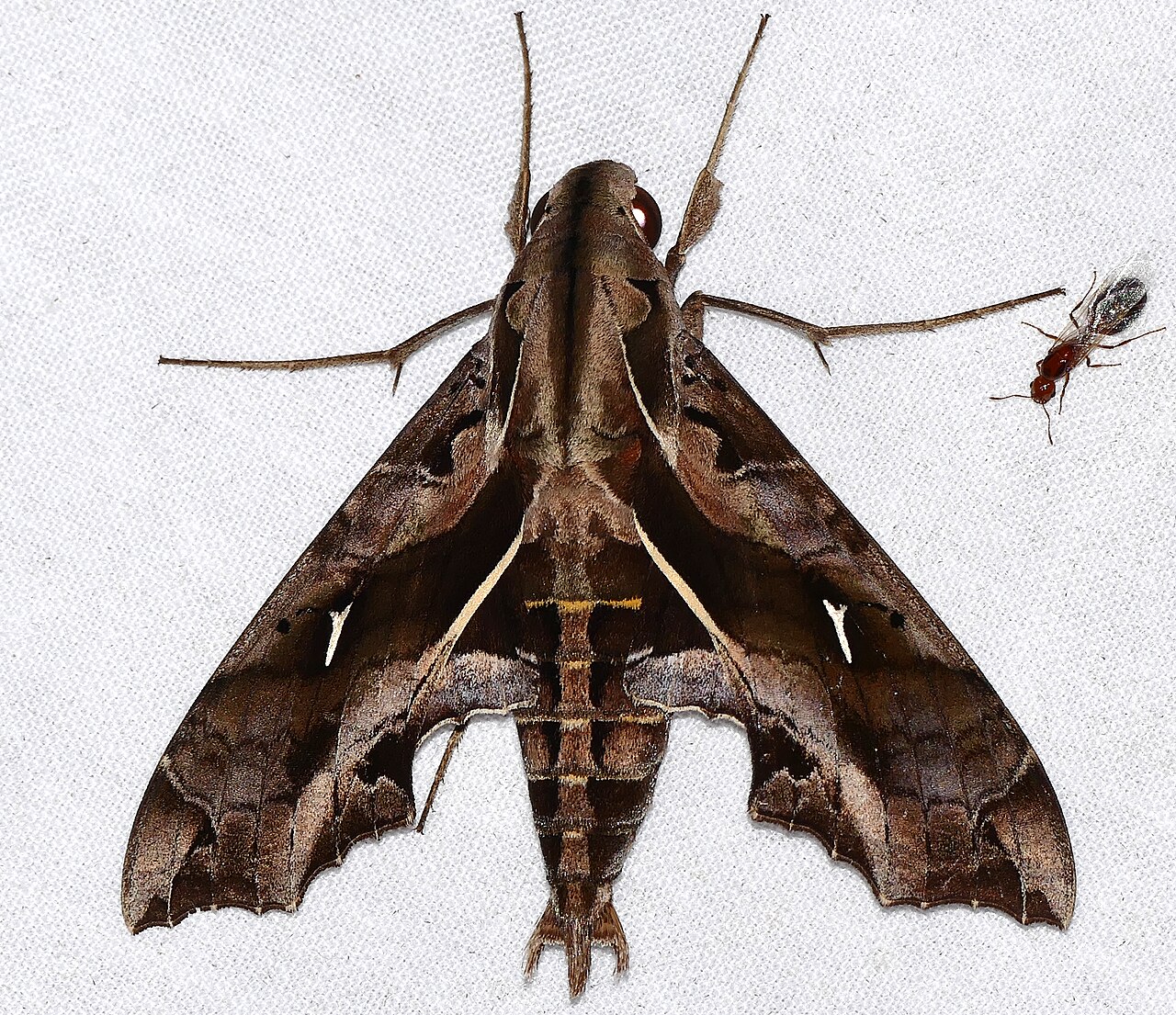
The pandorus sphinx (Eumorpha pandorus) reaches 3.5 in (9 cm), is brown or green with five cream oval spots down each side, and pulls its head into its body when touched, producing a blunt, snake like front end. The hickory horned devil (Citheronia regalis) is bigger at 5 in (13 cm), carries orange and black horns, and is also harmless.
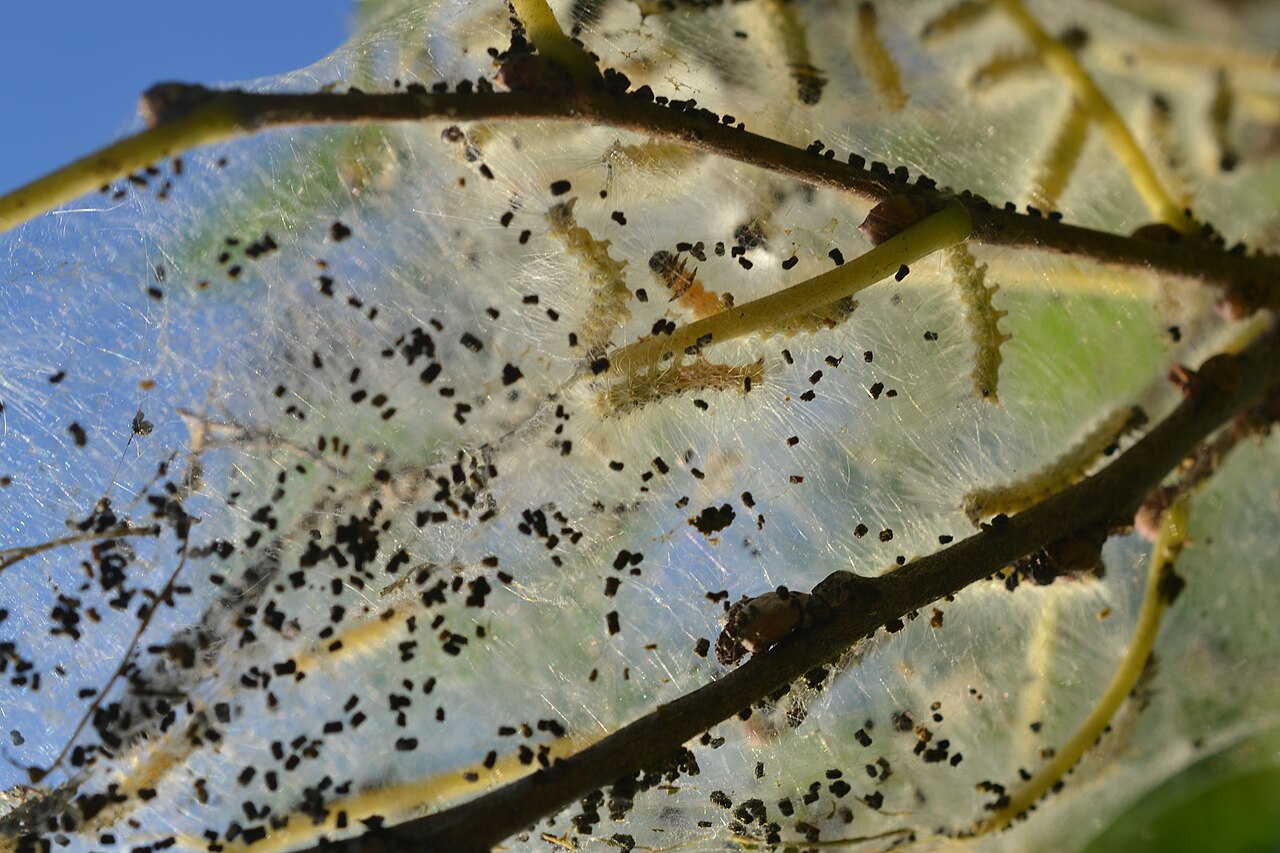
Fall webworms (Hyphantria cunea) get dragged into this question but are not mimics at all. They are small, hairy, cream to yellow caterpillars that build messy silk tents over branch tips in late summer and turn into plain white tiger moths. If your caterpillar is one of hundreds inside a web, it is a webworm. The birds that eat caterpillars are the audience the eyespots evolved to fool. For patterned larvae without eyespots, start with black and yellow caterpillars or black and orange caterpillars.
Caterpillar or Snake? How to Tell Them Apart
The reliable test is the belly. A caterpillar has short, fleshy prolegs with tiny hooks under its abdomen, and no snake has legs of any kind. Second check: a snake has a scaled head with a visible mouth line, while a mimic has a smooth capsule head tucked under the fake face, much smaller than the eyespots suggest.
| Feature | Snake mimic caterpillar | Real snake |
|---|---|---|
| Legs | 6 true legs plus fleshy prolegs along the belly | None |
| Eyes | Painted spots, do not move or blink | Real eyes with a pupil, track movement |
| Skin | Smooth and soft, no scales | Overlapping scales |
| Tongue | Never flicks a tongue | Flicks a forked tongue |
| Size | 1 to 5 in (3 to 13 cm) | Usually longer than 8 in (20 cm) |
| Movement | Slow caterpillar crawl, body arches | Smooth lateral slither |
| Risk to you | None | Depends on species |
Related reading: bugs that look like cockroaches.
Related reading: snakes that look like coral snakes.
Frequently Asked Questions
Are there caterpillars that look like snakes?
Yes. Swallowtail caterpillars such as the spicebush and eastern tiger swallowtail carry large false eyespots behind the head, and tropical sphinx moth larvae like Hemeroplanes triptolemus can inflate the body into a convincing snake head. The resemblance is defensive mimicry aimed at birds, and all of these species are harmless.
Is the snake caterpillar poisonous?
No. Snake mimicking caterpillars are not poisonous to touch and not venomous. Swallowtails only release a forked orange gland with a citrus smell. The caterpillars that genuinely sting in the US are the spiny or furry ones, including the puss caterpillar and the saddleback, not the smooth mimics with eyespots.
What does a snake caterpillar turn into?
It depends on the species. The spicebush and eastern tiger swallowtail caterpillars become large swallowtail butterflies. Hemeroplanes triptolemus, the dramatic tropical mimic, becomes a fairly plain brown sphinx moth, which is why the adult almost never appears in the viral photographs.
What do fall webworms turn into?
Fall webworms become the fall webworm moth, a small white tiger moth that sometimes carries dark speckles on the wings. The caterpillars are hairy, feed in groups inside silk tents on branch tips, and have no eyespots, so they are not snake mimics even though they show up in the same searches. The eastern University of Florida Department of Entomology and Nematology keeps identification pages for both groups. Snake mimicry also runs the other direction in nature, since several birds that eat snakes rely on spotting the real thing, and black and white snakes are the pattern people confuse with banded caterpillars.