Sunfish: Ocean Giant and Freshwater Panfish Explained
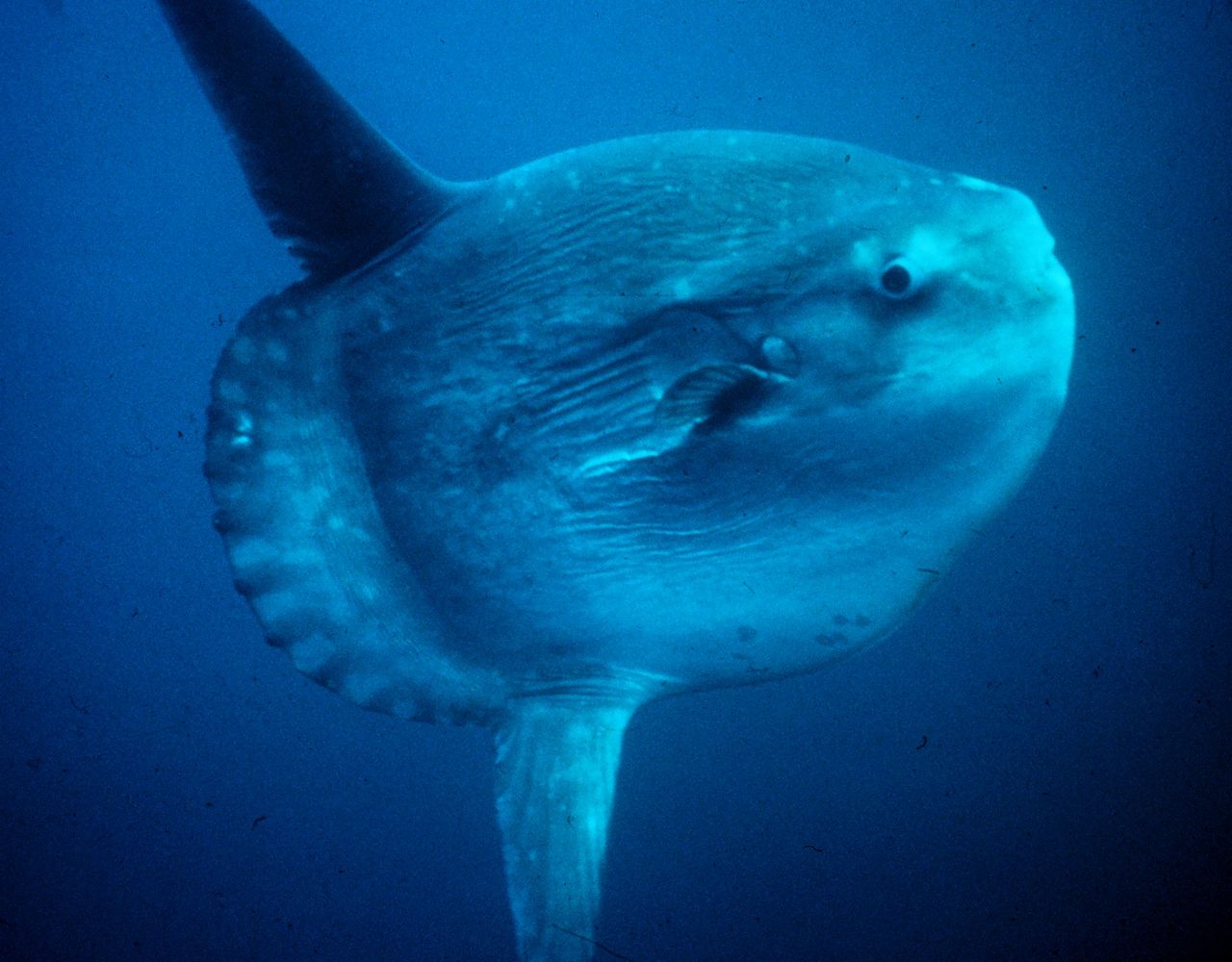
Two completely different fish are called sunfish, and which one you mean changes everything. The ocean sunfish (Mola mola) is the heaviest bony fish in the world, a disc-shaped open-ocean giant that can exceed 5,000 lb and looks like a swimming head with fins. Freshwater sunfish are the small colorful panfish of North American lakes and ponds, including bluegill and pumpkinseed, that rarely exceed 12 in.
They are not related in any meaningful way, and the shared name is an accident of both being seen basking near the surface. This guide covers the ocean sunfish in depth, including the parasite problem that drives its strangest behavior and the 300 million eggs a single female can carry, then covers the freshwater group and which sunfish people actually eat.
| Feature | Ocean Sunfish | Freshwater Sunfish |
|---|---|---|
| Scientific group | Mola, family Molidae | Lepomis, family Centrarchidae |
| Size | Up to 10 ft and over 5,000 lb | 4 to 12 in, rarely over 2 lb |
| Habitat | Open ocean worldwide | Lakes, ponds, slow rivers of North America |
| Diet | Jellyfish, salps, small fish, crustaceans | Insects, larvae, small fish, snails |
| Danger to people | None, though large enough to injure a boat | None |
| Eaten by people | Rarely, banned in the EU | Yes, popular panfish |
Two Very Different Fish Called Sunfish
The name comes from behavior rather than relationship. Ocean sunfish lie on their sides at the surface in a posture that looks like sunbathing, and freshwater sunfish are often visible basking in the shallows of a sunlit pond. That is the entire connection.
Everything else diverges. Ocean sunfish belong to the order Tetraodontiformes alongside pufferfish and triggerfish, while freshwater sunfish are perciform fish related to bass and crappie. One lives in the open ocean worldwide, the other in North American fresh water.
Size makes the confusion easy to resolve in practice. If someone caught it in a lake and it fits on a dinner plate, it is a Lepomis. If it was photographed at sea and dwarfs the boat, it is a Mola. Our guide to what fish eat covers the feeding ecology behind both groups.
The Ocean Sunfish: World’s Heaviest Bony Fish
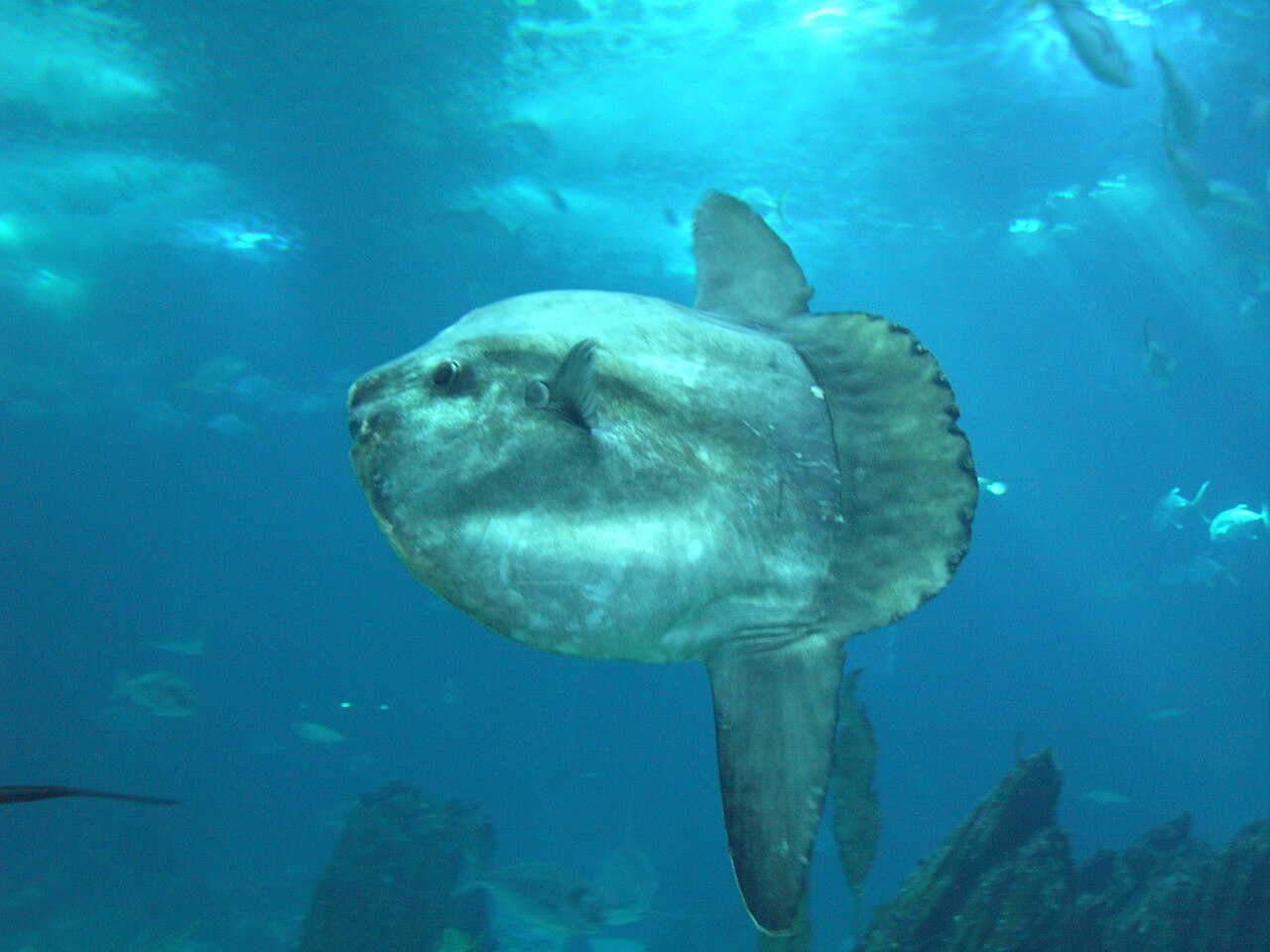
Mola mola is a genuine record holder. Adults commonly reach 6 to 10 ft in length and a similar height fin to fin, and weights of 2,000 to 5,000 lb are documented. The heaviest bony fish ever recorded was a related species, Mola alexandrini, weighing roughly 6,050 lb, landed off the Azores in 2021.
Only cartilaginous fish such as whale sharks and basking sharks grow larger, and those are a different structural class entirely. Among fish with true bony skeletons, the molas stand alone.
The growth involved is extraordinary. A newly hatched sunfish larva is about 0.1 in and weighs a fraction of a gram, and reaching adult size represents an increase of roughly 60 million times its starting mass, one of the largest size changes of any vertebrate. They occur in temperate and tropical waters worldwide and are regularly seen off both coasts of North America.
Why It Looks Like a Head With Fins
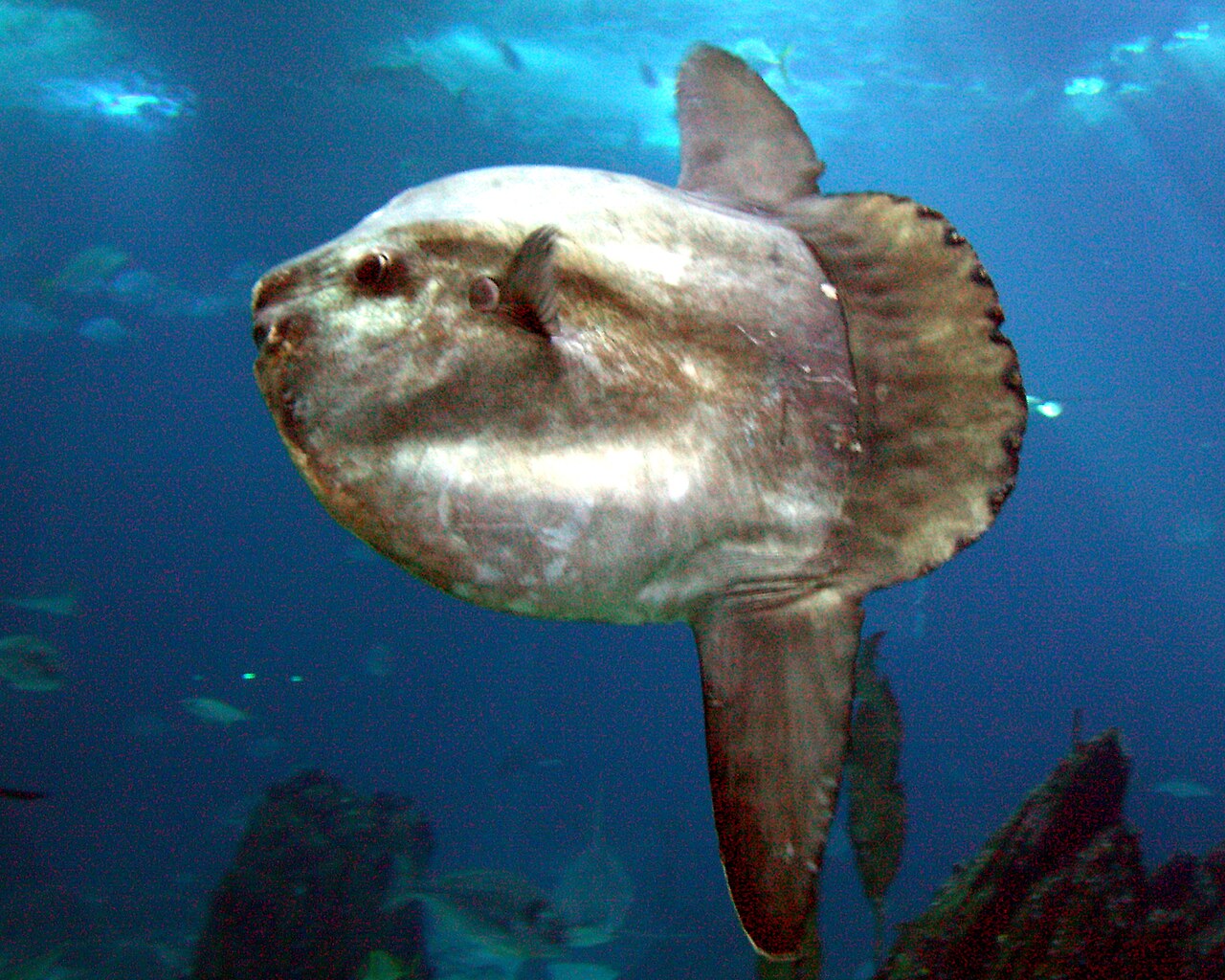
An ocean sunfish appears truncated because it effectively is. During development the rear portion of the body does not extend into a normal tail, and instead the dorsal and anal fin rays fold back and fuse into a stiff rudder-like structure called a clavus. There is no true caudal fin at all.
Propulsion works differently as a result. The fish sculls with its tall dorsal and anal fins beating side to side like a pair of wings, steering with the clavus, and this produces a slow, deliberate, oddly graceful movement quite unlike normal fish swimming.
They are also better swimmers than their reputation suggests. Tracking studies published by university marine research groups have shown molas making regular deep dives, sometimes below 2,000 ft, actively pursuing prey, and covering substantial distances, which contradicts the older view of them as passive drifters at the mercy of currents. The skin is thick, rough, and covered in mucus rather than scales, and it is elastic enough to be several inches deep in a large animal.
What Ocean Sunfish Eat
The classic account says jellyfish, and that is partly right but incomplete. Gelatinous zooplankton including jellyfish, salps, and comb jellies do form a substantial part of the diet, and molas consume them in large volumes because the nutritional content is so low.
Stomach content and DNA studies have revised the picture. Adult and juvenile sunfish also take small fish, crustaceans, squid, brittle stars, and eel larvae, with juveniles in particular eating more energy-dense prey. The diet is broader and more variable than the jellyfish-only story implies.
Their feeding creates a real conservation problem. Floating plastic bags closely resemble jellyfish, and ingested plastic blocks the digestive tract, which is a documented cause of death in molas. The same hazard affects sea turtles for the same reason, and it is one of the clearest direct links between plastic pollution and marine mortality.
Sunbathing and the Parasite Problem
Ocean sunfish carry an extraordinary parasite load. More than 40 species of parasites have been recorded on and in a single sunfish, including flatworms, copepods, and various worms, colonizing the skin, gills, and internal organs. This is among the heaviest documented parasite burdens of any fish.
The famous basking behavior is partly a response. Lying on the side at the surface warms the body after deep cold-water dives, and it also presents the flank to seabirds. Gulls and albatrosses land on basking molas and pick parasites directly from the skin, and the fish tolerates it.
They use cleaner fish too, and actively seek out kelp beds and reef areas where cleaner wrasses and other species operate. A sunfish arriving at a cleaning station will hold still and even position itself vertically to give access. Some populations make regular movements between feeding areas and known cleaning sites, which makes the parasite problem a genuine driver of their behavior and distribution rather than a side effect.
300 Million Eggs
Female ocean sunfish produce more eggs than any other known vertebrate. A single large female can carry an estimated 300 million eggs at once, released into open water where they are fertilized externally.
Almost none survive. The eggs and larvae drift as plankton in an environment where nearly everything eats them, and the survival rate is minuscule, which is exactly why the number is so large. Producing hundreds of millions of eggs is the strategy that compensates for near-total mortality.
The larvae look nothing like adults. A newly hatched mola is a tiny spiny sphere resembling a pufferfish larva, complete with protective spines that are lost as it develops. Watching that pinhead-sized larva become a two-ton adult is the biological journey that makes this species remarkable, and much of the intermediate development remains poorly documented because juveniles are rarely observed.
Are Sunfish Dangerous or Endangered?
Ocean sunfish are harmless to people. They have no teeth capable of injury, no venom, no aggression, and divers routinely swim alongside them without incident. The only genuine risk is physical: a two-ton fish that breaches near a small boat can cause damage, and collisions with vessels do occur.
Conservation status is a real concern. The IUCN lists Mola mola as Vulnerable, with bycatch the primary threat. Sunfish are caught incidentally in enormous numbers in drift gillnet and longline fisheries, and in some Mediterranean swordfish fisheries they have made up a large share of total catch by weight.
Other pressures add up. Plastic ingestion kills individuals directly, ocean warming shifts the distribution of the gelatinous prey they depend on, and their slow reproduction to maturity means populations recover slowly despite the enormous egg numbers. Public attention helps, and molas have become a significant draw for wildlife tourism in several regions, which gives them economic value alive.
Freshwater Sunfish: Bluegill and Relatives
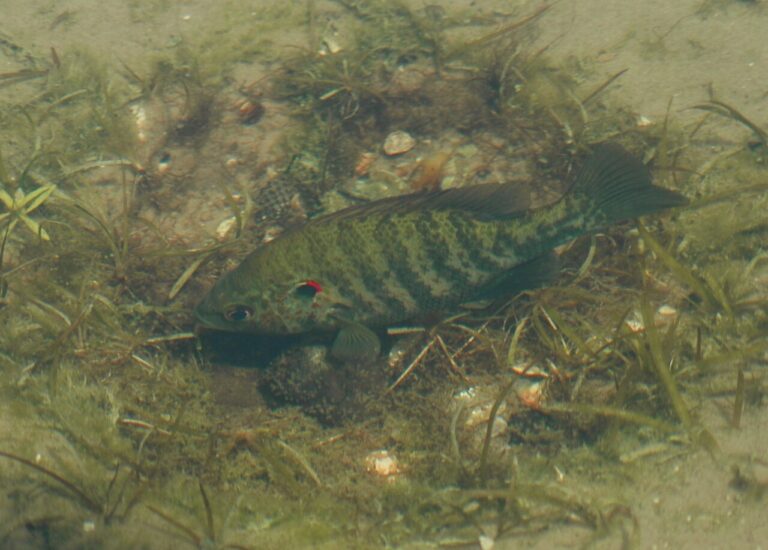
The other sunfish are members of the genus Lepomis in the family Centrarchidae, native to North America and now introduced widely. The group includes bluegill, pumpkinseed, redear sunfish, green sunfish, longear sunfish, and warmouth, and they are collectively the panfish that most American anglers catch first.
They are small and colorful. Most run 4 to 8 in with larger individuals reaching 12 in and around 2 lb, and they wear combinations of blue, green, orange, and yellow with dark opercular flaps that give bluegill and longear their distinctive look. Diet is insects, larvae, small crustaceans, snails, and small fish.
Their nesting behavior is worth watching. Males excavate shallow circular depressions in gravel or sand in the shallows, often in dense colonies of dozens of nests, then guard the eggs and fry aggressively against anything that approaches. A pond bottom covered in saucer-shaped craters in early summer is a bluegill spawning bed, and it is one of the more visible fish behaviors available to a shore observer. Our guides to the oranda goldfish and betta fish cover the ornamental species most people keep instead.
Can You Eat Sunfish?
Freshwater sunfish are excellent eating and are among the most popular panfish in North America. Bluegill in particular has firm white mild flesh, and the group supports enormous recreational fisheries. Local advisories on mercury and other contaminants apply as they do to any freshwater fish, and state agencies publish consumption guidance by water body.
Ocean sunfish are a different matter. The meat is eaten in parts of East Asia, notably Japan, Taiwan, and Korea, but it is banned from sale across the European Union, which prohibits products derived from the family Molidae. The flesh is watery and unremarkable, and concerns about toxins in the organs have contributed to its poor reputation elsewhere.
The practical answer is that the two questions are unrelated. If you caught a sunfish in a lake, it is a bluegill or a relative and it is good food. If you encountered one at sea, it is a mola, it is protected in some jurisdictions and prohibited in others, and it is worth watching rather than catching. The freshwater species share their ponds with the amphibians in our guide to what tadpoles eat and with the reptiles in our guide to the baby snapping turtle.
Related reading: Walleye Teeth.
Related reading: World Record Smallmouth Bass.
Related reading: Smallmouth Bass.
Frequently Asked Questions
How big does an ocean sunfish get?
Commonly 6 to 10 ft long and 2,000 to 5,000 lb, making it the heaviest bony fish in the world. The record, a related species called Mola alexandrini, weighed roughly 6,050 lb and was landed off the Azores in 2021.
Why does an ocean sunfish look like it has no tail?
Because it does not have one. The rear body never extends into a true caudal fin, and instead the dorsal and anal fin rays fold back into a stiff rudder called a clavus. The fish swims by sculling its tall dorsal and anal fins side to side.
Why do ocean sunfish lie on their sides at the surface?
To rewarm after deep cold dives and to let seabirds pick parasites from their skin. Molas carry more than 40 parasite species and also visit cleaning stations where wrasses and other cleaner fish remove them, sometimes positioning themselves vertically to give access.
Are sunfish dangerous?
No. Ocean sunfish have no teeth capable of injuring a person, no venom, and no aggression, and divers swim with them routinely. The only risk is physical, since a two-ton animal breaching near a small boat can cause damage. Freshwater sunfish are harmless too.
What is the difference between ocean sunfish and freshwater sunfish?
They are unrelated. Ocean sunfish are molas in the family Molidae, related to pufferfish, reaching thousands of pounds in the open ocean. Freshwater sunfish are Lepomis species in the family Centrarchidae, related to bass, and rarely exceed 12 in and 2 lb in North American lakes.
How many eggs does an ocean sunfish lay?
An estimated 300 million at once, more than any other known vertebrate. Nearly all are eaten as plankton, which is why the number is so high. Larvae hatch as tiny spiny spheres about 0.1 in and grow roughly 60 million times in mass to reach adult size.
Can you eat sunfish?
Freshwater sunfish such as bluegill are popular panfish with firm mild white flesh, subject to local mercury advisories. Ocean sunfish are eaten in parts of East Asia but banned from sale in the European Union, and the flesh is watery with concerns about toxins in the organs.