Green Sunfish: How to Identify One and Why Ponds Fear Them
The green sunfish (Lepomis cyanellus) is a small, heavy jawed North American panfish that rarely passes 8 in (20 cm) but fights and feeds like something twice its size. You can tell it from a bluegill by its large mouth, thick body, and the yellow to white edging on its fins, and you can tell it is in trouble water when it is the only sunfish left in a pond.
It is native to the central United States and has spread across most of the country, where fisheries agencies treat it less as a sport fish and more as a problem to manage. That reputation is earned, but it is not the whole story: green sunfish are tough, aggressive, edible, and the most reliable fish a kid with a worm can catch.
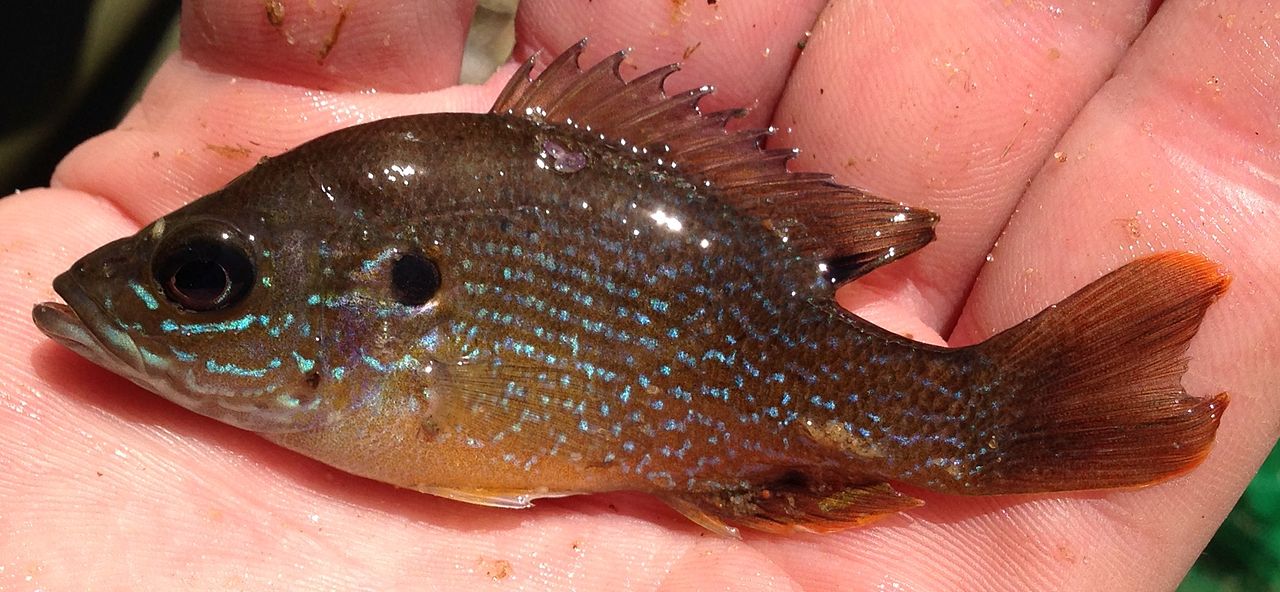
Green sunfish are 4 to 8 in (10 to 20 cm) panfish identified by a large mouth reaching under the eye, a stocky olive green body with faint vertical bars, and yellow edged fins. They are aggressive, highly tolerant of poor water, and overpopulate small ponds, stunting both themselves and bluegill.
| Feature | Green Sunfish | Bluegill |
|---|---|---|
| Mouth | Large, jaw reaches under the eye | Small, jaw stops well short |
| Body shape | Stocky, elongated | Deep, strongly compressed |
| Fin edges | Yellow to white margins | No pale margin |
| Ear flap | Black with pale border | Solid black |
| Pectoral fin | Short and rounded | Long and pointed |
| Typical size | 4 to 8 in (10 to 20 cm) | 6 to 10 in (15 to 25 cm) |
How to Identify a Green Sunfish
Start with the mouth. A green sunfish has a distinctly large mouth for a sunfish, with the upper jaw extending back to a point beneath the middle of the eye. No other common Lepomis in most waters has a mouth that size, and it is visible the moment the fish is in your hand.
The body is olive to brassy green with turquoise flecks on the cheeks and gill cover, plus faint vertical bars that fade with age. The dorsal, anal, and caudal fins carry a cream, yellow, or orange margin, the most useful field mark at a distance.
The black ear flap has a pale edge and stays short, unlike the long flap of a redear sunfish. Green sunfish also feel more solid than a bluegill of the same length, since the body is thicker front to back rather than disc shaped.
Green Sunfish vs Bluegill

Green sunfish and bluegill overlap constantly, and the mouth settles it every time. A bluegill’s small mouth suits picking insects and zooplankton; a green sunfish’s large mouth lets it take crayfish, minnows, and other sunfish fry, which is why it dominates in shared water.
Size is the second difference that matters. Bluegill reach 10 in (25 cm) and make a real meal, while green sunfish usually top out at 7 or 8 in (18 to 20 cm). A pond that once produced 9 in (23 cm) bluegill and now produces 4 in (10 cm) green sunfish has changed for the worse.
Behavior separates them too. Green sunfish hold tight to cover and strike hard, while bluegill cruise more openly in loose schools.
Why Don’t You Want Green Sunfish in a Pond?

Green sunfish wreck small pond fisheries because they breed early, breed often, and eat the fry of everything else. A female spawns at 2 to 3 in (5 to 7.5 cm), sometimes in her first year, and males guard nests in colonies through several waves from late spring into summer.
The result is a pond full of stunted 3 in (7.5 cm) fish competing for food that no longer supports growth. They also prey on bluegill and largemouth bass fry, which breaks the predator side of the balance that would keep their own numbers down. Most state agencies recommend removing them entirely rather than trying to thin them.
Eliminating them is nearly impossible once they are established, because they tolerate low oxygen, high turbidity, warm water, and pools that nearly dry up. That toughness is why they turn up in ditches and degraded creeks where no other sunfish survives.
How Aggressive Are Green Sunfish?
Green sunfish are the most aggressive common Lepomis, both toward other fish and toward anything that lands in the water. Nesting males chase off intruders many times their size and will strike lures nearly as long as their own bodies.
That aggression makes them excellent for teaching someone to fish. A small piece of worm, a 1/32 oz jig, or a tiny popper near a shaded bank will draw strikes all afternoon.
In an aquarium they are equally combative and harass tank mates constantly. Their diet in the wild is broad: insects, crayfish, snails, worms, and small fish. More on how freshwater species feed in this overview and what pond snails eat.
Can I Eat a Green Sunfish?
Yes, green sunfish are perfectly edible and taste much like bluegill: firm, white, mild flesh. The obstacle is size, not quality. A 5 in (13 cm) fish yields two very small fillets, so most people cook them whole, scaled and gutted, in a pan.
Because they thrive in stagnant and polluted water, source matters more here than with most panfish. Check your state’s consumption advisories before eating fish taken from urban creeks or drainage ditches.
Where they are overpopulated, eating them is useful management. Removing hundreds of small green sunfish gives the remaining bluegill and bass room to grow.
Where Green Sunfish Live and How to Catch Them
Green sunfish are native to the Mississippi and Great Lakes basins and have been introduced across nearly every state, largely through bait bucket releases. They prefer small, slow water: farm ponds, creek pools, backwaters, and shallow reservoir edges, always close to rock, brush, or undercut bank.
Fish tight to that cover with the lightest tackle you own. Ultralight gear with 4 lb line, a small hook, and a split shot is enough. State fisheries pages such as those maintained by Texas Parks and Wildlife carry current distribution and regulation details.
The species is unrelated to the ocean sunfish in our sunfish overview, which shares only a name. For a trophy freshwater catch see the world record smallmouth bass, and for the aquarium side our comet goldfish profile.
Frequently Asked Questions
Are green sunfish related to bluegill?
Yes. Both belong to the genus Lepomis in the family Centrarchidae, which also includes pumpkinseed, redear, warmouth, and longear sunfish. They are close enough to share habitat, spawning season, and nesting behavior, which is why hybrids between the two are common wherever both species live.
Can bluegill breed with green sunfish?
They can and frequently do. Green sunfish and bluegill hybridize readily, producing fish with an intermediate mouth size and mixed coloration that confuse identification. Hybrids are often larger and more aggressive than either parent, and some are stocked deliberately because most are male and reproduce poorly, which limits overpopulation.
What is the difference between a green sunfish and a warmouth?
Both have large mouths, but a warmouth (Lepomis gulosus) has three to five dark red brown lines radiating back from the eye and a mottled brown body, while a green sunfish is more uniformly olive green with pale fin margins. Warmouth also have a patch of teeth on the tongue.
How big do green sunfish get?
Most green sunfish reach 4 to 8 in (10 to 20 cm) and weigh a few ounces. In waters with low competition and good forage they occasionally exceed 10 in (25 cm). The all tackle world record is just over 2 lb, taken in Missouri, which is an exceptional fish for the species.
What do green sunfish eat?
Green sunfish eat aquatic insects, crayfish, snails, worms, small fish, and the fry of other sunfish and bass. That last item is what makes them such a problem in managed ponds. Their large mouth lets them take prey far bigger than a bluegill of the same length can handle.
Why can’t you touch a sunfish?
That warning belongs to the ocean sunfish, a huge marine species with delicate skin and a protective mucus layer that handling damages. Freshwater green sunfish are safe to handle with wet hands, though the sharp dorsal spines and gill covers can prick you if you grip one carelessly.