Queen Angelfish: Size, Diet, Price, and Tank Reality Check
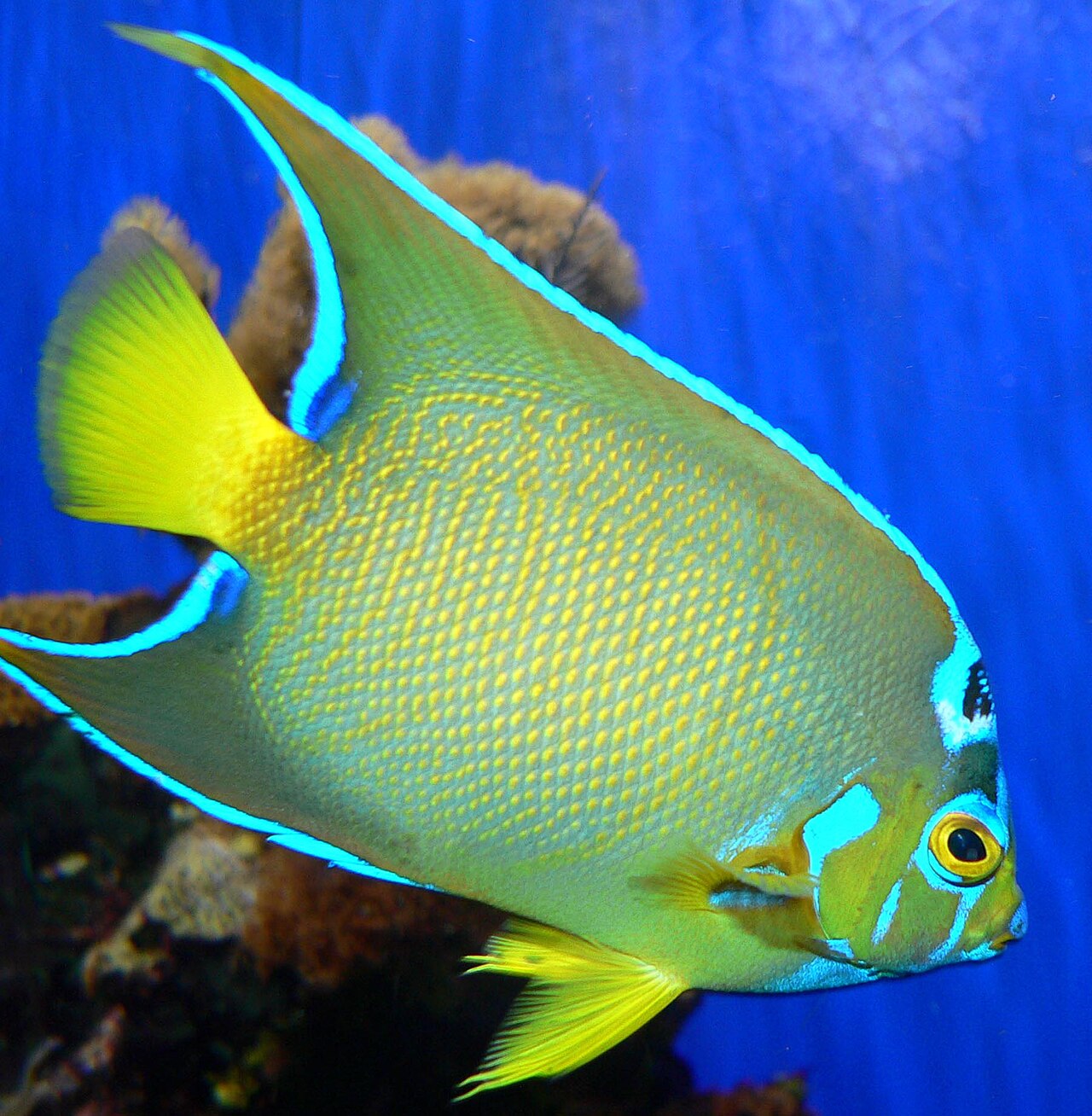
The queen angelfish (Holacanthus ciliaris) is a large tropical reef fish of the western Atlantic, easily told apart from every other angelfish by the dark blue “crown” spot ringed in brilliant blue on its forehead. Adults are electric blue over most of the body with yellow fins, a yellow tail, and blue lips. Divers meet them on coral reefs from Florida and the Bahamas through the Caribbean to Brazil, usually alone or in a bonded pair.
Most people arrive at this fish with three practical questions: how big it gets, whether it can live in a home aquarium, and what it costs. The short version is that it is a stunning but demanding animal, sold at a price that reflects both its beauty and the difficulty of keeping it alive.
The queen angelfish is a western Atlantic reef fish that reaches about 18 in (45 cm) and eats mainly sponges. It is not rare in the wild, but it is a difficult aquarium fish: it needs a tank of at least 180 gallons, is aggressive toward similar species, and is not reef safe.
| Quick Facts | Queen Angelfish |
|---|---|
| Scientific name | Holacanthus ciliaris |
| Adult size | Up to 18 in (45 cm), commonly 12 to 15 in |
| Range | Florida, Bahamas, Caribbean, Gulf of Mexico, south to Brazil |
| Depth | 3 to 230 ft (1 to 70 m), usually on coral reef |
| Main diet | Sponges, plus tunicates, algae, and hydroids |
| Minimum tank | 180 gallons for a single adult |
| Typical price | $100 to $400 depending on size and origin |
How to Identify a Queen Angelfish
Look at the forehead first. The queen angelfish carries a dark blue spot studded with lighter blue flecks just above the eyes, and this crown is the single reliable field mark. The body is deep and disc shaped, the scales are blue with yellow rims, and the dorsal and anal fins trail into long yellow filaments on mature fish.
The species most often confused with it is the blue angelfish (Holacanthus bermudensis), which lacks the crown and has a pale, whitish tail edge rather than a solid yellow tail. The two interbreed where their ranges overlap, and the hybrid was once described as its own species. Juveniles of both are dark blue with vertical bars and look nothing like the adults, which is why angelfish identification trips up so many divers. The darker, oval French angelfish is another common mix-up on Caribbean reefs.
How Big Do Queen Angelfish Get?
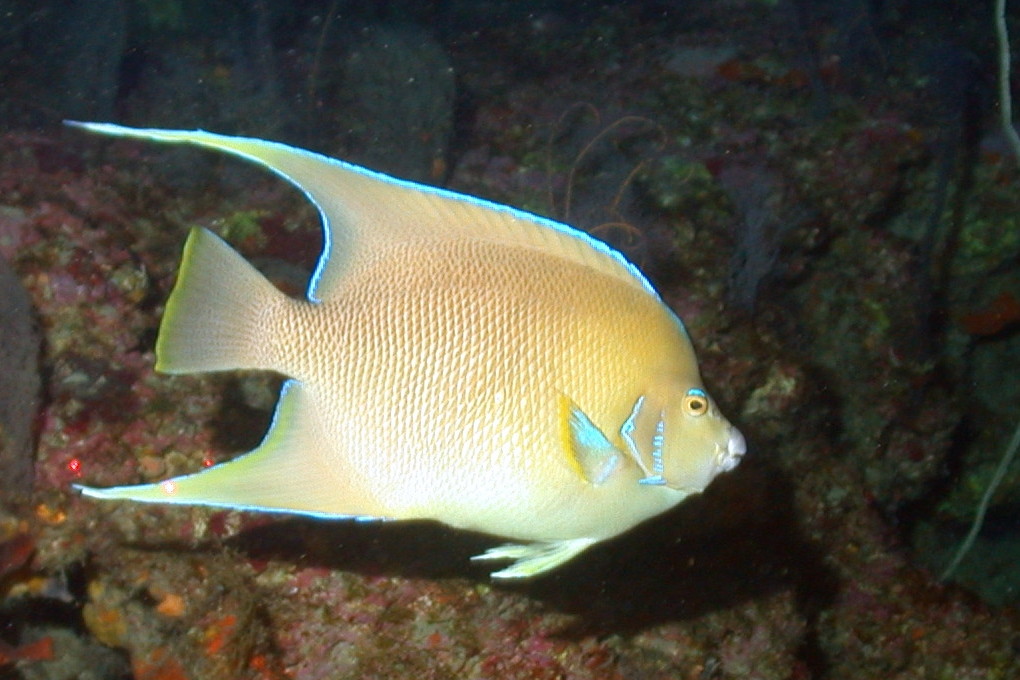
Queen angelfish reach a maximum of about 18 in (45 cm) and roughly 3.5 lb (1.6 kg), though the fish most divers see measure 12 to 15 in (30 to 38 cm). That size makes them one of the largest angelfish in the Atlantic, comparable to the Indo-Pacific emperor angelfish in bulk if not in pattern.
Growth is slow. A juvenile bought at 2 in may take three to four years to pass 8 in, and it will shift from the barred juvenile pattern to adult colors somewhere around 4 to 6 in. Fish in the trade are almost always caught small for this reason, which means the buyer is committing to an animal that will eventually outgrow most home systems.
What Do Queen Angelfish Eat?
In the wild, queen angelfish are sponge specialists. Sponges make up the majority of the stomach contents of adults, supplemented with tunicates, hydroids, bryozoans, soft corals, and algae. Their teeth are fine and comb-like, built for rasping rather than crushing, and the gut is adapted to a diet most reef fish cannot digest at all.
That specialization is the core problem in captivity. A queen angelfish will accept mysis shrimp, nori, and prepared foods, but it still needs a sponge-based angelfish formula several times a day or it slowly declines over months. Juveniles also work as cleaners, picking parasites off larger fish at reef cleaning stations. If you are curious how far diets diverge across species, what fish eat varies far more than most aquarium guides suggest.
Can Queen Angelfish Be Kept in Aquariums?
Yes, queen angelfish can be kept in aquariums, but they belong to experienced marine keepers with large systems and not to anyone setting up a first saltwater tank. The species is rated expert-only by most suppliers for three reasons: adult size, the sponge diet, and territorial behavior toward anything that resembles another angelfish.
A single adult needs at least 180 gallons with open swimming room and plenty of rock caves to retreat into. Water should sit near 75 to 82 F (24 to 28 C) with stable salinity and near-zero nitrate, and stability matters more than any single number, much as it does when you dial in aquarium water temperature for smaller fish. Expect to feed four to five small meals a day rather than one large one.
How Much Does a Queen Angelfish Cost?
A queen angelfish costs roughly $100 to $400 in the US trade. Small juveniles of 1.5 to 2.5 in usually sit between $100 and $180, medium fish of 3 to 5 in run $200 to $300, and large or show-grade specimens can pass $400. Captive-bred stock, still uncommon, carries a premium and is worth it for hardiness.
The purchase price is the smaller number. A 180-gallon system with the filtration, lighting, and quarantine setup this fish requires runs into the thousands, and specialized frozen angelfish foods are an ongoing cost. Buying the fish before the tank is the most common and most expensive mistake in this hobby.
Are Queen Angelfish Rare or Aggressive?
Queen angelfish are not rare. The International Union for Conservation of Nature lists the species as Least Concern, and it is common across healthy Caribbean reefs. Encounters feel special because the fish are shy of divers and hold to particular stretches of reef, not because numbers are low. The US Fish and Wildlife Service and its partners track reef fish health more broadly at fws.gov.
Aggression is a different story. Queen angelfish are aggressive toward other angelfish and toward any fish with a similar deep-bodied shape, and a mature adult will harass tankmates it decides are rivals. They are generally peaceful with unrelated species that keep out of the way, which is why choosing angelfish tank mates takes more planning than picking fish that simply look good together.
Frequently Asked Questions
What fish not to put with angelfish?
Avoid other angelfish, especially members of the same genus, and avoid deep-bodied lookalikes such as butterflyfish. Slow, timid fish like seahorses and pipefish will be outcompeted at feeding time. Small ornamental shrimp are often eaten. Robust tangs, wrasses, and groupers of similar size usually coexist without trouble.
How big of a tank does a queen angelfish need?
Plan on 180 gallons minimum for one adult, and 250 gallons or more if you want it housed with other large fish long term. Smaller tanks can hold a juvenile for a year or two, but they force a rehoming decision later. Length and open swimming space matter more than total volume.
Can I put 2 angelfish in a 10 gallon tank?
No. A 10 gallon tank is far too small for two angelfish of any kind, and it is nowhere near adequate for a single queen angelfish, which needs about eighteen times that volume. Even the small freshwater angelfish sold in pet stores outgrow a 10 gallon tank within months.
Do angel fish need a bubbler?
A bubbler is not required if the tank already has strong surface movement from a powerhead, return pump, or protein skimmer. Angelfish need well oxygenated water, and gas exchange at the surface delivers that. In a marine system with a skimmer and good flow, an air stone adds nothing but noise.
Are queen angelfish reef safe?
No. Queen angelfish eat sponges, tunicates, and soft corals in the wild, and captive adults commonly nip stony coral polyps, clam mantles, and zoanthids. Some individuals behave for months before starting, which makes the risk unpredictable. Keep them in a fish-only system with live rock rather than a coral display.