Abyssinian Guinea Pig: Care, Rosettes, Cost, and Lifespan
The Abyssinian guinea pig is a short haired breed defined by rosettes, the circular swirls of hair that grow out from a central point across its body. A show quality Abyssinian carries eight to ten symmetrical rosettes, though pet animals often have fewer and messier ones. Care is nearly identical to any other guinea pig, with one exception: the coat traps debris and needs weekly attention.
This breed is one of the three oldest recognized guinea pig varieties and remains the most common rough coated pet in American households. Expect a bold, busy animal that weighs 1.5 to 2.6 lb (700 to 1,200 g), lives 5 to 7 years, and reacts to your kitchen routine loudly enough that neighbors learn the sound.
Abyssinian guinea pigs are a rough coated breed with 8 to 10 rosettes, weighing 1.5 to 2.6 lb (700 to 1,200 g) and living 5 to 7 years. They need 7.5 sq ft (0.7 sq m) of cage space, unlimited timothy hay, daily vitamin C, weekly brushing, and a same species companion.
| Trait | Abyssinian Guinea Pig |
|---|---|
| Adult weight | 1.5 to 2.6 lb (700 to 1,200 g) |
| Body length | 8 to 12 in (20 to 30 cm) |
| Coat | Rough, 1.5 in (4 cm), 8 to 10 rosettes |
| Lifespan | 5 to 7 years |
| Grooming | Brush 1 to 2 times weekly |
| Minimum cage | 7.5 sq ft (0.7 sq m) for a pair |
| Purchase price | 25 to 60 USD |
What Is an Abyssinian Guinea Pig?
The Abyssinian is one of the original three guinea pig breeds recognized by the American Cavy Breeders Association, alongside the smooth coated American and the long coated Peruvian. Despite the name, the breed has no connection to Ethiopia. It descends, like every domestic guinea pig, from Cavia porcellus populations domesticated in the Andes of South America several thousand years ago.
What separates the Abyssinian from other guinea pig breeds is the rosette gene, which causes hair to radiate outward from fixed points instead of lying flat along the body. The result is a coat of about 1.5 in (4 cm) that stands up in ridges where neighboring rosettes collide. Those ridges follow the animal’s body into adulthood and do not smooth out with age.
The breed appeared in English exhibition records in the mid nineteenth century and reached the United States as a show animal before it became a common pet. Today most Abyssinians sold in American pet stores are pet quality rather than show quality, meaning the rosettes are present but irregularly placed.
How to Identify an Abyssinian by Its Rosettes
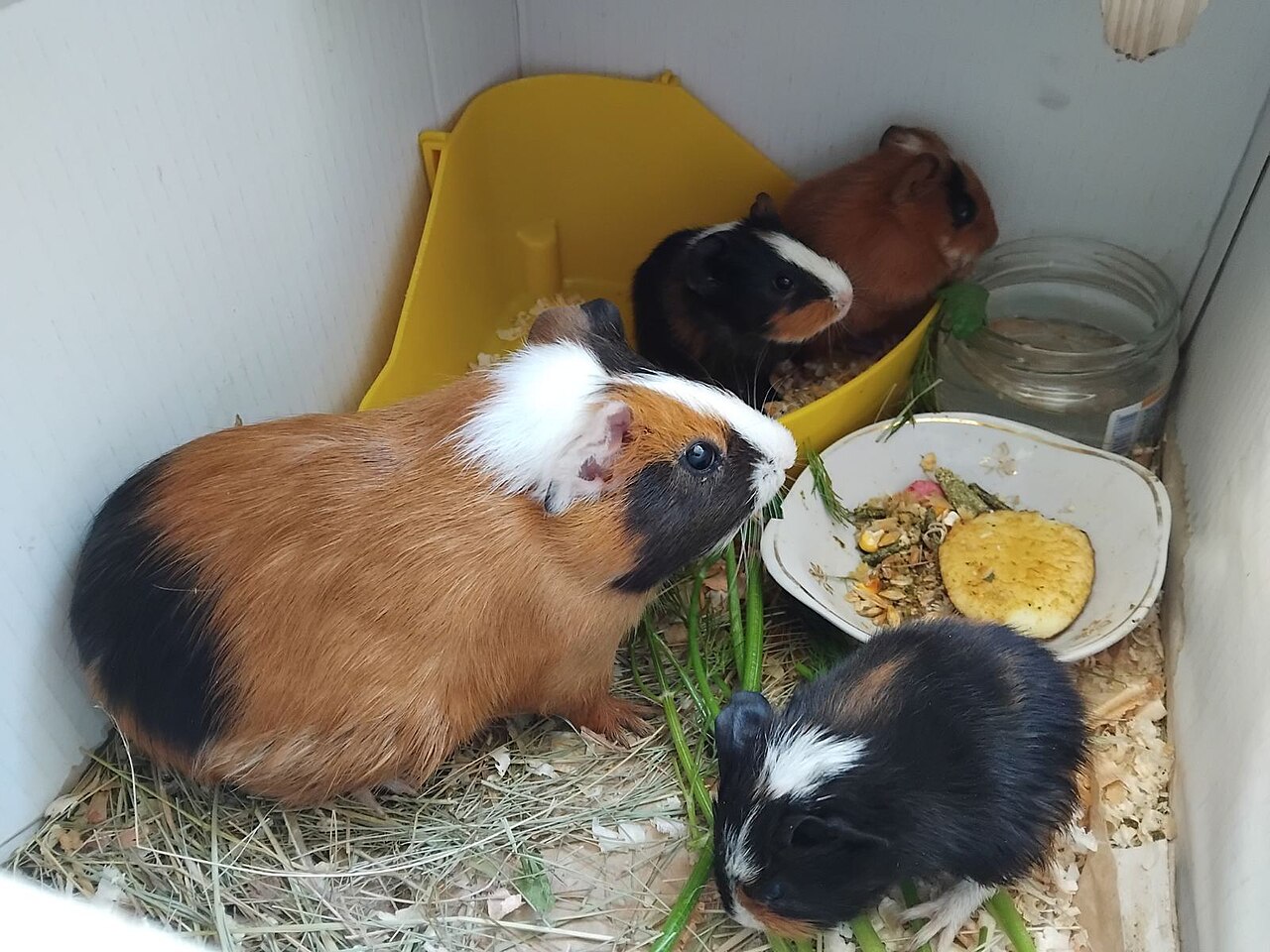
Count the swirls. A true Abyssinian has a minimum of eight rosettes: four across the back in two pairs, two over the hips, and two on the rump, with a ridge of raised hair running between each neighboring pair. Show judges look for symmetry and clean separation, not simply the number.
Two features confirm the identification beyond the body rosettes. The first is the collar, a ridge of hair that rings the shoulders and stands up from the neck. The second is the mutton chop, a pair of raised hair sections on the cheeks that give the head a broader, squarer look than a smooth coated guinea pig has.
Crossbred animals, sometimes sold as Abyssinian mixes, may show two or three rosettes on a mostly flat coat. They make perfectly good pets and often have easier coats to maintain, but they are not the breed. If the coat lies flat along the spine with no raised ridge, the animal is a cross rather than a purebred Abyssinian.
Abyssinian Coat Colors and Patterns
Abyssinians come in nearly every color accepted in the cavy standard: self colors such as black, white, cream, and red; agouti patterns where each hair is banded; and broken or roan patterns that combine two or more colors in patches. Brindle, an even mix of red and black hairs, is traditional in the breed and difficult to produce cleanly.
Roan and dalmatian patterning carries a genetic warning. Breeding two roan Abyssinians or two dalmatians together produces lethal white offspring, animals that are typically blind, deaf, and missing teeth, and that rarely survive long. Responsible breeders always pair a roan with a solid colored animal, and buyers should ask directly about parentage.
Coat color has no effect on temperament, health, or care requirements. It does affect price, since show quality brindle and tortoiseshell animals command more than a common agouti.
Abyssinian vs Peruvian Guinea Pig: How to Tell Them Apart
The difference between an Abyssinian and a Peruvian guinea pig is hair length and hair direction. An Abyssinian has short, rough hair of 1 to 1.5 in (2.5 to 4 cm) that grows outward from 8 to 10 rosettes spread over the body. A Peruvian has no rosettes along the body and grows straight hair that never stops lengthening, reaching 12 to 20 in (30 to 50 cm) and covering the face unless it is trimmed.
| Feature | Abyssinian | Peruvian |
|---|---|---|
| Coat | Short and rough, 1 to 1.5 in (2.5 to 4 cm) | Long and silky, 12 to 20 in (30 to 50 cm) |
| Rosettes | 8 to 10 across the body | None on the body, two at the rump that sweep hair forward |
| Grooming | Brush once or twice a week | Daily brushing plus regular trimming |
| Temperament | Bold, busy, vocal | Calmer and slower moving |
| First guinea pig | Suitable | Demanding, the coat is daily work |
For a first guinea pig the Abyssinian is the easier of the two. Its coat needs a brush once or twice a week, while a Peruvian in full coat needs daily attention and usually a trim to keep hair out of food and bedding. Many Peruvian owners keep the coat cut short all year, and at that length the two breeds differ mainly in rosette pattern and energy level.
Rosettes are the fastest check at a pet store, because coat length is misleading in a young animal. A three week old Peruvian still has short hair, but the two rosettes at the rump already point the hair forward over the back, while an Abyssinian shows swirls scattered across the shoulders, flanks, and hindquarters from the first week.
Abyssinian Guinea Pig Temperament
Abyssinians have a reputation as the most active and mischievous guinea pig breed, and owners who have kept multiple breeds usually confirm it. They explore more, test cage fittings more persistently, and settle for handling later than a smooth coated American does. That energy makes them entertaining and slightly harder for a young child to hold.
They are also among the most vocal. Abyssinians wheek loudly at the sound of a refrigerator door, rumble when establishing dominance, and purr when content. Learning the difference between these calls tells you more about the animal’s state than watching it does, and the full range of guinea pig sounds is worth studying before the first week ends.
Taming takes patience rather than technique. Sit beside the cage daily, offer a piece of bell pepper by hand, and let the animal come to you. Most Abyssinians accept lap time within three to four weeks, though a minority stay squirmy for life and prefer floor time inside a pen to being held.
How Big Do Abyssinian Guinea Pigs Get?
Adult Abyssinians reach 8 to 12 in (20 to 30 cm) in body length and weigh 1.5 to 2.6 lb (700 to 1,200 g), with boars consistently heavier than sows. Growth is fastest in the first four months, slows through month eight, and stops entirely at around 14 months of age.
Weekly weighing on a kitchen scale is the single most useful health habit for this species. Guinea pigs hide illness well, and a drop of more than 2 oz (57 g) in a week is often the first measurable sign of dental disease, a respiratory infection, or bladder stones, appearing days before any visible change in behavior.
The rosettes make visual body condition assessment unreliable. A raised coat hides both weight loss and the swollen abdomen of bloat, so run your hands along the spine and ribs during the weekly brush. Ribs that feel sharp rather than gently padded mean the animal is underweight regardless of what the coat suggests.
How Long Do Abyssinian Guinea Pigs Live?
Abyssinian guinea pigs live 5 to 7 years in good conditions, with well managed individuals reaching 8. That is at the upper end for the species, and slightly longer than the long coated breeds such as the Texel guinea pig, which face more skin and hygiene complications over a lifetime.
Three factors decide where an individual lands in that range. Constant access to grass hay keeps the continuously growing teeth worn down. Adequate vitamin C prevents scurvy, which guinea pigs cannot avoid on their own because they lack the enzyme to synthesize it. Cage size determines activity level, and inactive animals develop bladder and foot problems earlier.
Sows bred after about ten months of age face a specific risk: the pubic symphysis fuses, and a late first pregnancy frequently ends in dystocia that kills both mother and pups. This is the main reason pet owners should never breed an adult sow acquired from a store, where unplanned pregnancies are common on arrival.
Cage Size and Setup for an Abyssinian
The Humane Society recommends a minimum of 7.5 sq ft (0.7 sq m) for one or two guinea pigs, and 10.5 sq ft (1 sq m) is noticeably better. Floor area matters more than height, since guinea pigs do not climb. A cage 30 by 36 in (76 by 91 cm) meets the pair minimum with room for a hide at each end.
Use a solid floor. Wire mesh flooring causes pododermatitis, the painful foot sores also called bumblefoot, and the condition is difficult to reverse once the footpad breaks down. Line the base with fleece over absorbent padding or with paper based bedding, and avoid cedar and untreated pine shavings, whose aromatic oils irritate the respiratory tract.
Abyssinian coats pick up bedding more than smooth coats do, so bedding depth is a real decision. Keep it at about 1 in (2.5 cm), spot clean daily, and replace fully twice a week. Two hides, a hay rack, a heavy ceramic bowl, and a water bottle checked daily for airlock complete the setup.
What to Feed an Abyssinian Guinea Pig
Unlimited timothy or orchard grass hay is the foundation and should make up about 80 percent of intake. It supplies the fiber the hindgut needs and the abrasion that keeps the teeth from overgrowing. Alfalfa hay is for animals under six months and for pregnant sows only, because its calcium load contributes to bladder stones in adults.
Add roughly 1/8 cup of plain timothy based pellets daily and about 1 cup of fresh vegetables. Bell pepper, romaine, and cilantro are strong daily choices. Broccoli works a few times a week in small amounts, and sweet items such as apples and blueberries belong in the treat category at once or twice weekly.
Vitamin C is the non negotiable part. Guinea pigs need 10 to 30 mg per day and cannot produce any themselves, and the vitamin C in pellets degrades within weeks of the bag being opened. Supply it through fresh vegetables or a dosed oral supplement rather than water additives, which break down in light and make intake impossible to measure. Veterinary teaching hospitals such as Cornell University College of Veterinary Medicine publish current guidance on small mammal nutrition.
Grooming an Abyssinian Coat
Brush one to two times a week with a soft bristle brush, working outward from the center of each rosette. The raised ridges where rosettes meet are where hay dust, bedding, and dried droppings collect, and left alone that debris mats into the base of the coat and irritates the skin underneath.
Bathing should be rare. A healthy Abyssinian needs a bath only when genuinely soiled, perhaps two or three times a year, using a small animal shampoo in shallow warm water. Dry the animal thoroughly with towels in a draft free room, because damp guinea pigs chill quickly and respiratory infection follows.
Trim nails every three to four weeks with small animal clippers, taking only the tip and staying clear of the pink quick. Check the grease gland just above the tail base during each grooming session: Abyssinian boars in particular accumulate a waxy buildup there that needs occasional cleaning with a mild degreasing shampoo.
Common Health Problems in Abyssinians
Scurvy from vitamin C deficiency shows as a rough coat, reluctance to move, swollen joints, and bleeding gums. It is entirely preventable and responds quickly to supplementation, but an Abyssinian’s naturally rough coat hides the earliest sign, so the behavioral changes matter more here than the coat does.
Respiratory infection is the most common serious illness. Bordetella and Streptococcus cause discharge from nose and eyes, audible crackling, and lethargy, and the progression is fast enough that a guinea pig showing symptoms in the morning needs veterinary care the same day. Poor ventilation, dusty bedding, and rabbit housemates all raise the risk.
Dental problems, bladder stones, and mites round out the list. Overgrown molar spurs cause drooling and dropped food; calcium rich diets and low water intake drive stones; and mites produce intense scratching and hair loss that owners often mistake for normal Abyssinian coat texture. All three need an exotic pet veterinarian rather than a general practice.
Do Abyssinian Guinea Pigs Need a Companion?
Yes. Guinea pigs are herd animals, and a solitary animal shows measurable stress: reduced activity, less vocalization, lower food intake, and more time hidden. Several European countries require keeping them in pairs or groups for this reason, and the behavioral evidence is consistent enough that single housing should be treated as a last resort.
Two sows is the easiest pairing, followed by a neutered boar with one or more sows. Two boars can work if they are littermates or introduced young and have enough space, but adult boar pairs introduced late often fight. Never house guinea pigs with rabbits: rabbits carry Bordetella without symptoms and can injure a guinea pig with a single kick.
Introduce new animals on neutral ground, in a space neither has occupied, with two of everything and multiple hides that have two exits each. Rumbling, chasing, and teeth chattering during the first days are normal dominance behavior. Only actual biting that draws blood requires separating the pair and restarting the process.
How Much Does an Abyssinian Guinea Pig Cost?
The purchase price runs 25 to 60 USD from a breeder or pet store, and rescues typically charge 20 to 40 USD for a bonded pair, often including the cage. Show quality animals from established breeders reach 75 USD or more, though the qualities being priced are rosette symmetry and color, not health or temperament.
Setup costs more than the animal. Budget 150 to 300 USD for an adequate cage, hides, a hay rack, bowls, and a scale, and expect the cheap starter cages sold alongside guinea pigs in chain stores to be roughly half the minimum recommended floor area.
Ongoing costs run 40 to 70 USD per month for a pair, covering hay, pellets, fresh vegetables, and bedding. Veterinary care is the variable: an exotic pet exam costs 60 to 120 USD, and treatment for bladder stones or dental spurs commonly reaches several hundred. Setting aside a small monthly reserve is more practical than pet insurance for this species.
Frequently Asked Questions
How many rosettes should an Abyssinian guinea pig have?
A show quality Abyssinian has eight to ten rosettes arranged symmetrically: two pairs across the back, two over the hips, and two on the rump. Pet quality animals often have six or seven, placed less evenly. Fewer than four rosettes on an otherwise flat coat usually indicates a crossbred animal.
What is the friendliest breed of guinea pig?
Most keepers rank the American and the Silkie as the friendliest, because both settle for handling faster than an Abyssinian does. Abyssinians are bolder and more curious but squirmier in the hand. Temperament varies more between individual animals than between breeds, and daily handling matters more than either.
Are Abyssinian guinea pigs good for beginners?
They are suitable for beginners willing to brush weekly and handle an active animal. Abyssinians are bolder and busier than smooth coated Americans, which makes them harder for very young children to hold securely. Their care requirements are otherwise identical to any other short coated guinea pig breed.
Do Abyssinian guinea pigs need to be brushed?
Yes, once or twice a week. The raised ridges between rosettes trap hay, bedding, and droppings that mat into the coat if left. Brush outward from the center of each rosette rather than along the body, which takes about two minutes and doubles as a weekly health check.
How long do Abyssinian guinea pigs live?
Abyssinians typically live 5 to 7 years, and well cared for individuals reach 8. Lifespan depends mainly on constant hay access, adequate daily vitamin C, and enough cage space for regular activity. That range sits at the upper end for domestic guinea pigs generally.
Can Abyssinian guinea pigs live alone?
They should not. Guinea pigs are herd animals, and solitary individuals eat less, move less, and hide more. Keep two sows, or a neutered boar with sows. Rabbits are not a substitute companion because they carry Bordetella without symptoms and can injure a guinea pig by kicking.
What do Abyssinian guinea pigs eat?
Unlimited timothy hay makes up about 80 percent of the diet, plus roughly 1/8 cup of timothy based pellets and 1 cup of fresh vegetables daily. Bell pepper and leafy greens supply the 10 to 30 mg of vitamin C they need each day, since guinea pigs cannot produce it themselves.