Black Butterfly Spiritual Meaning: Omen or Blessing?
A black butterfly is read as a symbol of transformation, the end of one phase and the start of another, and in several traditions as a message from someone who has died. The readings split sharply by culture: in parts of Europe and Central America a black butterfly has been treated as an omen of death, while in Japan, China, and parts of the Philippines it is auspicious, associated with the soul, with rebirth, and with good news.
That contradiction is the most useful thing to know about the symbol, because it means no single reading is the correct one. What is consistent across traditions is the association with change and with the dead, and how that is felt depends entirely on the cultural frame. This guide covers the readings, where they come from, and which butterfly you probably saw.
A black butterfly means transformation, endings, and in many traditions a message from someone who has died. Readings split by culture: ominous in parts of Europe and Central America, auspicious in Japan, China, and the Philippines. It is not a death omen in most modern interpretations, which read it as a phase closing rather than a warning.
| Tradition or Context | Reading |
|---|---|
| General modern reading | Transformation, an ending, release |
| Japan and China | The soul, rebirth, good news |
| Parts of Europe | Historically an omen of death |
| Mexico and Central America | Varies; both soul and ill omen |
| Lands on you | A departed loved one; protection |
| Enters the house | News arriving; in some traditions a visitor |
| Likely species | Black swallowtail, spicebush, mourning cloak |
What Does a Black Butterfly Symbolize?
Transformation, like every butterfly, but with the emphasis shifted toward endings rather than beginnings. The colour black carries associations with completion, mourning, mystery, and the unknown in most Western symbolism, and applied to a butterfly it reads as a phase closing rather than a phase starting.
Release is the second common reading. Because the butterfly emerges from a chrysalis in which the previous body was dismantled, a black butterfly is often interpreted as something being let go of, whether a relationship, a job, a habit, or a version of oneself. That reading is modern rather than traditional but it is the dominant one now.
Protection appears in several traditions, drawing on black as a colour that absorbs rather than reflects. In some readings a black butterfly is a guardian presence rather than a message, which sits alongside the soul-of-the-dead interpretation without contradicting it. The guide to a butterfly landing on you covers the encounter generally.
Is a Black Butterfly a Bad Omen?
In some traditions historically, yes, and in most contemporary readings, no. The death-omen interpretation is documented in parts of Europe, particularly where dark moths and butterflies entering a house were treated as a warning, and in some Central American folk belief the black witch moth is associated with death or misfortune.
The black witch is worth separating out because it drives much of the fear. It is a large dark moth, not a butterfly, with a wingspan up to seven inches, and it is called mariposa de la muerte in parts of Mexico and Central America. In other regions the same insect is read as a bringer of money or good fortune, which is exactly the pattern of contradiction that runs through the whole subject.
The opposite reading is at least as widespread. In Japan butterflies represent the souls of the living and the dead and are broadly auspicious, in Chinese tradition they carry associations with love, longevity, and rebirth, and in parts of the Philippines a black butterfly entering a house signals news or a visitor. Nothing about the insect itself supports either version. The black and white butterfly guide covers the species involved.
Does It Mean a Loved One Is Near?
It is one of the most commonly reported readings, and it applies to black butterflies as strongly as to any other colour. People report butterflies at funerals, memorials, and on anniversaries and take them as presence rather than coincidence.
The connection between butterflies and souls is unusually old and unusually widespread. In ancient Greece the word psyche meant both butterfly and soul, and the goddess Psyche was depicted with butterfly wings. Similar associations appear independently in Japanese, Chinese, Mexican, and various Native American traditions.
Black adds a specific note to that reading: rather than a general message, a black butterfly is often taken as connected to grief itself, to a loss being processed, or to permission to move on from one. Whether that helps is a personal matter rather than a factual one. The monarch butterfly meaning guide covers the best-documented version of this symbolism.
What Does It Mean in Christianity?
Butterflies generally represent resurrection, with the caterpillar as earthly life, the chrysalis as the tomb, and the emerging butterfly as the soul released. That reading is built on the life cycle rather than on colour, so it applies to a black butterfly as much as to any other.
Where colour enters, black is associated with mortality, penitence, and mourning in Christian symbolism, which pushes a black butterfly toward the death-and-resurrection reading rather than away from it. The combination is generally treated as hopeful rather than ominous: death followed by transformation is the point of the image.
Scripture itself says nothing about butterflies, which surprises people who search for it. The butterfly-resurrection association is a later Christian adoption of a much older Greek image, and it has no scriptural basis, which is worth stating plainly rather than inventing verses for.
Which Black Butterfly Did You See?
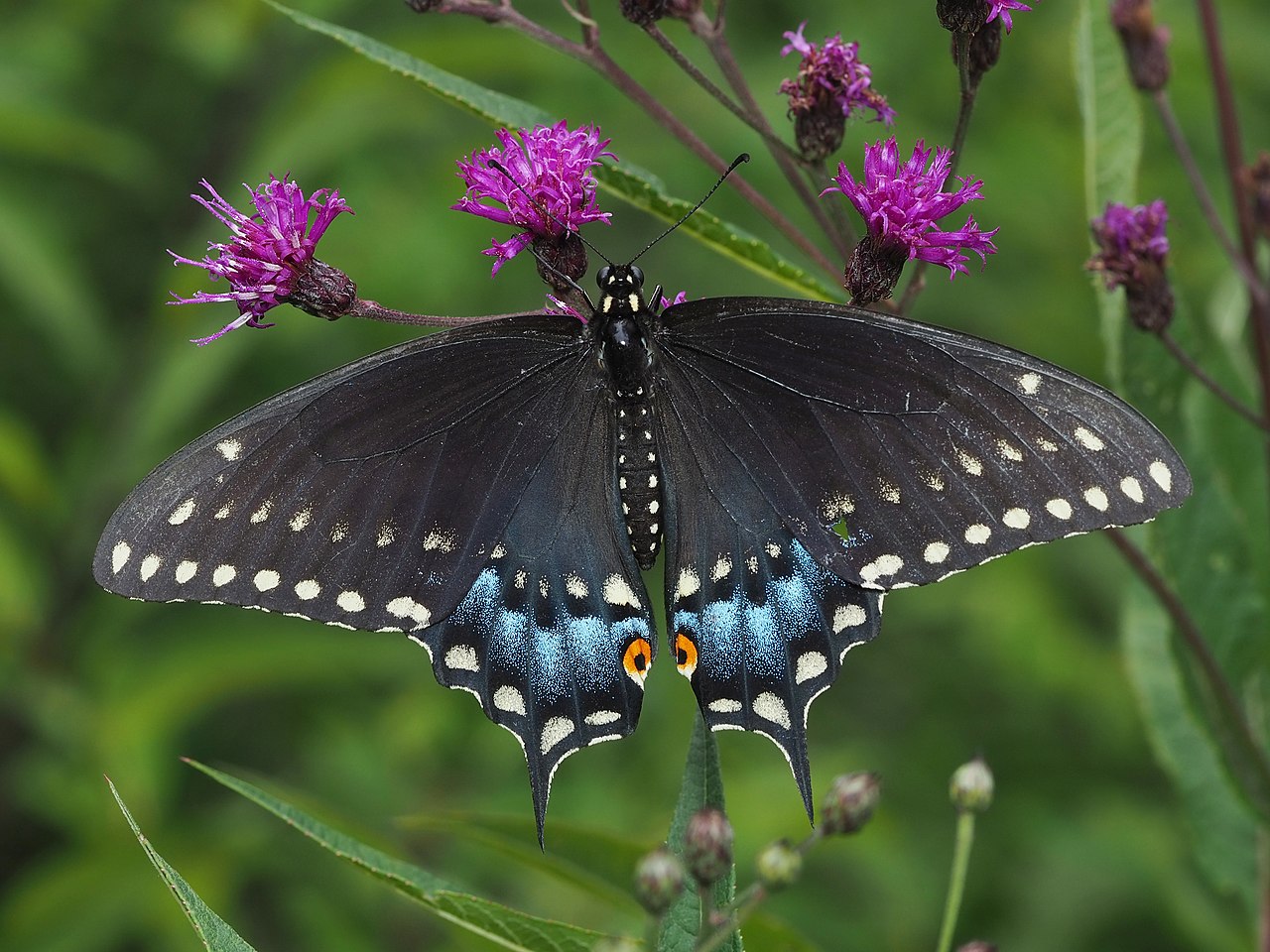
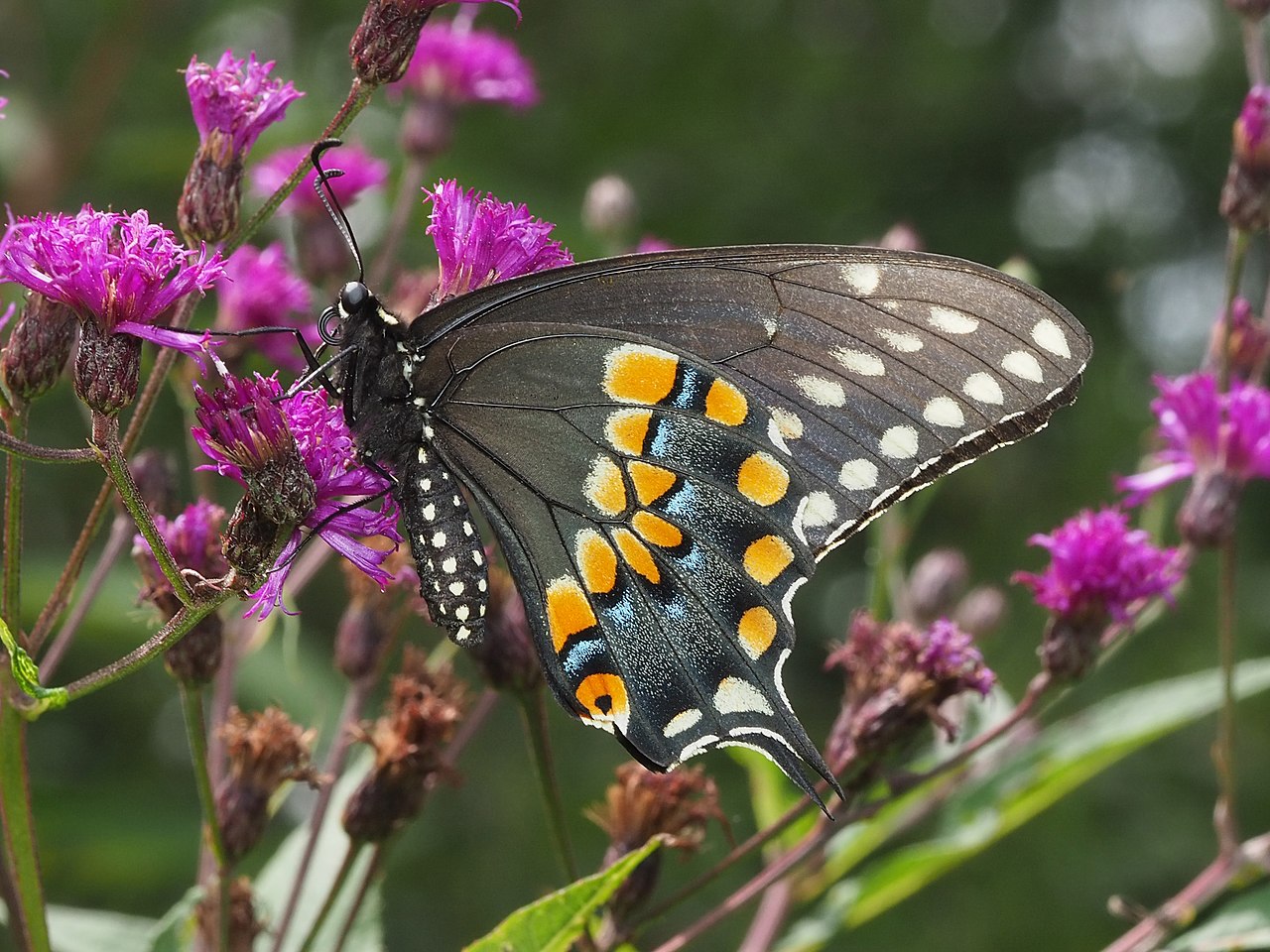
In eastern North America, most likely a black swallowtail, spicebush swallowtail, pipevine swallowtail, dark-form female tiger swallowtail, or red-spotted purple. All are large dark butterflies with blue scaling on the hindwings, and they resemble each other because most are mimicking the toxic pipevine swallowtail.
Mourning cloaks are the other common candidate and are unmistakable once seen: dark maroon-brown with a broad cream-yellow border and a row of blue spots inside it. They overwinter as adults and are frequently the first butterfly on the wing in late winter, sometimes flying over snow.
Smaller dark butterflies are usually duskywings or sooty wings, both skippers, and dark swallowtails in the west include the anise and Indra swallowtails. A genuinely all-black butterfly with no markings is rare in North America and usually turns out to be a moth. The pipevine swallowtail guide covers the model the rest are copying.
How Rare Is a Black Butterfly?
Not rare at all in most of the eastern United States, where several large black swallowtails are common garden and woodland species through the summer. The impression of rarity comes from how they are seen rather than how many there are.
Dark butterflies are genuinely harder to notice than bright ones. A black swallowtail moving through dappled shade at a woodland edge reads as a shadow, while a yellow tiger swallowtail in the same place is visible from a distance, so black species are consistently under-reported relative to their numbers.
Some are scarce. The Diana fritillary female is a striking black and blue butterfly restricted to parts of the southern Appalachians and Ozarks and is a genuine find, and several black-form populations are local. But a black butterfly in a garden in July is an ordinary occurrence with an extraordinary reputation.
Why Are So Many Butterflies Black?
Mimicry, mostly. The pipevine swallowtail is genuinely toxic, storing aristolochic acids from its host plant, and its dark body with an iridescent blue hindwing sheen is a warning pattern that birds learn to avoid. At least five other species have converged on that appearance to gain the same protection without paying the cost.
That convergence is why so many eastern butterflies are dark rather than brightly coloured, and why the pattern is concentrated where pipevine swallowtails occur. Dark-form female tiger swallowtails are common in the south and east and scarce in the north and west, tracking their model exactly.
The mimicry only works while the mimics stay rarer than the model. A predator that keeps eating harmless copies stops associating the pattern with a bad experience, so the protection weakens as mimics become common, which is why the frequency of dark-form females tracks pipevine swallowtail abundance so closely rather than simply spreading everywhere.
Thermal reasons matter too. Dark wings absorb heat faster, which lets a butterfly reach flight temperature earlier in the morning and later in the season, and this is why several species have darker spring forms and why mourning cloaks can fly in late winter. It is a real advantage in cool climates rather than an incidental one.
What Should You Do If One Lands on You?
Stay still and let it leave when it is ready. Butterfly wings are covered in microscopic scales that come off on contact and cannot be replaced, and repeated handling damages the wing surface and the insect’s ability to fly and thermoregulate.
It has landed for a practical reason. Butterflies take salt and moisture from skin, and are drawn to bright clothing that reads as a flower, and a warm still person is a reasonable perch. Whether that coexists with a symbolic reading is up to the person; both explanations can be true at once.
If it is indoors and needs to go out, guide it toward an open window with a piece of card rather than catching it, and do not release a butterfly outdoors in freezing weather. Species that overwinter as adults, including mourning cloaks and question marks, need a cold sheltered space such as an unheated shed rather than an open door in January. Conservation organisations such as the Xerces Society (xerces.org) publish guidance on supporting overwintering butterflies. The blue butterfly guide covers another colour-based reading.
Frequently Asked Questions
What does a black butterfly symbolize?
Transformation with the emphasis on endings, release, and letting something go, plus protection in some traditions. It is widely read as a message from someone who has died.
Is a black butterfly lucky?
It depends on the tradition. Japan, China, and parts of the Philippines treat it as auspicious; parts of Europe and Central America historically read it as an omen of death. Modern readings are mostly positive.
Is a black butterfly a bad omen?
Not in most contemporary interpretations. The death-omen reading largely attaches to the black witch, a large dark moth called mariposa de la muerte in parts of Mexico and read as good fortune elsewhere.
Does a black butterfly mean a loved one is near?
It is one of the most commonly reported readings. The butterfly and soul association is ancient and widespread, and black adds a connection to grief and to processing a loss specifically.
How rare is it to see a black butterfly?
Common in the eastern United States, where several large black swallowtails are ordinary summer species. Dark butterflies are simply harder to notice than bright ones against shaded backgrounds.
What does Scripture say about butterflies?
Nothing. The butterfly and resurrection association is a Christian adoption of a much older Greek image in which psyche meant both butterfly and soul, and it has no scriptural basis.
Which black butterfly did I see?
Most likely a black, spicebush, or pipevine swallowtail, a dark-form female tiger swallowtail, a red-spotted purple, or a mourning cloak. A large dark insect indoors at night is usually a moth.

Similar Posts
Red and Black Beetle: What It Actually Is and How to Handle It
Most red and black beetles are not beetles at all. How to tell boxelder bugs and milkweed bugs from real beetles, and what to do about each.
Fox Crossing Your Path: Meaning, Symbolism, and the Real Reason
A fox crossing your path signals cleverness, adaptability and a second look at something misjudged. Traditions across cultures, plus why you are seeing more foxes.
Deer Poop vs Rabbit Poop: Size, Shape, and Garden Damage
Deer poop vs rabbit poop: deer pellets run larger and oval, rabbit pellets are smaller true spheres. Identification and what each means for garden damage.
Opossum Sounds: Hisses, Clicks, and the Bluff Behind Them
Opossums hiss, growl, click, screech and sneeze, but the hiss is almost always bluff. What each sound means and why most night noise is not an opossum at all.
Bobcat Sounds: The Winter Scream and Every Call Explained
Bobcat sounds decoded: the famous winter breeding scream, growls, hisses, kitten chirps, and how to tell a bobcat from the fox and owl it gets confused with.
Albino Ball Python: Genetics, Care, Size, and Morphs
Albino ball pythons are amelanistic, white and yellow with red eyes. Here is what the genetics mean, plus size, morphs, price and full care.