Click Beetle: Why It Snaps, Why It Is Indoors, and How to Get Rid of It
A click beetle is harmless to people, and the snapping sound it makes is an escape trick, not a threat. Flip one onto its back and it arches, releases a spring loaded hinge between its thorax segments, and launches itself several inches into the air with an audible click.
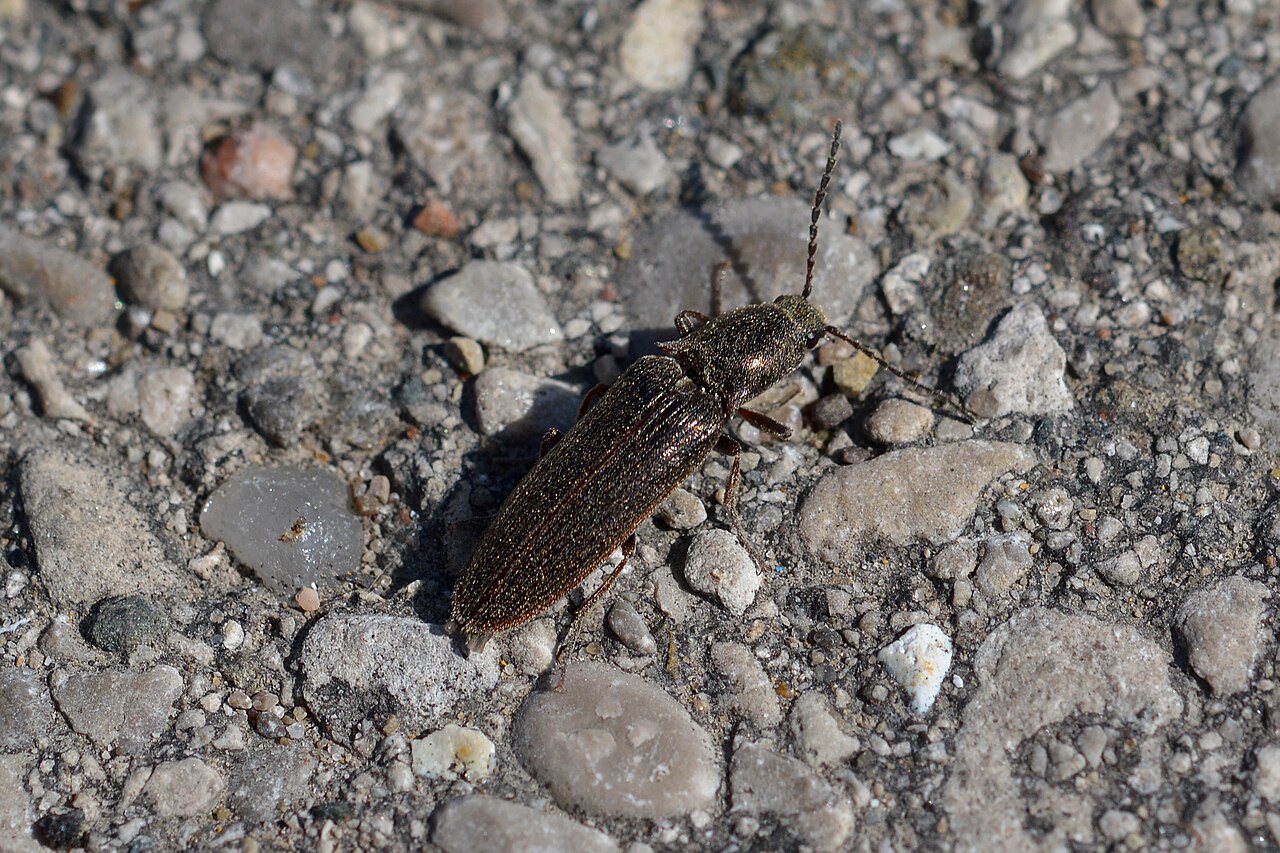
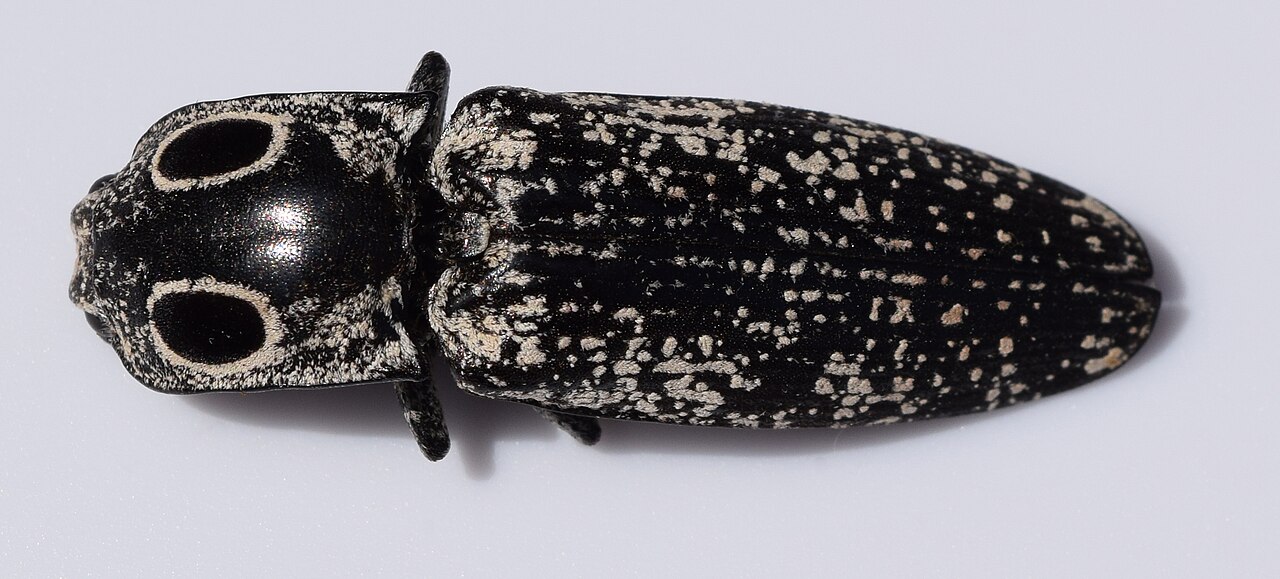
The family is Elateridae, with roughly 965 species in North America. Most are slender brown or black beetles between 0.4 and 0.8 in (10 to 20 mm), shaped like a narrow capsule with the back corners of the thorax drawn into points. The one people notice is the eastern eyed click beetle, far bigger and wearing two false eyespots.
Click beetles are harmless adults that do not bite or sting. They click by snapping a spine on the prosternum into a notch, which flips them upright and can launch them up to 12 in (30 cm). Their larvae, called wireworms, damage crop roots but not homes.
| Species | Size | Where you see it | Notes |
|---|---|---|---|
| Eastern eyed click beetle (Alaus oculatus) | 1 to 1.8 in (25 to 45 mm) | Eastern US hardwoods | Two false eyespots |
| Brown click beetles (Agriotes, Melanotus) | 0.3 to 0.6 in (8 to 15 mm) | Lawns, porch lights | Larvae are crop wireworms |
| Fire beetles (Pyrophorus) | 0.8 to 1.6 in (20 to 40 mm) | Florida, Texas | Bioluminescent thorax |
| Blood red click beetle (Ampedus) | 0.4 to 0.6 in (10 to 15 mm) | Rotting logs | Bright red wing covers |
| Wireworm (larval stage) | 0.5 to 1.5 in (12 to 38 mm) | Soil, potted plants | Hard, shiny, orange |
Is a Click Beetle Harmful?
No. Adult click beetles have chewing mouthparts sized for plant material and cannot break human skin. They carry no venom, no defensive spray, and no disease that matters to people or pets.
They also do nothing to a house. Click beetles do not tunnel into structural wood, feed on wool, or reproduce indoors. Unlike carpet beetle larvae, which chew through wool rugs for months, a click beetle indoors is a dead end that dies of thirst within days.
The harm sits underground. Wireworms feed on germinating seeds and roots and cost growers real money in corn and potatoes. In a home garden they show up as hollowed seed potatoes and wilting seedlings.
Why Does a Click Beetle Click?
The click is a righting mechanism. A spine under the front thorax segment sits in a groove on the segment behind it. The beetle arches, loads the joint like a latch, releases it, and the body snaps straight against the ground.
That snap throws the beetle up to 12 in (30 cm) into the air with peak accelerations in the hundreds of g, one of the fastest self righting movements known in insects. It doubles as defense: a bird that pins one gets a loud snap and a body that vanishes.
Why Would a Click Beetle Be in My House?
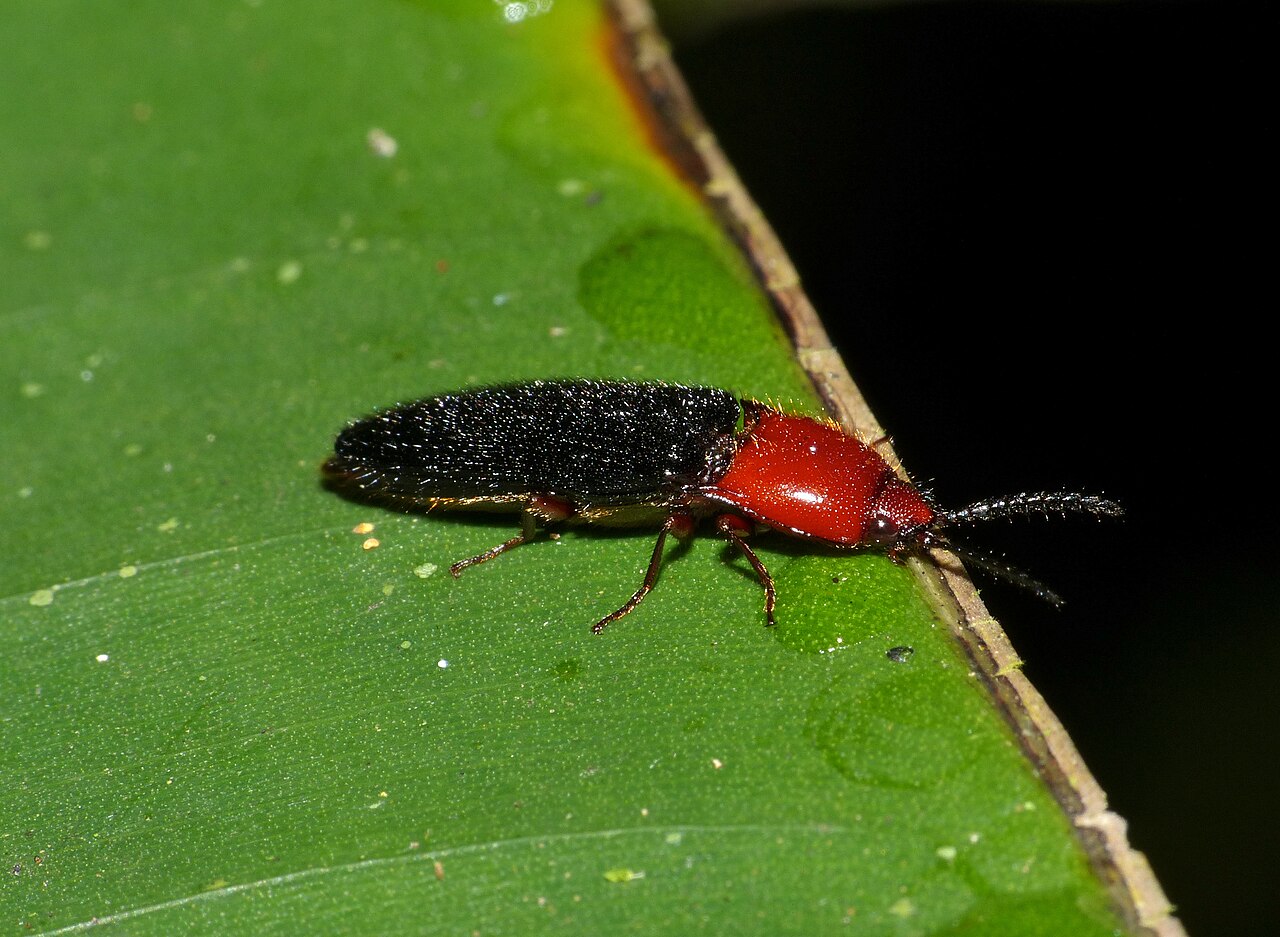
Light, almost always. Click beetles fly at night from late spring through midsummer and orient to porch lights and lit windows. They slip in through torn screens, gaps under doors, and open garage doors.
The second route is soil. Potting mix brought inside, overwintered container plants, and firewood by the stove can carry wireworms or pupae that emerge weeks later. That explains a click beetle in February.
Either way the count stays low. One or two a week during flight season is normal on a wooded property. A steady stream points to a light source or a torn screen, not an infestation, and the same holds for a black beetle of any kind indoors.
Are Click Beetles the Same as Roaches?
They are not related, and the confusion comes from shape. A brown click beetle and a small cockroach are both flat, brown, and about an inch long at a glance across a kitchen floor.
Beetles have hard wing covers meeting in a straight line down the back. Roaches have a leathery shield over the thorax that partly hides the head, plus long whip like antennae that sweep constantly. Click beetle antennae are short, serrated, and held close to the body.
The behavior test settles it. Nudge the insect onto its back: a click beetle lies still, arches, then snaps into the air, while a roach rights itself and runs. Telling lookalikes apart is the same skill needed for a carpet beetle or bed bug call.
Where Do Click Beetles Live in the US?
Every state has them, with the greatest diversity in the eastern hardwood belt from the Ohio Valley through the southern Appalachians. Adults rest by day under loose bark and in leaf litter, then fly at dusk.
Larvae live in soil and decaying wood for two to six years, which is why populations stay steady even after a hard winter. Some, like the Hercules beetle, share the same rotting log habitat without competing. State agencies such as the Missouri Department of Conservation publish regional identification pages.
How Do You Get Rid of Click Beetles?
Indoors, pick them up and put them outside. A jar and a piece of card works, or a vacuum if you would rather not touch one. No spray is warranted for a beetle that cannot breed in your home.
Prevention is a lighting and sealing job. Switch exterior fixtures to warm LED or yellow bug bulbs, move lights away from doors, repair screens, and add door sweeps. Clearing leaf litter back 12 in (30 cm) from the foundation also cuts Asian lady beetle pressure in fall.
Outdoors, target wireworms only if the garden is suffering. Rotate away from grasses and grains, avoid planting into recently turned sod, and improve drainage. Broadcast insecticide hits harmless species too, from pollinators to the bald faced hornet that eats garden caterpillars.
Frequently Asked Questions
Can you touch a click beetle?
Yes, safely. Click beetles have no venom, no bite that can break skin, and no irritating secretions. Held in an open palm, one will usually walk to the edge and fly. If it snaps while you hold it, the jolt is startling but harmless.
Do click beetles bite?
Adults do not bite people. Their mandibles are built for soft plant tissue and are too weak to break skin. Wireworm larvae chew roots underground and never meet human skin. Reports of a click beetle bite almost always turn out to be a different insect.
Can I keep a click beetle as a pet?
You can, though adults live only a few weeks to a few months. Use a ventilated container with two inches of moist coconut fiber, bark for cover, and slices of apple replaced every other day. Larger species like the eyed click beetle handle captivity best.
What kills click beetles?
Adults die from ordinary contact insecticides, but there is rarely a reason to use one. For wireworms in soil, beneficial nematodes in the genus Steinernema give partial control, and crop rotation plus better drainage does more over a season. Birds and ground beetles help.
How long do click beetles live?
The whole life cycle runs two to six years, nearly all of it underground as a wireworm. Pupation happens in late summer, the adult overwinters in soil or under bark, and it emerges the following spring to fly, mate, and die within a few months.
What is the hardest bug to get rid of in your house?
Bed bugs and German cockroaches top most pest control lists, followed by pharaoh ants and carpet beetles once larvae are established in rugs. Click beetles do not belong in that group, since they cannot reproduce indoors and every one you see arrived from outside.