Corn Snake Morphs: 20 Types and How to Identify Yours
Corn snake morphs are color and pattern variants of a single species, Pantherophis guttatus, produced by mutations that change how pigment is made or arranged. There are roughly 30 proven single gene traits in the hobby today, and because most of them stack, breeders have named hundreds of combinations. Amelanistic, anerythristic, hypomelanistic, caramel, lavender, motley, and stripe are the foundation genes. Nearly everything else on a price list is two or three of those mixed together.
That is the useful way to read a morph name. A snow is not its own mutation, it is amelanistic plus anerythristic. A butter is amelanistic plus caramel. Once you know the seven or eight base genes and what each one removes or rearranges, an unfamiliar label stops being a mystery and becomes an equation you can solve on sight.
Corn snake morphs fall into three groups: color mutations that remove pigment (amelanistic, anerythristic, hypomelanistic, charcoal), color mutations that add or shift pigment (caramel, lavender, bloodred), and pattern mutations that rearrange the saddles (motley, stripe, tessera, Aztec). Combination morphs such as snow, blizzard, ghost, and opal are simply two or more of these genes in one animal.
| Morph | Genetics | What you see |
|---|---|---|
| Amelanistic (albino) | Recessive, single gene | Orange and red, red eyes, no black |
| Anerythristic | Recessive, single gene | Gray and black, no red |
| Snow | Amel plus anery | White to pale pink saddles |
| Ghost | Anery plus hypo | Washed pastel gray and lavender |
| Butter | Amel plus caramel | Solid yellow on yellow |
| Motley | Recessive pattern | Connected saddles, clean white belly |
| Palmetto | Recessive, rare | White with scattered colored scales |
What Is a Corn Snake Morph?
A morph is an inherited variation in appearance, not a separate species or subspecies. Every morph on the market descends from wild Pantherophis guttatus, the same snake found in fields and outbuildings from New Jersey to Florida, and they all interbreed freely. Captive breeding just concentrates mutations that would be rare and short lived in the wild, where an albino snake is a conspicuous meal.
Most corn snake mutations are simple recessives. A snake needs two copies of the gene to show the trait, and a snake with one copy is a normal looking het, short for heterozygous. That is why a pair of wild type looking snakes can produce a clutch with albinos in it, and why listings are full of notations like “normal het amel, anery.” If you are new to the species, start with the corn snake care and identification guide before shopping for genetics.
Classic or Normal Corn Snakes

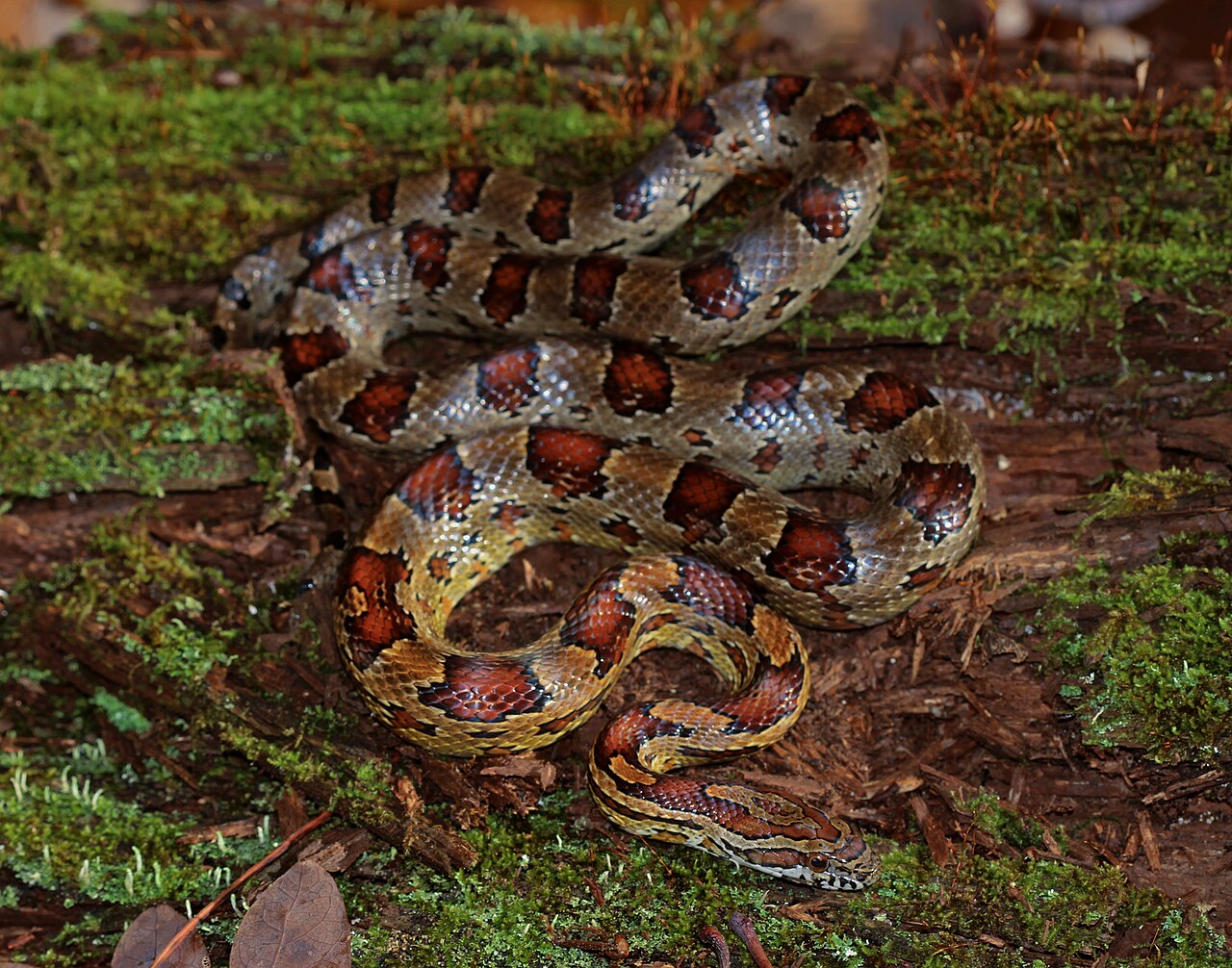
The classic, also called normal or wild type, is the baseline every other morph is measured against. It shows orange to brownish orange ground color, red or red brown saddles outlined in black, and a black and white checkerboard belly. This is the phenotype you find under a sheet of plywood in a Carolina field.
Within the classic pattern there are locality lines that are not single gene morphs at all. Okeetee corns come from Jasper County, South Carolina, and carry unusually thick black saddle borders. Miami phase animals show silver gray ground color with orange saddles. Both are line bred, meaning the look comes from selecting parents over generations, not from one mutation you can inherit cleanly.
Amelanistic Corn Snakes (Albino)
Amelanistic corns cannot produce melanin, so every trace of black is gone. What remains is orange, red, and white, with red or pink eyes. This was the first corn snake mutation established in captivity, appearing in the 1960s, and it is still the most common morph in pet stores.
The trait is recessive and it is the single most useful gene to understand, because it appears inside dozens of combination names. Any morph with snow, blizzard, butter, opal, or candy cane in the label carries amelanism. For the full care picture and what these animals look like as they mature, see the albino corn snake profile.
Next question: Corn Snake Lifespan: 15 to 20 Years, and What Decides It
Anerythristic and Charcoal Morphs

Anerythristic corn snakes are the mirror image of albinos. They lack red pigment instead of black, which leaves a gray snake with dark charcoal saddles and often a yellow wash along the neck in adults. Breeders call the original version anery type A.
Charcoal, sometimes called anery type B, is a separate recessive gene at a different locus. Charcoal animals look similar but lack the yellow neck coloring entirely and read colder and flatter gray. Because the two genes are not the same, breeding an anery to a charcoal produces normal looking babies that carry both, a classic beginner surprise.
Hypomelanistic and Ghost Corn Snakes
Hypomelanistic, or hypo, reduces black pigment instead of erasing it. The saddle outlines fade to pale gray or brown, and the underlying reds and oranges look brighter because nothing is muting them. Several unrelated hypo genes exist, including sunkissed, lava, and dilute, each with its own subtle signature.
Ghost is hypo combined with anerythristic. Removing red and reducing black leaves soft pastel grays, lavenders, and tans that photograph beautifully and are among the most popular intermediate morphs. Ghost hatchlings often look dull and gain their color over their first year, which is true of most corn snake hatchlings.
Caramel, Butter, and Amber
Caramel replaces red pigment with yellow to yellowish brown, producing a snake in shades of mustard, tan, and chocolate. On its own it is an understated morph, and its value comes from what it does in combination.
Butter is caramel plus amelanistic, which strips the black and leaves a nearly solid yellow animal with faint yellow saddles. Amber is caramel plus hypo, giving warm tan and orange tones with soft brown borders. Both are good examples of how two modest genes produce something that looks nothing like either parent.
Lavender and Opal
Lavender corn snakes carry a recessive mutation that turns the ground color pale pinkish gray and the saddles a soft plum or mauve. The eyes are burgundy rather than black, which is the fastest field mark for identifying one. Color varies widely between lines, from near white to distinctly purple.
Opal is lavender plus amelanistic. With melanin removed, the lavender base becomes an iridescent white to pale pink snake with red eyes, and in good light the scales show a faint sheen that gives the morph its name. Opals are among the most consistently requested display animals in the hobby.
Bloodred and Diffused Corn Snakes
The gene behind bloodred is properly called diffused. It eliminates the belly checkering and blurs the saddle borders on the sides, so the pattern bleeds into the ground color instead of standing apart from it. A diffused snake alone is not necessarily red.
Bloodred is diffused combined with decades of selective breeding for deep saturated red. Modern bloodreds hatch with visible saddles and darken into near uniform brick red adults with clean white bellies. The morph is a good illustration that not every named look is one gene: here a mutation and a breeding program both had to happen.
Motley and Stripe Patterns
Motley is a recessive pattern gene that connects the saddles into a chain of blotches or rings down the back and clears the belly to solid white or cream. Motley animals often show small round spots inside the pattern, and the clean belly makes them easy to confirm by flipping the snake.
Stripe is allelic with motley, meaning the two genes sit at the same locus. Stripe produces two continuous dorsal lines running the length of the body with no saddles at all. Because they are allelic, a snake can carry one copy of each, and those motley stripe animals show an intermediate pattern that breeders use to prove genetics.
Tessera and Aztec
Tessera is one of the few corn snake pattern traits that is not recessive. A single copy produces a thin unbroken dorsal stripe with rectangular lateral markings along the flanks, so tessera babies appear in the first generation rather than hiding for two. That dominance made it spread through the hobby quickly after 2008.
Aztec and zigzag are aberrant patterns in which the saddles break apart into irregular jagged shapes. They are polygenic and line bred rather than cleanly inherited, so outcomes are unpredictable and two Aztecs do not reliably produce Aztec offspring. Pattern chaos of this kind also shows up in milk snakes and other colubrids kept in captivity.
What Is the Rarest Morph of Corn Snake?
Palmetto is the standard answer. Discovered in South Carolina in 2008, it is a recessive trait that produces a white snake speckled with random scales of red, orange, or black, and no two look alike. Founder stock was a single wild animal, so the gene entered the hobby through one bloodline and prices stayed high for years.
Scaleless corn snakes are a close second in novelty. The trait arrived through a historical cross with a rat snake and leaves the animal with belly scutes but almost no dorsal scales. Terrazzo, masque, and buf are other genuinely uncommon traits. Rarity in this hobby moves fast, and a morph that costs four figures at release often falls to two within a decade.
How to Tell What Morph Your Corn Snake Is
Work through it by elimination. Look for black first: no black anywhere plus red eyes means amelanistic is in the mix. Then look for red: gray tones with black saddles and no red means anerythristic or charcoal. Faded gray saddle outlines over bright color point to hypo, and burgundy eyes point to lavender.
Then flip the snake over. A checkered black and white belly means the pattern genes are normal, a clean white belly points to motley, stripe, or diffused. Photograph the animal in daylight against a neutral background, because indoor lighting shifts these colors badly. For wild found snakes, confirm the species first: a red and black banded animal in the yard is not a corn snake, and the coral snake comparison explains why that distinction matters. Range and natural history references from the University of Georgia Savannah River Ecology Laboratory are a reliable starting point.
Frequently Asked Questions
How many morphs do corn snakes have?
About 30 proven single gene traits exist, but because most of them combine freely, breeders recognize several hundred named morphs and combinations. Large marketplaces list roughly 40 traits including line bred looks. The number keeps growing because new combinations only require pairing genes that already exist.
What are the most beautiful corn snake morphs?
Taste varies, but opal, ghost, palmetto, and high contrast Okeetee classics are the four that consistently draw attention at reptile shows. Opals for the pearl sheen, ghosts for the pastel tones, palmettos for the random speckling, and Okeetees because the wild pattern at its best is still hard to beat.
Are boy or girl corn snakes nicer?
There is no reliable temperament difference between sexes in corn snakes. Males may wander more during breeding season and females can be defensive while gravid, but both are among the calmest colubrids kept. Handling history as a hatchling predicts temperament far better than sex does.
Do corn snakes recognize people?
Corn snakes learn to associate a keeper’s scent and handling routine with safety, and many become visibly calmer with a familiar person. That is habituation rather than affection. They have no social bonding behavior in the wild, so a relaxed snake is a comfortable snake, not an attached one.
How old is a 5 ft corn snake?
A corn snake at 5 ft (152 cm) is an adult of at least 3 to 4 years, and most likely older, since that is near the upper end of the species range of 3 to 6 ft. A 25 in (64 cm) snake is usually 8 to 12 months old. Growth depends heavily on feeding schedule, so length gives an estimate, not an age.
What is the biggest trouble with corn snakes as pets?
Escapes. Corn snakes are strong, persistent, and able to push through a lid that is merely resting in place, and a lost snake in a house is hard to recover. Locking enclosures solve almost every common problem with the species. Feeding refusals during winter brumation are the other routine worry and are usually normal.