Red Bird Not a Cardinal? 12 Look Alikes and How to Tell Them Apart
If you saw a red bird and it was not a cardinal, the most likely answers are a summer tanager, a scarlet tanager, a house finch, or a vermilion flycatcher. The fastest way to separate them is the crest: a northern cardinal always has a pointed crest and a thick orange bill, and none of the common look alikes have both. Everything else follows from that one check.
Red is a rare color in North American birds, which is exactly why a red flash at the feeder or in the canopy gets noticed. About a dozen species can produce it, and they differ in size, shape, bill, wing pattern, and where in the country they appear. This guide covers each one, with the field mark that settles the identification in a few seconds.
A red bird with no crest and a pale heavy bill is a summer tanager. Red with black wings is a scarlet tanager. Small, streaky, and red only on the head and chest is a house finch. Slim, tiny, with a dark mask and long tail in the Southwest is a vermilion flycatcher.
| Species | Red where | Crest | Size | Range |
|---|---|---|---|---|
| Northern cardinal | Entire body, black face mask | Yes, tall | 8 to 9 in | East, Midwest, Southwest |
| Summer tanager | Entire body, no mask | No | 7 in | Southeast and South |
| Scarlet tanager | Body red, wings and tail black | No | 7 in | Eastern forests, summer |
| House finch | Head, throat, upper chest | No | 5 to 6 in | Nationwide |
| Purple finch | Head and back, raspberry wash | Slight peak | 6 in | North and East |
| Vermilion flycatcher | Crown and underparts, brown mask | Slight | 5 to 6 in | Southwest border |
| Pyrrhuloxia | Face, crest tip, chest stripe | Yes, thin | 8 in | Texas to Arizona desert |
What Red Bird Is Not a Cardinal?
Start with the head. A northern cardinal carries a tall pointed crest it can raise and lower, plus a black face mask running from the forehead through the throat and a thick cone shaped bill in bright orange red. That combination exists in no other North American bird.
If the bird you saw was uniformly red but smooth headed, with a pale yellowish bill and no mask, it was a summer tanager. If it was red with jet black wings, it was a male scarlet tanager in breeding plumage. If it was small, sparrow sized, and streaked brown below with red confined to the face and chest, it was a house finch.
Habitat narrows it further. Tanagers stay high in the canopy and rarely come to feeders, while house finches swarm them. A cardinal works low, in shrubs and at ground level, which is why it dominates feeder sightings in the East.
Summer Tanager: The All Red Bird With No Crest
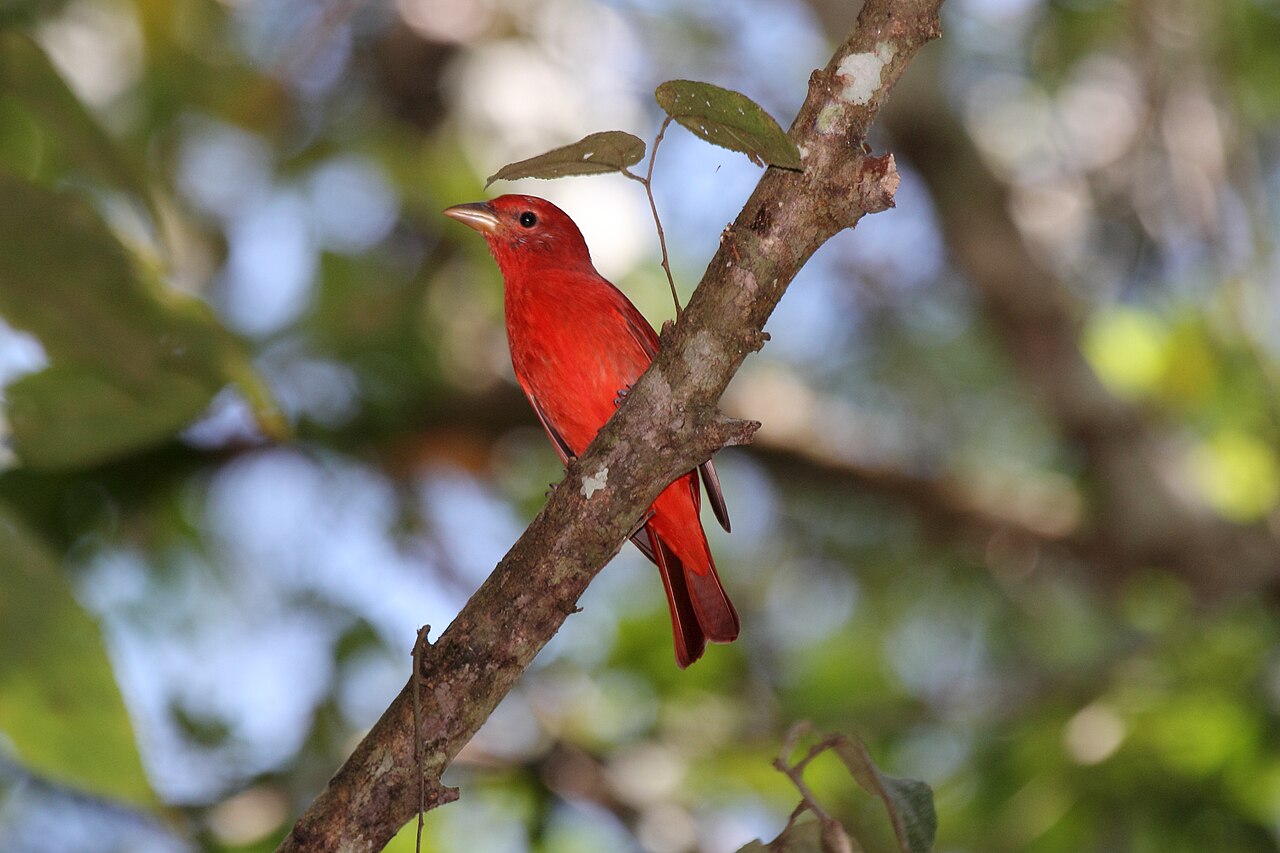
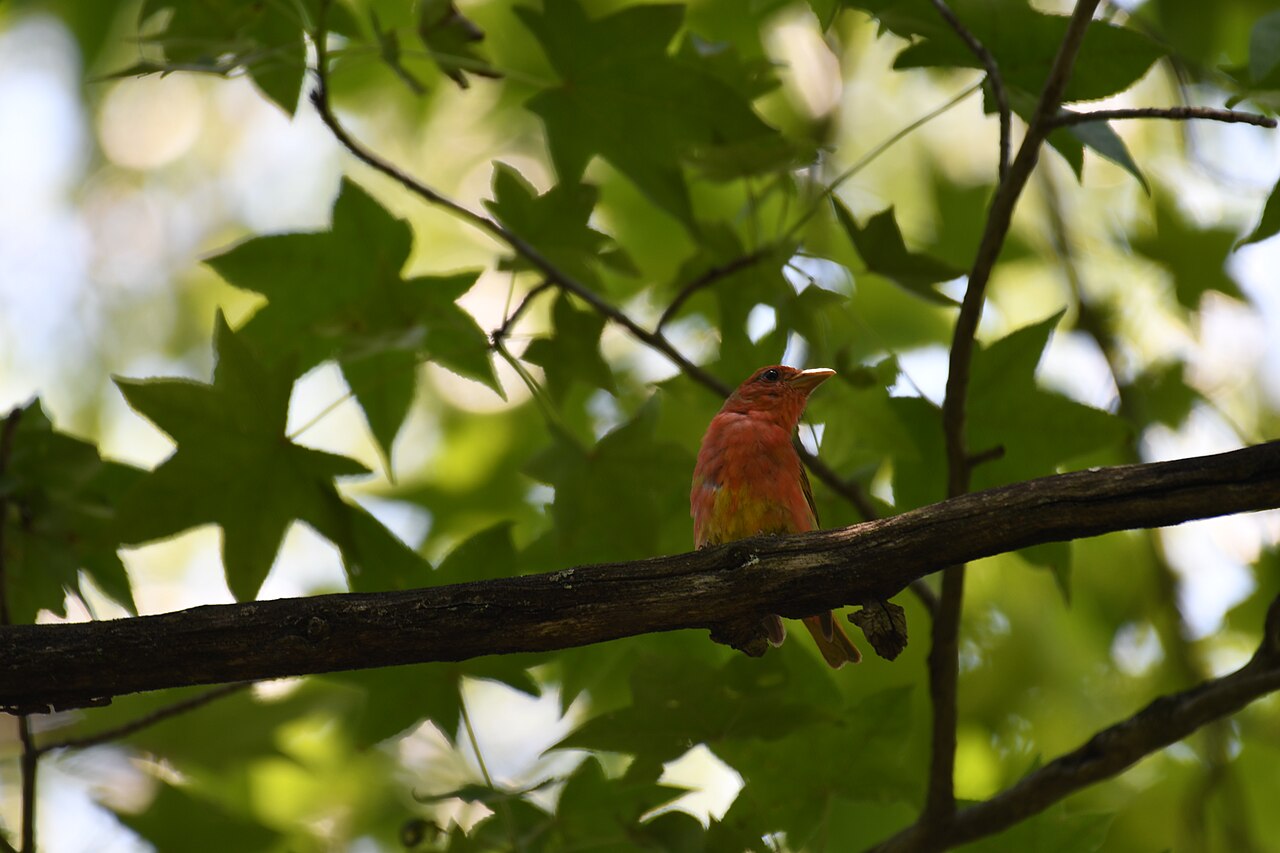
The summer tanager (Piranga rubra) is the only completely red bird in North America. Males are an even rosy red from bill to tail with no black anywhere, a smooth rounded head, and a notably large pale bill that looks almost yellow in good light. Females are a warm mustard yellow, which throws people off entirely.
It breeds across the South and Southeast in open oak and pine woodland, arriving in April and leaving by September for Central and South America. The song is a robin like series of burry phrases, and the call is a distinctive sharp pit ti tuck that experienced birders use to find them before seeing them.
Summer tanagers are bee and wasp specialists. They catch stinging insects in flight, beat them against a branch to remove the sting, and will raid paper wasp nests for larvae. That behavior is unique enough that it is often the first clue a summer tanager is in the area.
Scarlet Tanager: Red Body, Black Wings
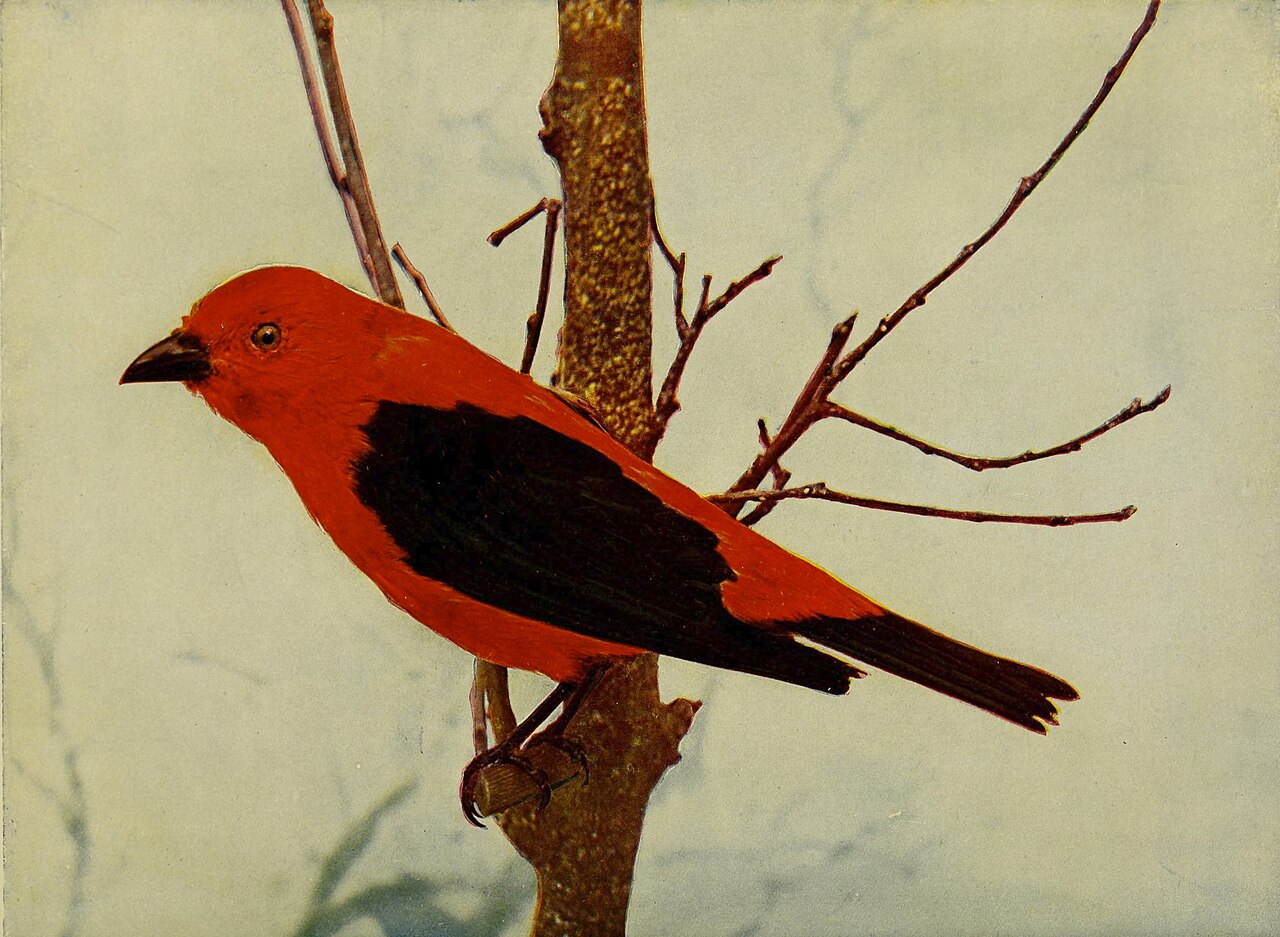
A scarlet tanager (Piranga olivacea) in breeding plumage is the most intensely colored bird in eastern North America: brilliant scarlet with coal black wings and tail. The contrast is so sharp that a bird glimpsed in dappled canopy light often reads as red and black rather than as a shape.
They breed in mature deciduous forest across the Northeast, Midwest, and Appalachians, and they stay high. Most sightings come from a red spot moving through oak leaves 60 ft (18 m) up, which is why many people who live inside their range have never noticed one.
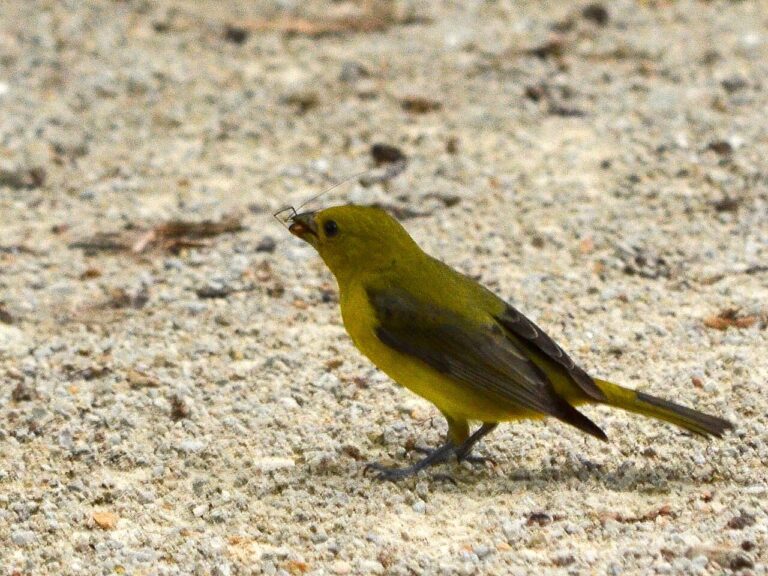
By late summer males molt into olive green with black wings for migration, so a strange olive bird with dark wings in September is very likely this species. Females are olive yellow year round with dusky wings.
House Finch: The Red Bird at Most Feeders
The house finch (Haemorhous mexicanus) accounts for more mistaken cardinal reports than any other species, because it is the red bird people actually see daily. Males show red on the forehead, throat, and upper breast, fading into brown streaked flanks and a brown back, with a short conical bill and no crest at all.
The red varies enormously. It comes from carotenoid pigments in the diet, so some males are deep red, others orange, and a small percentage are yellow. This variation is why two males at the same feeder can look like different species.
House finches are native to the West and were introduced to the East Coast in the 1940s, spreading nationwide since. They are gregarious, noisy, and heavy feeder users, so a yard that hosts cardinals almost certainly hosts these too. If a feeder is drawing nothing at all, placement rather than species mix is usually the issue.
Purple Finch: Raspberry, Not Red
The purple finch is best described the way Roger Tory Peterson did it: a sparrow dipped in raspberry juice. The color is a wine or rose wash spread over the head, back, and breast rather than a clean red patch, and it extends much further down the back than a house finch’s does.
Structurally it is chunkier, with a slightly peaked crown, a larger bill, and a noticeably notched tail. Females are the easier identification: a strong white eyebrow stripe and a dark cheek patch that house finch females lack completely.
Purple finches breed in northern and mountain conifer forests and move south irregularly in winter, so in much of the country they are a cold season visitor that appears some years and not others.
Vermilion Flycatcher: The Southwest Standout
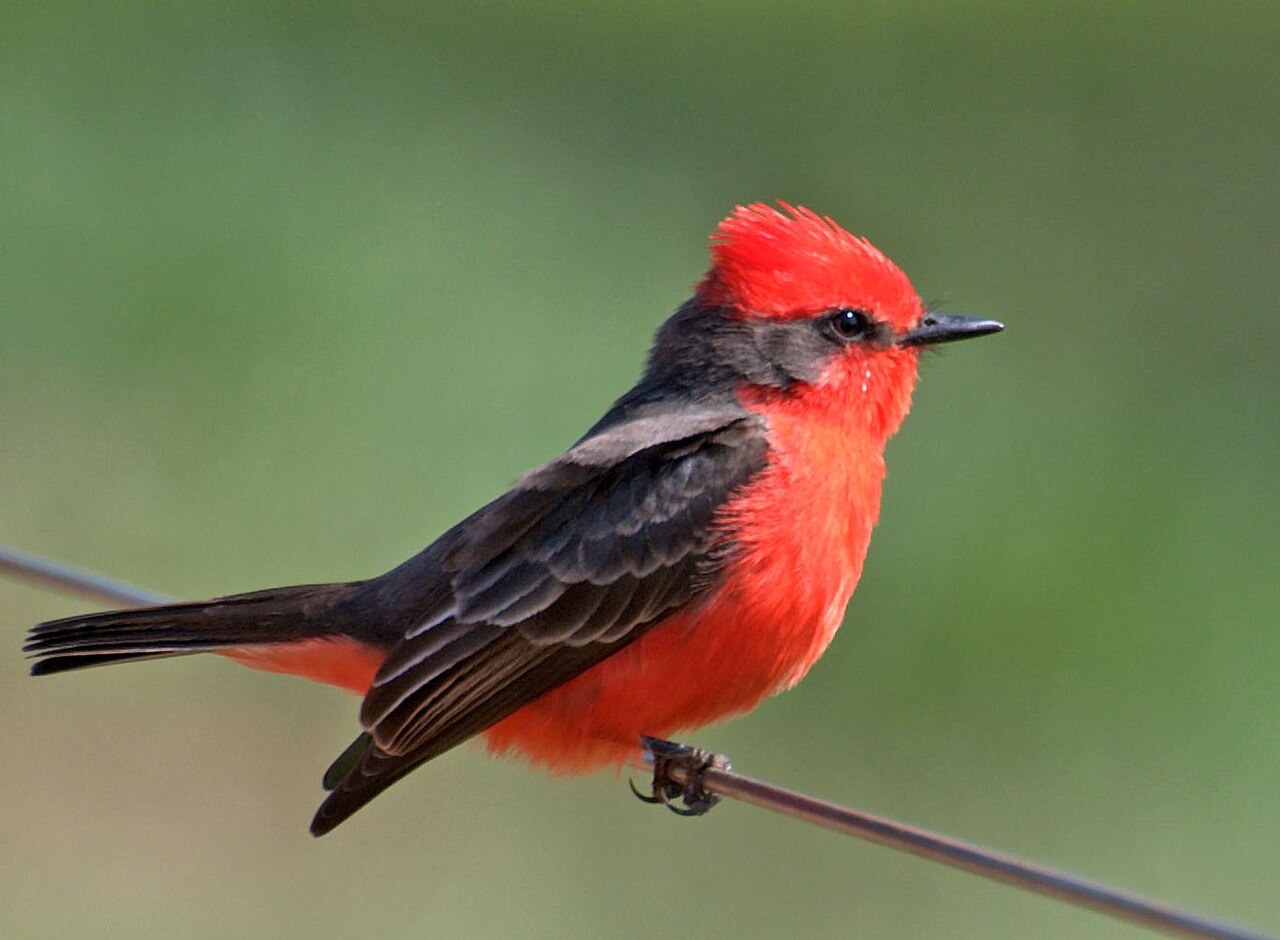
The vermilion flycatcher (Pyrocephalus rubinus) is unmistakable once seen: a tiny bird with a flaming red crown and underparts, a dark brown mask through the eye, and brown wings and back. Males perform a fluttering display flight above open ground while singing, which is often what draws attention.
Range is limited to the desert Southwest and southern Texas, extending into California and occasionally wandering further. They favor open country near water: ranch ponds, desert washes, golf courses, and park edges with scattered perches.
Behavior is the giveaway even at distance. This is a flycatcher, so it sits upright on an exposed perch, sallies out to catch an insect in midair, and returns to the same spot. No cardinal or finch behaves that way.
Red Crossbill and White Winged Crossbill
Male red crossbills are a brick red bird of conifer forests with a bill whose tips cross over each other, an adaptation for prying open spruce and pine cones. The color is duller and more orange brick than cardinal red, and the birds are usually in noisy flocks moving through treetops.
White winged crossbills are pinker with two bold white wing bars. Both species are nomadic, following cone crops rather than a fixed migration, which means they can appear far south of their normal range in irruption years and vanish the next season.
If a red bird is clinging sideways to a cone and working at it like a parrot, crossbills are the answer. The bill is visible with binoculars at moderate range and settles it immediately.
Pyrrhuloxia: The Desert Cardinal
The pyrrhuloxia is the closest thing to a cardinal that is not one. It shares the crest and the general shape but is mostly grey, with red restricted to the face, a stripe down the chest, the crest tip, and the tail edges. The bill is the clincher: short, stubby, strongly curved, and pale yellow rather than orange.
It lives in mesquite and thorn scrub from southern Texas through southern Arizona and into Mexico, overlapping with cardinals in places. Where both occur, a grey bird with red trim and a parrot like bill is a pyrrhuloxia every time.
Female cardinals in the same habitat are warm buff brown with red trim and an orange bill, so bill color separates them cleanly. Anyone stocking seed aimed at cardinals in the Southwest will often draw both.
Red Headed and Red Bellied Woodpeckers
A red bird clinging vertically to a trunk is a woodpecker. The red headed woodpecker has a completely crimson head, a clean white belly, and black wings with large white patches, a bold three color pattern visible at a distance.
The red bellied woodpecker is the more common source of confusion, since its name misleads. The red is a cap running over the crown and nape, the back is black and white barred, and the belly wash is faint. People frequently report it as a red headed woodpecker.
Both visit suet feeders and will take sunflower seed. Neither can be confused with a cardinal once posture is noted, because woodpeckers brace on the trunk with a stiff tail rather than perching crosswise on a branch.
Female Cardinals and Why They Confuse People
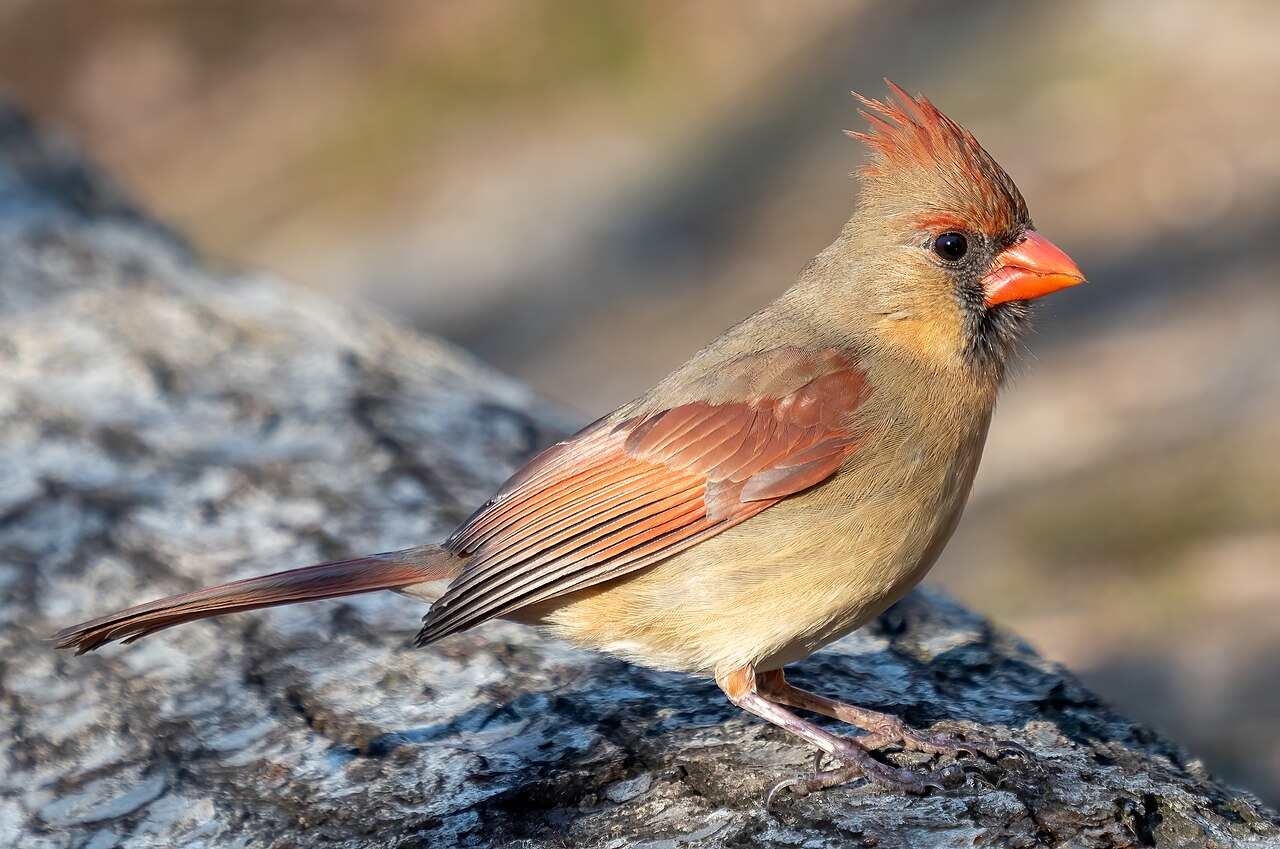
A female northern cardinal is not red, which surprises people who only know the male. She is a warm tan to olive brown with red edging on the wings, tail, and crest, and she keeps the orange bill and black face markings, though the mask is softer and greyer.
That plumage overlaps visually with female tanagers and with the pyrrhuloxia. The bill remains the reliable mark: a female cardinal’s bill is heavy, conical, and orange, while a summer tanager female has a longer pale bill and no crest at all.
Juvenile cardinals add another layer, since they resemble females but have a dark grey or blackish bill for their first months. A crested brown bird with a black bill in late summer is a young cardinal, often still being fed near the nest site.
How to Tell a Cardinal From a Look Alike in Three Seconds
Run three checks in order. First, crest: present and pointed means cardinal or pyrrhuloxia; absent means tanager, finch, or flycatcher. Second, bill: thick, orange, and conical means cardinal; pale and stubby means pyrrhuloxia; long and pale means tanager; small and brown means finch.
Third, red coverage: full body red including the wings means cardinal or summer tanager; red body with black wings means scarlet tanager; red only on head and chest over streaky brown means house finch. These three checks resolve the great majority of sightings without any other information.
Where the bird is seen refines the rest. Feeder and shrub level favors cardinal and finch, high canopy favors tanager, exposed desert perch favors vermilion flycatcher, and a tree trunk favors woodpecker. The Cornell Lab’s All About Birds guide carries range maps and recordings for every species here.
Where and When You See Each Red Bird
Cardinals are non migratory and present year round across the eastern half of the country, the Midwest, and parts of the Southwest. A red bird at a January feeder in Ohio is almost certainly a cardinal or a house finch, because the tanagers are in the tropics by then.
Both tanagers are long distance migrants present only from April to September. Vermilion flycatchers hold territory year round in parts of Arizona and Texas and withdraw from the northern edge in winter. Crossbills appear unpredictably, driven by cone crops rather than season.
Season is therefore a strong filter. In winter across most of the East the candidate list shrinks to cardinal, house finch, purple finch, and the two woodpeckers. Other red toned birds of prey, such as the red shouldered hawk, are a different size class entirely and rarely enter the comparison.
Frequently Asked Questions
What red bird looks like a cardinal but has no crest?
A summer tanager. Males are entirely red like a cardinal but have a smooth rounded head with no crest, no black face mask, and a longer pale yellowish bill. They stay in the tree canopy and rarely visit feeders, so most sightings come from wooded areas rather than yards.
What is a red bird with black wings called?
That is a male scarlet tanager in breeding plumage, found in mature eastern deciduous forest from April through September. The combination of brilliant scarlet body with completely black wings and tail occurs in no other North American songbird, making it one of the easiest identifications once seen clearly.
Is a house finch a type of cardinal?
No. House finches belong to the finch family and are much smaller at 5 to 6 in compared with a cardinal’s 8 to 9 in. They have no crest, a small brown bill instead of a thick orange one, and red limited to the head and chest over brown streaked underparts.
What red bird is in the desert Southwest?
Two stand out. The vermilion flycatcher is a small bird with a red crown and underparts and a dark brown mask, usually perched upright in the open near water. The pyrrhuloxia is a grey crested bird with red trim and a stubby curved yellow bill, found in mesquite scrub.
Why do some house finches look orange or yellow?
House finch color comes from carotenoid pigments in the fruits and seeds they eat rather than from the bird itself. Males on a carotenoid poor diet develop orange or yellow plumage instead of red. Females prefer the reddest males, since the color signals a well fed bird.
Are female cardinals red?
Female northern cardinals are warm tan to olive brown with red edging on the crest, wings, and tail, not fully red like males. They keep the heavy orange bill and the crest, which distinguishes them from female tanagers. Juveniles look similar but have a dark grey bill for their first few months.