Downy Woodpecker Sounds: Pik, Whinny and Drumming Decoded
A downy woodpecker sounds like a short, sharp pik dropped into the middle of a quiet yard, followed a few seconds later by a descending whinny that rolls downhill like a tiny horse. Those two notes cover most of what you will ever hear from Dryobates pubescens, the smallest woodpecker in North America, and once you know them you can pick this bird out of a winter feeder crowd without seeing it.
The rest of its vocabulary is quieter and more situational: scolding when a hawk slides overhead, soft contact notes between a pair working the same branch, and the thin squeals of nestlings in June. Drumming is a separate matter entirely. It is not a call, it is a signal hammered into wood, and it is the sound most likely to end up against your siding at 6 a.m. in April.
Downy woodpeckers make a short, high pik call and a descending whinny or rattle that falls in pitch. Both are given year round by males and females. In late winter and spring they also drum: a fast, even burst of about 15 taps per second lasting less than a second, repeated every few seconds.
| Sound | What it sounds like | Main season | Why the bird makes it |
|---|---|---|---|
| Pik call | Single sharp pik or pick | Year round | Contact, location, mild alarm |
| Whinny or rattle | Descending pi-pi-pi-pi-pi | Year round, peaks in spring | Pair contact, territory edges |
| Drumming | Fast even roll on wood or metal | January to May | Advertising territory and mate |
| Scolding series | Rapid run of piks | Year round | Predator near the bird or nest |
| Begging calls | Thin, insistent squeals | May to July | Nestlings and fledglings asking for food |
| Soft tapping | Slow, irregular knocks | Year round | Feeding or excavating, not communication |
What Does a Downy Woodpecker Sound Like?
Think small and sharp. Everything a downy woodpecker says is pitched higher than you expect from a woodpecker, because the bird is barely longer than a house sparrow at 5.5 to 6.7 in (14 to 17 cm). The two sounds that matter are the pik and the whinny, and they work as a pair: the pik says “here I am,” the whinny says “here I am and this is my patch.”
Both sexes give both calls, which is unusual among backyard birds and makes voice useless for telling males from females. Use the red nape patch instead, which only the male carries. For the full visual rundown, see our guide to the downy woodpecker and the differences in the female downy woodpecker.
Volume is low. A downy calling 40 ft (12 m) up in a cottonwood is easy to miss on a windy day, which is why most people first notice this bird at a suet feeder where it calls from 15 ft (4.5 m) away.
The Pik Call: The Sound You Hear Most
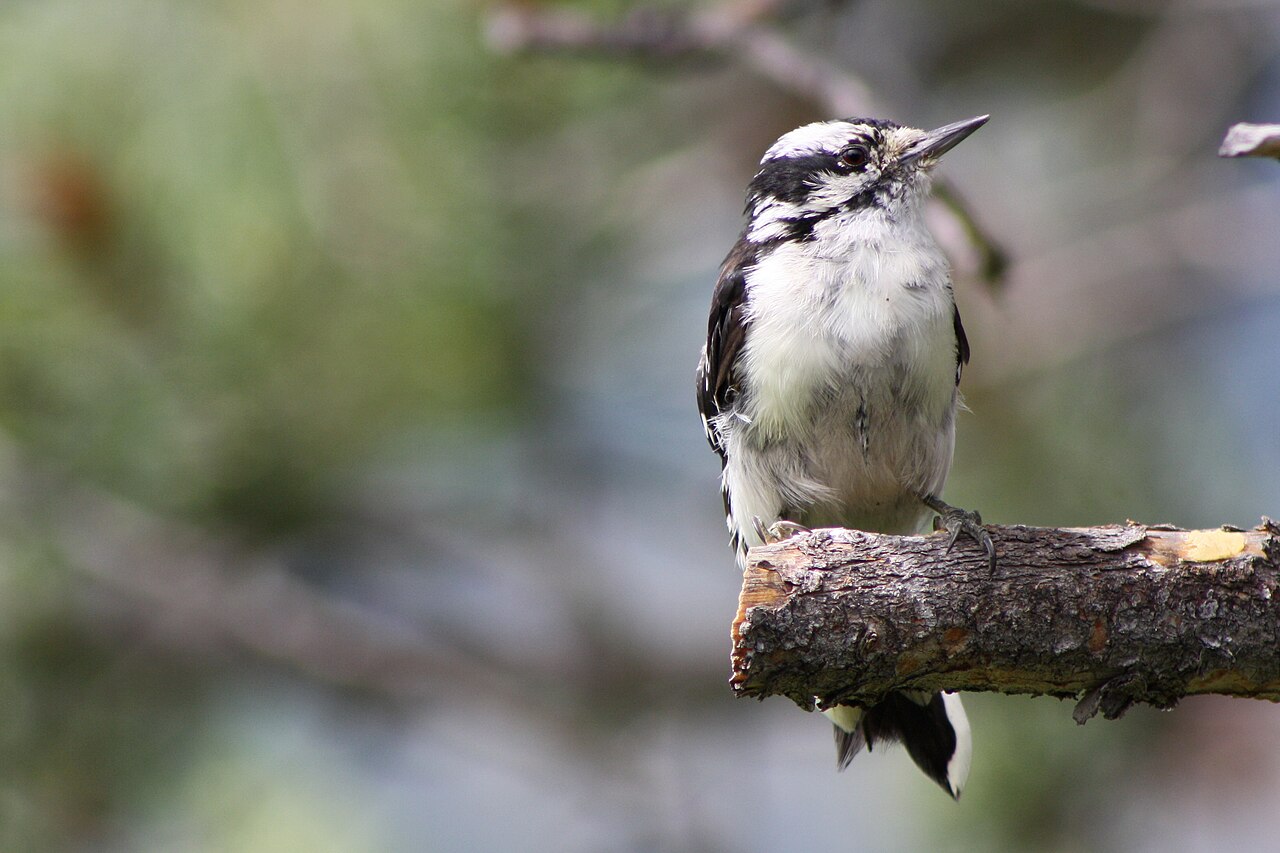
The pik is a single, clipped, slightly metallic note. Written out it reads as pik, pick, or chik, and it lasts a fraction of a second with a clean start and stop, like a pebble dropped on a tile floor. Birds give it from perches, in flight, and between pecks while feeding.
Spacing tells you the bird’s mood. Isolated piks spread 10 or 20 seconds apart are a calm bird keeping track of its mate. Piks that tighten into a steady run of five or ten notes mean something is wrong: a sharp-shinned hawk, a cat on the fence, or you standing too close to a nest hole.
The closest confusion in the same yard is the sharper, lower, fuller peek of the hairy woodpecker, and the thin pit of a nuthatch. Pitch is the giveaway. Downy piks sit high and small.
The Whinny Call: A Descending Rattle
The whinny is the call that convinces people they have something unusual in the yard. It is a run of 10 to 20 notes that slides steadily down in pitch across about a second and a half, often translated as a horse whinny or a tiny laugh. In recordings labeled “downy woodpecker call audio” online, this is usually the one being demonstrated.
Downies use the whinny at territory boundaries, during pair interactions, and when a bird returns to a shared feeding tree. In late winter you can often hear two birds trading whinnies back and forth across 100 ft (30 m) of woodland edge, which is the audible version of a property line being negotiated.
The hairy woodpecker’s equivalent rattle does not drop in pitch. It stays flat and sounds harsher. That single feature separates the two species by ear more reliably than anything else.
Drumming: The Spring Sound That Is Not a Call

Drumming is mechanical, not vocal. The bird picks a resonant surface and hammers it in a fast, even burst of roughly 15 strikes per second, usually under a second long, then pauses several seconds and repeats. The rhythm is steady from the first tap to the last, with no acceleration and no slowdown.
Males drum most, females drum too, and both do it to claim ground and attract a mate rather than to find food. Peak season runs from January through May, with the highest rates in March and April. On cold clear mornings a single male may drum a few hundred times before noon.
Feeding taps sound nothing like this. They are slow, uneven, and often accompanied by bark flaking off. If the rhythm is irregular, the bird is working for insects, not broadcasting.
Alarm and Scolding Calls
When a predator appears, piks compress into a hard, urgent series and the bird usually freezes flat against the far side of a trunk. Downies also join mixed flocks of chickadees and titmice in mobbing, and in that chorus their contribution is a rapid stutter of piks from a safe branch rather than a dive at the intruder.
Nest defense is louder than anything else in the repertoire. A downy with young in a cavity will scold continuously from 10 ft (3 m) away and may add a harsh, drawn-out note you will not hear at any other time of year. That is your cue to back off and watch from a distance.
For the deeper, more carrying alarm of a much larger relative, compare the pileated woodpecker sound, which can be heard a quarter mile off.
Nestling and Fledgling Begging Calls
From late May into July, cavity nests give away their location acoustically. Nestlings produce a thin, buzzy, insistent squeal that rises every time an adult lands at the entrance, then dies back into a murmur. From outside the tree it sounds like a faint electrical hum coming from the trunk.
Fledglings are louder and much more annoying to their parents. For two to three weeks after leaving the nest, young downies follow adults through the canopy giving a repeated begging note that is harsher and flatter than the adult pik. People often report a “broken” woodpecker call in June, and this is almost always what they are hearing.
When You Hear Each Sound Through the Day and Year
Downies are early risers but not dawn chorus specialists. Calling starts around first light, holds steady through the morning, drops off in the heat of the afternoon, and picks up briefly before roosting. Unlike owls, they are silent at night, so a nocturnal knocking or calling sound is something else.
Seasonally, drumming dominates from January to May, whinnies peak during pair formation in late winter, begging calls own June, and the pik runs all twelve months. Birds do not migrate across most of their range, so winter silence is just cold weather, not absence. Our overview of woodpecker sounds lays the seasons out species by species.
Downy vs Hairy Woodpecker Sounds: The Pitch Test
These two species look nearly identical and share the same yards, so sound is often the faster identification. Run three checks. First, the single note: downy is a high, small pik, hairy is a loud, lower peek with more punch. Second, the series: downy descends, hairy stays flat. Third, the drum: hairy drums faster and the roll sounds drier and more powerful.
If you are weighing bill length, back pattern, and voice together, our side by side breakdown of downy vs hairy woodpecker covers the visual marks that confirm what your ears suggested. The Cornell Lab’s reference recordings on its Downy Woodpecker species account are worth listening to twice before you commit to an identification.
Other Woodpecker Sounds People Confuse With Downies
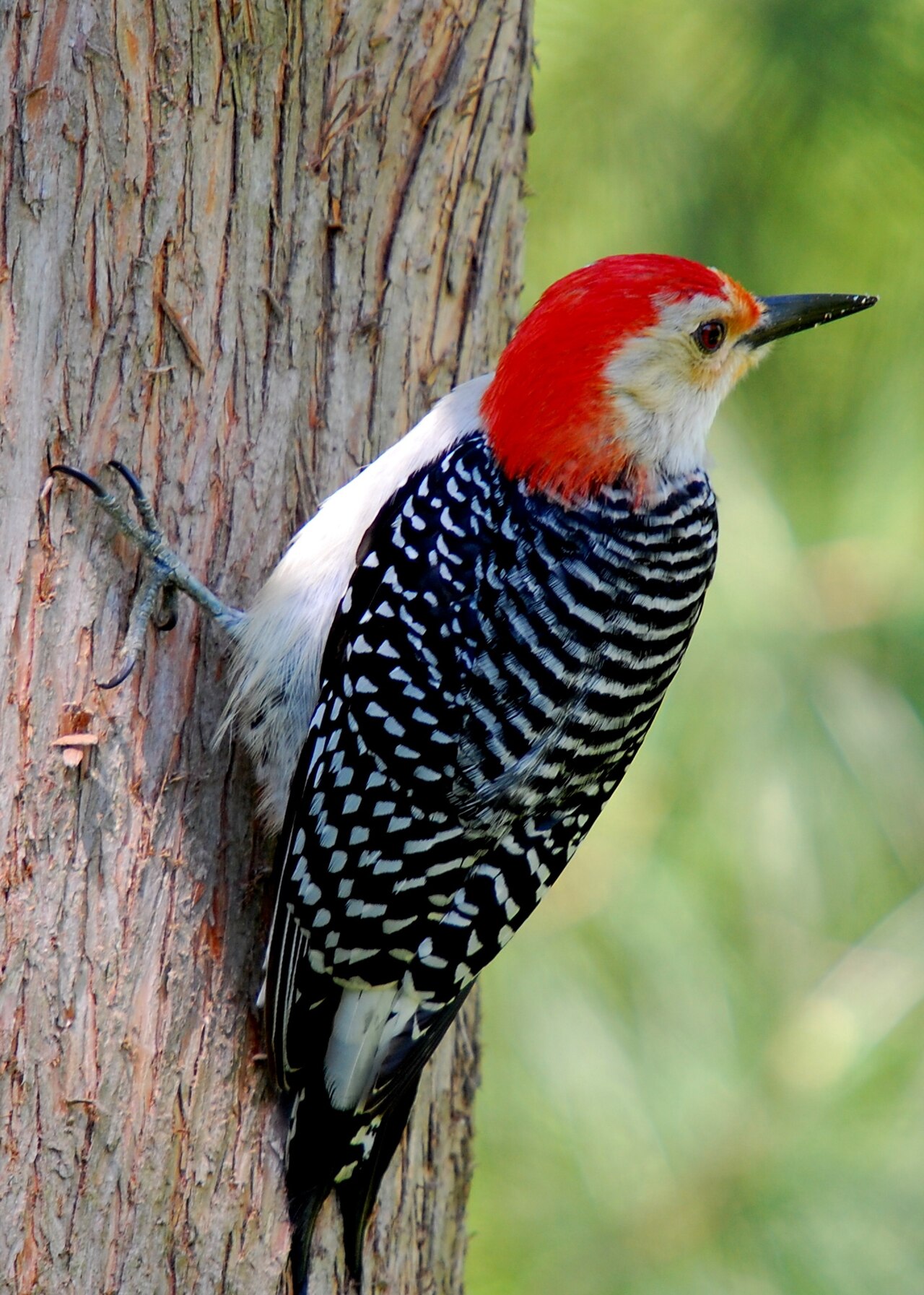
Red-bellied woodpeckers give a rolling churr that is far throatier than anything a downy produces, plus a rapid cha-cha-cha during territorial disputes. Northern flickers deliver a long, ringing wick-wick-wick that carries across a whole neighborhood. Yellow-bellied sapsuckers drum in an unmistakable stuttering morse code pattern instead of an even roll.
Nuthatches and chickadees round out the confusion, since both share downy feeding flocks and both have short, sharp notes. White-breasted nuthatches sound nasal, almost like a toy horn, and black-capped chickadees say their own name. If you want the broader comparison across genera, start with our general guide to woodpecker sound types.
Drumming on Your House: Why It Happens and How to Stop It
A downy drumming on metal flashing, a gutter, a chimney cap, or hollow cedar siding is not damaging your house for food in most cases. It has found the loudest amplifier on the block and is using it to advertise. The behavior is concentrated in spring mornings and usually stops once the bird pairs up, which can take two to six weeks.
Three fixes work. Change the acoustics by padding the resonant panel from behind or covering it with burlap. Make the spot unpleasant with hanging reflective tape or a sheet of plastic that moves in the wind. Offer a better option by mounting a dead limb or a purpose built drumming post 30 ft (9 m) away. If the bird is actually excavating holes rather than drumming, you likely have an insect problem in the wood that needs addressing first.
Frequently Asked Questions
What does a male downy woodpecker call sound like compared to a female?
They sound the same. Both sexes give the sharp pik and the descending whinny, and researchers cannot reliably separate them by ear in the field. Males drum somewhat more often during the breeding season, but females drum too. Use the red patch on the back of the head to identify a male visually.
Is downy woodpecker call audio available for free?
Yes. The Cornell Lab’s All About Birds species account hosts reference recordings of the pik, the whinny, and the drum, and the Macaulay Library archive holds hundreds more submitted by birders. These are the recordings worth learning from, because each one is vetted and labeled by sound type.
Can I use a downy woodpecker call as a ringtone?
You can, and many people do, but recordings from public archives carry individual licenses that vary by contributor. Check the terms on the specific file. In the field, avoid playing calls through a speaker near active nests during spring, since repeated playback pulls birds off their territories and wastes their energy.
Do downy woodpeckers make noise at night?
No. Downies roost in cavities after dusk and stay silent until first light. Knocking, scratching, or calling after dark in a wall or attic points to flying squirrels, mice, or raccoons. Woodpecker complaints are a morning phenomenon, typically between sunrise and 9 a.m. in spring.
Why does a downy woodpecker drum instead of singing?
Woodpeckers lack the elaborate song of a thrush or warbler, so they broadcast with percussion instead. Drumming carries farther through forest than a high call, announces territory boundaries, and signals fitness to potential mates. It is the functional equivalent of song, delivered through a tree rather than a throat.
What sound does a downy woodpecker make when alarmed?
It runs its pik notes together into a rapid, hard series and often adds a longer scolding note near a nest. The bird usually shifts to the opposite side of the trunk while calling. A sudden burst of tight piks in your yard is worth a look upward for a hawk.