Pileated Woodpecker Sound: 4 Calls and What Each Means
The pileated woodpecker sound is a loud, ringing wuk-wuk-wuk-wuk that rolls through the treetops and carries close to half a mile on a still morning. It is the deepest, wildest call any woodpecker in the United States makes, and once you have matched it to the bird, you will never confuse it with anything else.
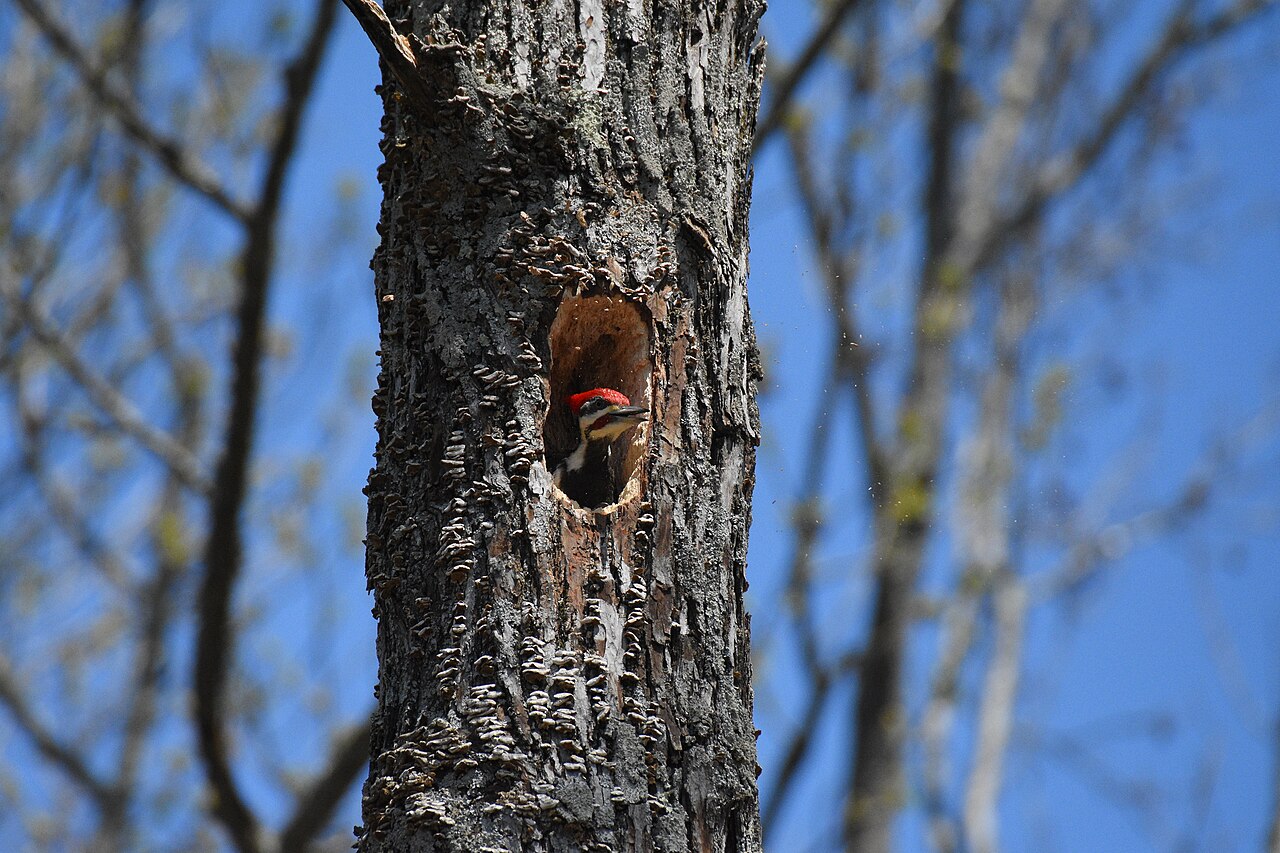
Most people hear this crow-sized bird (Dryocopus pileatus) long before they see it. Knowing which of its calls you are listening to tells you what the bird is doing: holding territory, greeting a mate, warning a rival, or simply hammering out a nest cavity in a dead pine.
Pileated woodpeckers make a loud, irregular wuk-wuk-wuk call that rises and falls in pitch, a sharper cuk-cuk given in flight or alarm, and a slow, deep drum that fades at the end. The call sounds like a jungle bird or a manic laugh and carries up to a half mile through mature forest.
| Sound | What it sounds like | What it means | When you hear it |
|---|---|---|---|
| Territorial call | Loud rolling wuk-wuk-wuk, uneven pitch | This patch of forest is taken | Year round, peaks late winter |
| Flight or alarm call | Short, sharp cuk, cuk, cuk | Bird is moving or startled | Any time it flushes |
| Drumming | Deep, hollow roll, about 1 second, trailing off | Mate attraction, territory | February to May |
| Contact call | Soft single notes between two birds | Pair staying in touch | Nesting season |
| Excavation | Slow, heavy chopping, no rhythm | Bird is digging for food or a nest | All year |
| Nestling begging | Continuous buzzy rasping from a cavity | Chicks are being fed | May to July |
What Kind of Sounds Do Pileated Woodpeckers Make?
Pileated woodpeckers use two vocal sounds and two mechanical ones. The vocal side is a long, rolling call and a shorter sharp call; the mechanical side is drumming on a resonant surface and the blunt chopping of actual excavation. Every recording you find online is one of those four.
The reason the calls stand out is the size of the bird. At 16 to 19 inches (40 to 49 cm) long, this is the largest woodpecker most Americans will ever encounter, and its voice has the volume to match. If you are working through several species by ear, our guide to woodpecker calls across North America lines them up side by side.
The Classic Call: A Loud, Rolling Wuk-Wuk-Wuk
The signature call is a series of 10 to 30 loud notes, usually written as wuk-wuk-wuk or kuk-kuk-kuk, delivered at an uneven tempo and an uneven pitch. It swells in the middle and tapers off, which is exactly what separates it from its nearest sound-alike.
Listeners describe it as maniacal laughter, a jungle bird, or a monkey. That impression is why the species was the model for Woody Woodpecker’s cackle. The call is given from a perch, often high on a trunk, and a mated pair will answer each other back and forth across several hundred yards.
Drumming: The Slow, Deep Hammering That Carries a Mile
Pileated woodpecker drumming is slower and deeper than that of any other North American woodpecker. A burst lasts about one second, runs 11 to 30 beats, starts strong and fades at the end, like a ball bouncing to a stop.
The bird picks the loudest surface it can find. Hollow trunks, dead limbs, metal gutters, and chimney caps all get used, because the point is broadcast, not carpentry. Drumming peaks from February through April, when pairs are forming and boundaries are being redrawn.
Pileated Woodpecker Sound Meaning: What Each Call Signals
The long rolling call is a territorial announcement. It says the bird is present and the forest patch is claimed, which is why it comes most often at dawn and most intensely in late winter when rivals are testing edges.
The short cuk notes are situational. Given in flight, they are a contact signal between mates; given from a perch with the crest raised, they are agitation, often aimed at a hawk, a squirrel, or you standing too close to a nest tree. A bird that drops to a low, quiet clucking is usually settling, not alarmed.
Male Pileated Woodpecker Sound vs Female
Male and female pileated woodpeckers sound essentially the same to the human ear. Both sexes call, both drum, and neither has a pitch signature you can rely on in the field, which is unusual among loud forest birds.
Telling them apart is a visual job, not an auditory one. The male has a red malar stripe running back from the bill and red all the way to the forehead; the female shows a black stripe and a gray-brown forecrown. Our profile of the female pileated woodpecker walks through the differences at feeder range.
Pileated Woodpecker Call at Night: What You Are Really Hearing
Pileated woodpeckers are strictly diurnal. They roost inside cavities after dusk and do not call in the dark, so a loud woodpecker-like sound at 2 a.m. is almost always something else.
The usual culprits are barred owls, whose caterwauling duets can sound startlingly like laughter, and flying squirrels or raccoons scrabbling on a roof. If the sound has an owl’s tone, compare it against the barred owl call before you credit it to a woodpecker. A woodpecker hammering at first light, however, can begin well before sunrise.
How to Tell It from a Northern Flicker by Ear
The northern flicker is the call most often mistaken for a pileated. The flicker’s version is a flat, even, machine-gun wick-wick-wick that holds one pitch and one tempo from start to finish, and it is noticeably higher and thinner.
The pileated call wavers. It speeds up, slows down, and drifts in pitch, and it sounds bigger because it is. A second tell is the drumming: a flicker rolls fast and evenly, while a pileated hammers slow and trails off at the end.
Why Is It Called Pileated?
The name comes from the Latin pileatus, meaning capped, from pileus, the felt cap worn by freed slaves in ancient Rome. It refers to the bird’s flaming red crest, which both sexes wear and raise when agitated.
Both pronunciations are accepted, PIE-lee-ay-ted and PILL-ee-ay-ted, and ornithologists split roughly down the middle on which to use. The scientific name Dryocopus pileatus keeps the same idea: dryocopus means tree cutter.
How Rare Is It to See a Pileated Woodpecker?
Pileated woodpeckers are far less rare than their reputation suggests. The population has grown steadily since the mid 20th century as eastern forests matured, and the species now occupies most of the eastern United States, the northern tier west to the Pacific, and much of Canada.
They are uncommon in any single yard because each pair defends 150 to 200 acres (60 to 80 ha), so density stays low even where numbers are healthy. Hearing one is routine in mature woods; watching one work a stump for ten minutes is the part that feels rare. Full details are in our pileated woodpecker species profile.
What Attracts a Pileated Woodpecker?
Dead wood attracts them more than anything you can buy. Standing snags, rotting stumps, and fallen logs hold carpenter ants, which make up the bulk of the diet, and a yard that keeps its dead trees standing is doing most of the work already.
Beyond that, suet in a large tail-prop feeder, mature hardwoods for nesting, and water will hold a pair that already lives nearby. They will not be lured into a treeless subdivision by food alone, because the territory has to support them year round.
What Time of Year Are Woodpeckers Most Active?
Vocal and drumming activity peaks from late February through May, when territories are contested and pairs form. That is when the forest sounds busiest, even though the birds themselves are present all year.
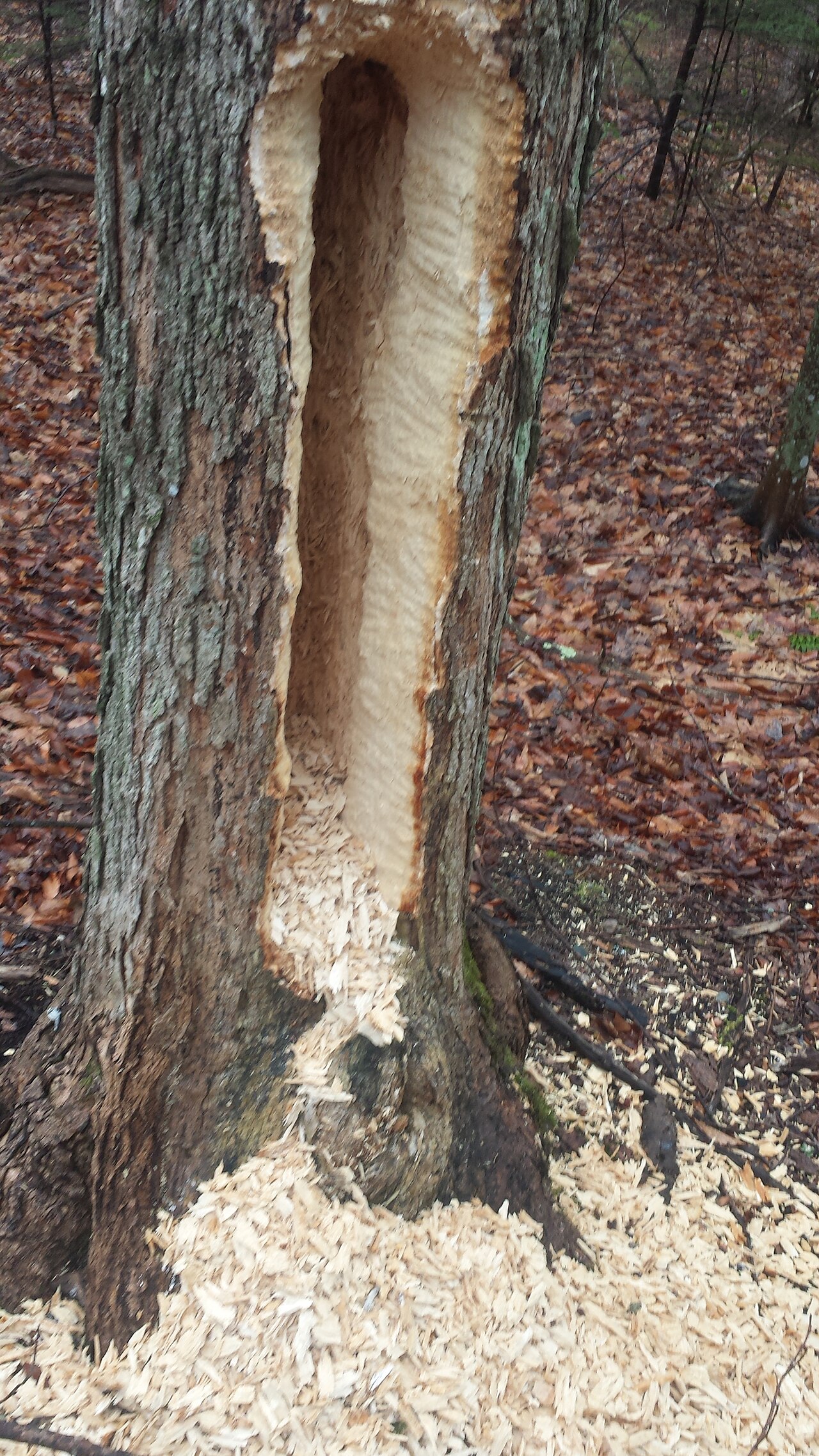
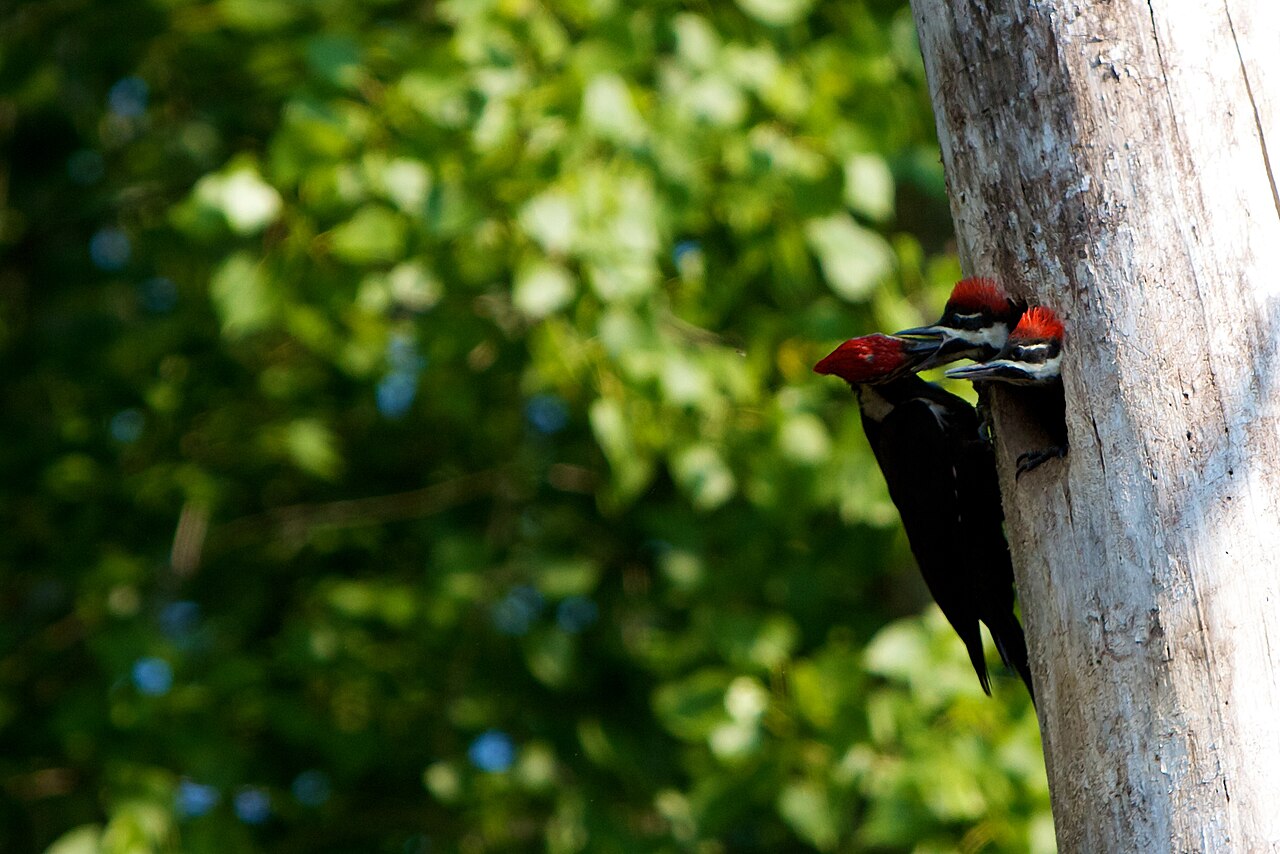
Pileated woodpeckers do not migrate. In midwinter you will hear less calling but more feeding noise, the slow chopping that leaves the distinctive rectangular holes in dead trunks. Late summer brings a second burst of sound from fledglings begging near the nest tree, which many listeners mistake for a new species. For a smaller forest voice that stays loud all winter, compare the blue jay’s calls.
Frequently Asked Questions
What does it mean if you see a pileated woodpecker?
Ecologically, it means the surrounding woods are mature and hold plenty of dead wood, since the species needs large snags to nest and carpenter ant colonies to feed on. Folklore treats the bird as a symbol of determination and opportunity, but the reliable reading is habitat quality, not omen.
What kind of sounds do pileated woodpeckers make at the nest?
Nestlings produce a continuous buzzy rasping that rises to a near scream when a parent lands at the cavity entrance. From a distance it resembles a swarm of insects inside the trunk. The noise runs for roughly four weeks before the young fledge in June or July.
Is there a pileated woodpecker sound mp3 I can download?
Yes. The Cornell Lab’s All About Birds species account and the Macaulay Library host free reference recordings of the call, the drum, and the nestling begging. They are the recordings ornithologists actually use for comparison.
What smell do woodpeckers hate?
Strong peppermint and garlic-based repellents are the two most commonly used, and both show mixed results in practice. Woodpeckers have a weak sense of smell relative to mammals, so scent deterrents rarely solve drumming on siding. Physical barriers and removing the insect food source work better.
What are woodpeckers most afraid of?
Sudden movement and reflective, shifting objects unsettle them most, which is why streamers and reflective tape outperform static decoys. Hawk silhouettes lose effect within days once the bird learns they never move. Sound-based deterrents follow the same pattern, as our guide to bird deterrent sounds explains.
What is a natural enemy of a woodpecker?
Cooper’s hawks and northern goshawks are the main predators of adult pileated woodpeckers, while rat snakes, raccoons, and squirrels take eggs and nestlings from cavities. Great horned owls catch them at dawn and dusk near roost trees. Adult mortality is low, which is why individuals can live 9 to 12 years.