Woodpecker Sound: Drumming or Digging, and What It Means
A woodpecker sound is usually one of two very different things: a fast, rhythmic drum roll that is a territorial signal, or an irregular tapping that means the bird is digging for food. Telling them apart takes about three seconds once you know what to listen for, and it decides whether you have a bird advertising for a mate or a bird chewing into your siding.
Drumming is deliberate communication, the woodpecker equivalent of song. Foraging and excavation are work, and they sound like work: uneven, patient, with pauses while the bird listens for larvae moving under the bark.
Drumming is a rapid, even burst of about 10 to 25 beats per second lasting one to three seconds, repeated at regular intervals, and it means a bird is claiming territory or attracting a mate. Slow, irregular tapping means foraging or cavity excavation. Woodpeckers also give sharp vocal calls, which are separate from both.
| Species | Drum pattern | Typical call |
|---|---|---|
| Downy Woodpecker | Short even roll, about 1 second | Sharp pik, descending whinny |
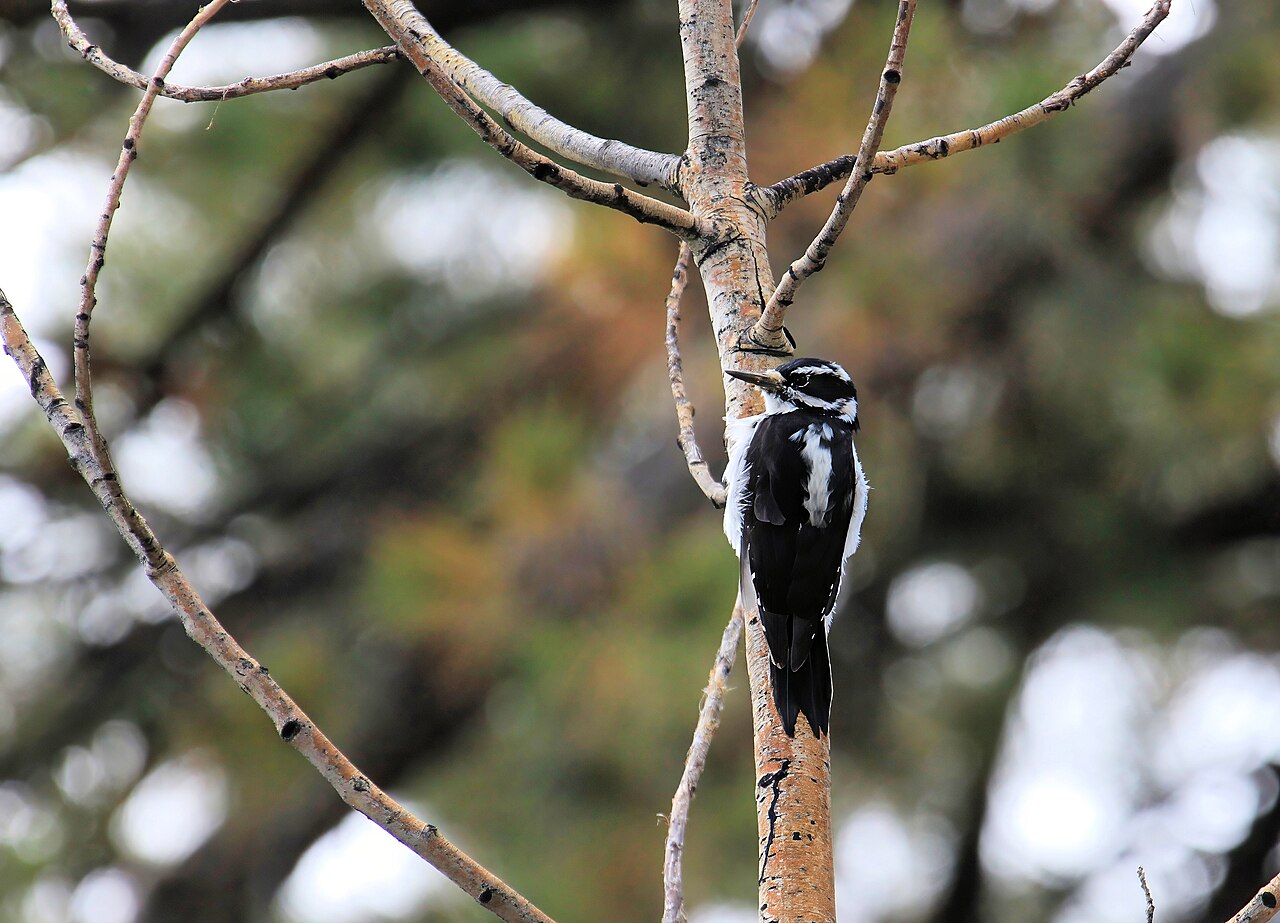
| Hairy Woodpecker | Very fast, dry, about 1 second | Loud peek, rattling series |
| Pileated Woodpecker | Deep, loud, slows and trails off | Ringing kuk kuk kuk |
| Northern Flicker | Long steady roll, often on metal | Loud wick wick wick |
| Red-bellied Woodpecker | Short, slower, evenly spaced | Rolling churr |
| Yellow-bellied Sapsucker | Stuttering, irregular, Morse like | Nasal, cat like mew |
Drumming Versus Pecking: The Basic Split
Drumming is machine steady. The beats come too fast to count, the burst ends cleanly, and the bird repeats it every few seconds from the same perch. Nothing is being excavated, and no wood chips fall.
Foraging taps are slower, uneven and clustered, with gaps of several seconds while the bird moves along a branch. Nest excavation sits between the two: steady and methodical, but with an audible chiseling quality and a shower of chips at the base of the tree.
What Does It Mean When You Hear a Woodpecker Pecking?
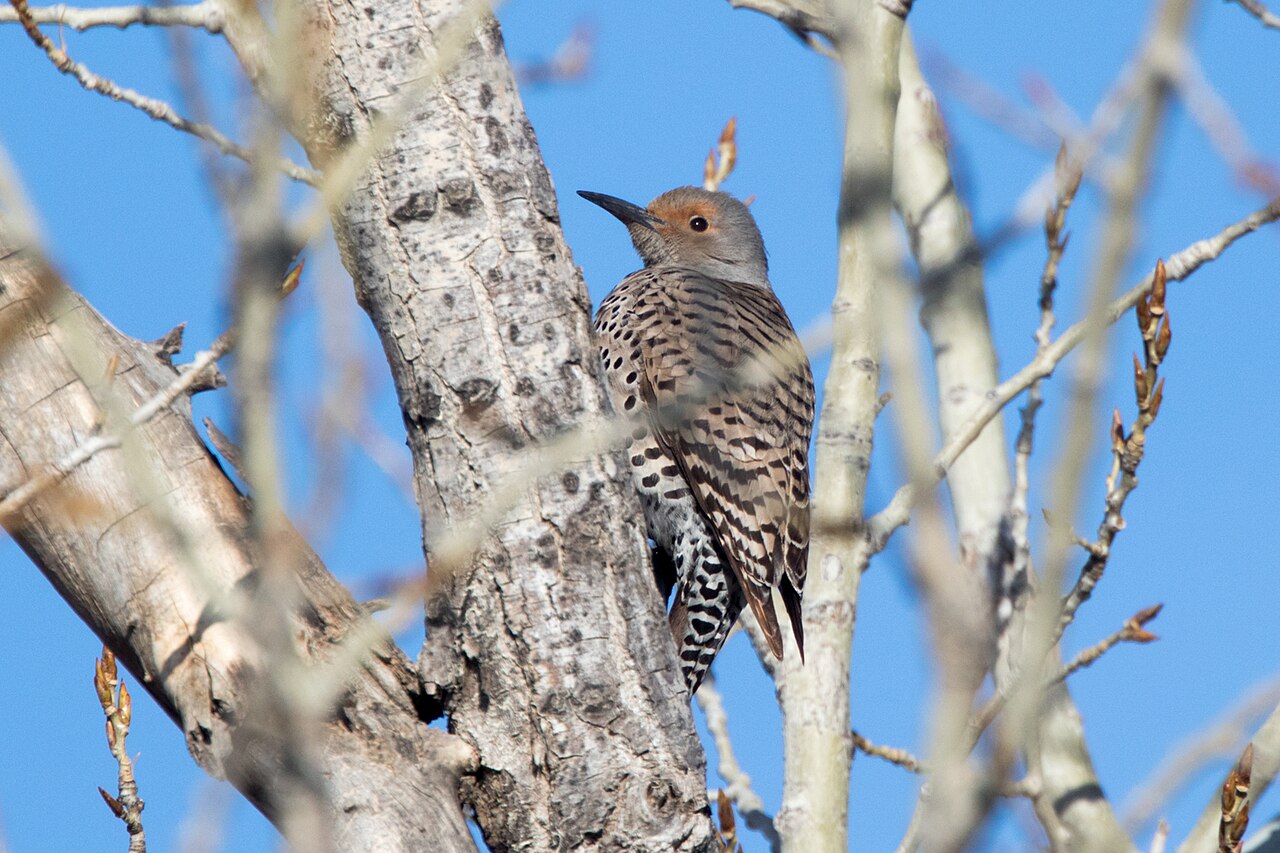
When you hear a woodpecker pecking on wood, the bird is almost always after insects, cutting a cavity, or storing food. Pecking on a resonant surface such as a gutter, flashing or a dead limb is instead a territorial announcement. The surface tells you which one you are hearing.
Insect hunting is the most common reason on houses. Carpenter bees, wood boring beetle larvae and ants live in siding and trim, and a woodpecker that has found them will return daily. Our guide to what woodpeckers eat covers the prey that draws them in.
How to Recognize Woodpeckers by Their Drumming

Species differ in speed, length and cadence, and with practice the drum alone identifies the bird. Downy Woodpeckers give a short, even roll; Hairy Woodpeckers drum noticeably faster and drier; Pileated Woodpeckers produce a deep, booming roll that slows and fades at the end. Sapsuckers are unmistakable because they stutter.
Reference recordings help more than descriptions here. The species accounts at All About Birds include drums as well as calls, and a few minutes of comparison fixes the differences in your ear. The deepest of them is covered in our guide to the Pileated Woodpecker sound.
The Calls That Come With the Drumming
Woodpeckers are vocal as well as percussive, and the calls are often the first sign a bird is present. Downy Woodpeckers give a sharp pik and a descending whinny, Red-bellied Woodpeckers a rolling churr, and Pileated Woodpeckers a ringing series that carries through whole woodlots.
Calls work at close range and for contact between mates, while drumming does the long distance work. A bird that switches from calling to drumming has usually just detected a rival. A full species by species breakdown is in our guide to woodpecker calls by species.
What Time of Year Do Woodpeckers Peck on Houses?
Drumming on houses peaks from February through June, with the loudest weeks in early spring when territories are being settled. That is when metal gutters, chimney caps, vents and satellite dishes get hammered at dawn. The behavior fades once pairs are established and incubation starts.
Damage from feeding follows a different calendar and can happen in any month, though late summer and fall are common when carpenter bee larvae are large. Cavity excavation clusters in April and May for nests, and again in autumn when birds cut winter roost holes.
Why They Choose Gutters and Metal
A drumming woodpecker wants volume, not wood. Metal flashing, gutters, downspouts, chimney caps and even street signs resonate far better than any tree, so a bird that finds one has effectively been handed a megaphone. It will use the same spot every morning for weeks.
This is good news for a homeowner, because pure drumming does no structural damage. A dent in aluminum is cosmetic. The noise at 5 a.m. is the real problem, and it ends when the breeding season does.
What Should I Do If I Hear a Woodpecker in My House?
If the sound is coming from inside a wall, it is not a woodpecker. Woodpeckers work from the outside, and tapping or scratching heard from within the wall cavity points to mice, squirrels, wasps or bats. Our guide to the sounds bats make helps rule out the most common candidate.
If a bird has entered an attic or chimney through an open vent, do not chase it. Open the largest exit, close interior doors, dim the room and leave it alone for an hour. Birds that refuse to leave are a job for a licensed wildlife rehabilitator, since all North American woodpeckers are protected under the Migratory Bird Treaty Act administered by the U.S. Fish and Wildlife Service.
What Will Make Woodpeckers Leave?
Removing the reason works; scaring the bird rarely does for long. If insects are the draw, treat and seal the siding and the pecking usually stops within days. If the bird is excavating, fill and cap the hole promptly, because an abandoned start is an invitation to return.
For drumming, dampening the surface is the most reliable fix. Foam backing, a piece of rubber or a strip of hardware cloth under the resonant metal kills the sound the bird wants and it moves on. Deterrents that address the surface beat deterrents that address the bird.
What Smell Do Woodpeckers Hate the Most?
No smell repels woodpeckers reliably. Peppermint oil, garlic sprays and similar home remedies circulate widely, but birds have a limited sense of smell compared with mammals and no scent product has strong field evidence behind it. Money spent on scent repellents is usually wasted.
Sticky polybutene gels are sometimes sold for this purpose and should be avoided entirely. They foul feathers, trap small birds and can kill the bird they were meant to discourage. Physical exclusion is both more effective and safer.
What Sound Are Woodpeckers Afraid Of?
Woodpeckers react to the calls of hawks and to woodpecker distress calls, and sonic deterrents built around those recordings do work at first. The problem is habituation: a bird that hears the same hawk scream from the same speaker learns within a week that nothing ever happens.
Rotating the sound, moving the speaker and pairing audio with reflective tape or spinning deterrents keeps the effect alive longer. The principles are the same for any species, and we cover them in detail under sound based bird deterrents.
What Birds Make a Sound Similar to Woodpeckers?
Nuthatches tap loudly enough to be mistaken for small woodpeckers, and Brown Creepers and chickadees both work bark noisily. Squirrels gnawing on a branch or a soffit produce a convincing irregular tapping, and a squirrel on a metal roof sounds remarkably like a drumming flicker.
Among vocal confusions, the descending whinny of a Downy Woodpecker resembles a small owl, and the rolling churr of a Red-bellied Woodpecker gets confused with hawk calls. If the sound is a whinny after dark, you are hearing an owl rather than a woodpecker.
Frequently Asked Questions
Is it rare to hear a woodpecker?
It is not rare at all. About 22 woodpecker species live in North America, and the Downy Woodpecker occupies nearly every wooded area in the Lower 48, including city parks and suburbs. Most yards with mature trees have at least one species within earshot year round.
What is a natural enemy of a woodpecker?
Cooper’s Hawks and Sharp-shinned Hawks take adults in flight, and Great Horned Owls hunt them at roost, as do barred owls. Nests are raided by rat snakes, raccoons and squirrels, and European Starlings evict woodpeckers from finished cavities, which is a major pressure on flickers.
What does a female woodpecker sound like?
Females give the same calls and drum the same way as males, so voice cannot sex a woodpecker. Both sexes drum to defend territory and to contact a mate. Plumage does the job instead, usually a red patch on the head that the female lacks or shows differently.
What does a Pileated Woodpecker sound mean?
The loud ringing series means a bird is announcing its territory, and the deep, trailing drum carries the same message across a large home range. Pileated Woodpeckers hold territories of well over 100 acres, so the sound is built for distance. Rectangular excavations at the base of dead trees mark their foraging.
Why do woodpeckers drum at dawn?
Sound travels farther in the cool, still air just after sunrise, so a dawn drum reaches more rivals and potential mates for the same effort. Birds also drum before feeding, when territorial pressure is highest. This is why a gutter that is quiet all afternoon becomes an alarm clock at 5 a.m.
Where can I find a woodpecker sound mp3?
The Macaulay Library and xeno-canto both offer free recordings of calls and drums by species and region, with license terms listed on each file. For yard identification, compare the drum length and speed rather than the pitch. Recording your own bird on a phone makes the comparison far easier.