Bluebird Song and Calls: 7 Sounds and What Each Means
A bluebird’s song is a soft, low warble of two to four notes, usually written as tu-a-wee or chur-lee, delivered from a fence post or wire in the first hour after sunrise. It is quieter than almost any other backyard bird of its size, which is why many people live near bluebirds for years without ever consciously hearing one. The bluebird song is easy to miss and unmistakable once you know it.
Eastern bluebirds (Sialia sialis) have a vocabulary of roughly a dozen distinct sounds, and each one tells you something specific about what the bird is doing: holding a territory, warning a mate, begging for food or driving off a rival. This guide walks through each call type, what triggers it, what time of year you hear it and which other backyard species get mistaken for it.
Bluebirds make a soft, musical warble usually described as tu-a-wee or chur-lee, repeated every few seconds from an exposed perch. Males sing most from March through June. Bluebirds also give a sharp chit alarm note, a harsh chatter when chasing rivals, and nestlings produce a thin, insistent begging buzz.
| Sound | What it sounds like | What it means | When you hear it |
|---|---|---|---|
| True song | Soft warble, tu-a-wee, 2 to 4 notes | Territory and mate attraction | Dawn, March to June |
| Contact call | Single rising chur-lee or tu-wee | Pair keeping in touch | Year round, all day |
| Alarm note | Hard, dry chit or tic, repeated | Predator or intruder near the nest | April to July |
| Chatter | Fast harsh scolding rattle | Fighting over a nest box | Early spring |
| Nestling begging | Thin buzzy zeee, rapid | Hungry young in the box | Late April to July |
| Fledgling call | Louder, scratchier version of the contact call | Young bird locating its parents | May to August |
| Flight call | Short mellow tu-wee from overhead | Flock moving between fields | Fall and winter |
What Sound Does a Blue Bird Make?
The core sound is a low warble made up of two to four short notes that rise and fall gently, with no sharp edges and no trill. Written out it reads as tu-a-wee, chur-lee or tru-ly, and it lasts under two seconds. Birders consistently describe the quality as mellow, which separates it from the bright, piercing tones of most other open-country songbirds.
Volume is the detail that surprises people. A singing male bluebird carries only about 100 to 150 ft (30 to 45 m) on a still morning, far less than a robin or a cardinal. If there is traffic, a lawn mower or wind in the trees, the song simply disappears into the background.
The Eastern Bluebird Song: The Full Territorial Version
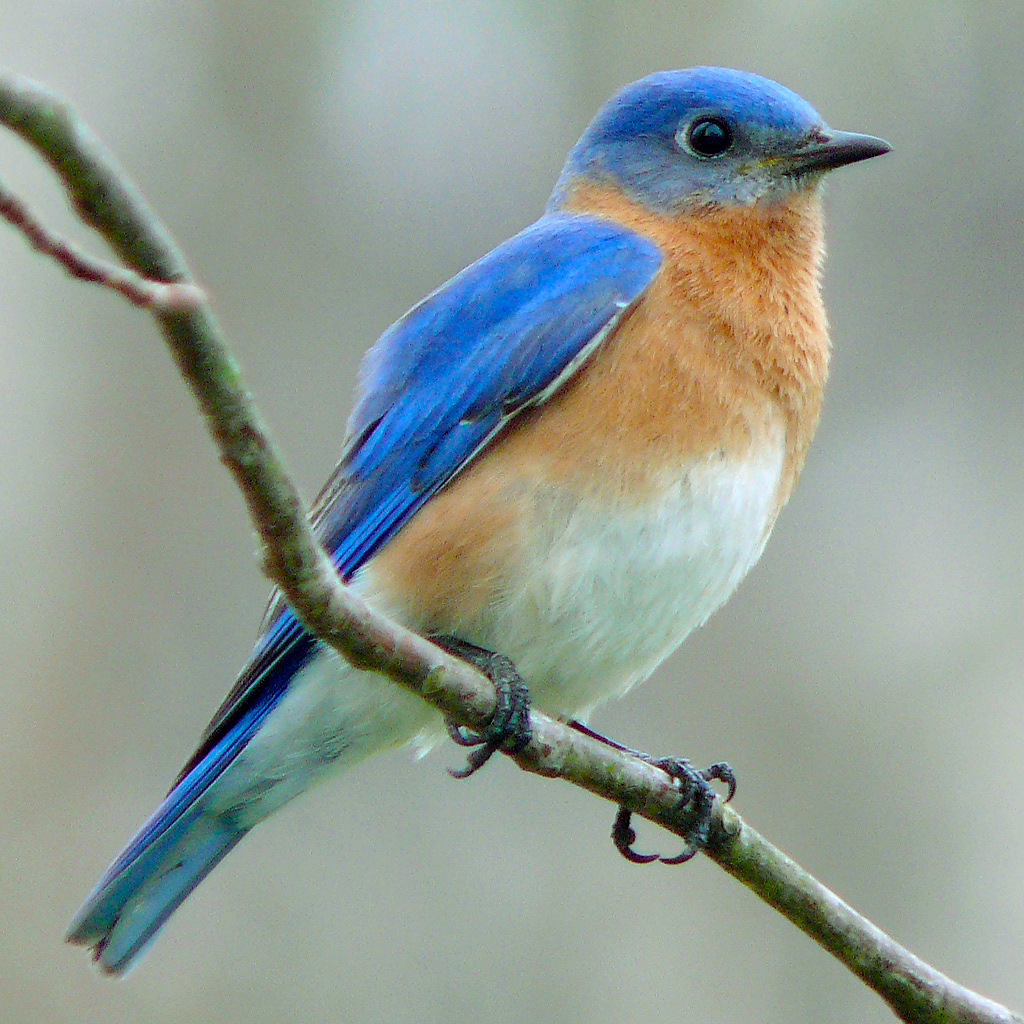
The true song is the male’s territorial advertisement, and it is longer and more structured than the single contact note. A singing male strings together warbling phrases with brief pauses, repeating the pattern for several minutes at a time from the highest perch in his territory. The phrases vary slightly each time rather than repeating exactly.
Recordings of the full song are available from the Cornell Lab at All About Birds, which is the fastest way to lock the sound into memory before you go listening. Hearing it once in a recording makes the live version obvious, in the same way that blue jay sounds become easy to separate after a single careful listen.
The Contact Call: Chur-lee and Tu-wee

The contact call is the sound you will hear most often across the year. It is a single soft note, rising at the end, given by both sexes as they move around the territory. Pairs use it constantly to keep track of each other, and one bird will usually answer within a second or two.
Unlike the song, the contact call never stops for the season. Bluebirds in winter flocks give it while foraging on sumac and juniper berries, and it is the main sound of a flock passing overhead in November. If you hear a mellow single note from a bird you cannot see in open country, bluebird is a reasonable first guess.
The Alarm Call and Warning Notes
The alarm note is a hard, dry chit with no musical quality at all, repeated at an increasing rate as a threat gets closer. It is the sound that tells you a cat, snake, house sparrow or person is near an active nest box, and it carries noticeably further than the song.
Both parents give it, often from opposite sides of the box, and they will add shallow wing flicks and tail flicks while calling. If the alarm speeds up into a continuous stutter, something is at the box rather than near it, which is worth checking in person. House sparrows killing bluebird nestlings is a common and preventable cause of nest failure. For a closely related question, see our guide to eastern bluebird sounds.
There is a quieter version used for aerial threats, a thin high seee that is hard to locate by ear. This is the same acoustic trick used by many songbirds against hawks, and it is one reason birds that sound like owls and raptor mimics cause such a reliable panic response in backyard species.
Courtship Song and Nest Box Displays

During courtship the male adds a soft, rapid warble delivered with partly spread wings while perched at the entrance of a nest cavity. He will fly to the hole, look in, flutter his wings and sing a shortened version of the song, then do it again. The female watches and eventually inspects the cavity herself.
This display song is quieter than the territorial song and is directed at one bird rather than broadcast. It runs from late February in the Southeast to early May in the northern states, tracking the start of the breeding season. Mated pairs continue a muted version through nest building.
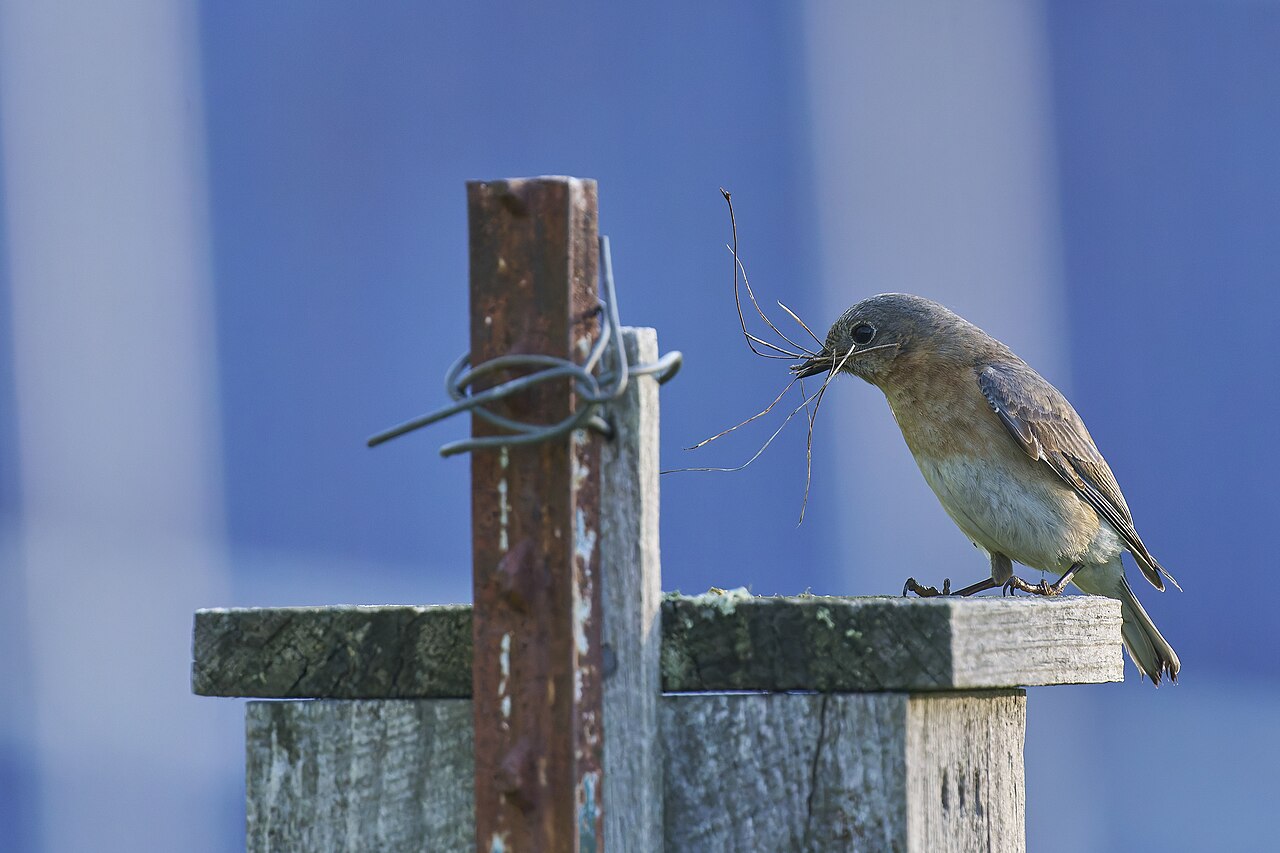
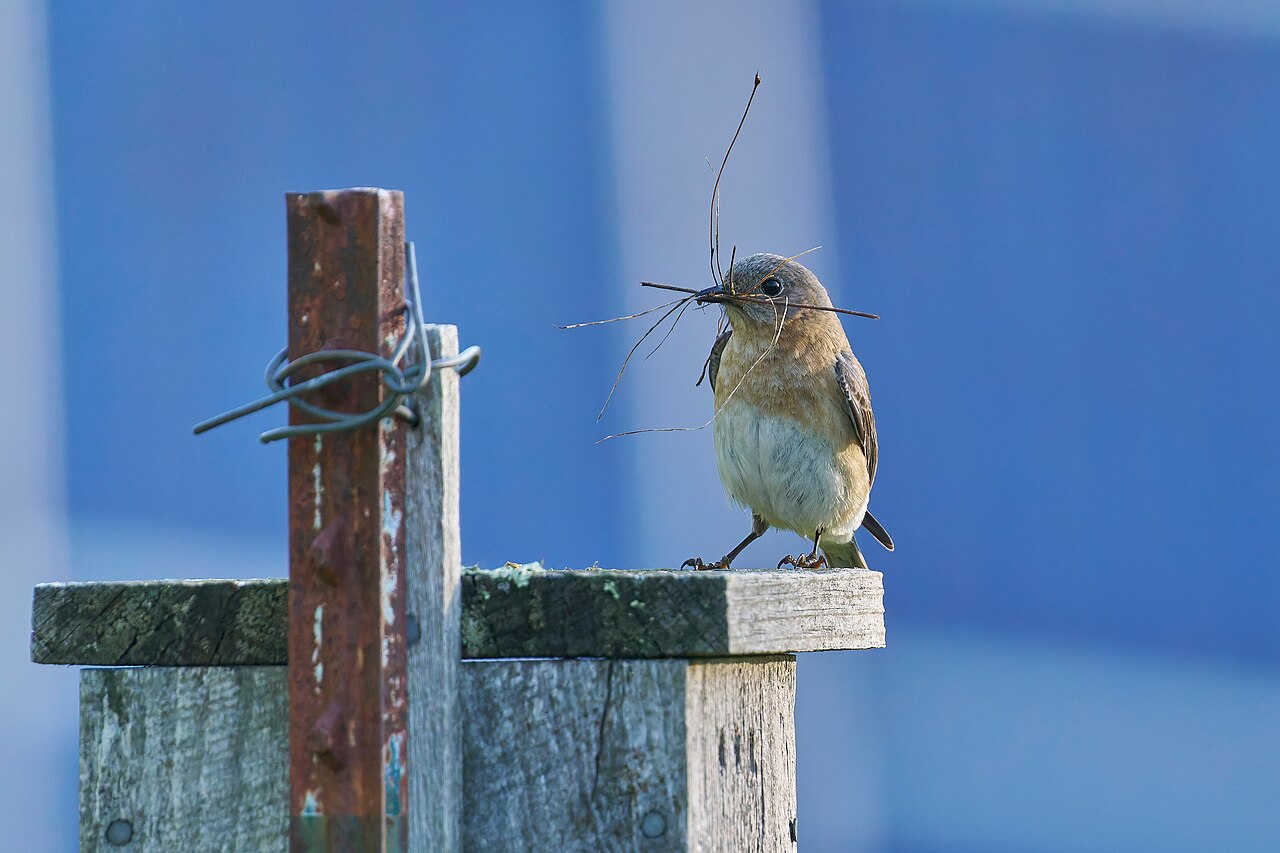
Males also carry nest material to the hole during this performance without actually building, since the female does nearly all of the construction. If you see a male singing softly at a box with a pine needle in his bill, pairing is in progress, and your bluebird feeding setup will matter a great deal over the next six weeks.
What Baby Bluebirds Sound Like in the Nest
Nestlings give a thin, buzzy zeee that rises in volume and speed every time an adult lands at the box. From the outside it sounds like a faint electrical buzz coming from inside the wood, audible only within about 15 ft (4.5 m) during the first week.
Begging calls get dramatically louder as the young approach fledging at 17 to 21 days. In the last few days the sound is obvious from across the yard and becomes one of the easiest ways to judge timing without opening the box. Once begging is loud, stop opening the box, since disturbance at that stage can trigger early fledging.
Fledglings keep calling for two to three weeks after leaving, using a scratchier, louder version of the adult contact call from dense cover. That persistent calling is often the first clue that a brood has left the box.
Does the Female Eastern Bluebird Sing?
Yes, though less often and more quietly than the male. Female eastern bluebirds give a subdued version of the song, most commonly when the male returns to the nest area and occasionally when a predator approaches. Research on the species has also documented females singing in response to intruding females.
Female song is short, usually one or two notes, and lacks the repeated phrasing of the male’s territorial song. Because the plumage difference is subtle at a distance, with the female showing grayer upperparts and a softer rusty breast, sound alone is not a reliable way to sex a bird you are watching.
If you are trying to tell the pair apart on a nest box, position is more useful than voice: the female does the building and nearly all the incubation. Details on separating the sexes by appearance are covered in the guide to the female bluebird.
Mountain and Western Bluebird Sounds
Mountain bluebirds (Sialia currucoides) sing a higher, thinner warble than eastern bluebirds, often described as a clear tru-lee given well before dawn from a perch in open sagebrush or grassland. Their calls are softer still, and in windy high country they frequently go unheard entirely.
Western bluebirds (Sialia mexicana) sound closest to eastern bluebirds, with a few or kew call note that is slightly harder and less sweet. Where ranges overlap in Texas, Colorado and the Southwest, song is not a safe identification tool on its own, and a visual check on throat color settles it: blue throat for western, rusty throat for eastern.
When to Listen: Time of Day and Season
The best listening window is the 45 minutes starting about 20 minutes before sunrise, from mid March through June. That is when males sing the full territorial song with the least competition from traffic and from louder species. A second, weaker peak comes in the hour before dusk. Wind above about 10 mph erases the song entirely, so a still morning matters more here than for most songbirds.
Across the year, song appears first on warm February days in the Southeast and drops off after the last brood fledges in August. By September bluebirds are mostly silent except for the contact call, which continues through the winter in flocks of 5 to 20 birds.
Sounds Commonly Mistaken for Bluebirds
Northern mockingbirds imitate bluebird calls accurately and repeat them in long sequences, which is the most frequent source of false reports. The tell is repetition: a mockingbird runs the phrase three to six times, then switches to a completely different bird. A real bluebird varies its phrases and does not switch species.
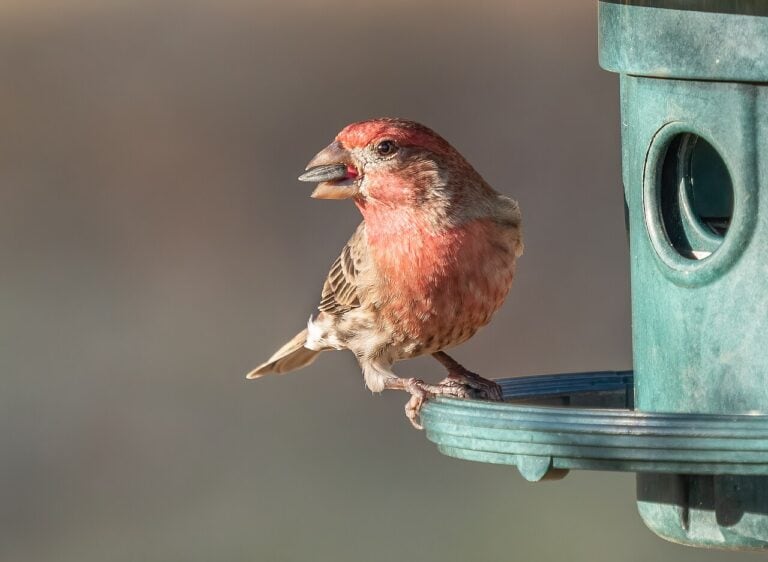
American robins, close relatives in the thrush family, sing a louder, more rolling version of a similar warble, often written as cheerily, cheer up. House finches produce a longer, scratchier jumble ending in a harsh note.
Starlings add another layer by mimicking anything in the neighborhood. If a mellow warble is coming from a bird with a straight yellow bill on a chimney, it is a starling. For sorting out sharper, lower calls in the same yard, compare against the harsh notes in barred owl sounds, which many people misplace entirely by time of day.
How to Get Bluebirds Calling in Your Yard
Open ground is the requirement. Bluebirds hunt insects by dropping from a low perch onto short grass, so a mowed or grazed area with scattered perches produces far more activity than a wooded lot. Nest boxes with a 1.5 inch (3.8 cm) entrance hole, mounted 4 to 6 ft (1.2 to 1.8 m) up on a predator-guarded pole, are the standard setup.
Mealworms bring bluebirds in close and get them calling, since arriving birds announce themselves with the contact call before landing. Offer them in a shallow dish with raised sides and keep the quantity modest, roughly 10 to 15 worms per bird per day during nesting.
Avoid playing recordings during the breeding season. Playback pulls territorial males off their nests to investigate a rival that does not exist, and repeated use measurably reduces time spent feeding young. It is a reasonable tool for a single identification check in winter and a poor habit in April.
Related reading: Eastern Bluebird Sounds.
Frequently Asked Questions
What is bluebirds’ favorite food?
Insects, overwhelmingly, during spring and summer. Beetles, crickets, grasshoppers and caterpillars make up the bulk of the diet, with spiders and snails added. Mealworms are the preferred offering at feeders. In fall and winter bluebirds shift to fruit, especially sumac, dogwood, juniper berries and wild grape, which is what sustains the winter flocks.
Why are bluebirds so special?
Partly recovery, partly accessibility. Eastern bluebird numbers fell sharply through the mid 1900s because of competition from house sparrows and starlings and the loss of nesting cavities. A volunteer nest box movement reversed that decline, and the species is now increasing. Few birds let ordinary homeowners contribute that directly to a measurable population rebound.
What does a bluebird mean spiritually?
Across North American and European folk traditions the bluebird is read as a sign of happiness, renewal and good news arriving, an association carried into popular culture by the phrase “bluebird of happiness.” Some interpretations connect a bluebird sighting to a message from someone who has died. These are folk beliefs rather than documented teachings.
Does the Bible say anything about bluebirds?
No. Bluebirds are North American species and do not appear in scripture, which references birds found in the Near East such as doves, ravens, eagles and sparrows. Devotional writing that connects bluebirds to divine messages draws on general passages about God’s care for birds, particularly Matthew 6:26, rather than on any specific text.
Do bluebirds sing at night?
Rarely. Bluebirds are strictly diurnal and normally fall silent well before full dark, roosting in cavities or dense cover. A mellow warbling song heard after midnight is far more likely to be a northern mockingbird, which sings through the night in spring, especially unmated males near artificial light.
How can I tell a bluebird call from a mockingbird imitating one?
Count the repeats. Mockingbirds repeat each borrowed phrase three to six times before switching to a different species, producing a long medley from one perch. A bluebird varies its phrasing slightly and stays within its own vocabulary. Mockingbird imitations also tend to be louder and sharper than the real thing.