Pacific Tree Frog: The Tiny Frog Behind Hollywood’s Ribbit
Every time a movie cuts to a quiet night scene and a frog goes “ribbit” in the background, you are almost certainly hearing a Pacific tree frog (Pseudacris regilla), a thumb sized amphibian from the West Coast of North America. Early Hollywood studios recorded their night ambience in the canyons around Los Angeles, and this one small frog ended up as the sound of nighttime for the entire planet.
It is also the most commonly encountered frog west of the Cascades and the Sierra Nevada, and one of the most confusing to name, since it goes by two common names and was recently split into three species. Here is how to recognize one, why the same individual can be green one month and brown the next, and whether it belongs in a tank.
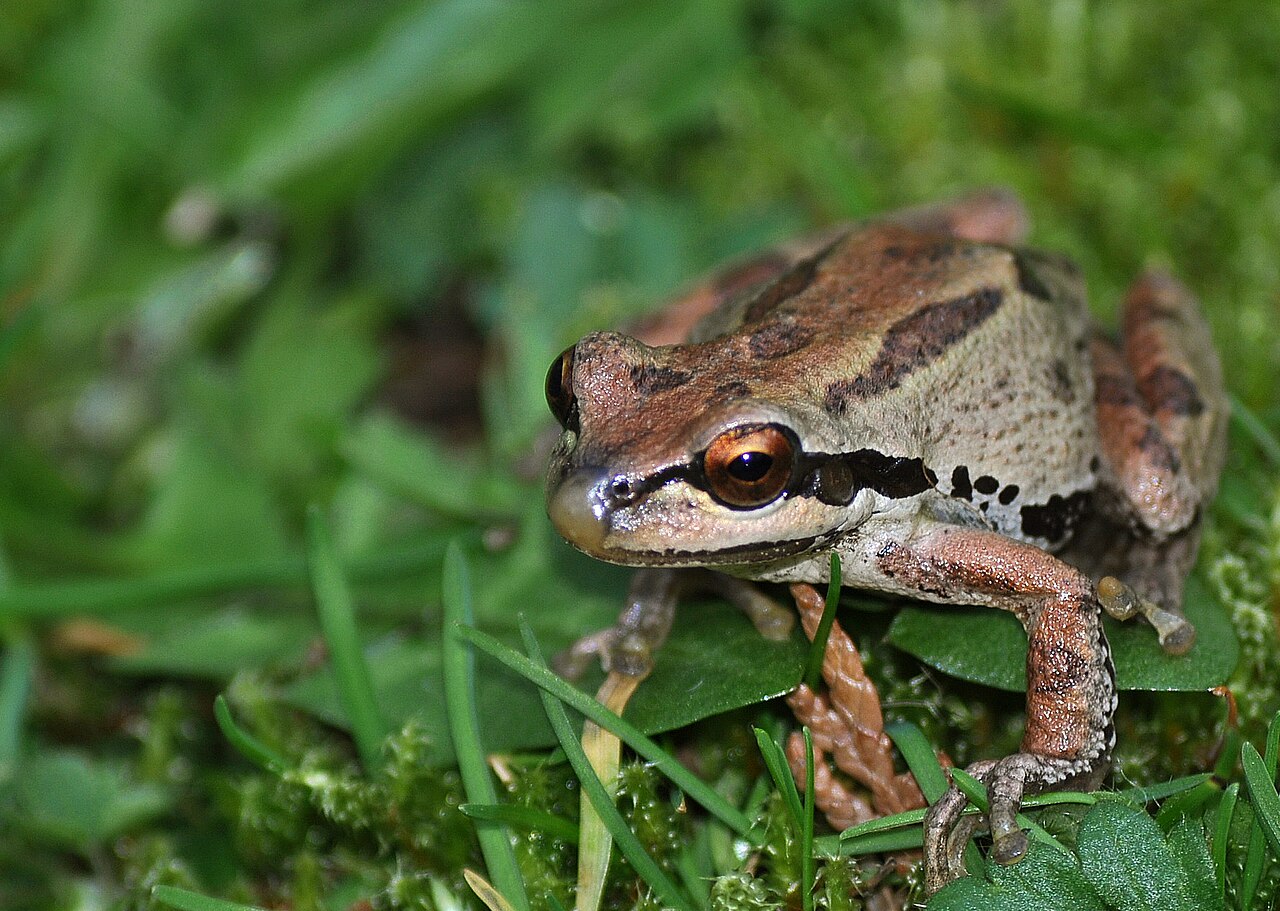
The Pacific tree frog is a small West Coast frog, 0.75 to 2 inches (2 to 5 cm) long, identified by a dark stripe running from the snout through the eye to the shoulder and by round sticky toe pads. It is not venomous, it is common rather than rare, and it lives one to three years in the wild.
| Quick Fact | Pacific Tree Frog |
|---|---|
| Scientific name | Pseudacris regilla (formerly Hyla regilla) |
| Other name | Pacific chorus frog |
| Size | 0.75 to 2 in (2 to 5 cm) |
| Range | Baja California to British Columbia, east to Montana |
| Colors | Green, brown, bronze, gray, changeable |
| Lifespan | 1 to 3 years wild, longer in captivity |
| Conservation status | Least Concern, widespread |
What Is a Pacific Tree Frog?
The Pacific tree frog is a small chorus frog native to the Pacific coast of North America, found from Baja California north to British Columbia and inland to Idaho, Montana, and Nevada. Despite the name it spends most of its life on the ground, in low vegetation, and among damp debris rather than up in trees, though its toe pads let it climb well when it wants to.
It occupies an enormous span of habitat, from sea level marshes and backyard ponds to alpine meadows above 10,000 feet (3,000 m), and it tolerates suburbs better than almost any other western amphibian. That adaptability is why a frog this small is the default frog of the West Coast, in the way the green tree frog is in the Southeast.
Pacific Tree Frog or Pacific Chorus Frog?
Both names describe the same animal, and biologists increasingly prefer Pacific chorus frog because the species belongs to the chorus frog genus Pseudacris, not to the true treefrogs. Older field guides list it as Hyla regilla. Federal agencies now generally use the chorus frog name, while the public and the pet trade stay with tree frog.
A 2006 genetic study split the group into three species: the northern Pacific treefrog (Pseudacris regilla), the Sierran treefrog (Pseudacris sierra) of the Sierra Nevada and Great Basin, and the Baja California treefrog (Pseudacris hypochondriaca) of southern California. The split is not universally accepted, and in the field the three look essentially identical.
How to Identify a Pacific Tree Frog
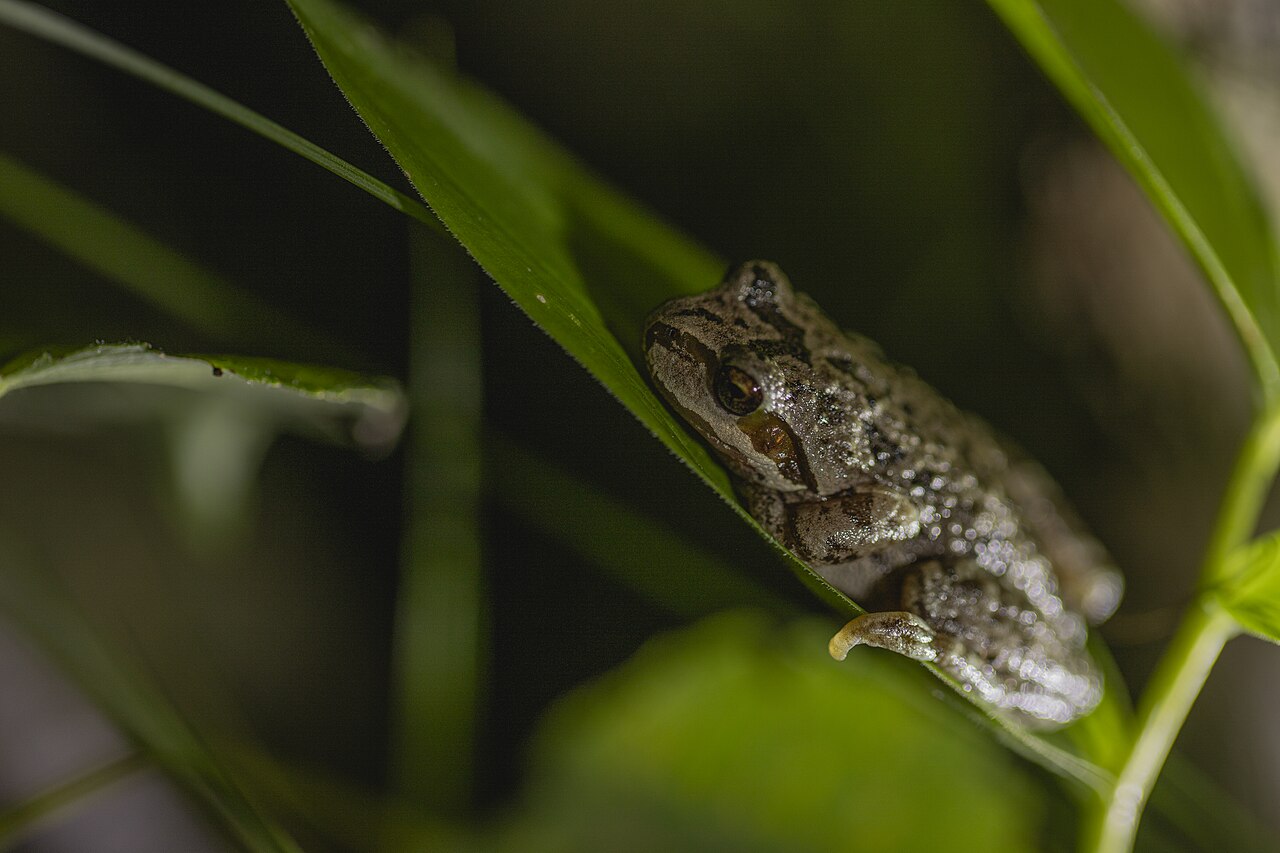
Start with the eye stripe. A dark band runs from the nostril, through the eye, and back to the shoulder, and it stays put no matter what color the rest of the frog is. That single mark separates this species from nearly every other small frog in its range, and it is visible even on a muddy animal in poor light.
Then check size and toes. Adults measure 0.75 to 2 inches (2 to 5 cm), with females larger, and the toes end in small round sticky pads with limited webbing. The skin is smooth to slightly bumpy, and a pale belly is normal. Anything larger than about 2.5 inches (6 cm) on the West Coast is a different species, usually a young bullfrog.
Why They Change Color
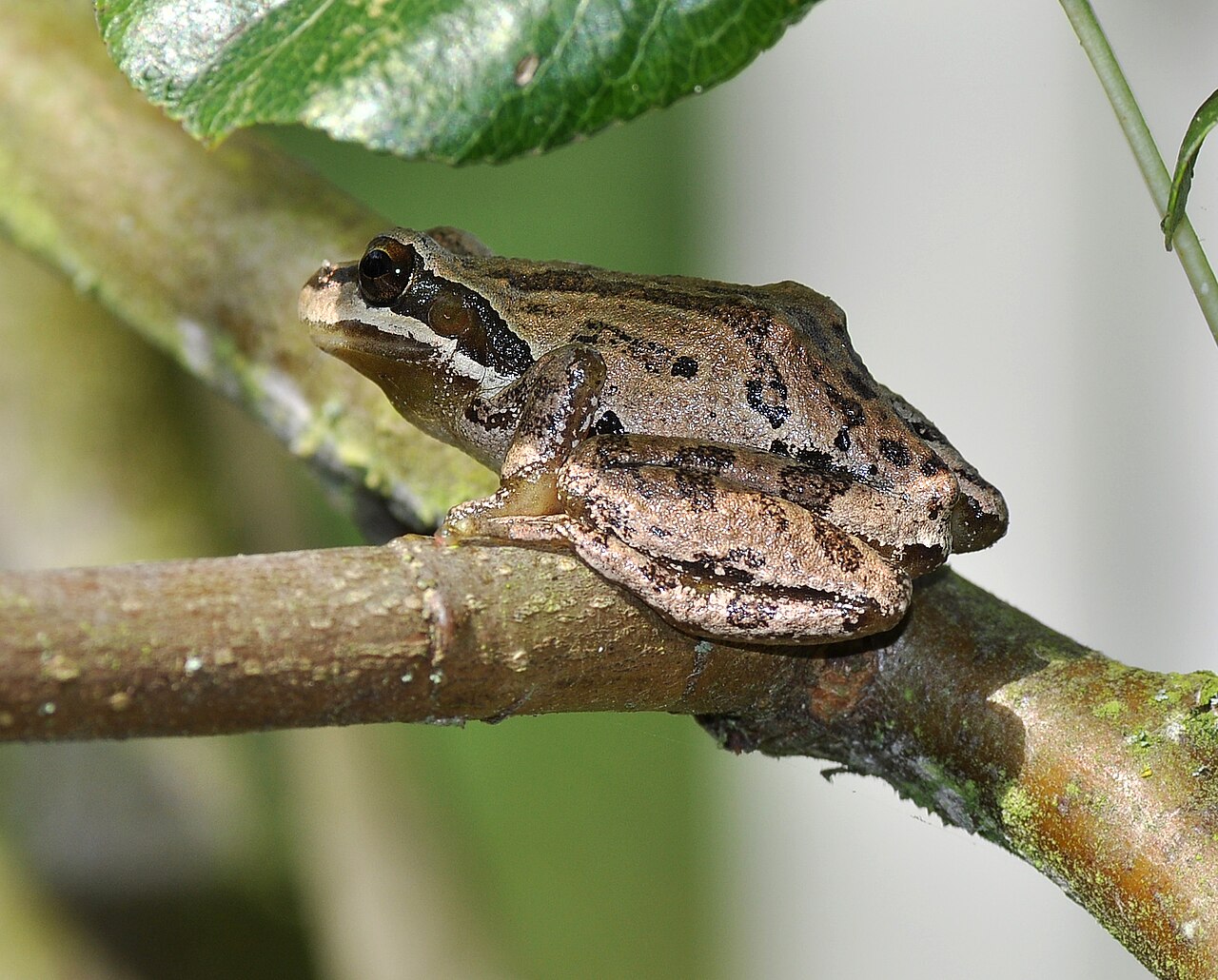
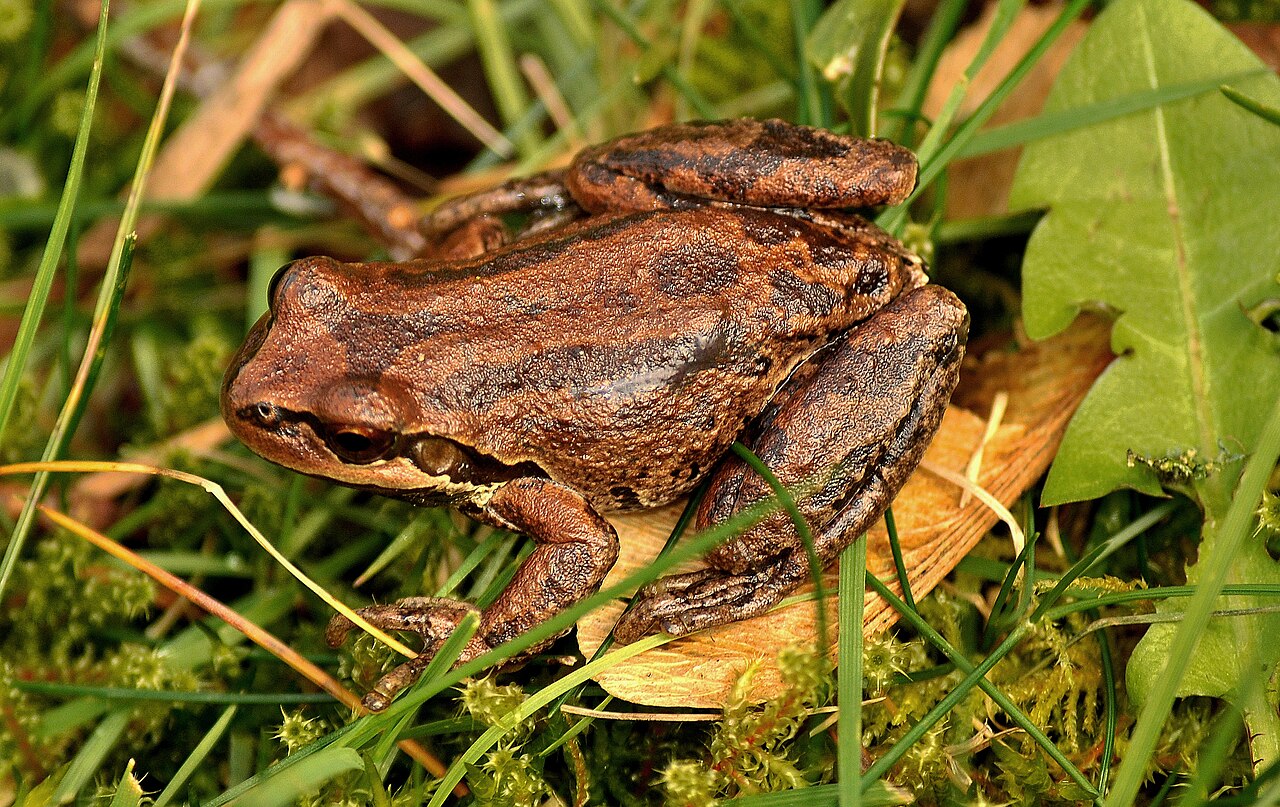
A single Pacific tree frog can be bright green in spring and mottled brown by late summer. The change takes days to weeks, not seconds, and it is driven by temperature and humidity rather than by the background the frog happens to be sitting on. Cool and damp conditions push animals toward green; warm and dry conditions push them toward brown.
Individuals differ in how far they can shift, and some stay locked in one color range for life. Bronze, tan, gray, reddish, and even near black animals all occur, sometimes in the same pond on the same night. This is the usual reason people report finding three frog species in one yard when they have found one, an issue that also confuses gray tree frog sightings in the East.
Where Pacific Tree Frogs Live
Breeding happens in shallow still water: ponds, ditches, slow creek margins, marshes, cattle tanks, and garden ponds. Outside the breeding season the frogs disperse onto land and shelter under logs, rocks, leaf litter, boards, and flower pots, often several hundred feet from any water. They are nocturnal and far more often heard than seen.
In winter they stay on land, wedged into rodent burrows, root cavities, and damp crevices below the frost line rather than freezing solid the way some eastern frogs do. The U.S. Geological Survey tracks the species as part of its national amphibian monitoring, and it remains one of the most reliably detected frogs in western surveys.
The Sound Hollywood Made Famous
The male call is a loud two part “kreck ek” that most American ears hear as ribbit, repeated over and over on damp evenings from January through July depending on elevation. For an animal that weighs less than a nickel, the volume is startling, and a full chorus in a roadside ditch can be heard a quarter mile away.
The Hollywood connection is real and it is why the call is so familiar. Sound crews working in southern California recorded local night ambience and that audio was reused in films set everywhere from Georgia to the Amazon. Generations of moviegoers therefore associate a West Coast chorus frog with swamps that have never held one.
Is the Pacific Tree Frog Venomous?
No. The Pacific tree frog is not venomous, since venom requires a delivery mechanism such as fangs or a spine, and this frog has neither. It is also not meaningfully poisonous. Like most amphibians it produces mild skin secretions that taste bad to a predator and can sting if they reach your eyes, and that is the extent of it.
There is no species in the United States remotely comparable to a red eyed tree frog habitat neighbor such as a poison dart frog. Handling a Pacific tree frog will not hurt you. Wash your hands afterward, keep them away from your face, and treat the animal as the fragile party in the exchange.
What Frogs Not to Touch
In the United States, the short list is the cane toad in Florida and southern Texas, whose parotoid gland secretions are genuinely dangerous to dogs, and the Colorado River toad of the Southwest, for the same reason. Every other native frog and toad is safe to touch briefly, and the folk belief that toads cause warts is simply false.
The bigger rule runs the other way. Amphibian skin absorbs chemicals directly, so sunscreen, insect repellent, hand sanitizer, and soap residue can all be lethal. Wet your hands in pond water first, keep contact brief, and never move a frog to a new pond, which is how chytrid fungus spreads. The invasive Cuban tree frog is the one exception where relocation rules differ.
Are Pacific Treefrogs Rare?
Not at all. The species is listed as Least Concern by the IUCN, its population is large, and it remains common across most of its range, including in suburban yards, farm ditches, and city parks. If you live west of the Cascades or the Sierra Nevada, there is a reasonable chance one is under a pot on your patio right now.
Local declines do happen, usually where wetlands are drained, where introduced bullfrogs and predatory fish take over a pond, or where the parasitic flatworm Ribeiroia ondatrae causes limb deformities in developing tadpoles. Pacific tree frogs also carry chytrid fungus while tolerating it well, which makes them a reservoir for species that tolerate it poorly.
What Is the Lifespan of a Pacific Tree Frog?
Wild Pacific tree frogs typically live one to three years after metamorphosis, with a small number reaching five. Mortality is heaviest in the egg and tadpole stages, where garter snakes, diving beetle larvae, dragonfly nymphs, wading birds, and fish take the large majority before a single frog leaves the water.
In captivity, with steady food and no predators, individuals have lived considerably longer, and reports of seven to nine years exist. Those figures come from hobbyists rather than controlled studies, so treat them as plausible rather than established. The ordinary fate of a Pacific tree frog is a short, loud life.
What They Eat and How They Hunt
Adults eat spiders, beetles, flies, ants, isopods, moths, and anything else small enough to fit in the mouth, hunting at night by sitting still and lunging. Tadpoles are different animals entirely, grazing algae and detritus off pond surfaces for roughly two to two and a half months before transforming.
Because their prey is mostly small and mostly nocturnal, a porch light over a garden pond turns into a feeding station, which is why the frogs colonize suburban yards so readily. A yard that keeps standing water through spring and skips broad spectrum insecticides will hold a chorus every year, the same principle that attracts a squirrel tree frog in the Southeast.
Can I Keep a Pacific Tree Frog as a Pet?
Legally, this depends on where you are, and collecting wild native amphibians is restricted or prohibited in California, Oregon, and Washington without the appropriate license. Check your state wildlife agency first. Even where it is allowed, taking an animal out of a local population is the wrong way to acquire one.
Practically, they do keep well: a 10 gallon vertical tank, temperatures of 65 to 75 F (18 to 24 C), a water dish, live plants or bark for cover, and a diet of appropriately sized crickets and fruit flies will suit them. They are hardier than most exotic tree frog species. Buy captive bred stock, and be prepared for an animal that hides all day and calls loudly at 2 a.m.
Frequently Asked Questions
What is the friendliest frog?
Among commonly kept species, White’s tree frog is the usual answer, since it is calm, slow moving, and tolerates brief handling better than most. Friendly here means tolerant, not affectionate. Pacific tree frogs are nervous and quick by comparison, and they are best treated as display animals rather than frogs you interact with.
Do frogs get attached to humans?
Frogs can learn to associate a keeper with food and will approach at feeding time, but there is no evidence of attachment in the way a dog or a parrot forms it. Amphibian brains lack the structures behind social bonding in mammals and birds. What looks like recognition is reliable conditioning, which is still interesting and worth encouraging with a routine.
What is the hardest frog to take care of?
Poison dart frogs of the genus Oophaga are among the hardest, requiring exact humidity, live plant vivariums, and cultures of springtails and fruit flies. Glass frogs and many mantellas are similarly demanding. Difficulty in amphibians almost always comes down to humidity stability and tiny live food rather than the animal itself being fragile.
Where can I find a Pacific tree frog for sale?
They appear occasionally through captive bred sources and reptile expos, though the species is uncommon in the trade because it is so ordinary in its home range. Do not buy wild caught stock. If a seller cannot document captive breeding, assume the animal was collected, which is illegal in several western states.
Are Pacific tree frog eggs easy to find?
Fairly, in the right season. Females attach loose clusters of 10 to 70 eggs to submerged grass stems and twigs in shallow water, and a breeding pond may hold dozens of clusters. Leave them alone. Raising wild egg masses at home is illegal in some states and usually fatal to the tadpoles anyway.
What eats Pacific tree frogs?
Garter snakes, raccoons, herons, egrets, jays, bullfrogs, introduced fish, and house cats all take adults, while tadpoles are eaten by nearly everything in the pond, including insect larvae. Their defense is numbers and camouflage. A female produces several hundred to over a thousand eggs a season, and very few of them reach a second summer.