Red-Shouldered Hawk: Identification Guide
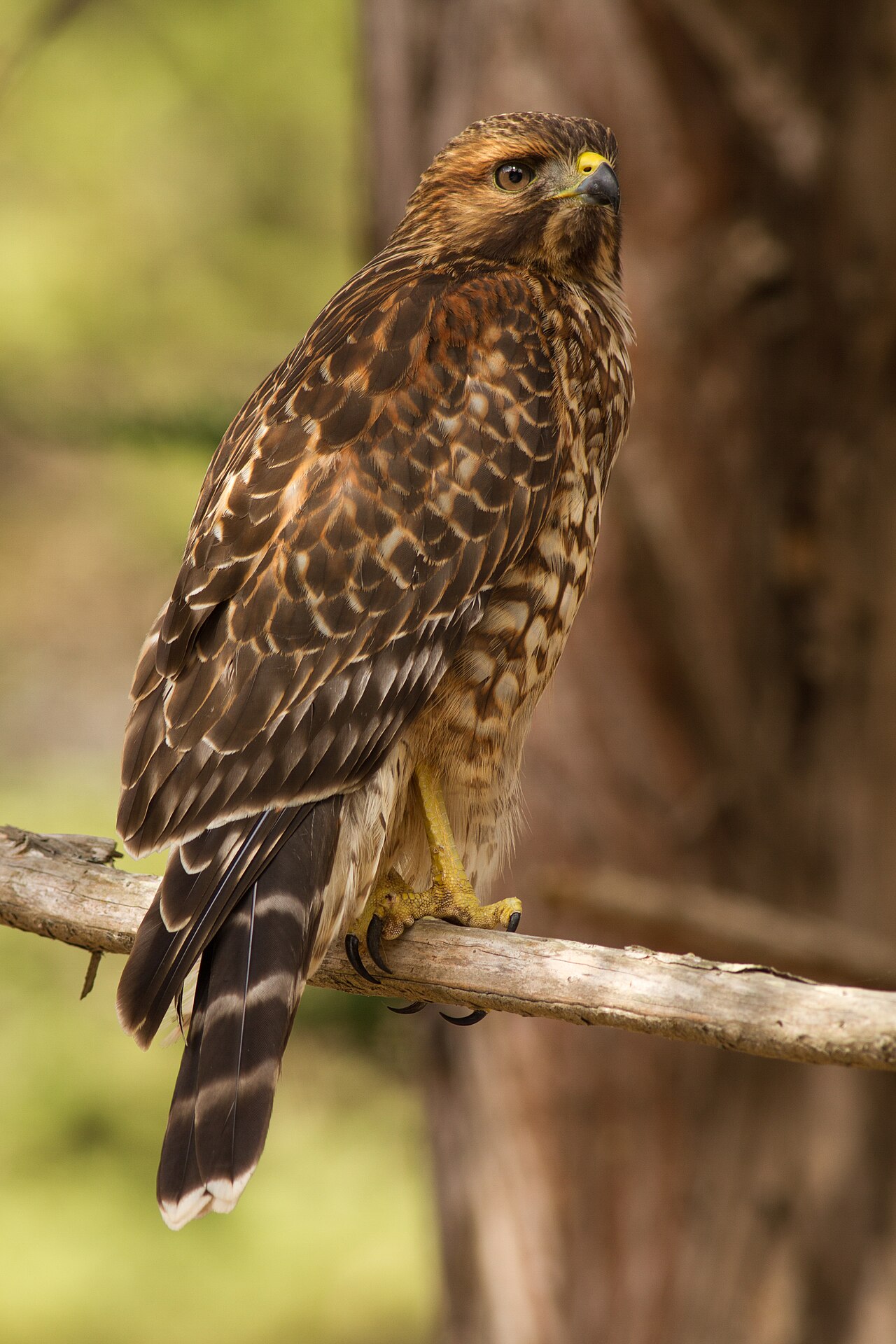
A Red-Shouldered Hawk is identified by the rust-red patches on its shoulders, a dark back checkered with white spots, a rust-barred chest, and a black tail crossed by several narrow white bands. It is smaller and more slender than the Red-Tailed Hawk, favors wooded habitat near water rather than open country, and is one of the most vocal hawks in North America, calling loudly and often even outside the breeding season.
| Fact | Detail |
| Length | 16.9 to 24 inches |
| Wingspan | 37 to 43.5 inches |
| Weight | 1.1 to 1.9 pounds |
| Key field mark | Rust-red shoulder patches, checkered back |
| Tail | Black with narrow white bands |
| Habitat | Wet woodland, river bottoms, swamps |
| Call | Loud, repeated “kee-yer” scream |
How to Identify a Red-Shouldered Hawk
Adults show warm rust-red shoulders and chest barring against a dark, white-spotted back, and in flight the underwings show a translucent, crescent-shaped pale patch near the wingtips known as a “window,” visible when backlit by the sun. The tail is black with several thin white bands, narrower and more numerous than the broader bands typical of many similar hawks. Juveniles are brown above with heavy vertical streaking below rather than barring, and lack both the rust shoulder patches and the strong wing windows of an adult until their second year.
Red-Shouldered Hawk vs Red-Tailed Hawk
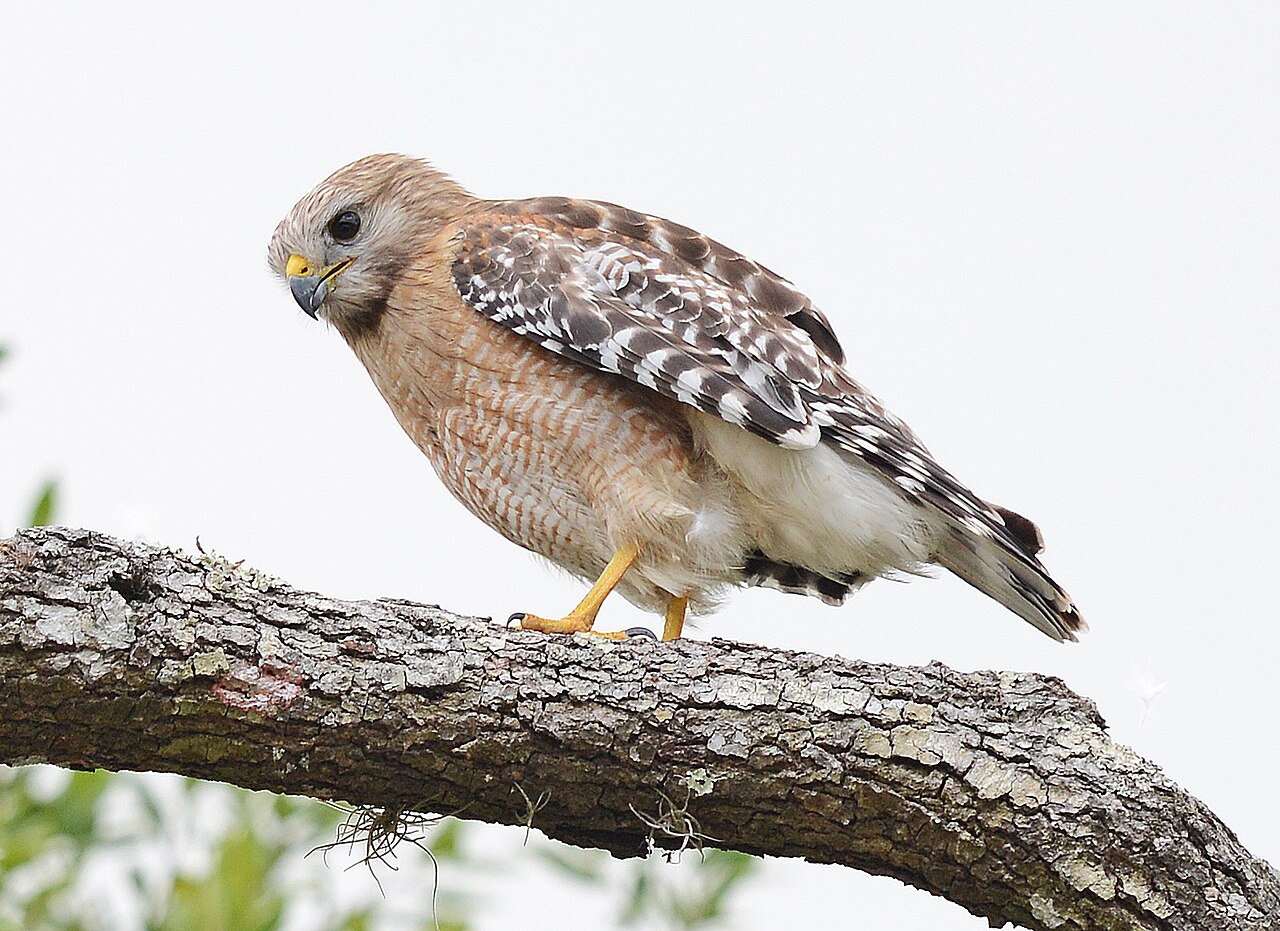
Size is the first clue: a Red-Shouldered Hawk is noticeably smaller and more slender than a Red-Tailed Hawk, with a proportionally longer tail and narrower wings. The tail pattern is the most reliable field mark, since a Red-Shouldered Hawk shows several narrow white bands on a black tail, while an adult Red-Tailed Hawk shows a solid brick-red tail with no strong banding. Habitat also differs: Red-Shouldered Hawks strongly prefer wooded areas near water such as river bottoms and swamps, while Red-Tailed Hawks favor open country and forest edges.
Diet and Hunting Behavior
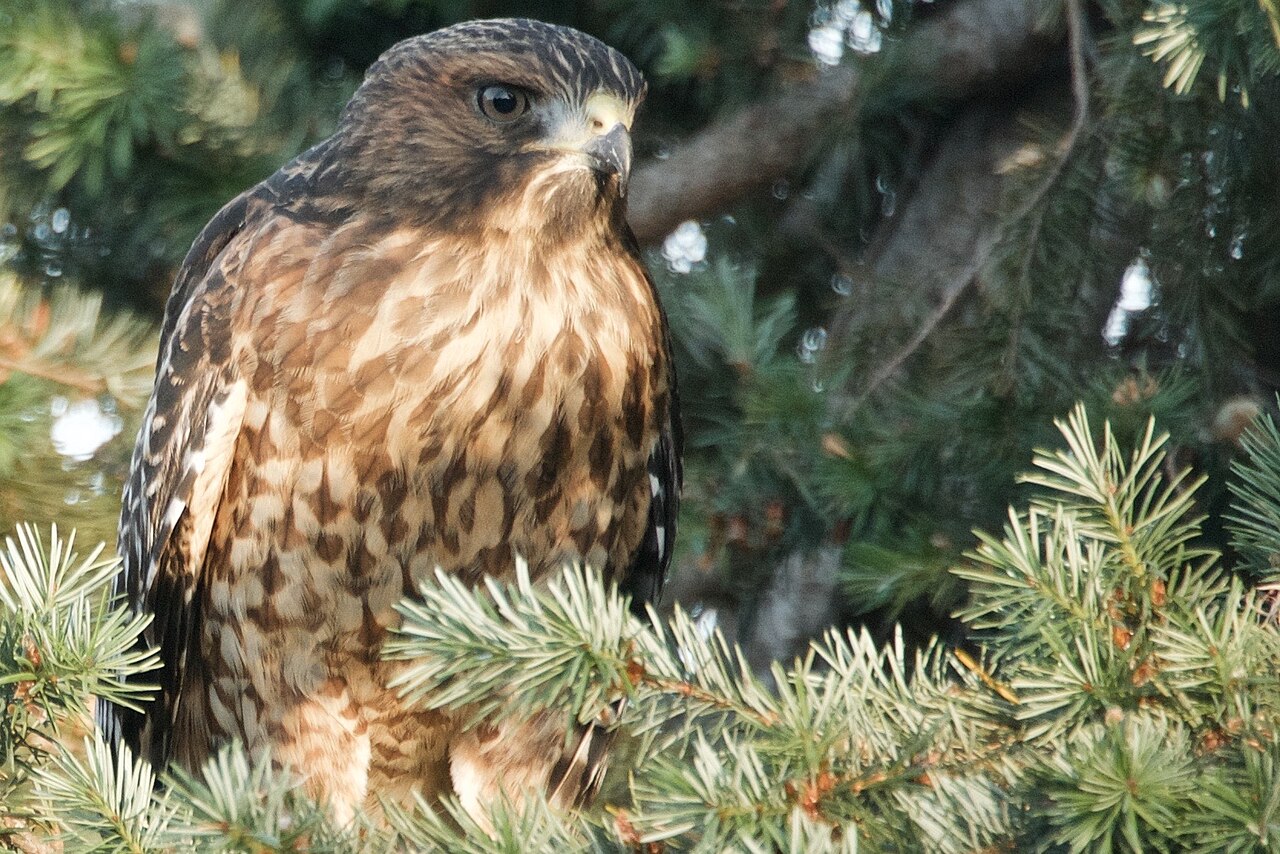
Red-Shouldered Hawks hunt from a perch inside or at the edge of wooded habitat, watching for small mammals, amphibians, reptiles, and large insects below rather than scanning wide open fields the way a Red-Tailed Hawk does. Their strong association with wet woodland means frogs, snakes, and crayfish make up a larger share of the diet than in most other North American hawks, a reflection of how closely tied the species is to swamps, streams, and river corridors.
Why Red-Shouldered Hawks Call So Often
Unlike many raptors that mostly vocalize during breeding season, Red-Shouldered Hawks call loudly and frequently throughout the year to maintain a year-round territory, particularly in the southeastern United States where pairs may remain on the same territory permanently. This near-constant calling is actually one of the best ways to detect the species even in dense forest where visual sightings are difficult, and it is also why the call is so frequently mimicked by Blue Jays, which can convincingly imitate a Red-Shouldered Hawk’s scream to scatter other birds from a feeder.
Conservation Status
According to the Cornell Lab of Ornithology, Red-Shouldered Hawk populations declined through much of the 20th century due to the loss of bottomland forest habitat but have since stabilized and increased in many areas, aided in part by the species’ willingness to nest in suburban woodlots and parks with sufficient tree cover. It remains more habitat-restricted than the highly adaptable Red-Tailed Hawk, making protection of mature wooded wetlands important for the species’ long-term outlook.
Range and Habitat
Red-Shouldered Hawks are found primarily in the eastern United States and along the California coast, with the densest populations in the Southeast where mature bottomland and swamp forest remain common. Northern populations in the upper Midwest and Northeast migrate south for winter, while southeastern and California populations are largely year-round residents defending the same wooded territory in every season.
Red-Shouldered Hawk vs Cooper’s Hawk and Broad-Winged Hawk
Beyond the size and tail-pattern differences already covered against the Red-Tailed Hawk, a Red-Shouldered Hawk is also sometimes confused with the accipiter-shaped Cooper’s Hawk, though the two have very different silhouettes: broad, rounded wings and a fanned tail on the Red-Shouldered Hawk versus short, rounded wings and a long tail on the Cooper’s Hawk. It shares more habitat overlap with the Broad-Winged Hawk, another forest buteo, but the Broad-Winged Hawk is noticeably smaller and shows a starker black-and-white banded tail rather than the narrower, more numerous white bands of a Red-Shouldered Hawk.
A Year-Round Presence in Southern Forests
Unlike many raptors that shift territory seasonally, southeastern Red-Shouldered Hawks are famous among local birders for holding the exact same territory and even the same nest tree for years at a stretch, with pairs frequently observed calling and displaying near the nest site in every month of the year rather than only during the breeding season. This site fidelity makes established pairs a familiar, almost neighborhood-like presence in older suburban areas with enough mature tree cover, in much the same way an urban Cooper’s Hawk pair can become a recognizable fixture of a particular block or park.
Juvenile Red-Shouldered Hawks
First-year Red-Shouldered Hawks lack the rust shoulder patches and barred chest of an adult, showing instead a brown back and heavy vertical streaking on a pale chest, a plumage that can make them harder to distinguish from young Red-Tailed or Broad-Winged Hawks without checking overall proportions and habitat. The reddish shoulder patches and clean chest barring typically develop over the bird’s first full year, and the loud, repeated call that makes adults so easy to detect is present in a rougher, less polished form even in recently fledged young still begging near the nest.
A Reliable Sign of Healthy Wetland Forest
Because Red-Shouldered Hawks depend so heavily on mature forest near water, their continued presence in a given area is often used informally as a sign of relatively intact bottomland habitat, since the species tends to disappear from areas where wetland forest has been cleared or significantly degraded. Birders and land managers alike sometimes treat a resident, calling pair as a positive indicator of overall forest health in a given tract, useful shorthand in places where a full habitat survey would otherwise take considerably more time and resources to carry out.
An Adaptable Southern Success Story
Despite its habitat requirements being more specific than a generalist like the Red-Tailed Hawk, the Red-Shouldered Hawk has shown a notable ability to adapt to suburban and even urban parks in parts of the Southeast and California, provided enough mature tree cover and some source of water remain nearby. Homeowners in these areas sometimes report the same resident pair using a favorite yard or park for years, defending it with the same loud calling behavior the species is known for in wilder bottomland forest, a reminder that habitat quality rather than remoteness from people is usually the deciding factor for this particular hawk. Landowners hoping to encourage a resident pair can help simply by leaving mature trees near water intact rather than clearing them for a more manicured look, a small, low-cost step that benefits far more wildlife than this one species alone, from songbirds to salamanders sharing the same shaded, cool, and damp forest understory below.
Frequently Asked Questions
How do you identify a Red-Shouldered Hawk?
Look for rust-red shoulder patches, a dark back checkered with white spots, rust barring on the chest, and a black tail crossed by several narrow white bands, often heard calling loudly from wooded habitat near water.
How big is a Red-Shouldered Hawk?
Red-Shouldered Hawks measure roughly 17 to 24 inches long with a wingspan of 37 to 43.5 inches, making them noticeably smaller and more slender than a Red-Tailed Hawk.
Which is bigger, a Red-Tailed Hawk or a Red-Shouldered Hawk?
The Red-Tailed Hawk is larger and bulkier overall, with broader wings and a heavier build, while the Red-Shouldered Hawk is smaller, more slender, and has a proportionally longer tail.
What does a Red-Shouldered Hawk eat?
Its diet includes small mammals, amphibians, reptiles, and large insects, with frogs, snakes, and crayfish featuring more heavily than in most other hawks due to its strong preference for wet woodland habitat.
Why does a Red-Shouldered Hawk call so much?
The species maintains a year-round territory in much of its range and calls frequently throughout the year rather than only during breeding season, which makes it one of the more reliably heard hawks in eastern forests.
Do Blue Jays really imitate Red-Shouldered Hawks?
Yes. Blue Jays are known to closely mimic the Red-Shouldered Hawk’s loud “kee-yer” call, sometimes convincingly enough to scatter other birds away from a feeder or food source.
Where do Red-Shouldered Hawks live?
They are found mainly in the eastern United States and along the California coast, favoring mature wooded habitat near rivers, swamps, and other wetlands rather than open country.