White Peacock Butterfly: ID, Range, and Host Plants
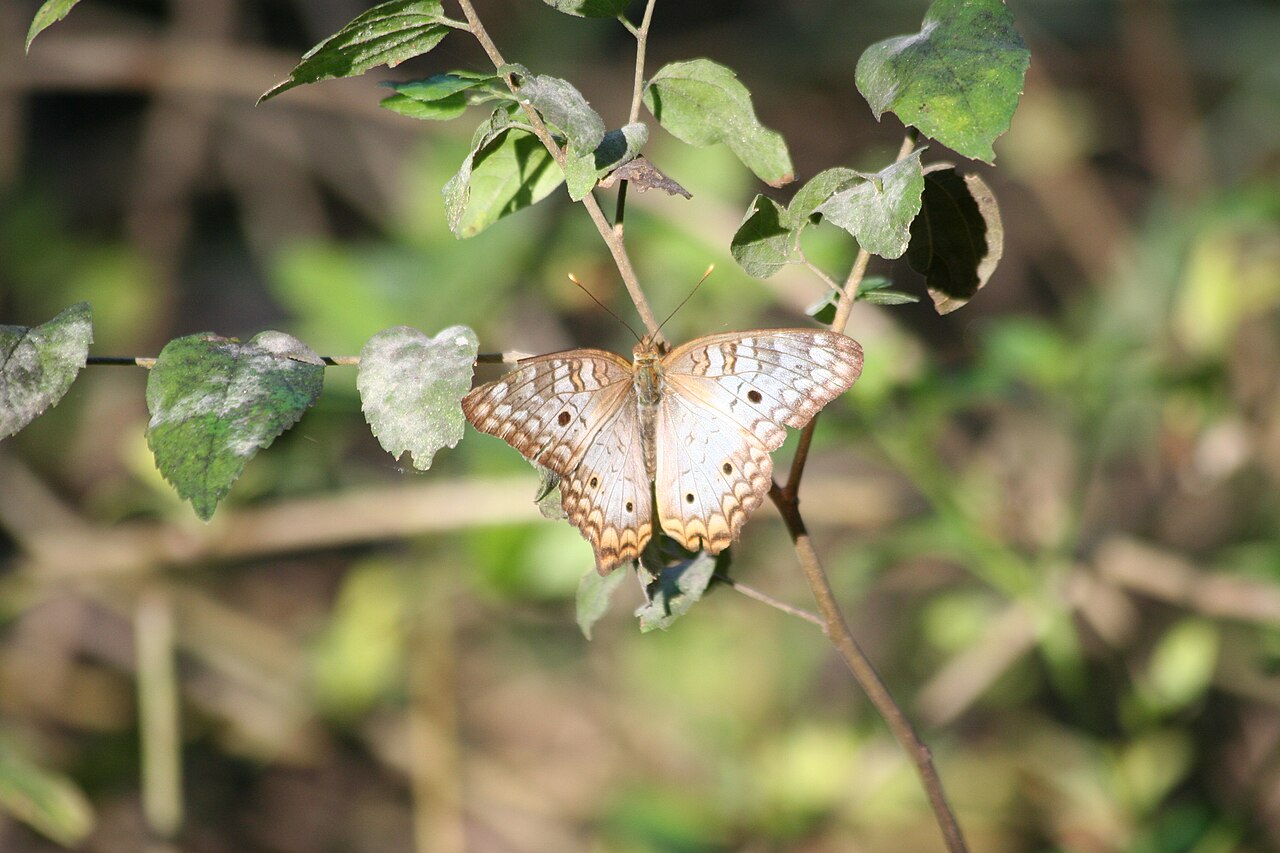
The white peacock is a pale butterfly of Florida, the Gulf Coast, and the American tropics, chalky white to cream with faint tan bands, a scalloped wing edge, and a small dark eyespot on each wing. It spans about two to two and three quarter inches, flies low over damp open ground, and is one of the most common butterflies in southern Florida year-round.
It is not related to the European peacock butterfly and does not have that species’ huge eyespots, which is the main source of confusion around the name. The white peacock is a resident tropical species that breeds continuously where frost never comes, and its northern edge shifts with warm summers. This guide covers identification, host plants, the seasonal forms, symbolism, and where to find one.
The white peacock is a chalky white butterfly with faint tan bands, a scalloped wing edge, and small dark eyespots, spanning two to two and three quarter inches. It lives in Florida, the Gulf Coast, and the American tropics, breeding year-round in frost-free areas. Caterpillars feed on water hyssop, frogfruit, and wild petunia in damp open ground.
| Feature | White Peacock |
|---|---|
| Scientific name | Anartia jatrophae |
| Wingspan | 2 to 2.75 in |
| Colour | Chalky white with faint tan bands |
| Eyespots | Small and dark, one per wing |
| Host plants | Water hyssop, frogfruit, wild petunia |
| Habitat | Damp open ground, ditches, pond edges |
| Range | Florida, Gulf Coast, American tropics |
What Does a White Peacock Butterfly Look Like?
Pale and distinctive rather than colourful. The wings are chalky white to off-white, crossed by faint light brown or tan bands, with a scalloped and slightly wavy outer edge fringed in white and light brown. Each forewing carries one small dark eyespot and each hindwing two, all much smaller than the name suggests.
Size is moderate, two to two and three quarter inches, and the flight is low, slow, and close to the ground, with frequent settling and basking with wings held open. That low fluttering flight over damp open ground is often the first thing that identifies it before any pattern is visible.
Fresh individuals look bright white; worn ones fade to grey-cream and lose the band definition. Males are territorial and hold small patches of open damp ground, launching at intruders and returning to the same spot, so an individual is often re-findable minutes later. The white butterfly guide covers the other pale species people encounter.
Is It Related to the European Peacock Butterfly?
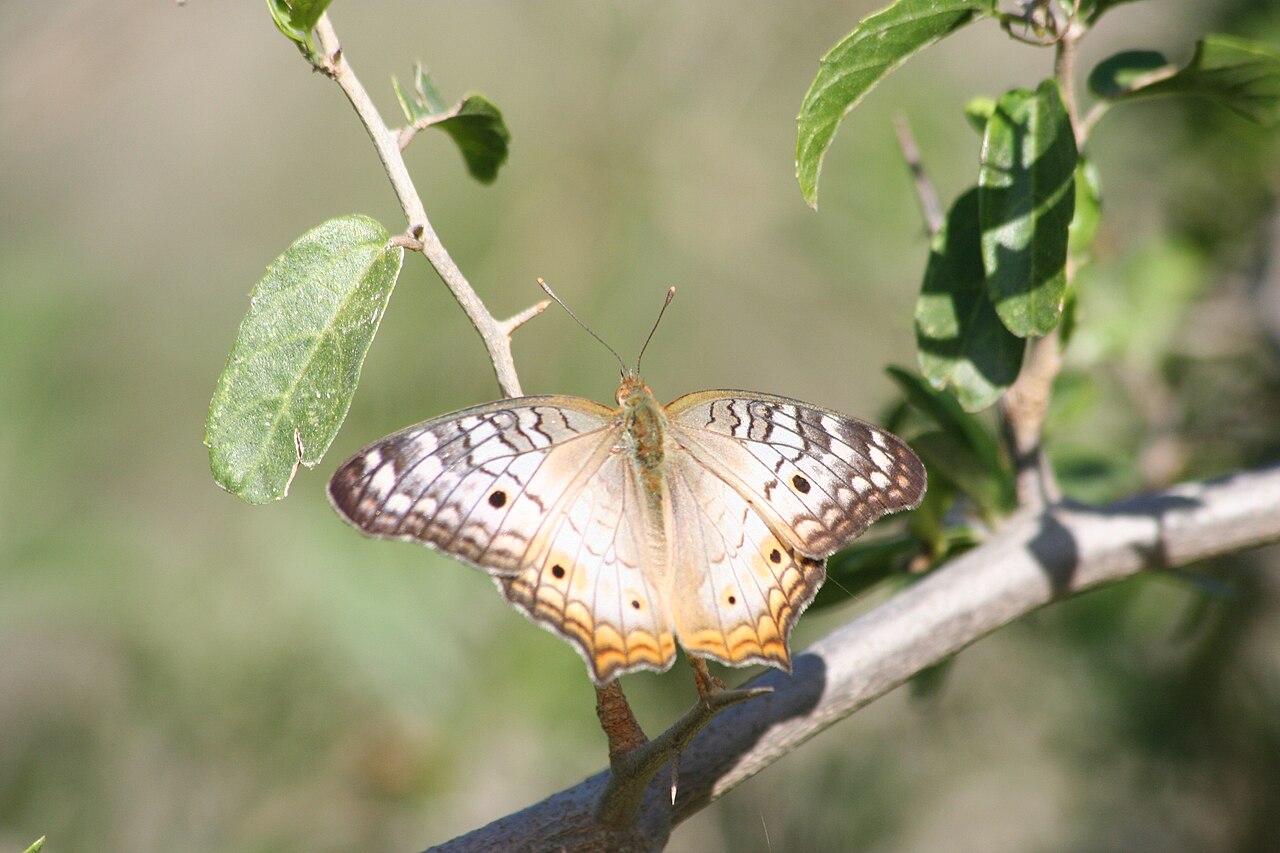
No. The European peacock, Aglais io, is a dark red-brown butterfly with four enormous, brilliantly coloured eyespots and does not occur in the Americas. The white peacock is Anartia jatrophae, in a different genus, and shares only the family Nymphalidae and the word peacock in its common name.
The names both refer to eyespots, but the resemblance stops there. European peacock eyespots are large, blue-centred, and function as a startle display, opened suddenly with an audible hiss made by rubbing the wings. White peacock eyespots are small, dark, and function mainly to deflect bird strikes to the wing edge.
The closest relative in the Americas is the banded peacock, Anartia fatima, a dark butterfly with a cream or yellow band that occurs from Mexico south and occasionally strays into south Texas. The two are similar in shape and behaviour but not in colour.
What Is the Host Plant for the White Peacock?
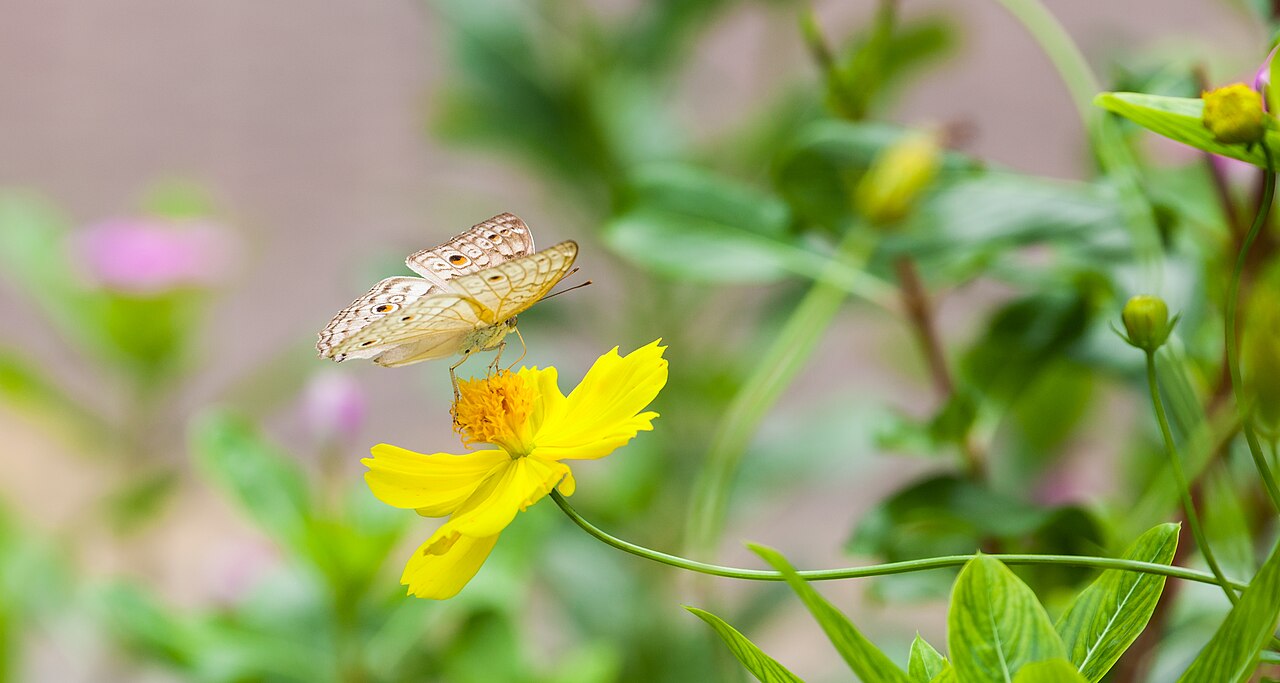
Water hyssop, frogfruit, and wild petunia, all low plants of damp open ground, along with several related species in the acanthus and verbena families. Frogfruit in particular is a common lawn and roadside plant across the southern states and is what supports most suburban populations.
Eggs are laid singly on leaves and buds of these low plants, and the whole life cycle takes place close to the ground rather than in shrubs or trees. The caterpillar is black with silvery or white speckling and branched black spines, and it has two long horns on the head. The spines look alarming but do not sting.
Because the host plants grow in ditches, canal edges, wet fields, roadside swales, and mown lawns, the butterfly is genuinely common in disturbed and managed landscapes. Frogfruit is increasingly recommended as a native lawn alternative in Florida, and planting it brings this species in directly. The black caterpillar guide covers other dark spiny larvae found in the same habitats.
Where Do White Peacocks Live?
Peninsular Florida, the Gulf Coast, south Texas, and south through Mexico, the Caribbean, and Central America into Argentina. It is one of the most abundant butterflies in southern Florida and is present year-round there, with the population breeding continuously rather than pausing for winter.
North of the frost line it is a seasonal wanderer. Individuals stray north into the southeastern states and occasionally as far as Kansas and Missouri in late summer, establishing temporary breeding populations that die out with the first freeze. Those northern records are strays rather than range expansion.
Habitat is consistent throughout: open, sunny, damp, and disturbed. Ditches, canal banks, pond and marsh edges, wet fields, roadsides, and irrigated lawns all hold them, and they avoid closed woodland entirely. A butterfly fluttering low over a wet ditch in Florida in any month is likely to be this one.
Are White Peacock Butterflies Rare?
Not in their range. In southern Florida the white peacock is among the commonest butterflies present, seen daily in suitable habitat throughout the year, and it is similarly abundant across much of the American tropics.
What makes it feel uncommon to most people is geography. Anyone outside Florida, the Gulf Coast, and south Texas will rarely or never see one, and a sighting in Georgia or the Carolinas is genuinely notable because it means a stray has wandered north.
Numbers within the range fluctuate with rainfall. Wet years produce abundant host plants in ditches and swales and correspondingly large populations, while drought reduces both. The species has no conservation concerns and benefits from the kind of disturbed damp habitat human landscapes produce in quantity.
Do They Change With the Seasons?
Yes, in a subtle way. White peacocks show seasonal variation in size and in the strength of the markings, with dry-season individuals typically larger and more heavily marked with darker bands and more defined eyespots, and wet-season individuals paler and smaller.
The mechanism is the same developmental response seen in other butterflies with seasonal forms: conditions experienced by the larva and pupa determine the adult’s appearance. In a tropical species the relevant cue is rainfall and its knock-on effect on host plant quality rather than day length.
The variation is not dramatic enough to cause identification problems, unlike the zebra swallowtail’s two forms, but it is noticeable in a series and is one reason individual white peacocks vary more than expected for a species with such a simple pattern. The buckeye butterfly guide covers a species with a much stronger seasonal shift.
What Does the White Peacock Butterfly Symbolize?
Symbolism here comes almost entirely from the colour rather than from the species. White butterflies are among the most consistently loaded in folk belief, widely read as spirits, souls, or messages from the dead, and in several European traditions a white butterfly is specifically taken as a departed loved one making contact.
Other readings attached to white butterflies include purity, peace, new beginnings, and good news, and in some traditions the first white butterfly of the year is an omen for the season ahead, positive in some versions and unlucky in others. The contradiction between sources is normal in butterfly folklore.
None of this is specific to the white peacock, which has no folklore of its own, and readings that claim otherwise are modern. What a sighting does indicate is a damp open habitat with native low-growing host plants nearby. The guide to a butterfly landing on you covers the encounter symbolism in general.
Why Do Males Hold Territory?
Because females come to the host plants, and the host plants grow in predictable damp open patches. A male that holds a good patch of frogfruit or water hyssop meets more females than one that searches at random, so males perch on low vegetation, launch at anything passing, and return to the same spot repeatedly.
The chases are display rather than combat. Two males spiral upward together until one breaks off, and the resident usually returns to its perch within seconds. Males will also investigate other butterflies, dragonflies, bees, and people who walk through the patch, which is why the species seems bolder than its size suggests.
The behaviour is useful for anyone trying to photograph one. A white peacock flushed from its perch nearly always comes back to the same few square feet within a minute, so standing still and waiting works far better than following it. Territories are small, often only a few metres across, and the same male can be found in the same spot on consecutive days.
What Else Looks Like It?
The Florida white and the great southern white are the main confusions, and both are in a different family. They are cleaner, brighter white, lack the tan bands and the eyespots, have rounded rather than scalloped wing edges, and fly faster and higher. Great southern whites have distinctive turquoise-tipped antennae.
Cabbage whites are smaller, plainer, and have black wingtips and one or two round black spots on each forewing rather than eyespots along the margins. They also fly in a bouncing, erratic way quite unlike the white peacock’s low glide.
Worn or pale individuals of other nymphalids occasionally cause trouble, but the combination of chalky white ground, faint tan bands, scalloped fringed edges, small marginal eyespots, and low flight over damp ground is not shared by anything else in the region. The Florida Museum of Natural History (floridamuseum.ufl.edu) maintains regional identification resources. The yellow butterfly guide covers another colour-first identification problem.
Frequently Asked Questions
What does a white peacock butterfly look like?
Chalky white with faint tan bands, a scalloped fringed wing edge, and small dark eyespots, spanning two to two and three quarter inches. It flies low and slowly over damp open ground.
Are white peacock butterflies rare?
Not in Florida, the Gulf Coast, south Texas, or the American tropics, where they are among the commonest butterflies. Outside that range a sighting is genuinely notable and means a stray.
What is the host plant for the white peacock?
Water hyssop, frogfruit, and wild petunia, all low plants of damp open ground. Frogfruit supports most suburban populations and is increasingly used as a native lawn alternative in Florida.
Is it related to the European peacock butterfly?
No. The European peacock is a dark red-brown butterfly with four huge blue-centred eyespots in a different genus. The two share only the family and the word peacock in their names.
What does the white peacock butterfly symbolize?
Nothing specific to the species. White butterflies generally are read as spirits, souls, or messages from the dead, along with purity, peace, and new beginnings, depending on tradition.
Where do white peacock butterflies live?
Peninsular Florida, the Gulf Coast, south Texas, and south to Argentina, always in open sunny damp habitat: ditches, canal banks, pond edges, wet fields, and irrigated lawns.
Do white peacocks change through the year?
Slightly. Dry-season individuals tend to be larger with darker bands and more defined eyespots, wet-season ones paler and smaller, driven by conditions during larval development.

Similar Posts
Chigger Bites vs Flea Bites: How to Tell Them Apart
Chigger bites cluster at the sock line and waistband, flea bites hit the ankles. Here is how to identify, treat, and prevent each one.
Albino Corn Snake: Genetics, Care, Size, and Morphs
The albino corn snake is amelanistic rather than truly white. Here is what the genetics mean, plus size, morphs, care and feeding for a 20 year pet.
Black and Orange Caterpillar: 4 Species and How to Tell Them Apart
Most black and orange caterpillars are harmless woolly bears, but a few fuzzy look-alikes can cause mild skin irritation. Here is how to tell them apart.
Katydid Sounds: The Katy-Did Call of Summer Nights
Katydids rasp katy-did katy-didn’t after dark by rubbing their wings together. Every call explained, how to tell them from cicadas and crickets, and when the chorus ends.
Deer Sounds: Snorts, Grunts, Bleats, and What Each Means
Deer sounds decoded: the alarm blow, social grunts, fawn bleats, rut grunting and the snort-wheeze, plus the distress bawl that actually warrants a look.
Monarch Butterfly: ID, Migration, and Milkweed
The monarch is the only butterfly making a true two-way migration, up to 3,000 miles. Identification, the milkweed dependency, look-alikes, and what actually helps.