House Finch Eggs: Color, Clutch Size, and Hatching Time
House finch eggs are small, pale bluish-white to faint blue-green, and lightly speckled with black and lavender dots concentrated toward the wider end. They measure roughly 0.7 by 0.5 in, and a typical clutch holds 4 or 5, laid one per morning until the set is complete. Incubation takes 13 to 14 days and only the female sits.
Most people meet these eggs by accident, because house finches nest in hanging baskets, door wreaths, porch lights, and ledges more readily than almost any other North American songbird. This guide covers identification against similar eggs, the nesting timeline, what to do when you find a nest on your porch, and the cowbird problem that plays out differently in house finch nests than in any other species.
| Quick Facts | House Finch Eggs |
|---|---|
| Color | Pale bluish-white, fine black and lavender speckles |
| Size | About 0.7 by 0.5 in |
| Clutch size | 2 to 6, usually 4 or 5 |
| Incubation | 13 to 14 days, female only |
| Nestling period | 12 to 19 days |
| Broods per year | 2 to 3, occasionally more |
What House Finch Eggs Look Like
The ground color is a pale blue-white, sometimes with a faint green cast, and it is subtle rather than the vivid blue people expect from a songbird egg. Against a dark nest cup they can look almost white in shadow and clearly blue in direct light, which is why descriptions vary so much.
The markings are the identifying feature. Fine speckles and short squiggles in black, dark purple, and pale lavender scatter across the shell, and they concentrate noticeably at the broader end, often forming a loose wreath. Some eggs in a clutch carry more marking than others, and the occasional egg is nearly unmarked.
Size is small even by songbird standards, at roughly 0.7 in long and 0.5 in wide, which is smaller than a robin egg and slightly larger than a hummingbird egg. Our guide to bird egg identification places them against the full range of backyard species.
When House Finches Lay and How Many
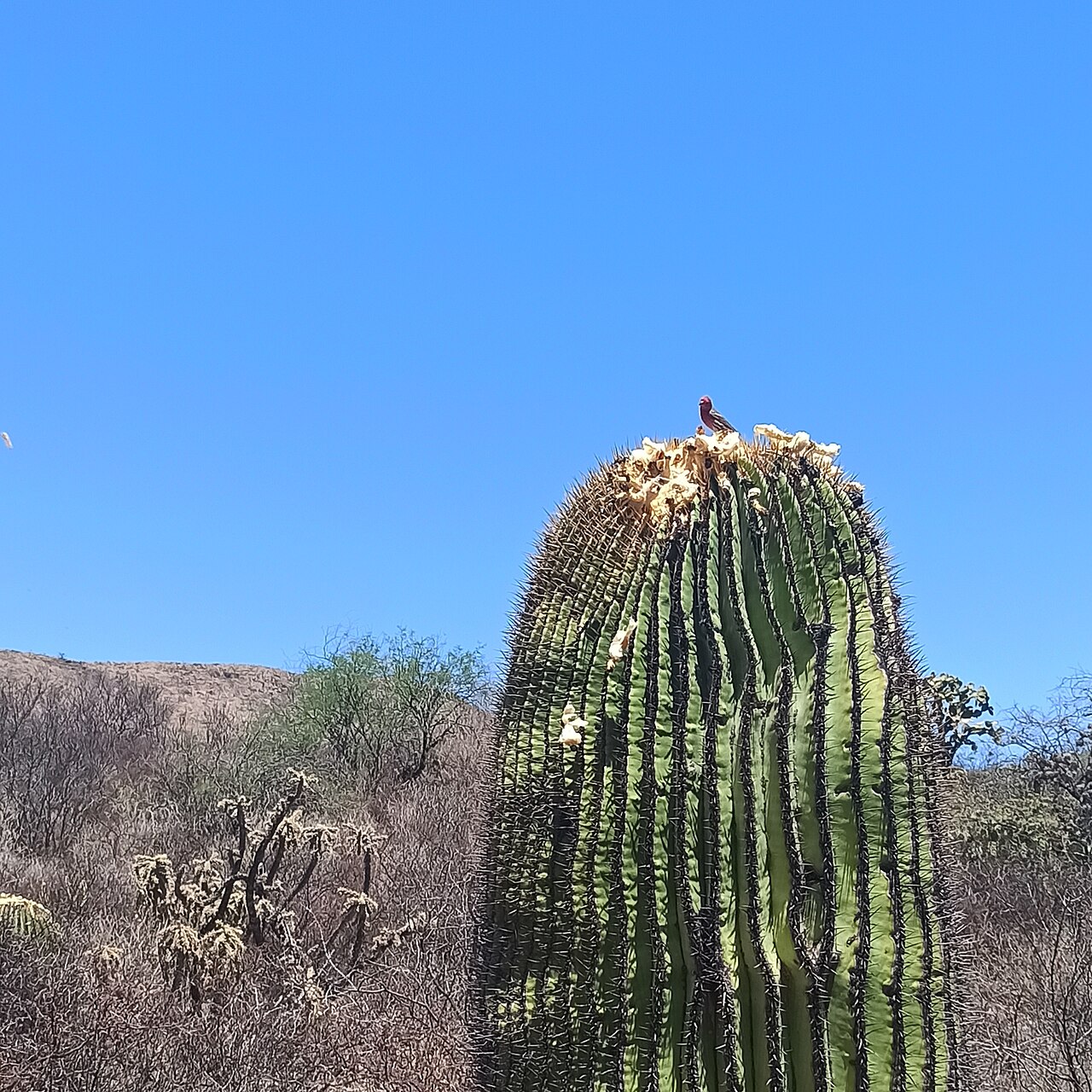
The breeding season runs from March through August across most of the range, starting earlier in the south and in warmer years. House finches are among the earliest nesters in many neighborhoods, and a pair may have a first clutch underway while other species are still pairing up.
Eggs are laid one per day, almost always in the early morning, until the clutch is complete at 2 to 6 eggs with 4 or 5 being typical. The female does not begin steady incubation until the clutch is nearly finished, which is why all the eggs hatch within a day of each other despite being laid across most of a week.
Two to three broods per year is normal and some pairs manage more, which is part of why house finches have become so abundant. A female frequently begins building a second nest while the male is still feeding fledglings from the first, and the same nest site is often reused across a season and across years.
How Long Until They Hatch?
Incubation runs 13 to 14 days from the start of steady sitting. The female does all of it, staying on the nest for long stretches, and the male feeds her at the nest throughout, which is one of the more visible courtship behaviors in a backyard.
Hatchlings emerge nearly naked, blind, and helpless, weighing well under a gram. Both parents feed them, and this is where house finches differ from nearly every other songbird: they feed nestlings an almost entirely vegetarian diet of regurgitated seeds rather than the insects most species rely on.
Nestlings stay in the nest 12 to 19 days, with the range depending on food supply and weather. Fledglings leave before they can fly well and spend several days on the ground and in low cover while the parents continue feeding them, which is when most people find a young bird that looks abandoned and is not. Our guide to the house finch covers the adult birds through the season.
House Finch Eggs vs Robin Eggs
Robin eggs are the comparison people reach for and the two are easy to separate. American robin eggs are a strong, saturated blue with no markings at all, and they are considerably larger at about 1.1 by 0.8 in. The famous robin’s egg blue is uniform across the whole shell.
House finch eggs are paler, smaller, and always speckled. If an egg is unmarked and vividly blue, it is not a house finch. If it is small, faintly blue-white, and carries black and lavender dots at the wide end, it is.
Nest structure confirms it. Robins build bulky cups with a distinctive mud layer holding the grass together, usually on a sturdy horizontal branch or ledge. House finch nests are smaller, cup-shaped, built of fine grass, twigs, string, and debris with no mud at all. Our guide to why robin eggs are blue covers the pigment chemistry behind that color.
House Finch vs House Sparrow Eggs
These two nest in similar places and are genuinely confused. House sparrow eggs are white to greenish-white with dense, heavy brown and grey blotching spread across the whole shell rather than concentrated at one end, giving them a muddier overall appearance.
The nests differ more than the eggs. House sparrows build messy, domed, cavity-filling structures stuffed with grass, feathers, and litter, often overflowing from whatever space they occupy. House finch nests are tidy open cups.
Behavior settles remaining doubt. House sparrows are aggressive cavity competitors that will destroy eggs and kill nestlings of other species to take a site, while house finches are non-aggressive and frequently lose nest sites to them. House sparrows are also a non-native species without federal protection in the United States, unlike house finches, which changes what you are legally allowed to do about a nest.
Cowbird Eggs in House Finch Nests
Brown-headed cowbirds lay their eggs in other birds’ nests and let the hosts raise the young, and house finch nests are parasitized regularly. A cowbird egg is noticeably larger, white to greyish with dense brown speckling across the whole surface, and obvious once you know what to look for.
What happens next is unusual. Cowbird nestlings normally outcompete their nest mates because they hatch earlier and beg harder, but in house finch nests they usually die anyway. The reason is the vegetarian diet: cowbird chicks need insect protein to develop, and a diet of regurgitated seeds cannot support them.
This makes house finches one of the few common hosts that effectively defeat cowbird parasitism without rejecting the egg. It costs the finches something, since a cowbird chick still consumes food and space for several days, but the parasite rarely succeeds. Removing a cowbird egg is illegal for most people in the United States regardless, since cowbirds are protected under the Migratory Bird Treaty Act.
Where House Finches Nest
House finches are exceptionally tolerant of human structures, which is why so many people encounter their eggs. Favored sites include hanging flower baskets, door wreaths, porch and barn light fixtures, ledges above doorways, dryer and stove vents, ivy on walls, and dense evergreen shrubs.
The nest itself is a compact open cup of fine grasses, thin twigs, leaves, rootlets, string, and whatever debris is available, lined with softer material. The female does the building over several days, and the finished cup is about 3 to 7 in across with a shallow interior.
Their willingness to nest at head height beside a front door is unusual and is a large part of why the species has thrived alongside people. It also means the nest is disturbed constantly, and house finches tolerate that better than most birds, though repeated close approach still causes some pairs to abandon. Our guide to the female house finch covers the bird doing nearly all of this work.
What to Do If You Find a Nest
Leave it alone, and understand that this is a legal matter rather than only an ethical one. House finches are protected under the Migratory Bird Treaty Act, which makes it illegal to move or destroy an active nest containing eggs or young without a federal permit. Penalties are real.
Practically, the disruption is short. From first egg to fledging runs roughly four to five weeks, so a wreath or basket you cannot use is out of commission for about a month. Watering carefully, using a different door, and accepting the mess for that period is usually the whole cost.
If the nest is genuinely unsafe, for the birds or for people, contact your state wildlife agency or a licensed wildlife rehabilitator rather than acting yourself. An empty nest with no eggs can be removed and the site blocked to prevent rebuilding, and that is the moment to do it if you would rather not host a nest next year. Our guide to the cardinal nest covers the same legal framework for another common backyard nester.
From Egg to Fledgling
The full cycle is fast. Nest building takes a few days to two weeks, egg laying takes 4 to 5 days, incubation runs 13 to 14 days, and nestlings fledge 12 to 19 days after hatching, so the whole sequence from first egg to empty nest is about four to five weeks.
Fledglings cannot fly competently when they leave. They spend several days hopping through low cover while the parents keep feeding them, and a fledgling on the ground with feathers and short tail is almost never abandoned. The correct response is to leave it, keep cats indoors, and watch from a distance for a parent returning.
Survival is the hard part. Most house finch eggs never produce a bird that reaches breeding age, with predation, weather, and disease taking a heavy toll, which is why the species lays so many clutches per season. House finch eye disease, a form of conjunctivitis that spread through the eastern population from the 1990s onward, remains a significant mortality factor, and keeping feeders and baths clean genuinely reduces its transmission. Distinguishing this species from its close relative is covered in our guide to the house finch vs purple finch.
Related reading: Hummingbird Nest.
Related reading: Loon Sounds.
Related reading: why is bird poop white.
Frequently Asked Questions
What do house finch eggs look like?
Small pale bluish-white eggs about 0.7 by 0.5 in, lightly speckled with black, dark purple, and lavender dots that concentrate toward the wider end. Some eggs in a clutch carry more marking than others, and an occasional egg is nearly unmarked.
How long do house finch eggs take to hatch?
13 to 14 days from the start of steady incubation, which the female does alone while the male feeds her at the nest. All eggs hatch within about a day of each other, because she does not begin sitting steadily until the clutch is nearly complete.
How many eggs do house finches lay?
Two to six per clutch, usually four or five, laid one per morning. Pairs raise two to three broods per season from March through August, and a female often starts a second nest while the male is still feeding the first brood.
How do house finch eggs differ from robin eggs?
Robin eggs are much larger at about 1.1 by 0.8 in, vividly and uniformly blue, and completely unmarked. House finch eggs are smaller, paler blue-white, and always speckled. Robin nests also contain a mud layer, which house finch nests never do.
Can I move a house finch nest from my porch?
Not legally once it contains eggs or young. House finches are protected under the Migratory Bird Treaty Act, and moving or destroying an active nest requires a federal permit. The full cycle takes about four to five weeks, after which an empty nest can be removed.
What if there is a bigger speckled egg in the nest?
It is probably a brown-headed cowbird egg, which is larger and covered in dense brown speckling. Cowbird chicks usually die in house finch nests anyway, because they need insect protein and house finches feed their young regurgitated seeds. Cowbirds are also federally protected, so the egg should be left alone.
Where do house finches build their nests?
In hanging baskets, door wreaths, porch light fixtures, ledges, vents, wall ivy, and dense evergreens. They are unusually tolerant of human structures and often nest at head height beside a front door, building a compact open cup of grass, twigs, and string with no mud.