Plants That Attract Birds: The Complete Guide to Native Bird-Friendly Plants
The single most effective thing you can do to attract birds to your yard isn’t a feeder, a bath, or even a nest box. It’s planting the right plants. A yard with three or four well-chosen native plants supports more bird species, more nesting pairs, and more total bird activity than any number of feeders alone. The reason: native plants produce native insects, and native insects are what most American birds actually feed their young. 96% of terrestrial bird species in North America raise their young on insects, not on seeds, and those insects come almost exclusively from native plants. This guide covers the plants that actually work, what makes a plant “bird-friendly,” which native species across categories (trees, shrubs, perennials, grasses, vines) deliver the most for birds, and how to think about plant selection for your specific region and goals.
Why Native Plants Matter More Than You’d Think
The research underlying bird-friendly landscaping comes from Doug Tallamy, an entomologist at the University of Delaware whose decades of research changed how serious birders think about yards. His core finding: native plants support 35× more insect biomass than non-native ornamental plants. A native oak tree supports 500+ species of caterpillars; a Norway maple supports about 30. Caterpillars are what most songbirds feed their nestlings, and a single nesting pair of Black-Capped Chickadees needs 6,000 to 9,000 caterpillars to raise a single brood.
This is why a yard full of beautiful Japanese maples, Bradford pears, and burning bushes can look bird-friendly but actually support far fewer birds than a “messier” native garden.
What native plants provide that non-natives don’t:
- Native insects for feeding nestlings and adult insectivorous birds
- Berries and seeds at the times when local birds need them (migration, winter)
- Nesting sites that native birds recognize and use
- Cover with the right density and structure for nesting and predator avoidance
- Pollen and nectar for hummingbirds and butterflies (which birds then eat)
If you’re new to backyard birding overall, the complete attract birds to your yard guide covers the broader habitat framework (food, water, shelter, safety). This guide focuses specifically on the plant selection within that framework.
What Makes a Plant “Bird-Friendly”
Not all native plants are equally valuable to birds. The best bird plants share three characteristics:
1. They Support Native Insects
The plant should host native caterpillars, beetles, true bugs, and other insects that birds eat. Oak trees lead this category dramatically, they support more caterpillar species than any other tree in most US regions. Other strong performers: native willows, cherries, birches, and pines.
2. They Produce Bird-Edible Fruit or Seeds
The fruit or seeds should be:
- Sized for native birds (not human-cultivated giant fruits)
- Ripe when local birds need them (often fall/winter, sometimes spring migration)
- Nutritionally valuable (high fat content for migration prep; high vitamin C for winter)
Strong performers: serviceberry, dogwoods, viburnums, native cherries, mountain ash, hawthorns.
3. They Provide Structural Cover or Nesting Sites
The plant should have:
- Dense branching structure birds can hide in
- Appropriate height for the species using it
- Native bird species recognition as suitable nesting habitat
Strong performers: native conifers (pines, spruces, cedars), thick deciduous shrubs (viburnums, dogwoods), tall native grasses.
Plants that excel at all three (insect host + food + cover) are the foundation species for bird-friendly yards. Native oaks, native cherries, and native dogwoods are arguably the three most valuable tree categories in most US regions.
The Top Plant Categories by Bird Value
Native Trees
Trees are the most valuable category because they last decades and support the largest number of insects and birds. A single mature native oak can support more bird species than an entire yard of non-native shrubs.
The top native trees for birds:
- Oaks (various species: White Oak, Red Oak, Pin Oak, Bur Oak depending on region). Support 500+ caterpillar species. Acorns feed jays, woodpeckers, ducks. Excellent nesting structure.
- Native Cherries (Black Cherry, Pin Cherry, Chokecherry). Support 400+ caterpillar species. Produce abundant berries eaten by many species.
- Native Dogwoods (Flowering Dogwood, Pacific Dogwood, Roughleaf Dogwood). High-fat berries critical for fall migration. Beautiful spring blooms.
- Native Birches (River Birch, Paper Birch). Support 400+ caterpillar species. Seeds eaten by goldfinches, chickadees, redpolls.
- Native Willows (Black Willow, Sandbar Willow). Support 400+ caterpillar species. Early spring source of pollen for native bees (which birds eat).
- Native Maples (Sugar Maple, Red Maple). Support 280+ caterpillar species. Seeds feed grosbeaks, finches.
- Native Conifers (Eastern White Pine, Eastern Hemlock, Douglas Fir). Cones and seeds. Critical nesting cover.
If space allows only one new tree, a native oak is almost always the right choice. An oak planted today will become the most important bird habitat element on your property within 15 to 25 years.
Native Shrubs
Shrubs fill the middle layer, between trees and ground plants. They provide nesting cover, fruit, and the dense structure that many songbird species require for nesting. Shrubs are also the fastest-growing way to add bird habitat to a small yard.
The top native shrubs for birds:
- Serviceberry (Amelanchier species, Downy Serviceberry, Shadbush). Berries ripen in spring during migration, valuable timing. Spring blooms support pollinators.
- Native Viburnums (Arrowwood Viburnum, Nannyberry, Highbush Cranberry). Berries persist into winter when other food is scarce.
- Native Dogwoods (shrub forms) (Red-Osier Dogwood, Gray Dogwood). High-fat berries. Dense branching for nesting.
- Elderberry (Black Elderberry, Red Elderberry). Late summer berries. Robust growth.
- Native Sumac (Smooth Sumac, Staghorn Sumac, Fragrant Sumac). Berries last all winter, critical late-season food.
- Spicebush (Northern Spicebush). Berries eaten by thrushes. Host plant for Spicebush Swallowtail.
- Native Hollies (American Holly, Winterberry Holly, Inkberry). Berries persist through winter. Dense cover.
- Native Roses (Carolina Rose, Virginia Rose, Pasture Rose). Hips persist into winter. Thorny cover protects nesters from predators.
For yards with limited tree-planting space, planting 3 to 4 native shrubs of different species creates more habitat value than a single non-native shrub of any kind.
Native Perennials and Wildflowers
Perennials and wildflowers provide seeds in fall and winter, host caterpillars during the growing season, and attract the insects that adult birds eat. The “messy” garden full of seed heads in winter is more valuable to birds than a manicured one.
The top native perennials for birds:
- Coneflowers (Purple Coneflower, Yellow Coneflower). Seeds eaten by finches through winter. Easy to grow.
- Native Sunflowers (Common Sunflower, Sawtooth Sunflower, Maximilian Sunflower). Massive seed production. Goldfinch favorite.
- Joe-Pye Weed (Hollow Joe-Pye Weed, Spotted Joe-Pye Weed). Late summer flowers attract butterflies and pollinators.
- Native Asters (New England Aster, Smooth Aster). Late-season pollinators support. Seeds eaten by sparrows.
- Goldenrod (Stiff Goldenrod, Showy Goldenrod). Critical late-season pollinator source. Seeds eaten by many species.
- Black-Eyed Susan (Rudbeckia hirta). Seeds eaten by finches and chickadees.
- Milkweed (Common Milkweed, Swamp Milkweed). Monarchs and many native pollinators. Seeds eaten by some birds.
- Native Salvias (especially red varieties for hummingbirds, see hummingbird-specific plants below).
Mass plantings (groups of 5 to 10 of one species) work better than scattered individuals for both pollinators and seed-feeding birds. Leave seed heads standing through winter rather than cutting back in fall.
Native Grasses
Native grasses are underused but valuable. They provide nesting material for many species, seeds for sparrows and juncos, and the structural variety birds appreciate in yard habitat. Cool-season grasses (Little Bluestem, Side-Oats Grama, Switchgrass) outperform manicured lawn for bird value by orders of magnitude.
The top native grasses for birds:
- Switchgrass (Panicum virgatum). Seeds, structural cover, drought-tolerant.
- Little Bluestem (Schizachyrium scoparium). Beautiful seasonal color, seeds, nesting cover.
- Side-Oats Grama (Bouteloua curtipendula). Hardy, attractive, supports many native insects.
- Indian Grass (Sorghastrum nutans). Tall, dramatic. Late-season seeds.
- Big Bluestem (Andropogon gerardii). Tall prairie grass. Nesting cover for grassland birds.
A small “meadow” of mixed native grasses and wildflowers in a section of your yard transforms it into bird habitat dramatically more than the same area maintained as lawn.
Native Vines
Vines are often overlooked but provide critical fruit and cover. For yards with structures (fences, trellises, dead trees) to support them, native vines are extremely valuable.
The top native vines for birds:
- Virginia Creeper (Parthenocissus quinquefolia). Excellent berries for fall migration. Beautiful fall color.
- Native Honeysuckle (Trumpet Honeysuckle, Coral Honeysuckle). Hummingbird magnet. Not invasive like Japanese Honeysuckle.
- American Bittersweet (Celastrus scandens). Persistent winter berries. Choose native, not the invasive Asian species.
- Wild Grape (Vitis species). Berries eaten by many species. Bark used as nesting material.
- Native Wisteria (American Wisteria). Beautiful spring blooms. Different species than the invasive Asian wisterias.
A wisteria-or-honeysuckle-covered arbor or fence becomes a vertical bird highway.
Special Category: Hummingbird-Specific Plants
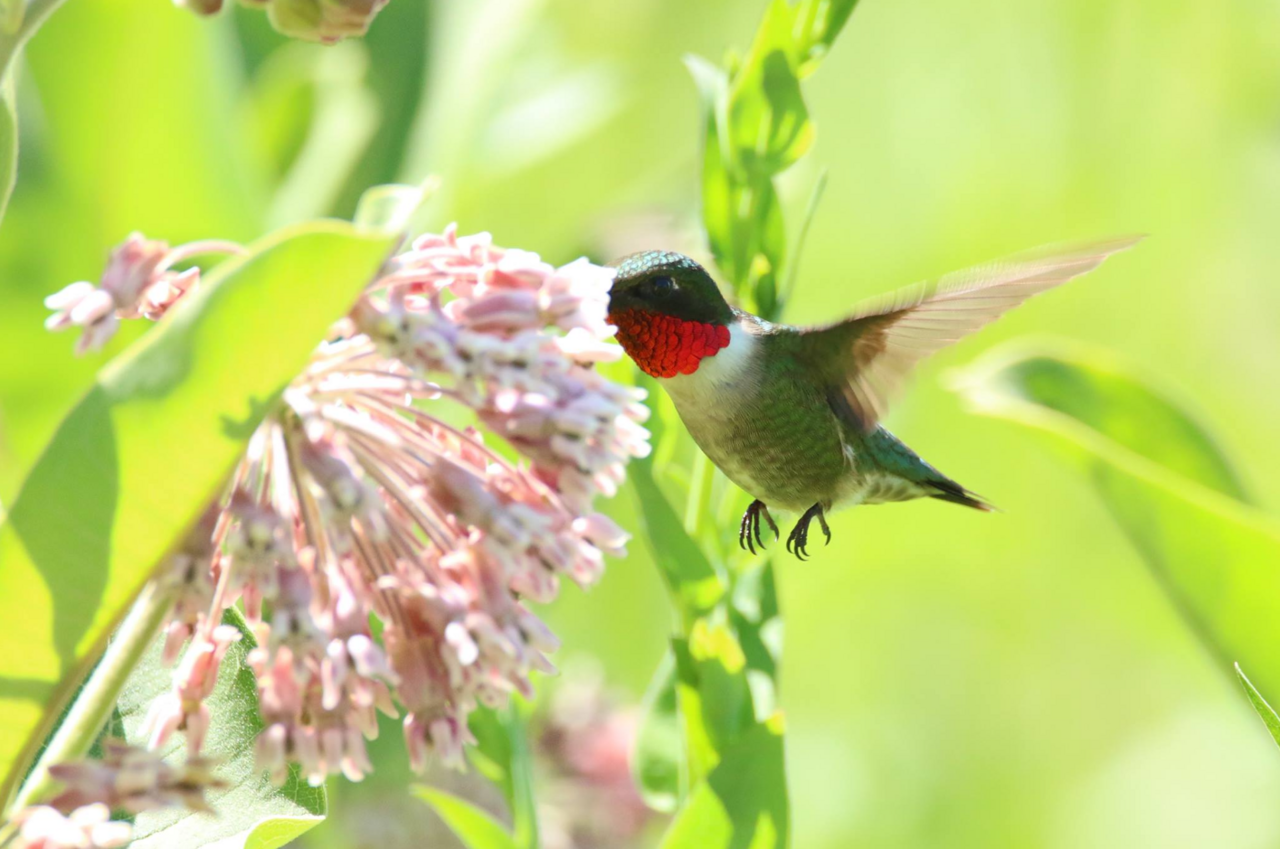
For hummingbird-focused yards, certain plants pull hummingbirds in ways few feeders can. The combination of native nectar plants plus a hummingbird feeder is dramatically more attractive than either alone.
The top hummingbird plants:
- Trumpet Honeysuckle (Lonicera sempervirens). Red tubular flowers, primary hummingbird food in eastern US.
- Cardinal Flower (Lobelia cardinalis). Brilliant red spires, late summer bloom.
- Bee Balm (Monarda didyma, Monarda fistulosa). Red and pink varieties especially.
- Trumpet Vine (Campsis radicans). Aggressive grower, hummingbird magnet.
- Native Salvias (especially red varieties like Salvia coccinea). Long bloom period.
- Columbine (Aquilegia canadensis). Spring-blooming, important for early migration.
- Native Penstemon species. Red and pink varieties for hummingbirds.
These plants work best when planted in mass groupings (3 to 7 plants of one species clustered together) rather than scattered individuals. Place near your hummingbird feeder for compound effect, see the hummingbird feeder placement guide.
Regional Considerations
What “native” means depends entirely on where you live. A plant that’s native to North America isn’t necessarily native to your specific region. Some recommendations:
Northeast (NY to Maine)
- Trees: White Oak, Red Oak, Black Cherry, Eastern Hemlock, Eastern White Pine
- Shrubs: Highbush Blueberry, Serviceberry, Winterberry Holly, Highbush Cranberry
- Perennials: New England Aster, Joe-Pye Weed, Cardinal Flower, Bee Balm
Southeast (VA to FL to TX)
- Trees: Southern Magnolia, Live Oak, Southern Live Oak, Wax Myrtle, Bald Cypress
- Shrubs: Beautyberry, Yaupon Holly, American Holly, Wild Olive
- Perennials: Native Salvias, Black-Eyed Susan, Trumpet Honeysuckle
Midwest (IL to KS to MN)
- Trees: Bur Oak, Black Oak, Hackberry, Eastern Cottonwood, Eastern Red Cedar
- Shrubs: Prairie Sumac, Wild Plum, Pasture Rose, Native Roses
- Perennials: Compass Plant, Prairie Coneflower, Big Bluestem
Southwest (TX to AZ to NV)
- Trees: Live Oak, Texas Mountain Laurel, Desert Willow, Mesquite (where native)
- Shrubs: Yucca, Cholla, Texas Mountain Laurel
- Perennials: Red Yucca, Native Salvias, Penstemon
West (CA to PNW to MT)
- Trees: Douglas Fir, Western Hemlock, Coast Live Oak, Pacific Madrone
- Shrubs: Pacific Wax Myrtle, Salal, Snowberry, Pacific Crabapple
- Perennials: California Poppy, Native Penstemons, Native Salvias
For specific region-appropriate plant selection, the Audubon Native Plants Database (native.audubon.org) accepts a zip code and returns location-appropriate species ranked by bird value. Doug Tallamy’s Bringing Nature Home book and follow-ups cover the science behind native plant selection in depth.
Plants to Avoid
Some plants actively damage bird-friendly habitat. Three categories to remove or avoid planting:
Invasive Non-Native Plants
- Japanese Honeysuckle. Strangles native plants, fruits eaten by birds spread the invasion.
- Multiflora Rose. Aggressive thorny invader replacing native cover.
- Bradford Pear (Callery Pear). Has become highly invasive, replaces oak forests.
- Burning Bush (Euonymus alatus). Spreads aggressively, displaces native shrubs.
- Privet (various species). Forms monocultures, supports almost no native insects.
- Buckthorn (Common and Glossy). Severe invasive, replaces native shrub layers.
Non-Native Plants with Low Insect Support
These don’t actively spread but provide little bird value:
- Bradford and other Callery Pears
- Norway and Sugar Maple cultivars (purple-leaf varieties especially)
- Most non-native crab apples and ornamental cherries
- Most non-native conifers (Colorado Blue Spruce often planted; Norway Spruce common)
- Decorative-only flower beds (tulips, marigolds, etc., beautiful but minimal bird value)
These aren’t actively harmful, but the space they occupy could host native plants providing significantly more bird value.
Pesticide-Treated Plants
Any plant treated with systemic pesticides (especially neonicotinoids) is essentially poisoned for native insects. Even “bird-friendly” native plants treated with these chemicals become bird traps, they attract insectivorous birds, and the insects the birds eat are contaminated. Avoid pesticide-treated plants from big-box garden centers and ask local nurseries about their pesticide practices.
How to Get Started: A Planting Plan
For yards with limited current bird habitat, the practical phased approach:
Phase 1 (Year 1): One Major Tree and Three Shrubs
Plant one native tree (likely an oak or native cherry for maximum impact) and three native shrubs (one each of serviceberry, viburnum, and elderberry, for example). Choose species native to your specific region.
Total plants: 4. Approximate cost: $100 to 250 for 2 to 3 gallon container plants.
Phase 2 (Year 2): Perennial Foundation
Plant a 50 to 100 square foot section of mixed native perennials and grasses. Coneflowers, native asters, goldenrods, switchgrass, little bluestem.
Total plants: 15 to 25 perennials. Approximate cost: $150 to 300.
Phase 3 (Year 3): Specialty Additions
Add hummingbird-specific plants near the feeder placement (see the hummingbird placement guide). Trumpet honeysuckle on a fence or arbor. Cardinal flower in a damp spot. Native salvias in sunny beds.
Add vines if structures support them. Native honeysuckle or wild grape on existing fences.
Phase 4 (Year 4+): Refinement
Identify what worked, what failed, what needs replacing or expanding. Replace any remaining non-native shrubs as they age out. Add additional native trees if space allows.
After 4 years, a yard that started with mostly lawn or non-natives transforms into established native plant habitat supporting significantly more bird species and individuals than before.
What to Expect After Planting
The realistic timeline for bird response to new native plantings:
- Year 1: Limited change. Plants are establishing. Some birds may visit but mostly using existing habitat features.
- Year 2: Plants growing, starting to produce flowers, seeds, and insects. Pollinator visits increase. Bird visits increase by 20 to 30% in many yards.
- Year 3: Substantial new habitat. Plants reaching mature size. Bird visits often double or triple from baseline.
- Years 4 to 10: Established habitat. Mature trees supporting full insect populations. Bird species count steadily growing.
The patience required is real, native plant habitat doesn’t happen overnight. The compensation: once established, native plantings require minimal maintenance, save money on bird food long-term, and produce ecological value that no feeder system can match.
Maintenance for Bird-Friendly Plants
Native plant maintenance is much less than ornamental plant maintenance, but a few practices help:
- Don’t deadhead. Leave spent flowers for seed-producing birds.
- Don’t clean up fall debris. Leaf litter and standing perennial stems shelter overwintering insects, which feed insectivorous birds.
- Avoid pesticides and herbicides. As discussed above, these poison the food chain. Native plant gardens generally don’t need them anyway.
- Water during establishment. First 1 to 2 years, supplemental water during dry periods. After establishment, native plants need little to no supplemental watering.
- Prune sparingly. Only as needed for plant health. Heavy pruning reduces flower and seed production.
The “low-maintenance” reputation of native plants is real, once established, they’re significantly less work than typical ornamental landscaping.
Frequently Asked Questions
What is the best plant for attracting birds?
A native oak tree, if you have room. Oaks support 500+ caterpillar species (which feed nestlings) and produce acorns eaten by many bird species. For yards without space for trees, a serviceberry shrub is the best single-plant choice, spring blooms, summer berries, fall color, and excellent bird food.
Why do birds prefer native plants?
Native plants support native insects, which are what most American songbirds feed to their young. Non-native plants support 30+ times fewer native insects than equivalent native plants. Native birds also recognize native plant berries, seeds, and nesting structures more readily than non-native equivalents.
What plants attract the most birds quickly?
Berry-producing shrubs that mature quickly. Serviceberry, native elderberry, and native viburnums begin producing within 2 to 3 years. For faster results, mass plantings (groups of 5 to 10 of one species) attract more attention than scattered individuals.
Do I need a big yard to attract birds with plants?
No. A 50 to 100 square foot section of native perennials and one or two native shrubs can dramatically improve bird visits even in small yards. Apartment balconies with container plants of native salvias, native columbine, or even just one native vine can attract hummingbirds and other species.
What’s the difference between native plants and wildflowers?
Native plants are species that evolved in your specific region, these include trees, shrubs, perennials, vines, and grasses. “Wildflowers” often refers to non-native flower mixes sold for meadow planting; many “wildflower” mixes contain non-native species. Always check that what you’re planting is native to your specific region.
Should I plant trees or shrubs first?
Both, ideally. Trees take longer to mature but provide the largest ecological value. Shrubs grow faster and provide visible results within 2 to 3 years. Most bird-friendly yards include both layers.
Will native plants kill my lawn?
Some native grasses can outcompete lawn over years if planted directly into it. For most yards, native plants are added as discrete beds or borders rather than replacing lawn. A meadow conversion (replacing lawn entirely with native grasses and wildflowers) is a multi-year project but possible.
How long until birds use my new native plants?
Some pollinators and insects find new native plants within weeks. Birds typically follow within months as insect populations build. Full habitat value takes 2 to 5 years as plants mature. Bird response is gradual rather than immediate.
Can I plant native plants in containers?
Yes, though with limitations. Many native plants grow well in containers for short periods (1 to 2 years), but most prefer in-ground planting for long-term health. Native salvias, native columbine, and some native grasses do well in containers. Larger trees and shrubs need ground planting eventually.
Where can I buy native plants?
Native plant nurseries (search “native plant nursery [your state]”) sell region-appropriate species. Local Audubon chapters often run native plant sales. Avoid big-box garden centers, which may sell non-native species labeled as native, may have pesticide-treated plants, and may not specify region-appropriate cultivars.
Do birds remember plants in my yard?
Yes, birds learn reliable food sources and return to them. Plants that produce reliable annual food (berries, seeds, insects) become anchor points birds incorporate into their seasonal routes. This is why year-over-year bird activity at well-planted yards tends to grow.
Should I remove existing non-native plants?
Replace gradually as you can. Removing all non-natives at once destroys whatever bird habitat your yard currently has, and replacements take time to establish. Prioritize removing actively invasive species (Bradford pear, burning bush, buckthorn, Japanese honeysuckle); replace less-harmful non-natives as they age out naturally.
Related reading: female painted bunting identification.