Killdeer Sounds: Calls, Night Noise, and the Broken Wing Act
The killdeer makes a loud, piercing kill-deer kill-deer call that gives the bird its name, along with a rapid trilling alarm, a rising dee-dee-dee, and a low stuttering call given during the broken-wing display. It is one of the noisiest birds in North America relative to its size, and it calls day and night, which is why so many people first encounter the species as an unexplained sound outside a bedroom window at two in the morning.
The killdeer is a shorebird that mostly does not live on shores. It nests on gravel driveways, parking lots, flat roofs, athletic fields, and bare ground far from water, which puts it directly into human spaces and makes its extremely loud alarm calls a common complaint. This guide covers each call, why the bird shouts at night, what the broken-wing display means, and what to do about a nest in an inconvenient place.
The killdeer’s main call is a loud, high kill-deer kill-deer that gives it its name, joined by a rapid trill when alarmed and a low stuttering call during the broken-wing distraction display. Killdeer call at night because they migrate and forage after dark and because they are alarmed by predators. The name is imitative of the call, not descriptive of any behaviour.
| Sound | Meaning |
|---|---|
| Kill-deer kill-deer | Main call; contact and mild alarm |
| Rapid trill | High alarm, intruder near nest or young |
| Rising dee-dee-dee | Given in flight and during display |
| Low stuttering call | Accompanies the broken-wing display |
| Night calling | Normal; migration, foraging, and alarm |
| Nest sites | Gravel, driveways, roofs, ball fields |
| Legal status | Protected under the Migratory Bird Treaty Act |
What Noise Does a Killdeer Make?
The signature killdeer call is a loud, clear, high-pitched two-syllable kill-deer, repeated insistently and audible from a considerable distance. It is delivered both from the ground and in flight, and a bird that feels mildly disturbed will call it over and over for minutes at a time while running along the ground ahead of whatever alarmed it.
When the alarm intensifies, the call speeds into a rapid, agitated trill, a run of shrill notes delivered without pause. This is what a killdeer produces when a person, dog, or predator approaches an actual nest or a brood of chicks, and it is loud enough to be genuinely startling at close range. The bird usually pairs it with running, wing-flashing, or the distraction display.
A third call is a rising dee-dee-dee given in flight and during aerial display, when a male flies in slow, exaggerated wingbeats over his territory. There is also a low, stuttering, almost purring call delivered while the bird performs the broken-wing act, which is different in character from anything else in the repertoire. The mockingbird sounds guide covers another bird whose night calling regularly puzzles people.
Why Do Killdeer Call at Night?
Killdeer are active at night, and this is normal rather than a sign of distress. They forage after dark, particularly on warm nights and under artificial lighting, and they migrate at night like most shorebirds, calling in flight as they go. A killdeer heard overhead at 2 a.m. in spring or autumn is very often a migrant passing over rather than a local bird.
Nocturnal alarm is the other explanation. Killdeer nesting on the ground are vulnerable all night to raccoons, skunks, foxes, cats, and owls, and a bird whose nest is approached will call loudly in the dark exactly as it would in daylight. Repeated bursts of calling from the same spot each night usually means a nest or brood nearby and a predator working the area.
Artificial light extends their activity. Killdeer readily forage on lit parking lots, ball fields, and around security lighting, where insects are concentrated, so a bird calling at night near a lit industrial yard is simply working. There is no way to stop the calling short of waiting out the nesting season, which runs roughly March through July depending on latitude.
Why Is a Killdeer Called a Killdeer?
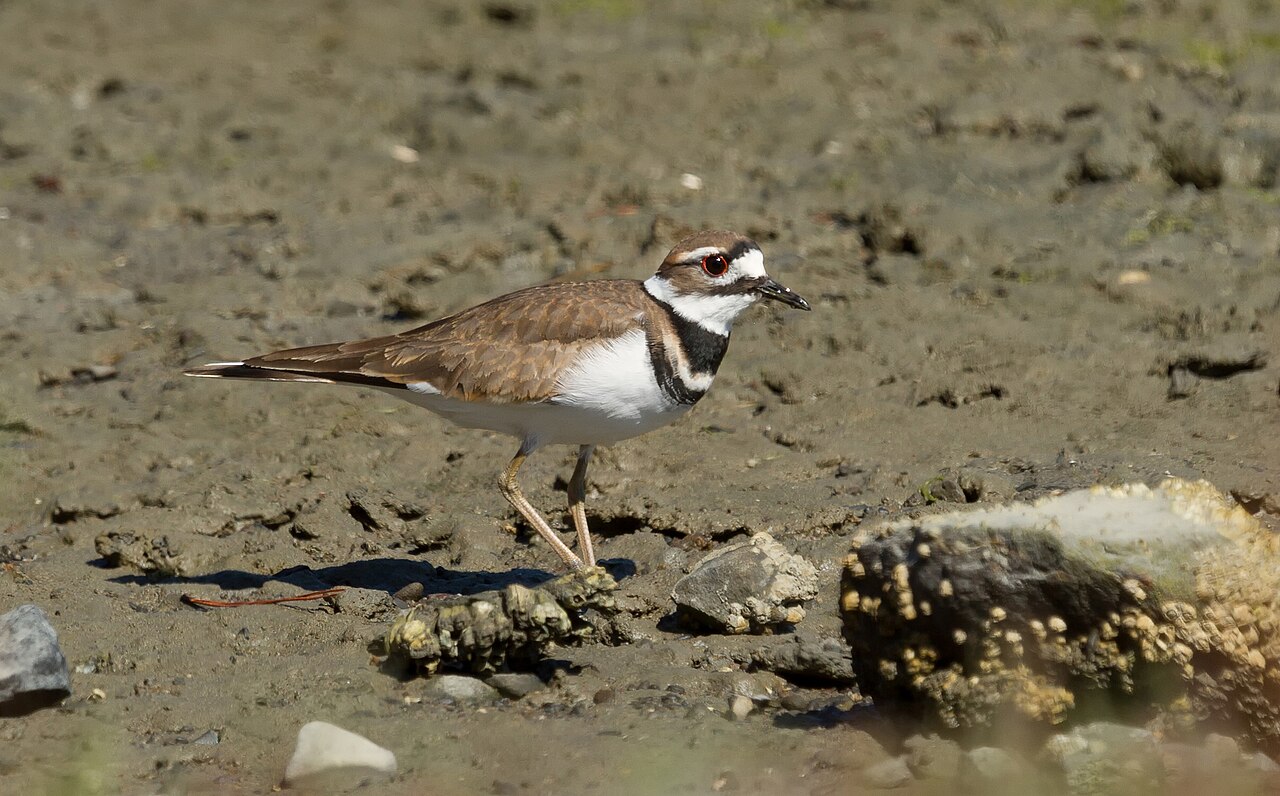
The name is purely imitative of the call and has nothing to do with deer or with killing anything. Killdeer eat insects, worms, snails, and crayfish, and a bird weighing about three ounces poses no threat to any vertebrate. The name is onomatopoeic in the same way as chickadee, whip-poor-will, and bobwhite, all named for the sound they make.
The scientific name is more descriptive: Charadrius vociferus, meaning the vociferous plover, which is a fair assessment. Older regional names include chattering plover and noisy plover, and the killdeer’s reputation for loudness is consistent across every source that mentions it.
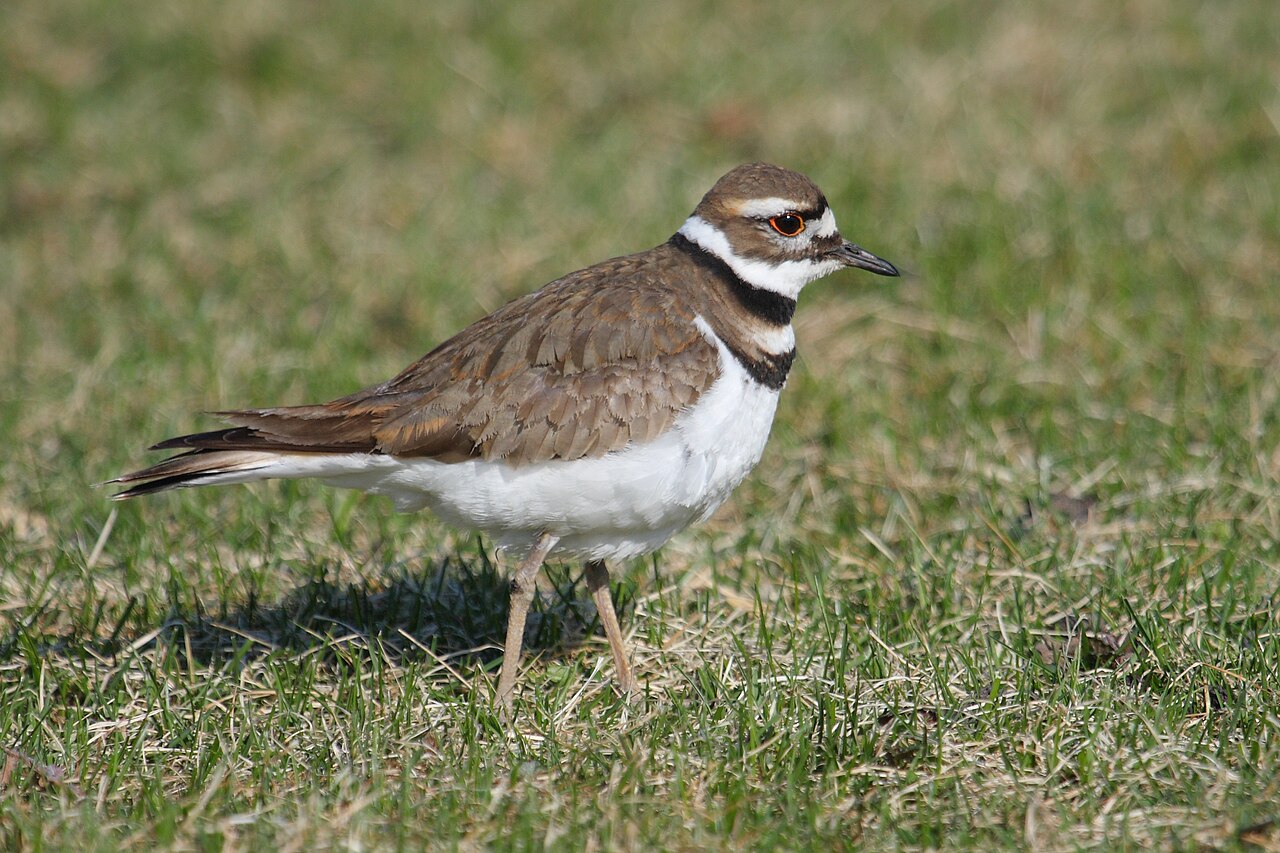
The killdeer is a plover, a family of shorebirds characterized by a run-stop-peck foraging style and by short bills, and it is the only North American plover with two black breast bands rather than one. It is also by far the most widespread and the least tied to actual shorelines, which is why it turns up in places no one expects a shorebird.
What Is the Broken-Wing Display?
The broken-wing display is the killdeer’s most famous behaviour: an adult drops one wing, drags it along the ground, fans its bright orange rump, and stumbles away from the nest calling pitifully, appearing badly injured. A predator that follows the apparently easy meal is led well away from the eggs or chicks, at which point the bird recovers and flies off.
The display is deliberate and graded. Killdeer adjust its intensity depending on how close the threat is and how it is behaving, and they will escalate to a full performance for a predator heading directly toward the nest while giving only a partial version for one passing at a distance. Research on plovers has shown they monitor the intruder’s gaze and position while performing, which suggests genuine assessment rather than a fixed reflex.
Against grazing animals the killdeer does something different: rather than feigning injury, it fluffs up, spreads its tail, and runs directly at the animal to startle it away from the nest, since a cow has no interest in an injured bird but can be redirected. If you see the broken-wing display, the correct response is to back away in the direction you came from, because you are close to a nest and moving forward risks stepping on it.
Where Do Killdeer Nest?
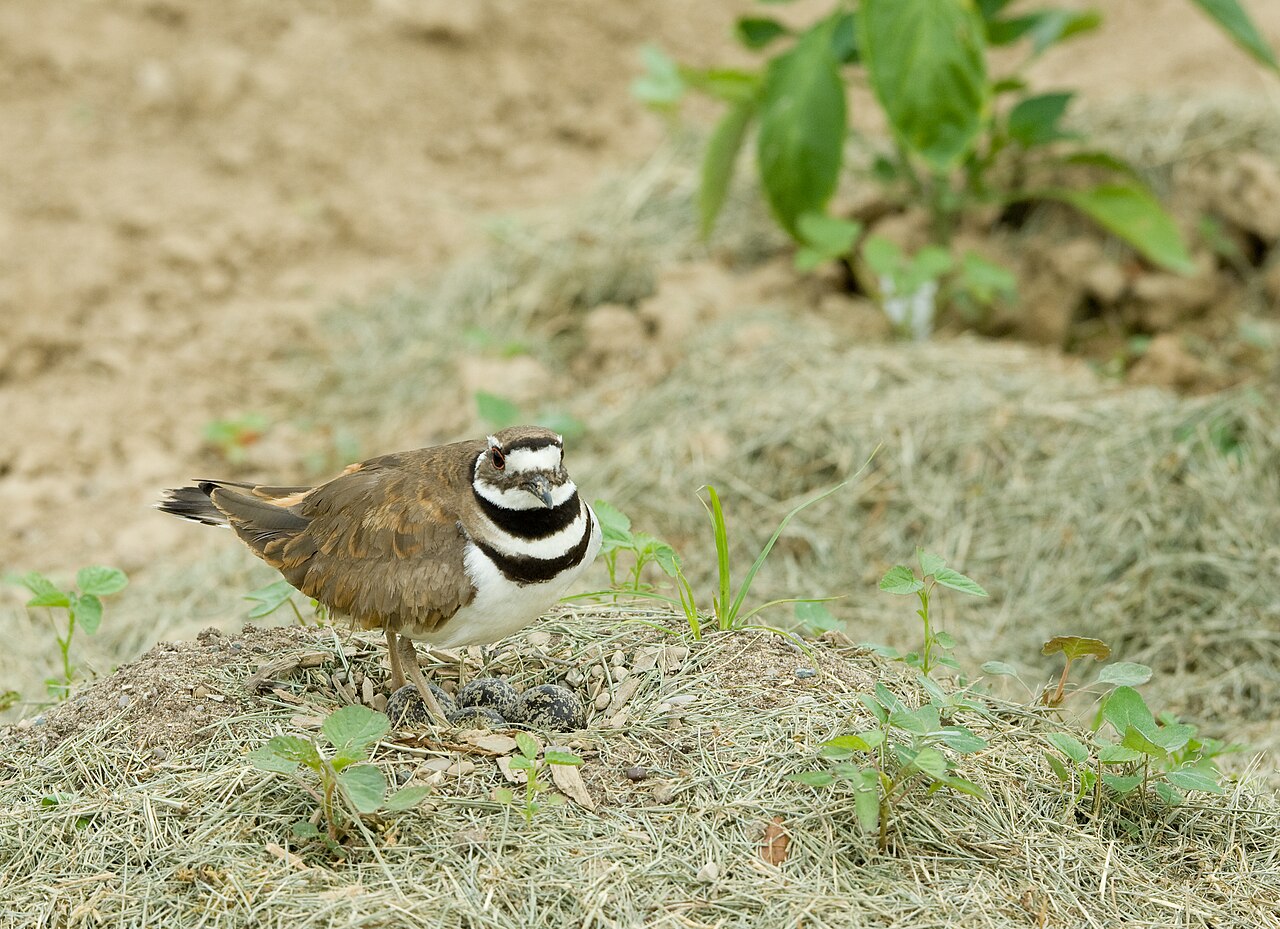
Killdeer nest on open bare ground, and their choices frequently put them in conflict with people. Typical sites include gravel driveways, parking lot islands, railroad ballast, athletic fields, flat gravel roofs, golf course roughs, construction sites, and garden beds with stone mulch. Proximity to water is not required, and nests are regularly found hundreds of yards from any.
The nest is barely a nest: a shallow scrape in gravel with a few pebbles, wood chips, or bits of shell added around the rim. The four eggs are heavily speckled and blotched and are extraordinarily well camouflaged, essentially invisible against gravel until you are almost standing on them. This is the entire defensive strategy, backed up by the adult’s distraction display.
Incubation runs 24 to 28 days, and the chicks are precocial, leaving the scrape within hours of hatching fully feathered in down and able to run and feed themselves. They cannot fly for about 25 days, during which the parents lead them to feeding areas and continue defending them loudly. A single black breast band distinguishes the downy chick from the two-banded adult.
What Should You Do About a Killdeer Nest?
Leave it and wait it out. Killdeer and their nests are protected under the Migratory Bird Treaty Act, and moving or destroying an active nest with eggs is illegal without a federal permit. The whole cycle from laying to chicks leaving takes roughly four to five weeks, which is inconvenient but finite.
Practical accommodation usually works. Marking the nest with cones, a bucket, or flagging keeps vehicles and equipment away without touching it, and killdeer tolerate a surprising amount of nearby activity as long as nothing comes directly at the scrape. Construction sites and airports deal with killdeer nests routinely by flagging and working around them.
Killdeer will sometimes move eggs a short distance themselves, which is unusual among birds, but people should not attempt to relocate a nest. If the situation is genuinely untenable, such as a nest on an active runway, the correct route is a permit through the U.S. Fish and Wildlife Service (fws.gov) and a licensed wildlife professional. Prevention for future seasons is easier: covering gravel areas, adding vegetation, or laying landscape fabric before the March nesting season starts makes a site unattractive.
Are Killdeer Good to Have Around?
Yes. Killdeer eat large quantities of insects including beetles, grasshoppers, caterpillars, ants, and fly larvae, along with snails, worms, and small crustaceans, and they forage across lawns, fields, and pastures. They cause no damage, do not raid gardens, and do not compete with other yard birds for feeders since they do not use them.
They are also among the more entertaining birds to watch. The run-stop-tilt foraging motion is characteristic of plovers, and killdeer often perform a foot-trembling behaviour, vibrating one foot against the ground to bring worms and insects to the surface. Aerial territorial displays in spring involve slow exaggerated wingbeats and continuous calling.
The main complaint is genuinely the noise, and there is no solution to it during the nesting season. Killdeer are numerous, with a North American population estimated at around a million birds, though Breeding Bird Survey data show a gradual decline over recent decades, consistent with the broader losses among grassland and open-country birds. Their foraging overlaps with the lawn-working American robin, which uses a similar run-and-pause technique.
How Do You Tell a Killdeer From Other Plovers?
Two black breast bands settle it. The killdeer is the only common North American plover with a double band across the chest; semipalmated plovers, Wilson’s plovers, and piping plovers all have a single band or an incomplete one. Killdeer are also larger, at around ten inches, and longer-tailed than the small beach plovers.
The rump is the other giveaway, visible in flight or during display: a bright orange-tan patch above the tail that flashes conspicuously and has no equivalent in the other species. Combined with the long tail and the loud calling, a killdeer in flight is unmistakable once seen.
Habitat separates them further. Piping and snowy plovers are birds of sandy beaches and alkali flats and are both of serious conservation concern, with piping plovers federally listed. Semipalmated plovers are migrants on mudflats and beaches. The killdeer is the one on the gravel driveway, the soccer field, and the parking lot, which is exactly why it is the plover almost everyone has met. The types of herons guide covers the larger wading birds that share their wetland edges.
Frequently Asked Questions
What noise does a killdeer make?
A loud, high, two-syllable kill-deer repeated insistently, plus a rapid shrill trill when highly alarmed, a rising dee-dee-dee in flight, and a low stuttering call during the broken-wing display.
Why do killdeer call at night?
Because they forage and migrate after dark and because ground nests are threatened by nocturnal predators. Night calling is normal and cannot be stopped; it ends when the nesting season does, usually by July.
Why is a killdeer called a killdeer?
The name imitates its call and has nothing to do with deer. The scientific name Charadrius vociferus means vociferous plover, and older regional names include chattering plover and noisy plover.
What is the killdeer’s broken-wing display?
A distraction act in which the adult drags a wing, fans its orange rump, and stumbles away calling, appearing injured, to lead a predator from the nest. If you see it, back away the way you came; you are very close to eggs.
What should I do about a killdeer nest in my driveway?
Leave it and mark it with cones or flagging so vehicles avoid it. The nest is protected under the Migratory Bird Treaty Act, and the full cycle to chicks leaving takes about four to five weeks.
Are killdeer rare?
No, they are common and widespread across North America with a population around a million birds, though Breeding Bird Survey data show a gradual decline consistent with broader losses among open-country species.
Where do baby killdeer go after they hatch?
They leave the scrape within hours, fully feathered in down and able to run and feed themselves. The parents lead them to feeding areas and defend them loudly for about 25 days until they can fly.