Black Birds: 12 Common Black Birds in North America with Identification (2026)
Black birds are among the most commonly seen and most commonly misidentified birds in North America. The American Crow looks similar to the Common Raven; grackles look like blackbirds; starlings look like grackles. Iridescent purple-green sheens on what appears to be a ‘black’ bird often reveals it’s actually a Common Grackle in good light. This guide helps you identify the black bird you’ve spotted by combining size, voice, behavior, geographic range, and the iridescent sheens that distinguish similar species. Several species (Red-Winged Blackbird, Yellow-Headed Blackbird) include distinctive non-black markings that help with identification.
Quick Reference: 12 Black Birds at a Glance
| Species | Size | Key ID Feature | Range |
|---|---|---|---|
| American Crow | 17.5″ | All black + medium size + fan tail | Continent-wide |
| Common Raven | 24″ | All black + LARGE + wedge tail | Western/Northern US |
| Common Grackle | 12.5″ | Iridescent black-purple + long tail + yellow eye | Eastern US |
| Boat-Tailed Grackle | 16.5″ | Glossy black + very long tail + yellow eye | Coastal SE |
| Great-Tailed Grackle | 17″ | Glossy black + very long tail (male) | SW US, expanding |
| Brewer’s Blackbird | 9″ | Glossy black + yellow eye (male) | Western US |
| Red-Winged Blackbird | 8.5″ | Black + red-yellow shoulder patches | Continent-wide |
| European Starling | 8.5″ | Iridescent black + speckled in winter | Continent-wide |
| Brown-Headed Cowbird | 7.5″ | Black body + brown head (male) | Continent-wide |
| Rusty Blackbird | 9″ | Black with rust edges (winter) | Northern forests |
| Yellow-Headed Blackbird | 9.5″ | Black + brilliant yellow head | Western US |
| Black Phoebe | 7″ | Solid black above + white belly | SW US |
Species Identification
American Crow vs. Common Raven
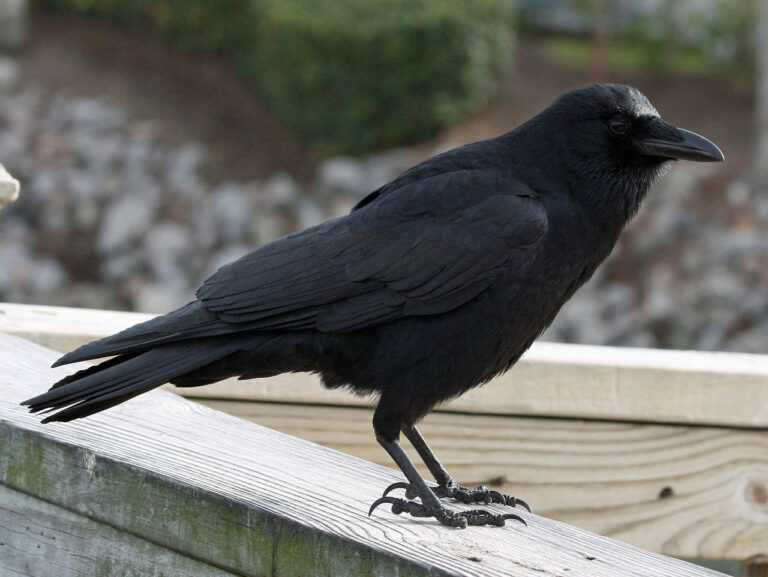
The most common ID challenge among black birds. Both species are all-black with stout bills, but several features distinguish them.
Size: Ravens are significantly larger (24 inches vs 17.5 inches for crows). The size difference is obvious when seen together but harder when seen separately.
Tail shape: Crows have rounded fan-shaped tails. Ravens have distinctive wedge-shaped tails (visible in flight).
Bill: Ravens have heavier, more massive bills. Crows have slimmer bills.
Voice: Crows say ‘caw-caw.’ Ravens make deeper ‘cronk-cronk’ or ‘gronk’ sounds.
Behavior: Ravens soar more often (like hawks). Crows flap continuously. Ravens are often in pairs or family groups; crows often in larger flocks.
Range: Crows are common everywhere in the US. Ravens are more common in the West, Northeast, and remote areas. Suburban areas typically have crows; wilderness areas often have ravens.
Common Grackle
A common backyard bird often mistaken for a ‘black bird.’ In good light, Common Grackles show stunning iridescent purple-blue-green sheens, they’re not actually solid black. Key features: long keel-shaped tail, bright yellow eye, and a sturdy black bill.
Range: Eastern US year-round (some winter migration south).
Habitat: Open habitat, lawns, parks, agricultural fields, backyards.
Key ID: Iridescent dark body + long keel-shaped tail + yellow eye. Larger than Red-Winged Blackbirds.
Where to see: Common backyard visitor. Often in noisy flocks. Will visit any feeder with corn, sunflower, or peanut pieces. Can be aggressive toward smaller birds.
Red-Winged Blackbird
One of the most abundant birds in North America. Male Red-Winged Blackbirds are jet-black with bold red shoulder patches (called epaulets) bordered with yellow, visible especially in flight or display. Females are streaky brown overall (look like large sparrows).
Range: Continent-wide year-round.
Habitat: Wetlands, marshes, fields, roadsides. Almost any open habitat with cattails.
Key ID: Black body + red shoulder patches = male Red-Winged Blackbird. Females totally different, brown-streaked, sparrow-like.
Where to see: Listen for their ‘konk-la-ree’ song from cattails in spring. Will visit feeders for sunflower and corn.
European Starling
An invasive species (introduced from Europe in 1890), now one of North America’s most abundant birds. In summer, adults are iridescent purple-green-black with bright yellow bills. In winter, they’re heavily spotted with white tips on dark feathers.
Range: Continent-wide year-round.
Habitat: Cities, suburbs, farms, almost any human-modified habitat.
Key ID: Bright yellow bill (summer) + iridescent purple-green coloration. Stockier than blackbirds. Walks (doesn’t hop).
Where to see: Common in cities and suburbs. Can monopolize feeders.
Brown-Headed Cowbird
A nest parasite that lays eggs in other species’ nests. Male Brown-Headed Cowbirds have a glossy black body with a chocolate-brown head. Females are uniform gray-brown.
Range: Continent-wide year-round.
Habitat: Open habitat, agricultural fields, edges of forests.
Key ID: Black body + brown head = male Brown-Headed Cowbird. The brown head is matte (not iridescent).
Where to see: Common backyard visitor. Listen for their gurgling song. Sometimes seen following cattle (their original habit, hence ‘cow’ bird).
Boat-Tailed Grackle
A larger southern grackle. Male Boat-Tailed Grackles are glossy black with a very long keel-shaped tail (longer proportionally than Common Grackle). Females are warm brown.
Range: Atlantic and Gulf Coasts.
Habitat: Coastal areas, marshes, saltwater habitats, parking lots near coast.
Key ID: Very long keel-shaped tail + glossy black + larger than Common Grackle. Range is mostly coastal.
Where to see: Coastal Southeast. Often in parking lots near beaches and marshes.
Great-Tailed Grackle
Similar to Boat-Tailed but ranges into the Southwest. Male Great-Tailed Grackles are similarly long-tailed and glossy black, often even larger than Boat-Tailed. Range expanding rapidly northward.
Range: Southwestern US, expanding north into Midwest.
Habitat: Open areas, agricultural lands, parks, parking lots.
Key ID: Very long tail + large size + glossy black. Often in noisy flocks.
Where to see: Common in Southwestern cities and towns. Now reaching Midwest.
Brewer’s Blackbird
A common western blackbird. Male Brewer’s Blackbirds are glossy black with subtle purple-green iridescence and a bright yellow eye. Females are dull dark brown.
Range: Western US year-round.
Habitat: Open habitat, parking lots, golf courses, fields.
Key ID: Glossy black + yellow eye + smaller than grackles. Common in parking lots in the West.
Where to see: Western cities and towns. Like Common Grackles in the East, they’re often the dominant blackbird species in open habitats.
Yellow-Headed Blackbird
An unmistakable bird. Male Yellow-Headed Blackbirds have a brilliant yellow head and breast contrasted against jet-black body and wings (with white wing patches visible in flight). Females are duller brown with yellow throat.
Range: Western and central US in summer. Migrates south for winter.
Habitat: Marshes with tall vegetation (cattails, reeds).
Key ID: Yellow head + black body = unmistakable. Larger than Red-Winged Blackbird.
Where to see: Western marshes in summer. Listen for their distinctive raspy ‘song’ (sounds more like a rusty gate than a bird song).
Rusty Blackbird
A declining species in conservation focus. In winter, Rusty Blackbirds show distinctive rust-colored edges on their black feathers (giving them a ‘rusty’ look). In summer breeding plumage, males are glossy black.
Range: Breeds in northern forests; winters in southeastern US.
Habitat: Wooded wetlands, swamp forests.
Key ID: Rust-edged feathers in winter (only blackbird with this pattern). Pale yellow eye.
Where to see: Increasingly rare. Conservation concern (population declined 85% since 1970s).
Black Phoebe
Not closely related to blackbirds but appears similarly black. Black Phoebes are flycatchers with a solid black head, breast, and back contrasted with a clean white belly. Often seen near water.
Range: Southwestern US and California.
Habitat: Near water, streams, ponds, fountains, irrigated areas.
Key ID: Black above + white below + flycatcher behavior (sallies from perch to catch insects).
Where to see: Watch for them near water, especially around buildings and fountains. Often perches on low branches and fence posts.
Black Birds and Backyard Feeding
Many backyard birders consider black birds ‘nuisance’ species because they monopolize feeders and exclude smaller songbirds. Here’s how to manage their presence:
To exclude blackbirds, grackles, and starlings: Use caged or weight-triggered feeders that exclude larger birds.
Switch to safflower seed instead of sunflower, blackbirds and grackles dislike it while cardinals, finches, and chickadees readily eat it.
Use upside-down suet feeders that starlings can’t access.
Avoid corn and mixed seed with cracked corn, these are blackbird/grackle favorites.
If you want to attract Red-Winged Blackbirds or Yellow-Headed Blackbirds (uncommon enough to be desirable in many yards), offer cracked corn and platform feeders in early spring.
Crows and ravens rarely visit feeders but may be attracted to peanut offerings or scraps.
Frequently Asked Questions
How do I tell a crow from a raven?
Size, tail shape, voice, and behavior. Ravens are significantly larger (24 inches vs 17.5 inches for crows), have wedge-shaped tails (vs fan-shaped for crows), make deeper ‘cronk’ sounds, and often soar like hawks. Crows are more common in suburban areas; ravens in wilderness.
What are those iridescent purple-black birds in my yard?
Most likely Common Grackles. They appear black at a distance but show stunning iridescent purple-blue-green sheens in good light. Look for the long keel-shaped tail and bright yellow eye to confirm.
Are starlings native to North America?
No. European Starlings were introduced to New York in 1890 by Shakespeare enthusiasts who wanted all birds mentioned in Shakespeare’s plays to live in the US. They’re now one of North America’s most abundant birds, and considered invasive.
Why are blackbirds bad at feeders?
Blackbirds (especially European Starlings and Common Grackles) are aggressive, larger than most songbirds, and quickly monopolize feeders. They eat enormous quantities of seed and may drive smaller birds away. Many birders use specialty feeders designed to exclude them.
Do crows and ravens eat at bird feeders?
Rarely at standard bird feeders. Crows occasionally take peanuts in shell or kitchen scraps from platform feeders or yards. Ravens almost never visit feeders. Both species prefer other food sources.
What’s a ‘parasitic’ blackbird?
Brown-Headed Cowbirds are brood parasites, they lay their eggs in other birds’ nests, leaving the host species to raise the cowbird chicks. This often reduces success of native songbird species.
Why is the Rusty Blackbird declining?
Rusty Blackbirds have declined approximately 85% since the 1970s, one of the steepest declines of any North American bird species. Causes include wetland habitat loss, mercury contamination, and forest changes in their breeding range.
Related reading: Black and White Birds.