Merlin (Falcon): Identification Guide
The merlin is a small, compact, dark falcon known for hunting small birds with fast, aggressive, low-altitude chases rather than the high dives typical of a peregrine falcon far above. Once called the pigeon hawk in North America, despite not being closely related to hawks at all in any meaningful taxonomic sense, the merlin is bigger than an American kestrel but noticeably smaller than a peregrine, and its heavily streaked underside and dark, direct flight style make it a distinctive presence over open country and increasingly over cities in winter.
| Fact | Detail |
|---|---|
| Size | Between American kestrel and peregrine falcon |
| Wingspan | 2 to 2.25 ft |
| Diet | Small birds, caught in fast, low pursuit flight |
| Hunting style | Direct, aggressive low-altitude chase, not high dives |
| Range | Breeds in northern forests, winters across much of the US |
| Former name | Pigeon hawk (not a true hawk) |
What Is a Merlin?
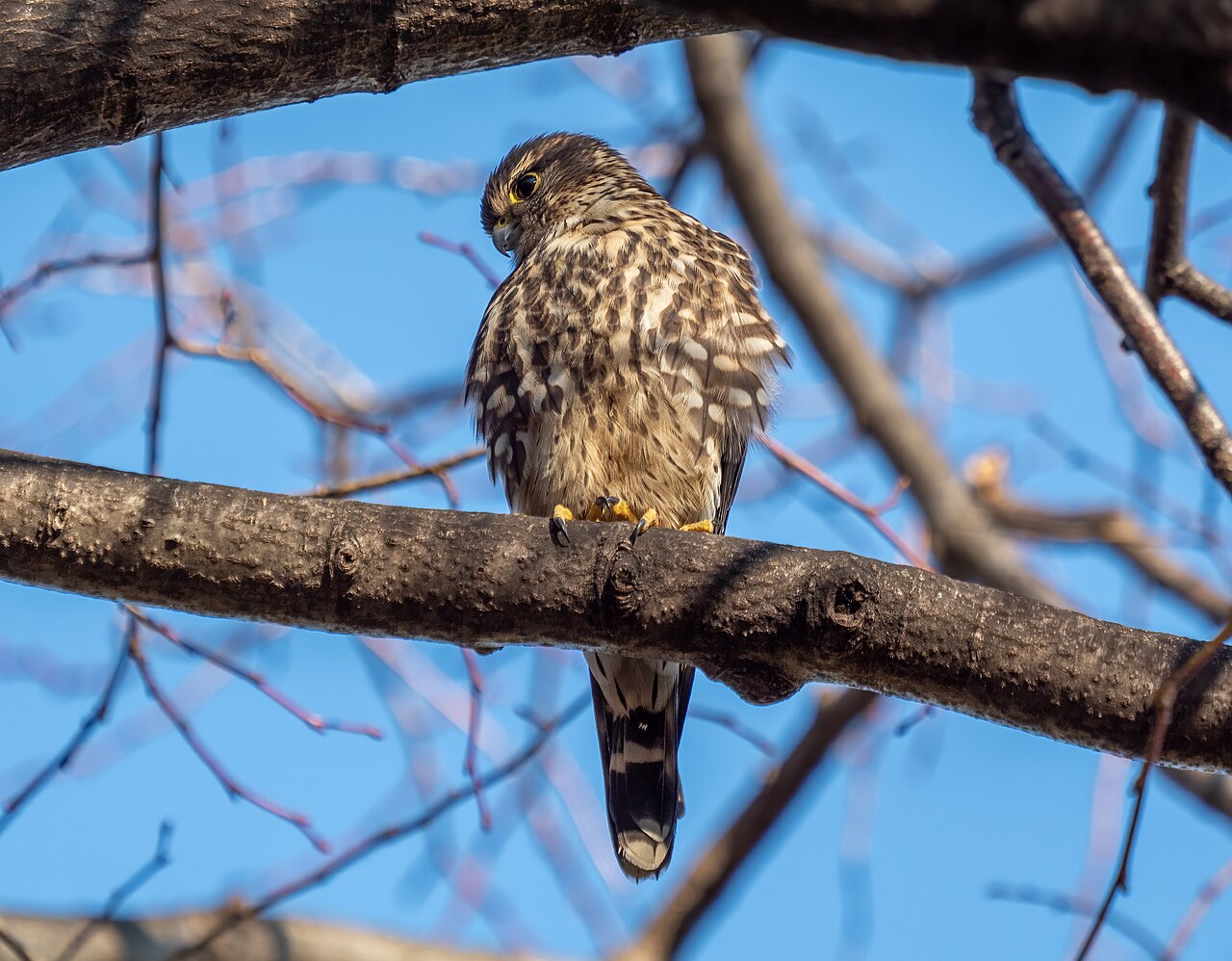
A merlin is a small falcon, larger than an American kestrel but smaller and noticeably stockier than a peregrine falcon, with a dark brown or slate-gray back depending on the individual and sex, and a heavily streaked, buffy underside. The historical North American name, pigeon hawk, reflects an old, imprecise use of “hawk” for almost any small bird of prey rather than any close relationship to true hawks, which belong to an entirely different family. Merlins lack the bold facial mustache mark that defines a peregrine falcon, showing instead a much fainter, less contrasting face pattern, and their tail is marked with several narrow pale bands rather than being mostly solid colored like some of their falcon relatives. In flight, a merlin’s wingbeats are quick and powerful, giving it a determined, direct flight style quite different from a kestrel’s light, hovering flight, and one that experienced birders often learn to recognize before any plumage detail comes into view.
Size and Appearance
A merlin measures roughly 9 to 13 inches long with a wingspan around two to two and a quarter feet, placing it firmly between the sparrow-sized American kestrel and the crow-sized peregrine falcon in overall bulk, a middle ground that still surprises birders expecting something closer in size to one extreme or the other. Males tend to have a more blue-gray back, while females and juveniles are typically darker brown, though individual variation and several recognized subspecies mean coloration can differ noticeably across a merlin’s range and even within a single wintering flock of songbirds it might be hunting. The chest and belly are heavily streaked with dark brown or rufous markings against a paler background, without the clean barring pattern seen on a peregrine’s underside. Overall, a merlin has a stockier, more thickset build than either the kestrel or peregrine, contributing to its reputation as a compact, powerfully built hunter despite its modest overall size.
Merlin vs. Peregrine Falcon
The most reliable way to separate a merlin from a peregrine falcon is size and facial pattern: a peregrine is noticeably larger, roughly crow-sized, with a bold black mustache mark below the eye, while a merlin is smaller, stockier, and shows only a faint, indistinct facial pattern by comparison. Hunting style offers a second clue, since peregrines specialize in high-altitude stoops that can exceed 240 miles per hour, while merlins hunt with fast, direct, low-altitude chases that rarely involve dramatic vertical dives. Habitat and season help too. Merlins are more likely seen low over open fields, coastlines, or even suburban yards in winter, actively pursuing songbirds at flock level, while peregrines are more associated with cliffs, bridges, and tall city buildings. Range overlaps broadly, so behavior and build are usually more reliable field marks than location alone.
Diet and Hunting Style
Merlins hunt almost exclusively small birds, including sparrows, shorebirds, and other songbirds, using a fast, direct, low-level pursuit rather than the high stoop favored by a peregrine falcon. A hunting merlin often flies just above the ground or water, using cover and speed to close the distance on a flock before the birds can scatter effectively, then singles out and overtakes one individual in a tail chase that can cover a surprising distance before the outcome is decided. This aggressive, sustained pursuit style demands stamina and maneuverability rather than the raw top speed a peregrine relies on, and it makes merlins particularly effective against flocking species like shorebirds along open coastlines. Merlins occasionally take large insects as well, especially dragonflies, but birds make up the overwhelming majority of their diet across nearly all of their range, a specialization shared with several other agile birds of prey, and one that demands the kind of sustained speed and stamina few other small raptors can match over a prolonged chase.
Range and Migration
Merlins breed across the boreal forests of Canada and the northern United States, then migrate south for winter to a range spanning most of the continental US, coastal areas, and as far as South America, making them a familiar winter visitor well outside their breeding range. Coastal areas and open shorelines are particularly attractive to wintering merlins, since shorebird flocks concentrated along beaches and mudflats provide a reliable, abundant food source through the colder months when songbirds elsewhere become harder to find in open numbers. In recent decades, merlins have also become increasingly common in suburban and urban settings during winter, following the same shift toward city living seen in peregrine falcons, likely drawn by concentrations of songbirds at feeders and roosting flocks of starlings. For the full falcon lineup found across North America, see our falcon species guide, and for related small raptors, our guide to the American kestrel.
Conservation Status
Like many raptors, merlin populations declined through the mid twentieth century due to the pesticide DDT, though the species was never as severely affected as the peregrine falcon, likely because merlins hunt smaller songbirds lower on the food chain rather than the larger prey that concentrated more pesticide residue. According to the Cornell Lab of Ornithology, merlin numbers have increased significantly across much of North America in recent decades, aided both by the DDT ban and by the species’ flexibility in adapting to human-altered landscapes, including suburban winter habitat. Merlins are not currently considered threatened anywhere in their range, and their expanding presence in cities and suburbs during winter has made them one of the more frequently reported small falcons on birding checklists in areas where they were once considered uncommon.
Merlin Subspecies and Regional Variation
North America is home to three recognized merlin subspecies, often loosely grouped by birders as the darker “black” merlin of the Pacific Northwest coast, the paler “prairie” merlin of the Great Plains and interior west, and the intermediate “taiga” merlin found across the boreal forest belt that stretches from Alaska to Newfoundland. These populations differ mainly in overall darkness and the boldness of facial markings rather than size, and where their ranges meet during migration or winter, individual birds can show a confusing mix of features that make precise subspecies identification difficult even for experienced birders. Regardless of subspecies, hunting style and overall structure remain consistent across the species, which is why build and behavior are more reliable identification tools than plumage tone alone when separating a merlin from other similarly sized falcons, particularly in regions where two subspecies’ winter ranges overlap.
Frequently Asked Questions
What is a merlin falcon?
A merlin is a small, dark, powerfully built falcon known for chasing down small birds in fast, low, direct flight rather than hunting from a high dive.
How big is a merlin compared to a peregrine falcon?
A merlin is noticeably smaller and stockier than a peregrine falcon, roughly between an American kestrel and a peregrine in overall size, with a wingspan of about 2 to 2.25 feet.
What is the difference between a merlin and a peregrine falcon?
Merlins are smaller, lack a peregrine’s bold facial mustache mark, and hunt with fast, low, direct chases rather than the peregrine’s signature high-speed diving stoop.
What do merlins eat?
Merlins eat almost exclusively small birds, such as sparrows and shorebirds, caught through fast, low, sustained pursuit flight, with occasional large insects like dragonflies.
Why was the merlin called a pigeon hawk?
The name pigeon hawk was an old, imprecise North American term for the species, reflecting general folk usage of “hawk” for small birds of prey rather than any true relationship to hawks.
Where do merlins live in winter?
Merlins winter across most of the continental United States, coastal areas, and as far south as South America, often concentrating near coastlines with abundant shorebird flocks.
Do merlins live in cities?
Yes, merlins have become increasingly common in suburban and urban areas during winter, drawn by concentrations of songbirds around feeders and roosting flocks.