Small Birds: Common Backyard Species and How to Identify Them
Small birds in US backyards fall into a handful of easily learned groups: chickadees and titmice (small, active, often upside-down foragers), sparrows (streaky brown, ground-feeding), warblers (small, often colorful, mostly seasonal), wrens (tiny, loud, tail cocked upward), and finches (conical bill, often colorful males). Learning to sort a small, unfamiliar bird into one of these groups first, before worrying about the exact species, makes identification dramatically faster and less overwhelming for anyone starting out, and this same sorting habit continues to pay off even after you’ve moved well beyond the beginner stage.
| Group | Key Field Marks | Common Example |
|---|---|---|
| Chickadees/Titmice | Black cap, active, forages upside-down | Black-capped chickadee |
| Sparrows | Streaky brown, ground-feeding, conical bill | Song sparrow |
| Warblers | Small, thin bill, often colorful, seasonal | Yellow warbler |
| Wrens | Tiny, loud song, tail cocked up | House wren |
| Finches | Thick conical bill, males often colorful | House finch |
| Nuthatches | Climbs down trees headfirst | White-breasted nuthatch |
Chickadees and Titmice: The Backyard Regulars
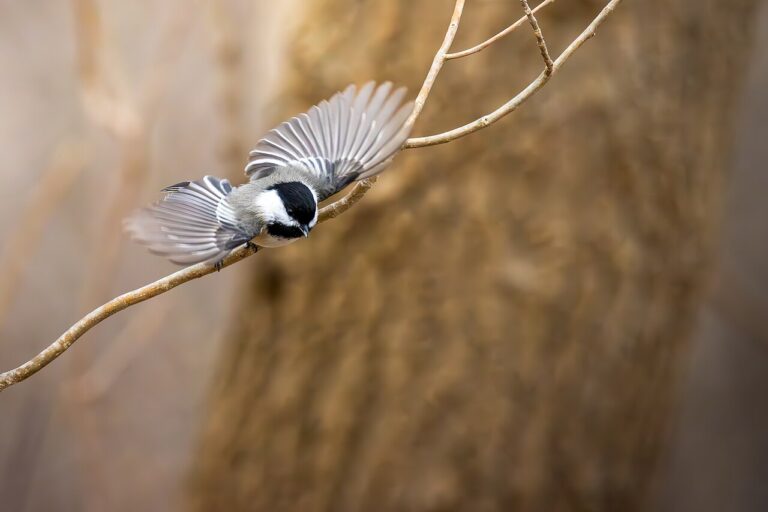
Chickadees are among the easiest small birds to learn first: black-capped chickadees have a black cap and throat separated by white cheeks, a gray back, and pale belly, and they’re famously acrobatic, often hanging upside-down from branches and feeders while foraging for insects and seeds. Tufted titmice, close relatives found in the eastern half of the country, share a similar small, active build but show a gray crest, large dark eyes, and a soft peach-colored wash on the flanks instead of a black cap. Both groups are common at suet and sunflower feeders year-round and are typically the boldest, least skittish small birds in most backyards.
Sparrows: Streaky Brown Ground-Feeders
Sparrows are frequently dismissed as “little brown jobs,” but most common backyard sparrows can be told apart with practice. Song sparrows show heavy brown streaking on a white breast that converges into a central dark spot, house sparrows (actually an unrelated Old World species) have a gray crown and black bib on males, and white-throated sparrows show a crisp white throat patch and yellow spot between the eye and bill. Nearly all sparrows feed primarily on the ground or low in shrubs, scratching through leaf litter or hopping under feeders to pick up dropped seed rather than perching directly on feeder ports.
Warblers: Small, Colorful, and Often Seasonal
Warblers are among the smallest and often most colorful backyard visitors, but many species are only present briefly during spring and fall migration, making them a seasonal rather than year-round identification challenge. The yellow warbler, one of the most widespread, is a solid bright yellow with faint reddish streaking on the breast in males, while the common yellowthroat shows a bold black mask on an otherwise yellow-and-olive body. Because warblers move quickly through foliage and rarely sit still, learning their distinctive high-pitched songs is often more useful for identification than visual cues alone.
Wrens: Tiny, Loud, and Full of Personality
Wrens are some of the smallest common backyard birds but punch well above their size in volume, producing surprisingly loud, bubbling songs from dense cover. The house wren is plain brown overall with faint barring on the wings and tail, almost always held cocked upward at a steep angle, a posture that alone helps separate wrens from most other small brown birds. Wrens are cavity nesters and readily use small nest boxes, making them one of the easier small birds to attract deliberately to a yard, provided the box is placed away from open lawn and closer to the dense brush and shrub cover the species strongly prefers for both nesting and general foraging activity.
Finches: Conical Bills and Colorful Males
Finches are built for cracking seeds, with a distinctly thick, conical bill that sets them apart from the thinner bills of warblers and sparrows. House finches, now common at feeders across the entire country, show males with red coloring concentrated on the head and breast over a brown, streaky body, while American goldfinches turn a brilliant, unmistakable yellow with a black cap and wings during breeding season, then molt to a duller olive color for winter. Finches are highly social at feeders, often gathering in loose flocks that tolerate close proximity to each other, quite unlike the more solitary, shrub-dwelling behavior typical of the gray catbird, which rarely visits open feeders at all.
Nuthatches: The Upside-Down Tree Climbers
White-breasted and red-breasted nuthatches are distinctive for a behavior more than a color: both species regularly climb head-first down tree trunks, a posture almost no other common backyard bird uses. White-breasted nuthatches are larger with a white face and breast and a blue-gray back, while red-breasted nuthatches are smaller with a rusty-orange breast and a bold black eye stripe. This head-down foraging style allows nuthatches to spot insects hidden in bark crevices that birds climbing upward might miss, giving them access to a food source that woodpeckers and other bark-foraging species, which almost always work their way up a trunk rather than down, tend to overlook entirely.
How to Start Identifying an Unfamiliar Small Bird
When faced with a small, unfamiliar bird, start by sorting it into a broad group using bill shape and behavior rather than trying to match colors first: a thick conical bill suggests a finch or sparrow, a thin pointed bill suggests a warbler or wren, and head-first tree-climbing points directly to a nuthatch. From there, narrow down using color pattern, especially on the head and face, since this is where most small bird species show the clearest distinguishing marks. For more specific identification help by color group, see our guide to identifying blue-colored backyard birds.
Why Small Bird Identification Gets Easier With Practice
According to the Cornell Lab of Ornithology, most new birders find that identification skill develops in a predictable pattern: the first dozen or so species learned take the most effort, but recognizing broad groups by silhouette, behavior, and general color pattern becomes increasingly automatic after that, even before every fine detail is memorized. This is part of why starting with common, easily learned species like chickadees and cardinals builds a foundation that makes trickier groups, like sparrows and warblers, considerably less intimidating once you’ve internalized the basic sorting process of bill shape, behavior, and habitat.
Small Birds vs Their Larger Look-Alikes
Some small birds are frequently mistaken for scaled-down versions of larger, more familiar species, and understanding these mix-ups can prevent a lot of misidentification. A female red-winged blackbird, despite technically being classified as a blackbird rather than a small songbird, is often reported as an oversized sparrow due to her streaky brown plumage. Similarly, the purple finch is regularly confused with the smaller, more common house finch despite belonging to the same finch family, and even birds as visually distinct as the Eastern phoebe get mistaken for various small brown birds until their tail-wagging habit gives them away. Learning these common points of confusion ahead of time saves considerable frustration compared to discovering them one by one through trial and error in the field. For a broader look at colorful backyard species that pair well with these smaller birds in a diverse yard, see our guide to identifying blue-colored backyard birds.
Frequently Asked Questions
What are the most common small birds in a US backyard?
The most common groups are chickadees and titmice, sparrows, finches, wrens, and seasonally warblers, each with distinct bill shapes and behaviors that make identification easier once learned.
How can I tell a sparrow from a finch?
Finches have a thicker, more conical bill and often show bolder color in males, while most sparrows are streaky brown overall with a more subtly patterned head that rewards a closer look.
Why do some small birds climb down trees headfirst?
Nuthatches climb down trees headfirst to spot insects hidden in bark crevices that birds foraging upward might overlook, a foraging style unique among common backyard birds and a strong identification clue on its own.
Are warblers year-round backyard birds?
Most warblers are only present seasonally during spring and fall migration, with far fewer species remaining to breed locally through summer depending on your region and available habitat.
What is the easiest small bird to identify?
The black-capped chickadee is often considered one of the easiest, thanks to its distinctive black cap and throat, active behavior, and consistent presence at feeders year-round in most of its range.
How do you identify an unfamiliar small brown bird?
Focus on the head pattern first, crown color, eye stripes, and throat markings, since overall body color and streaking are broadly similar across many small brown species like sparrows.
Why do wrens hold their tails cocked upward?
It’s a natural resting posture for the group and, combined with their small size and loud song, is one of the most reliable ways to distinguish a wren from other small brown birds.