Hummingbirds: The Complete Guide to Feeding, Attracting & Identification
A hummingbird is the smallest bird most people will ever see in their lifetime, and arguably the most extraordinary animal that visits a backyard. They weigh less than a nickel, beat their wings 50 times per second, hover in place like helicopters, and migrate thousands of miles across open water. One sugar water feeder hung at the right time of year transforms most yards into a hummingbird stop. This guide covers everything: which species visit which regions, how to set up your first feeder, the exact sugar water recipe that’s safe and effective, cleaning schedules, the plants that keep hummingbirds returning, and how to troubleshoot every common problem from ants to aggressive feeders to disappearing birds.
What Hummingbirds Actually Are
Hummingbirds are a family of tiny, nectar-drinking birds (Trochilidae) found only in the Americas. They’re the only birds in the world capable of true hovering flight and the only birds that can fly backward. Most species are tropical, there are over 350 hummingbird species, but the vast majority live in Central and South America. The United States and Canada host about 17 species that occur regularly, plus a handful of rare vagrants that occasionally show up far from their normal range.
What makes hummingbirds biologically remarkable comes down to their metabolism. A hummingbird’s heart beats over 1,200 times per minute in flight, and they consume roughly half their body weight in nectar every day to fuel it. They enter a state called torpor on cold nights, dropping their body temperature and heart rate to conserve energy. That extreme physiology is why your sugar water feeder is so reliably attractive, hummingbirds genuinely need consistent calorie sources, and they remember where they found them.
The other side of hummingbird life is the part most beginners don’t realize: they’re aggressive territorial birds, despite their small size. A single hummingbird will defend a feeder against all comers, chase off rivals with dive-bombs and sharp clicking calls, and patrol a perimeter from a favorite perch. The drama at a busy hummingbird feeder is constant and entertaining.
If you’re new to backyard birding overall, the complete beginner’s guide covers the broader setup. This guide goes deep on the hummingbird specifics.
Hummingbird Species in North America
Different hummingbirds live in different parts of the continent, and knowing which species occur in your region matters because each has different timing, behaviors, and preferences. The species you’ll see depends almost entirely on where you live.
Ruby-Throated Hummingbird
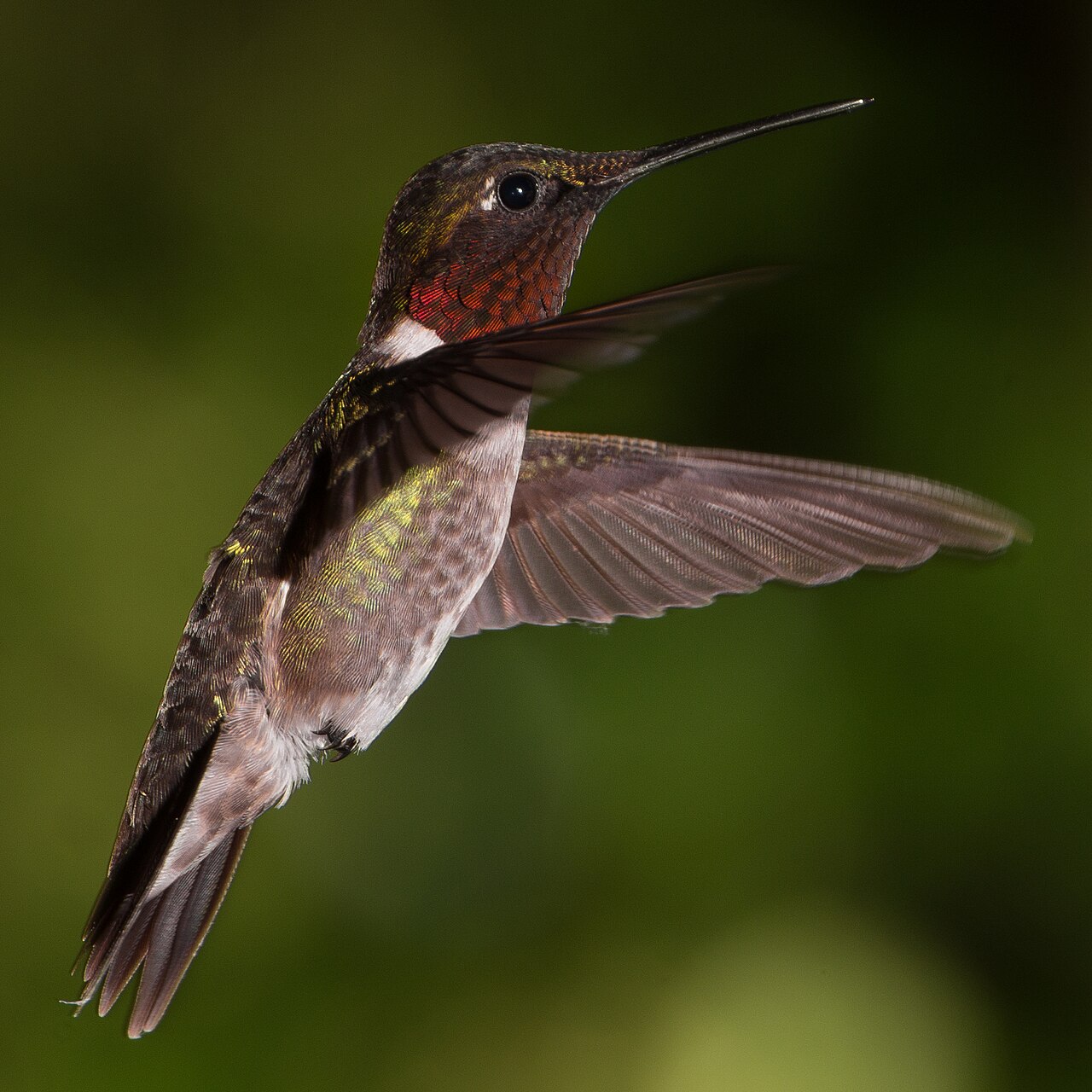
The Ruby-Throated is the only common breeding hummingbird in eastern North America, essentially every state east of the Great Plains. The male has a brilliant iridescent red throat (gorget); the female is plain white-throated with green back and white belly. If you live east of the Rockies and see a hummingbird, it’s almost certainly a Ruby-Throated. They arrive in spring (March in the Deep South, April through Texas and the Mid-Atlantic, May in the upper Midwest and New England) and leave by mid-October.
The Ruby-Throated’s most extraordinary feat is its non-stop trans-Gulf migration: many individuals fly directly across the Gulf of Mexico (500+ miles of open water) without stopping. They double their body weight in fat before the crossing.
See the Ruby-Throated Hummingbird species guide for the full deep-dive.
Anna’s Hummingbird
Anna’s Hummingbird is the year-round West Coast hummingbird, common from southern Alaska through California, expanding its range as climate and urban gardens have changed. The male’s head and throat are vivid magenta-pink in good light, glittering like a small jewel. Unlike most hummingbirds, Anna’s doesn’t migrate; in mild West Coast climates, they overwinter and even breed in midwinter.
Rufous Hummingbird
The Rufous is the long-distance migration champion. They breed in the Pacific Northwest and Alaska, further north than any other hummingbird in the world, and migrate to Mexico every winter, a round trip of over 4,000 miles. Males are brilliant orange-rufous overall; females are green-backed with rufous flanks. Rufous Hummingbirds are notoriously aggressive at feeders and will dominate other species during migration stops.
Black-Chinned Hummingbird
The western counterpart to the Ruby-Throated. Common throughout the western United States during summer breeding. Males have a black throat with a thin purple band at the base; females are similar to Ruby-Throated females and difficult to distinguish in the field.
Other Species
Beyond these four, several species occur regularly in specific regions: Allen’s Hummingbird (California coast), Calliope Hummingbird (the smallest US bird, mountain West), Broad-Tailed Hummingbird (Rocky Mountains), Costa’s Hummingbird (Southwest deserts), and Buff-Bellied Hummingbird (south Texas and Gulf Coast). Several rare visitors from Mexico occasionally show up at feeders in southeastern Arizona and west Texas, a major draw for traveling birders.
See the complete hummingbird species guide for region-by-region breakdowns and identification details.
How to Set Up a Hummingbird Feeder
A hummingbird feeder is a small reservoir of sugar water with feeding ports designed for hummingbird bills and tongues. A single well-placed feeder is enough to attract hummingbirds in most yards, the trick is choosing the right feeder, filling it correctly, placing it well, and maintaining it on schedule.
Choosing a Feeder
Two basic designs dominate the market:
Saucer feeders are flat, low-profile dishes with feeding ports on top. Pros: easier to clean, harder for bees and wasps to access, less likely to leak. Cons: smaller capacity, less visible from distance.
Vacuum (bottle) feeders are upside-down bottle reservoirs with ports on the bottom. Pros: larger capacity, classic look, very visible. Cons: more parts to clean, can leak in heat, easier for bees to find.
For beginners, saucer-style feeders (like the Aspects HummZinger HighView or Birds Choice models) are the easier recommendation. They’re easier to clean, less likely to drip, and have built-in ant moats on most models.
Capacity matters surprisingly little, even a “large” 32-oz feeder rarely needs to be filled to capacity. A heavily-visited 8-oz feeder needs refilling every 2 to 3 days anyway, which is the same cleaning interval as a 32-oz feeder. Match the feeder size to your traffic, not the other way around.
We compare specific feeder models in the best hummingbird feeders guide.
Where to Hang the Feeder
Placement matters more than feeder choice. The three things hummingbirds want from a feeder location: visible flight approach, partial shade, and a nearby perch.
- Visibility. Hummingbirds find feeders by sight, attracted to the red color of the feeder itself. Hang in an open area where the feeder is visible from a distance, especially during the first weeks after setup.
- Partial shade. Direct full-day sun cooks sugar water, it ferments and becomes harmful within hours in hot weather. Morning sun with afternoon shade is ideal. Full shade is fine.
- A perch nearby. Hummingbirds prefer a bare twig or wire within 10 to 15 feet of the feeder to use as a perch for surveying and chasing rivals.
Height: 4 to 6 feet off the ground is typical. Too low and you’re inviting predator harassment; too high and you can’t see and clean the feeder easily.
The dedicated hummingbird feeder placement guide covers the nuances by yard type and species.
The Sugar Water Recipe (Get This Right)
This is the most important section of the guide. The correct hummingbird nectar is a 1:4 ratio of white granulated sugar to water, and nothing else. That’s it. No red dye, no honey, no commercial mixes, no organic alternatives, no “improved” recipes.
The exact preparation:
- Measure 1 part white granulated sugar to 4 parts water. A common batch size: 1 cup sugar to 4 cups water.
- Heat the water until just before boiling (no need to actually boil) to dissolve the sugar fully and reduce bacterial load.
- Stir until completely dissolved.
- Cool to room temperature before filling the feeder.
- Refrigerate any unused portion in a sealed container, it keeps about 2 weeks.
Why Each Rule Matters
White sugar only. Hummingbirds evolved with the simple sucrose found in flower nectar. White granulated sugar is functionally identical. Brown sugar, raw sugar, turbinado, and powdered sugar contain trace iron and minerals that hummingbirds cannot process well.
No honey. Honey ferments fast and grows fungus that can kill hummingbirds. Never use it. Same with maple syrup, agave, or molasses.
No red dye. This is the most commonly violated rule. Commercial “hummingbird nectar” with red coloring is unnecessary, the red parts of the feeder itself attract hummingbirds, not the liquid. Red dye (typically Red Dye #40) has not been definitively proven harmful, but Cornell Lab and every major ornithology authority recommend against it as a precaution. There is zero benefit and uncertain risk. Skip it.
No artificial sweeteners. Hummingbirds need the actual calories. Diet sweeteners don’t provide them, and the bird will starve while drinking from your feeder.
Exact 1:4 ratio. This matches the average sucrose concentration of flower nectar. Sweeter mixes (1:3) can stress hummingbird kidneys; weaker mixes don’t provide enough energy.
The complete recipe with troubleshooting is in the dedicated sugar water recipe guide.
Cleaning and Nectar Replacement Schedule
The single biggest health risk for hummingbirds at feeders is fermented or contaminated nectar. Sugar water ferments fast in heat, and fermented nectar causes a fatal tongue infection (avian candidiasis) in hummingbirds. Maintaining a strict cleaning schedule isn’t optional, it’s part of the responsibility of feeding them.
Replacement Frequency by Temperature
The nectar replacement schedule depends on outdoor temperature:
- Below 70°F: Replace every 5 to 7 days
- 70 to 80°F: Replace every 3 to 4 days
- 80 to 90°F: Replace every 2 days
- Above 90°F: Replace daily
These intervals apply even if hummingbirds haven’t drunk all the nectar. Cloudy nectar, bubbles, or floating black spots indicate fermentation, empty and clean the feeder immediately, regardless of schedule.
How to Clean a Hummingbird Feeder
Every refill includes a cleaning, not just a refill. The protocol:
- Empty any old nectar.
- Rinse with hot water.
- Scrub all parts with a bottle brush. Pay particular attention to the feeding ports, black mold accumulates there and can spread back into fresh nectar.
- For deeper cleans (every 2nd refill or weekly), soak parts in a 1:4 vinegar-water solution for 10 to 15 minutes, then scrub.
- Rinse thoroughly with fresh water.
- Air-dry briefly before refilling.
Use a bottle brush small enough to reach all crevices. A set of “hummingbird feeder cleaning brushes” sold for around $10 includes the right sizes. Avoid soap unless absolutely necessary, soap residue is harder to fully rinse than vinegar.
The full cleaning protocol is in the dedicated hummingbird feeder cleaning guide, and the frequency reference covers the schedule in more detail.
Hummingbird Migration and Seasonal Timing
When you put out a hummingbird feeder matters. The first hummingbirds back in spring will visit your feeder within hours if you have it up before they arrive. Late setup misses the window.
Spring Migration Timing
Hummingbirds head north as soon as conditions allow, tracking the seasonal availability of flowers and insects. Arrival timing by region (approximate):
- Gulf Coast and Florida: Late February to early March
- Texas and Mid-South: Mid to late March
- Mid-Atlantic and lower Midwest: Early to mid-April
- Upper Midwest and Mid-New England: Late April to early May
- Northern New England and upper Great Lakes: Early to mid-May
- Canada: Mid-May to early June
The rule of thumb: set out your feeder two weeks before the earliest expected arrival date for your area. Hummingbirds use multiple food sources during migration; a feeder ready when they pass through your yard often becomes a stop they remember.
Hummingbirdcentral.com maintains a year-by-year migration map updated by user reports, the closest thing to a real-time arrival tracker.
Fall Migration Timing
Fall departure is more variable but generally:
- Northern range: Birds leave by mid-September
- Mid-Atlantic and Midwest: Most leave by early October
- Southeast and Texas: Through October, some lingerers into November
- Florida and southern Gulf: Some Ruby-Throateds overwinter; rare western species (Rufous, Black-Chinned) increasingly appear
Keep feeders up at least 2 weeks after you’ve stopped seeing hummingbirds in fall. Late migrants pass through, and an old wives’ tale that feeders prevent migration is exactly that, hummingbirds migrate based on day length and instinct, not feeder availability.
Year-Round Feeding (West Coast)
On the West Coast where Anna’s Hummingbird is resident, feeders stay up year-round. In freezing weather, bring feeders inside at night and put them back out at dawn, or use a feeder with a heating element. Frozen nectar isn’t accessible, and Anna’s depend on consistent food in cold snaps.
Plants That Attract Hummingbirds
A feeder alone attracts hummingbirds. A yard with hummingbird-friendly flowers attracts more hummingbirds, keeps them around longer, and supports them during the parts of the day when feeders aren’t enough. The combination of feeders plus nectar plants is the gold standard hummingbird yard.
The features hummingbirds look for in flowers:
- Tubular shape (matches their long bills and tongues)
- Red, orange, or pink colors (most attractive; they see red especially well)
- Sustained bloom (weeks to months of consistent flowering)
- High nectar production
Top Native Plants for Hummingbirds
The highest-yield plants vary by region, but these stand out across most of North America:
- Trumpet Honeysuckle (Lonicera sempervirens). Native vine with bright red-orange tubular blooms. The single most attractive plant for Ruby-Throated Hummingbirds in the East.
- Bee Balm / Monarda. Tall perennial with red, pink, or purple shaggy blooms. Hummingbird and butterfly magnet.
- Cardinal Flower (Lobelia cardinalis). Brilliant red spikes in late summer. Native to wet areas; thrives along ponds and streams.
- Trumpet Vine (Campsis radicans). Aggressive native vine with large orange-red trumpet flowers. Plant where you can let it spread.
- Salvia (native species). Many native salvias bloom for 8+ weeks with abundant nectar. Salvia greggii, S. coccinea (Texas Sage), and S. spathacea (Hummingbird Sage, California) are standouts.
- Coral Honeysuckle. Native alternative to the invasive Japanese Honeysuckle.
- Columbine (Aquilegia canadensis in East, A. formosa in West). Spring nectar bridge, one of the earliest flowers available when hummingbirds first arrive.
- Penstemon (native species). Region-specific; the West has dozens of native species, many hummingbird-pollinated.
What to Avoid
Some popular garden flowers are actively unhelpful or harmful:
- Hybridized cultivars of native species often have less nectar than the original (selectively bred for appearance, not function)
- Many double-flowered varieties make nectar inaccessible
- Invasive plants like Japanese Honeysuckle and Butterfly Bush can crowd out better natives
For the full breakdown and region-specific plant selection, see the guide to flowers that attract birds and the broader plants-for-birds guide.
Solving Common Hummingbird Feeder Problems
Several issues come up at hummingbird feeders. All are solvable with simple interventions.
Ants
Ants find sugar water within days. Once they find a feeder, they swarm it and contaminate the nectar.
The solution is an ant moat, a small water-filled cup positioned on the hanger above the feeder. Ants can’t cross water, so they’re physically blocked. Most quality hummingbird feeders include built-in ant moats; if yours doesn’t, you can buy a $5 add-on moat that hangs above the feeder.
Never use ant traps or pesticides near a hummingbird feeder. Even residual chemicals can kill hummingbirds. The water moat is the only safe option.
Full troubleshooting in the keep ants out of hummingbird feeder guide.
Bees and Wasps
Bees and wasps are drawn to sugar water just like ants. Bee guards (small mesh or plastic grids over feeding ports) help significantly, blocking access for larger insects while still allowing hummingbird bills through.
Saucer-style feeders are inherently more bee-resistant than vacuum bottle feeders because the nectar sits below the port, bees have to extend their tongues much further to reach it. If bees become a persistent problem, switching to a saucer design usually solves it.
A common myth: yellow attracts bees. Some research suggests yellow accents on feeders may attract more bees, so feeders with all-red coloring (no yellow flowers or accents) may help if you’re battling bee issues. Worth trying, though results vary.
Aggressive Hummingbirds
One dominant hummingbird often monopolizes a feeder, chasing all others away. The solution: add a second feeder out of sight of the first. A single bird can’t defend two feeders that aren’t visible from each other. This effectively doubles your hummingbird capacity.
Some birders run 3 to 4 feeders around a property for the same reason. With enough feeders spaced out, no single bird can dominate, and total hummingbird traffic grows substantially.
Hummingbirds Not Coming At All
If you’ve set up properly and waited 4+ weeks without hummingbird visits:
- Check timing. Are hummingbirds even in your region right now? Migration timing matters.
- Check visibility. Is the feeder visible from above and from passing flight paths? Move to a more open location.
- Check the nectar. Fresh batch made correctly? Fermented nectar repels rather than attracts.
- Check competition. A neighbor with established feeders may be holding the local population.
- Check season. First-year setups often see hummingbirds late in the first season as birds discover the new resource. Patience is part of it.
The dedicated DIY hummingbird feeder guide also covers homemade options if you want to test setups without commercial cost.
Identifying Hummingbirds You See
Identifying hummingbirds is harder than identifying most other birds because they move fast, hover in unpredictable poses, and many species look superficially similar. Identification works best by combining region, sex, and field marks.
The fastest approach:
- Where are you? Region narrows the candidates dramatically. East of the Mississippi means “almost certainly Ruby-Throated.” West Coast means “almost certainly Anna’s.” Specific regions narrow further.
- Is it male or female? Adult males have iridescent throat patches (gorgets) in specific colors and patterns. Females and immatures are duller and harder to distinguish.
- What’s the throat color? Ruby red (Ruby-Throated, Anna’s male), magenta-pink (Anna’s male in good light), orange (Rufous male), black with purple band (Black-Chinned male), brilliant violet (Costa’s male). Females are mostly white-throated with varying spotting.
- What’s the back color? Most species have iridescent green backs; Rufous has rufous-brown.
- Is the bird tail-pumping? Some species (Allen’s, Rufous) pump their tails while hovering at a feeder. Behavior is sometimes the easiest way to confirm.
For a complete identification breakdown, see the bird identification pillar for general principles, and the hummingbird species guide for species-specific details.
Photography and Close Observation
Hummingbirds reward close watching more than almost any other backyard species. A few setup choices put you in position to see them at extraordinary detail.
- Sit close. Hummingbirds habituate quickly to a still human within 5 to 10 feet of a feeder. They’ll feed inches from your face if you don’t move suddenly.
- Use a window feeder. A suction-cup hummingbird feeder mounted on a kitchen or living-room window puts birds at arm’s length.
- Camera basics. Hummingbirds at feeders are achievable with any modern camera or smartphone. Frozen wing motion requires shutter speeds of 1/1500s or faster.
- Time of day. Most active in the hour after dawn and the hour before sunset. Midday activity is lower but consistent.
We cover camera and lens choices in detail in the backyard bird photography guide.
Frequently Asked Questions
What’s the correct sugar water ratio for hummingbird feeders?
1 part white granulated sugar to 4 parts water. Stir until fully dissolved (heating helps). Cool before filling the feeder. No red dye, no honey, no artificial sweeteners, no organic substitutes. This ratio matches natural flower nectar and is the universal recommendation from Cornell Lab and every major ornithology authority.
How often should I change hummingbird nectar?
Every 2 days when temperatures are above 80°F, every 3 to 4 days from 70 to 80°F, every 5 to 7 days below 70°F, and daily above 90°F. Cloudy or bubbling nectar means fermentation, replace immediately regardless of schedule.
Do I need to use red dye in hummingbird nectar?
No. The red parts of the feeder itself attract hummingbirds; the liquid doesn’t need to be colored. Cornell Lab and major bird conservation organizations recommend against red dye as a precaution.
When should I put out my hummingbird feeder in spring?
Two weeks before the earliest expected arrival in your region. Gulf Coast and Florida: late February. Texas and mid-South: mid-March. Mid-Atlantic and lower Midwest: early April. Upper Midwest and New England: late April to early May. Hummingbirdcentral.com tracks live arrivals if you’re unsure.
When should I take down my hummingbird feeder in fall?
At least 2 weeks after your last hummingbird sighting. The myth that feeders prevent migration is false, hummingbirds migrate based on day length and instinct, not feeder availability. Late feeders help straggling migrants.
Why aren’t hummingbirds visiting my feeder?
Common causes: incorrect setup timing (no hummingbirds in your region yet), poor placement (not visible enough), competition from established neighbor feeders, fermented or contaminated nectar, or first-season patience required. Hummingbirds often discover new feeders late in their first season.
How many hummingbird feeders should I put up?
One is enough to attract birds. Multiple feeders (3 to 4 around a property, out of sight of each other) prevent any single hummingbird from dominating and can multiply your total traffic significantly. Quantity also makes the cleaning schedule easier to maintain.
Will hummingbirds find my feeder if it’s hidden?
Possibly, but more slowly. Hummingbirds find feeders by sight, especially during their initial exploration of a new area. A feeder visible from open flight paths is found in days; a feeder tucked under a porch may take weeks or never be discovered.
Can hummingbirds drink from a regular bird feeder or bath?
No. Hummingbird tongues are specialized for tubular flowers and feeder ports. They don’t perch and crack seeds (no bill for it) and only rarely bathe in standard bird baths (some prefer fine mist or shallow moving water specifically).
What if I see a sick hummingbird at my feeder?
Symptoms include fluffed feathers, sluggish behavior, sitting at the feeder for unusually long periods, or visible swelling around the bill or eyes. Take down all feeders immediately, clean thoroughly with vinegar solution, and wait 2 weeks before resuming. Sick hummingbirds typically have fungal infections from contaminated nectar, your maintenance was likely the cause.
Do hummingbirds remember my feeder year-over-year?
Yes. Hummingbirds have remarkable spatial memory and many return to the exact same feeders multiple years in a row. Putting up your feeder at the same time each spring often results in the same individual birds visiting.
Can I attract hummingbirds without a feeder?
Yes, with the right plants. Trumpet Honeysuckle, Cardinal Flower, Bee Balm, native Salvias, and Columbine are highly attractive nectar sources. A yard with several of these plants attracts hummingbirds even without sugar water feeders, especially during peak summer bloom.
Related reading: Hummingbird Sugar Water Recipe.
Related reading: Red Dye in Hummingbird Food.
More in this series: how to attract hummingbirds, what hummingbirds eat, when hummingbirds come back, when hummingbirds leave.
Related reading: hummingbird symbolism and meaning.
Related reading: female hummingbird identification.
Related reading: types of hummingbirds.