Backyard Birds of Florida: 15 Common Species (2026 Identification Guide)
Florida hosts a uniquely tropical-influenced backyard bird community unlike anywhere else in the continental US. The state’s combination of subtropical climate, extensive wetlands, year-round warm weather, and Caribbean proximity creates a bird mix that includes species you won’t find in any other state. Florida is home to one endemic species (Florida Scrub-Jay, found nowhere else on Earth) plus permanent populations of tropical species like White Ibis, Sandhill Crane, Limpkin, and Snail Kite. This guide covers the 15 most common backyard birds across Florida, with the key field marks, regional ranges (panhandle vs central vs south Florida), and attraction strategies tailored to Florida’s unique climate and habitats.
Quick Reference: 15 Common Backyard Birds of Florida
| Species | Size | Key ID Feature | Where in FL |
|---|---|---|---|
| Northern Mockingbird (state bird) | 10″ | Gray-white + white wing flashes + mimics | Statewide |
| Northern Cardinal | 8.5″ | All red (male) + crest + black face mask | Statewide |
| Mourning Dove | 12″ | Tan + long pointed tail + small head | Statewide |
| Common Grackle | 12.5″ | Iridescent purple-blue + keel tail + yellow eye | Statewide |
| Boat-Tailed Grackle | 16.5″ | Very long keel tail + glossy black + coastal | Statewide coast |
| Florida Scrub-Jay (endemic) | 11″ | Blue + gray back + no crest + crestless | Central FL scrub |
| Carolina Wren | 5.5″ | Rust-brown + bold white eyebrow | Statewide |
| Blue Jay | 11″ | Blue crest + black necklace + white below | Statewide |
| Tufted Titmouse | 6.5″ | Gray crest + buff flanks + black eye | Panhandle/N FL |
| Carolina Chickadee | 4.75″ | Black cap + white cheeks + black bib | Panhandle/N FL |
| Red-Bellied Woodpecker | 9.25″ | Red cap + zebra back + tan belly | Statewide |
| Eastern Bluebird | 7″ | Blue back + rust breast + white belly | Statewide |
| Painted Bunting | 5.5″ | Multi-color (male), winter visitor | Winter visitor |
| Ruby-Throated Hummingbird | 3.5″ | Iridescent green back + ruby throat (male) | Statewide warm season |
| White Ibis | 25″ | All white + curved red bill + red legs | Statewide wetlands/yards |
Species Identification
Northern Mockingbird (State Bird)
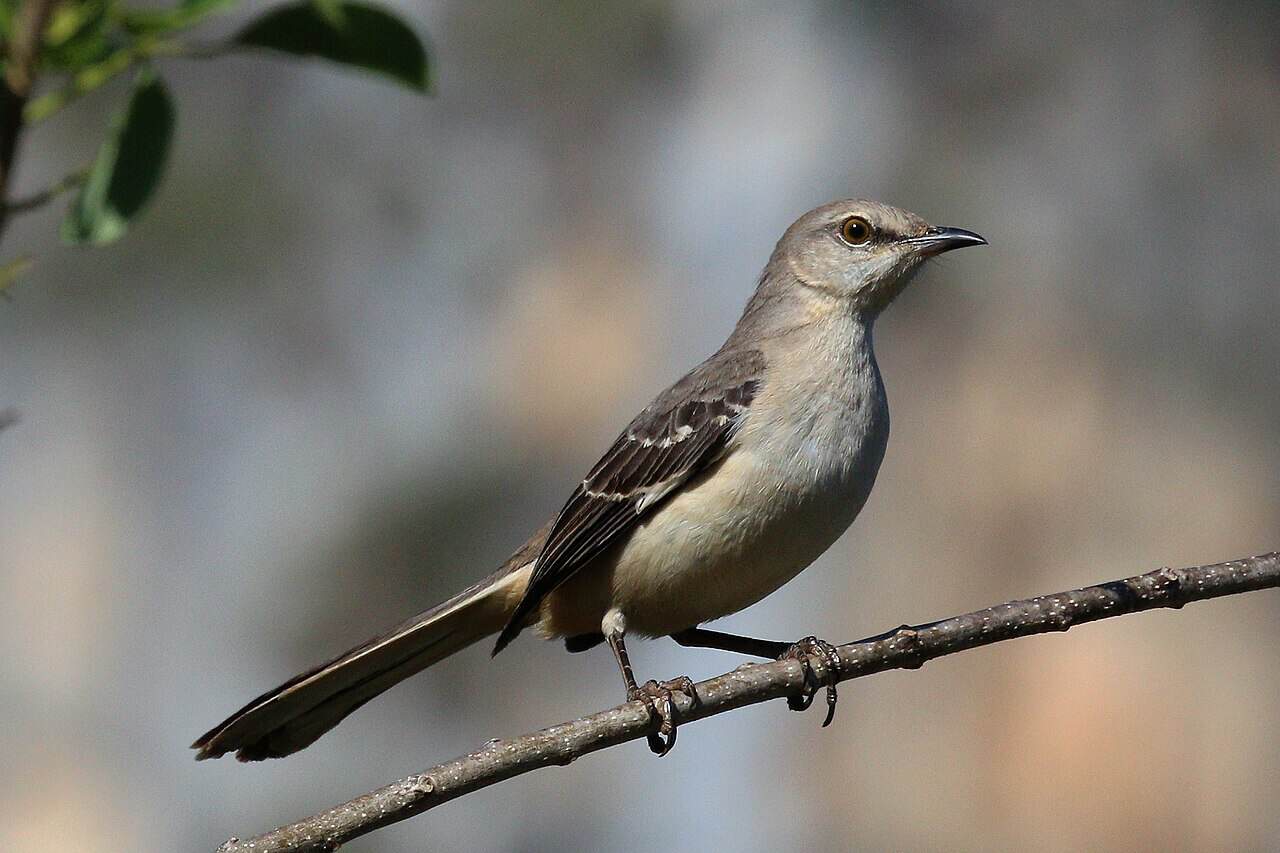
Florida’s official state bird, designated in 1927. Northern Mockingbirds are gray-white with darker wings, bold white wing flashes visible in flight, and a long tail often held cocked upward. Famous for mimicry, a single Florida mockingbird may imitate 100+ other species’ songs plus mechanical sounds like sirens and car alarms.
Range in Florida: Statewide year-round.
Habitat: Suburban yards, parks, edges of natural habitat, urban areas.
Key ID: Gray-white + white wing flashes + long tail. Often singing from prominent perches, sometimes through the night under street lights.
Where to see: Common in every Florida neighborhood. Will visit mealworm and fruit feeders. Plant native berry-producing shrubs like beautyberry and wild coffee.
Florida Scrub-Jay (Endemic Species)
Florida’s only endemic bird, found nowhere else on Earth. Florida Scrub-Jays have bright blue heads, wings, and tails contrasted with grayish-brown backs, pale gray underparts, and a distinctive white eyebrow stripe. Unlike Blue Jays, they have NO crest. Highly social, live in cooperative family groups.
Range in Florida: Central Florida scrub habitat, very localized. Found only in scrub oak habitats in central peninsular Florida.
Habitat: Florida scrub (oak-dominated low-growing dry habitat). Will NOT use lawns, dense forests, or developed areas.
Key ID: Blue + gray back + no crest + white eyebrow. The only crestless blue bird in central Florida. Endangered species, federal protection.
Where to see: Visit dedicated Florida Scrub-Jay preserves like Archbold Biological Station or Merritt Island NWR. They will not typically visit standard suburban backyards. Conservation concern, populations declining due to habitat loss.
Northern Cardinal
Florida’s most beloved year-round red bird. Male Northern Cardinals are brilliant red overall with a pointed red crest, black face mask, and thick orange-red bill. Females are tan-brown with red highlights on crest, wings, and tail. Pairs typically mate for life.
Range in Florida: Statewide year-round.
Habitat: Yards with shrubby cover, parks, edges of forests, gardens.
Key ID: Brilliant red + pointed crest + black face mask + thick orange-red bill (male). The most familiar ‘red bird’ in Florida.
Where to see: Hopper or platform feeders with sunflower or safflower seed. Plant native shrubs for nesting cover. Cardinals prefer dawn/dusk feeding.
Boat-Tailed Grackle
Florida’s coastal grackle with an exceptionally long tail. Male Boat-Tailed Grackles are glossy black with iridescent purple sheen, a very long keel-shaped tail (sometimes longer than the body), and (in northern Florida) yellow eyes. Females are dark brown with paler underparts.
Range in Florida: Statewide along coasts and inland wetlands.
Habitat: Coastal areas, marshes, parking lots near restaurants, urban waterfronts.
Key ID: Very long keel-shaped tail + glossy black + coastal habitat. Larger than Common Grackle.
Where to see: Coastal restaurants, parking lots near beaches, marshes. Will visit feeders aggressively.
Common Grackle
Florida’s second common grackle species. Common Grackles are slightly smaller than Boat-Tailed Grackles with shorter tails. Iridescent purple-blue-green sheen on a dark body, yellow eye, and a long (but not as long as Boat-Tailed) keel-shaped tail.
Range in Florida: Statewide year-round.
Habitat: Open areas, lawns, parks, agricultural fields.
Key ID: Iridescent dark body + yellow eye + keel-shaped tail (shorter than Boat-Tailed). Often in large flocks.
Where to see: Will visit any feeder. Often considered nuisance species, use feeders designed to exclude larger birds if undesirable.
Carolina Wren
Florida’s loudest backyard voice. Carolina Wrens have rich rust-brown upperparts, buff underparts, and a striking bold white eyebrow stripe. Their loud, ringing ‘tea-kettle tea-kettle tea-kettle’ song carries throughout Florida yards year-round. They nest in unexpected places, flower pots, garage corners, hanging baskets.
Range in Florida: Statewide year-round.
Habitat: Wooded yards, gardens with brush, edges of forests.
Key ID: Rich rust color + bold white eyebrow + loud voice. Larger than House Wrens.
Where to see: Common at suet feeders. Provide brush piles for cover. Will use small nest boxes.
Blue Jay
Florida’s familiar crested blue bird. Blue Jays have bright blue heads, wings, and backs (with black markings), white chests, and a prominent blue crest. Loud, intelligent, and dominant at feeders. They cache acorns and pine seeds, common in Florida’s pine and oak yards.
Range in Florida: Statewide year-round.
Habitat: Forests, parks, suburban backyards with trees.
Key ID: Blue + black necklace + prominent crest + white below. The most familiar blue bird in Florida yards.
Where to see: Platform feeders with peanuts in shell, sunflower seed, and corn. Will visit bird baths regularly.
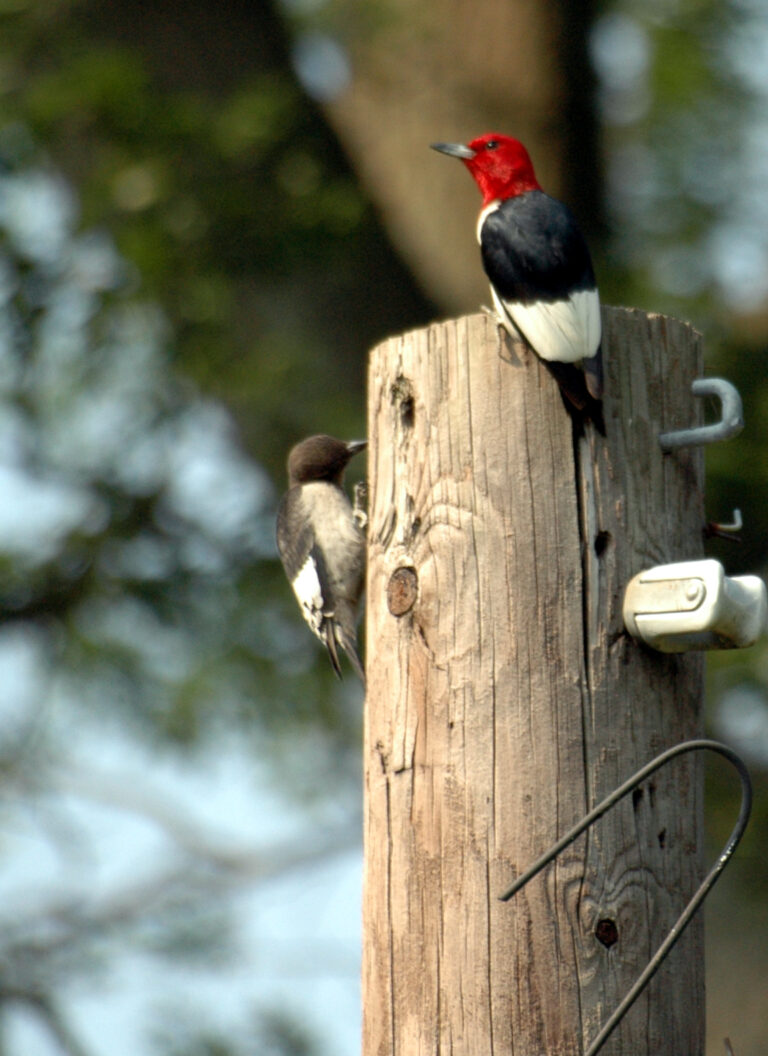
Red-Bellied Woodpecker
Florida’s most common backyard woodpecker. Red-Bellied Woodpeckers have a red cap and nape (males) or just red nape (females), a barred black-and-white (zebra-pattern) back, and tan-buff underparts. The ‘red belly’ is actually a faint pinkish wash on the lower belly, rarely visible in the field.
Range in Florida: Statewide year-round.
Habitat: Wooded yards, parks, forests with mature trees.
Key ID: Red cap/nape + zebra-pattern back + tan belly. The red is on the HEAD, not the belly (despite the name).
Where to see: Common at suet feeders. Will also eat peanuts and sunflower seed at platform feeders.
Eastern Bluebird
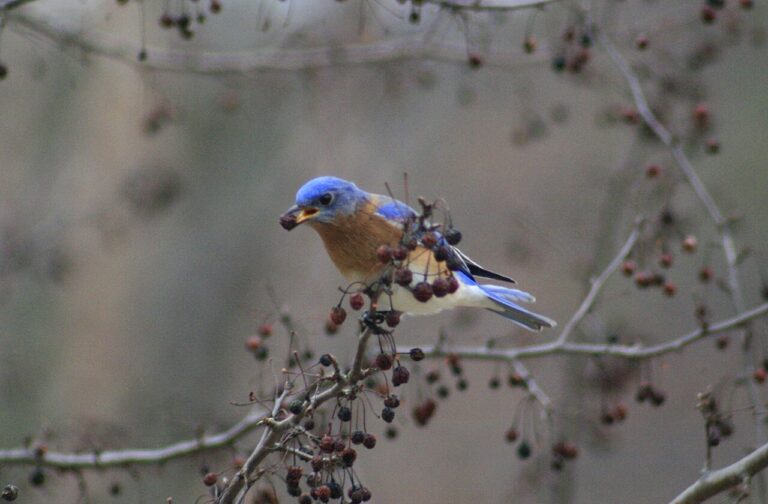
Florida’s bluebird species. Eastern Bluebirds have bright royal-blue heads and backs (males) and rust-orange breasts contrasted with white bellies. Females are paler. Cavity nesters that readily use nest boxes, a major focus of Florida bluebird conservation programs.
Range in Florida: Statewide year-round, especially common in open habitats with scattered trees.
Habitat: Open habitat with scattered trees, pastures, golf courses, parks, suburbs with scattered oak.
Key ID: Bright blue back + rust-orange breast + WHITE belly. (Western Bluebirds with rust on flanks don’t occur in Florida.)
Where to see: Install NABS-approved bluebird nest boxes. Provide mealworm feeders. Plant native berry-producing shrubs.
Tufted Titmouse
Northern Florida’s perky crested bird. Tufted Titmice have a clean gray back, white underparts with buff flanks, a gray crest, large black eyes, and a black forehead patch. Constantly active and vocal, among the loudest small birds at Florida feeders.
Range in Florida: Northern Florida (Panhandle, northern peninsula). Less common in central and south Florida.
Habitat: Mature deciduous forests, parks, suburban yards.
Key ID: Gray crest + buff flanks + black eye + small size. Distinctive crest separates from other small gray birds.
Where to see: Common at backyard feeders. Sunflower, peanuts, and suet. Often in mixed flocks with chickadees and nuthatches.
Carolina Chickadee
Northern Florida’s chickadee species. Carolina Chickadees have a black cap, black throat/bib, white cheeks, gray back, and buffy flanks. Smaller than the Black-Capped Chickadee (which doesn’t occur in Florida). Fast, high-pitched ‘chick-a-dee’ call.
Range in Florida: Northern Florida (Panhandle, north Florida). Replaced by no chickadee species in central and south Florida.
Habitat: Wooded yards, forests, parks.
Key ID: Black cap + black bib + white cheeks + range. The chickadee species in Florida.
Where to see: Common at sunflower and suet feeders in north Florida. Will use small nest boxes.
Painted Bunting (Winter Visitor)
Florida’s spectacular winter visitor, among the most colorful birds you’ll ever see at a feeder. Male Painted Buntings have a vivid green back, blue head, red eye-ring, and bright red underparts. Females are uniformly olive-green. Migrate to Florida from breeding grounds further north (Texas, Oklahoma) for winter (November-March).
Range in Florida: Statewide in winter, especially common in south and central Florida.
Habitat: Brushy areas, woodland edges, suburban yards with dense shrubs.
Key ID: Multi-color male (green back + blue head + red body) is unmistakable. Female olive-green throughout.
Where to see: White millet on ground or platform feeders during winter. Plant native shrubs for cover. They prefer rural and brushy suburban yards over urban areas.
White Ibis
Florida’s distinctive yard wading bird (yes, in your yard). White Ibises are large (25 inch), all-white wading birds with long curved red bills and red legs. Black wing tips visible in flight. Juveniles are brown-and-white. Unlike most herons/ibises, White Ibises regularly visit suburban Florida lawns, parks, and golf courses to hunt insects and small invertebrates.
Range in Florida: Statewide year-round, especially central and south Florida.
Habitat: Wetlands originally, but expanded to suburban lawns, parks, golf courses, sports fields.
Key ID: All white + long downcurved red bill + red legs + black wing tips in flight. Unmistakable in Florida yards.
Where to see: Common in central/south Florida suburbs. Often in flocks walking through lawns probing for insects. Don’t feed them, they’re foraging effectively on their own.
Regional Variations Across Florida
Florida’s three main bird zones each have distinct backyard communities. The Panhandle and North Florida (Tallahassee, Jacksonville, Pensacola) mirror Southeastern US patterns: Carolina Chickadees, Tufted Titmice, White-Breasted Nuthatches, Eastern Bluebirds, and Pileated Woodpeckers. Winter brings Yellow-Bellied Sapsuckers, juncos, and other northern species.
Central Florida (Orlando, Tampa, Ocala) is the transition zone where Florida-specific species become common. White Ibises become abundant. Florida Scrub-Jays inhabit central Florida scrub habitats (Highlands County, Polk County). Sandhill Cranes visit suburban yards in winter. Both Carolina Chickadees (decreasing) and chickadee-free zones occur.
South Florida (Miami, Fort Lauderdale, Naples) hosts the most distinctively Caribbean/tropical bird community. Look for White-Crowned Pigeon (south Florida only), Common Ground-Dove, Eurasian Collared-Dove, Common Myna (introduced, established), Black-Whiskered Vireo (Gulf Coast hammocks), Smooth-Billed Ani (rare). Snail Kites and Limpkins inhabit Everglades-edge yards. Caribbean species occasionally appear after hurricanes.
Florida Keys add their own specialty list: White-Crowned Pigeon, Mangrove Cuckoo, Black-Whiskered Vireo, plus introduced species like Common Myna and Spot-Breasted Oriole.
The Northern Mockingbird: Florida’s Voice
The Northern Mockingbird (Mimus polyglottos) was designated Florida’s official state bird in 1927, the same year Texas adopted it. Florida actually shares its state bird with four other US states (Arkansas, Mississippi, Tennessee, Texas), making it the third most popular state bird species.
Florida mockingbirds are particularly skilled mimics due to the state’s bird diversity. A single Florida mockingbird may have a repertoire of 50-100+ different songs and calls, copying everything from cardinal whistles to White Ibis grunts to car alarms. Some Florida mockingbirds learn the sounds of motor scooters, ambulance sirens, and even cell phone ringtones.
Mockingbirds defend their territories aggressively. Florida residents often experience ‘dive-bombing’ from defensive male mockingbirds during nesting season (April-July). The aggression extends to other species, mockingbirds will challenge cats, hawks, and even humans who venture too near nests.
Plant native berry-producing shrubs to attract mockingbirds: American Beautyberry, Florida-native Beautyberry, Wild Coffee, Inkberry Holly, Possumhaw Holly. Mockingbirds will defend a favorite berry shrub aggressively from other birds, sometimes for weeks.
How to Attract Florida Backyard Birds
Florida’s subtropical climate creates year-round birding opportunities, but the challenges are different from northern states. Heat, humidity, and frequent rain mean feeders and seed need more frequent maintenance. Mold growth is rapid in Florida’s climate.
Use seed that resists moisture absorption: black oil sunflower seed (universal favorite), safflower seed (cardinals love it; squirrels and grackles dislike it). Avoid mixed seed with millet in humid south Florida, it molds quickly. Refill smaller amounts more frequently.
Florida heat affects bird behavior. During summer (June-September), birds visit feeders most actively at dawn and dusk when temperatures are bearable. Provide shade, feeders in full Florida sun get minimal visitation during summer middays.
Water is critical, especially in central/south Florida’s dry season (November-May). Provide a quality bird bath with daily fresh water. Mosquito control: change water at least every 2 days, or add a dripper/wiggler. Florida birds need water more than seed for most of the year.
Native plant landscaping outperforms turfgrass dramatically. Native plants need less water, less fertilizer, and support 10-30x more bird food (insects, caterpillars, berries) than non-native landscaping. Florida-native salvias, beautyberry, wild coffee, firebush, and saw palmetto are productive backyard plantings.
Hummingbird feeders during migration (March-May, August-October) are essential. Ruby-Throated Hummingbirds breed in north Florida and migrate through the entire state. Multiple feeders reduce male territorial fighting. Clean every 3-4 days during summer heat.
For winter visitors: keep feeders active October-April when Painted Buntings, Indigo Buntings, and northern winter species arrive. White millet attracts buntings. Suet feeders attract winter warblers and woodpeckers.
Hurricane prep: bring feeders inside before tropical storms. Birds need natural cover post-storm. Resume feeding 2-3 days after the storm passes.
Top Native Florida Plants for Backyard Birds
**Beautyberry (Callicarpa americana):** Native shrub producing dramatic clusters of bright purple-violet berries in fall. Feeds Northern Mockingbirds, Cardinals, Carolina Wrens, and 40+ other Florida bird species. Tolerates Florida heat, humidity, and various soil types.
**Firebush (Hamelia patens):** Native shrub with tubular red-orange flowers blooming nearly year-round in central/south Florida. Critical hummingbird food. Also produces berries that feed mockingbirds and cardinals. Drought-tolerant once established.
**Wild Coffee (Psychotria nervosa):** Native shrub with shiny dark green leaves and red berries. Feeds Northern Mockingbirds, Catbirds, and migrating warblers. Tolerates shade well.
**Coral Honeysuckle (Lonicera sempervirens):** Native vine with tubular red flowers attracting Ruby-Throated Hummingbirds. Spring through summer bloom. Trains easily on fences and trellises.
**Saw Palmetto (Serenoa repens):** Native palm-like shrub providing essential cover and edible berries. Feeds 40+ Florida bird species. Habitat for ground-feeding birds, especially in central Florida.
**Live Oak (Quercus virginiana):** Florida’s keystone tree species. Each mature live oak supports hundreds of insect species which feed nesting birds. Acorns feed Blue Jays, woodpeckers, and other Florida species. Plant if you have space, most productive single planting for Florida yards.
Related reading: Backyard Birds of California.
Related reading: Backyard Birds of Georgia.
Related reading: Backyard Birds of Washington.
Related reading: Backyard Birds of Tennessee.
Related reading: Backyard Birds of New Jersey.
Frequently Asked Questions
What’s the most common backyard bird in Florida?
Northern Mockingbird (the state bird) is the most ubiquitous, found in essentially every Florida neighborhood year-round. Northern Cardinal is the most popular yard visitor. Common Grackles and Mourning Doves are extremely abundant. White Ibises are uniquely Florida, they regularly visit lawns and golf courses in central/south Florida.
Are there cardinals in Florida?
Yes, Northern Cardinals are common backyard birds throughout Florida year-round. Males are brilliant red with crests; females are tan-brown with red highlights. They’re among the most photogenic and reliable Florida feeder visitors.
What’s the all-white bird walking through my Florida yard?
Most likely a White Ibis, a large white wading bird with a long curved red bill and red legs. They’re common in Florida suburbs and regularly walk through lawns hunting insects. Juveniles are brown-and-white. Found year-round throughout Florida, especially central and south Florida.
What’s the blue bird with no crest in central Florida?
Likely a Florida Scrub-Jay, Florida’s only endemic bird, found nowhere else on Earth. They have blue heads, wings, and tails with grayish backs and NO crest (distinguishing them from Blue Jays). They live only in central Florida scrub habitat, not in typical suburban yards. Endangered species, federally protected.
Do hummingbirds stay in Florida all winter?
Generally no, Ruby-Throated Hummingbirds migrate to Central America for winter (October-March). However, some Florida yards (especially in south Florida) host wintering hummingbirds: Ruby-Throated stragglers, plus occasional Allen’s, Rufous, or Black-Chinned Hummingbirds. Keeping a feeder active year-round may attract winter visitors.
How do I attract Painted Buntings to my Florida yard?
Painted Buntings are winter visitors to Florida (November-March). Offer white millet on ground or low platform feeders. Plant dense native shrubs for cover (wild coffee, beautyberry, firebush). Provide a quiet, undisturbed water source. They prefer rural and brushy suburban yards over urban locations. South and central Florida have higher densities.
Why are there so many grackles in Florida?
Both Common Grackles and Boat-Tailed Grackles are native and abundant. Florida’s warm climate, year-round food availability (urban discarded food, agricultural areas, beach picnics), and abundant water create ideal grackle habitat. Coastal areas particularly attract Boat-Tailed Grackles. Populations can be reduced at feeders by using safflower seed (grackles dislike it) and feeders designed for smaller birds.
What bird makes the loud screaming sound at night in Florida?
Most likely Limpkin (in central/south Florida near wetlands), their loud, eerie scream is famous as a Florida nighttime sound. If urban, it could be Common Nighthawk (nasal ‘peent’ calls) or Eastern Screech-Owl (descending whinny). Northern Mockingbirds also sing at night under street lights during breeding season.